
Have you ever started writing an essay with plenty of ideas, only to get lost halfway through? That’s what happens when you don’t have a clear roadmap. A persuasive essay may rely on strong arguments, but without a proper structure, those arguments can fall apart quickly. That’s where a persuasive essay outline comes in. It acts as the foundation that keeps your writing clear, logical, and convincing.
In fact, outlining is one of the very first steps when learning how to write a persuasive essay, because it helps organize ideas and ensures every part of your essay works toward the same goal.
In this guide, we’ll break down what a persuasive essay outline is, why it matters, and how you can create one step by step. By the end, you’ll see how an outline doesn’t just make writing easier, it makes your arguments far more persuasive.
What Is a Persuasive Essay Outline?
A persuasive essay outline is more than just a list of points; it’s the framework that holds your entire essay together. It organizes your thesis, arguments, evidence, and counterarguments into a logical flow, making it easier to stay on track as you write. Without an outline, even strong ideas can lose their impact because they end up scattered or repetitive.
Think of it as a blueprint: before constructing a house, you need a plan to make sure everything fits in place. Similarly, an outline ensures that your introduction leads smoothly into your arguments, that each body paragraph supports your thesis, and that your conclusion ties everything together. So, before you start a persuasive essay, the first thing to do is create a solid outline.
By treating the outline as a guide rather than a rigid formula, you give yourself structure without limiting creativity, making the final essay more coherent and persuasive.
Why You Need an Outline for a Persuasive Essay
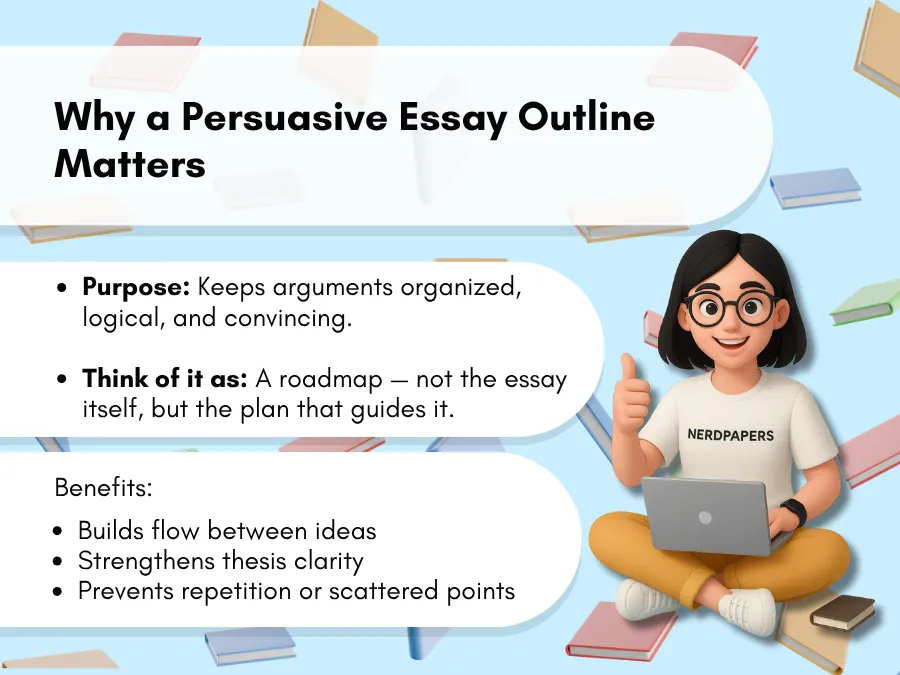
Writing without an outline is like taking a road trip without directions. You may eventually reach your destination, but the journey will be messy, and you’ll waste time doubling back. An outline gives your essay purpose and order, helping you present arguments in a way that is both logical and convincing.
When you create an outline, you’re not just listing points; you’re planning how ideas will connect and build on one another. This prevents repetition, keeps your thesis focused, and makes transitions between paragraphs smoother. It also ensures that you balance your own arguments with counterarguments, which is critical in persuasive writing.
The benefits go beyond the classroom. In real-world situations, whether you’re preparing a presentation, writing a report, or even making a case in a workplace discussion, knowing how to organize your thoughts before speaking or writing makes your message stronger. A persuasive essay outline trains you to do exactly that: think ahead, structure ideas, and communicate with clarity.
Breaking Down the Persuasive Essay Outline Structure
While every persuasive essay follows the basic structure of introduction, body, and conclusion, your outline takes this a step further — it breaks each section into smaller, actionable parts.
Instead of rewriting the structure itself, think of this as your planning framework — where you decide:
- What goes into each paragraph
- Which argument comes first (and why)
- Where to place your counterpoint for maximum effect
Here’s a simple outline template that builds on the classic structure:
- Introduction – Define your stance and preview main points.
- Body Paragraphs – Dedicate one paragraph per key argument. Under each, list:
- Supporting evidence (facts, stats, or examples)
- Counterpoint (optional)
- Rebuttal or transition idea
- Conclusion – Plan how you’ll restate your thesis and leave the reader with a final persuasive thought.
Step-by-Step: How to Write a Persuasive Essay Outline
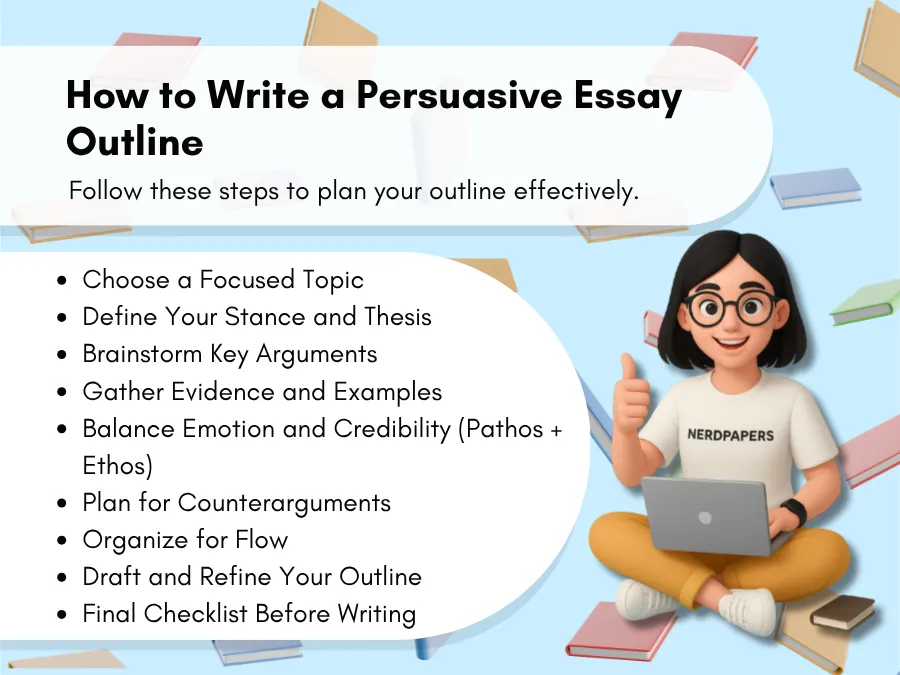
Creating a persuasive essay outline isn’t about filling boxes — it’s about organizing your thoughts so your arguments connect naturally and build momentum. Follow these steps to plan your outline effectively.
1. Choose a Focused Topic
Every persuasive essay starts with a clear topic, but success depends on focus.
Broad ideas like education or social media can scatter your argument. Instead, narrow it to something specific and debatable — for example, “Why schools should implement later start times.”
2. Define Your Stance and Thesis
Once you’ve chosen a topic, decide your exact position.
Ask yourself: What do I want readers to believe or do after reading this?
Your answer becomes your thesis statement — the anchor of your entire outline.
3. Brainstorm Key Arguments
Next, list every possible reason that supports your stance. Don’t worry about perfection yet — just get ideas down.
Then, group similar points together until you have three to four strong arguments.
Each one will become a main paragraph in your essay outline, ensuring your writing has balance and clarity.
4. Gather Evidence and Examples
A persuasive essay is only as strong as its proof.
For every key argument, note facts, statistics, expert quotes, or real-world examples that will back it up.
Adding evidence in the outline stage helps you stay organized and prevents unsupported claims later.
5. Balance Emotion and Credibility (Pathos + Ethos)
Effective persuasion blends emotion and trust.
Use pathos by planning where to add personal stories, vivid language, or relatable scenarios.
Add ethos by including credible sources, a respectful tone, and balanced viewpoints.
Together, these make your essay both convincing and authentic — the foundation of EEAT-driven academic writing.
6. Plan for Counterarguments
Strong persuasive essays acknowledge the other side.
Dedicate a small section in your outline to an opposing argument and then plan your rebuttal.
This step shows critical thinking, strengthens your logic, and makes your essay more credible.
7. Organize for Flow
Decide the best order for your arguments.
You can start with your strongest point to grab attention or build gradually toward a powerful conclusion.
Mark transitions between sections — this ensures smooth flow and prevents the essay from feeling choppy or repetitive.
8. Draft and Refine Your Outline
Your first outline is a working draft — review it with a critical eye.
Ask:
- Does each argument link to the thesis?
- Do I have evidence for every claim?
- Are transitions clear?
Refining your outline early saves time and helps you write confidently later.
9. Final Checklist Before Writing
Before turning your outline into a full essay, do a quick review:
- Every point supports the thesis.
- Counterarguments are addressed.
- Evidence is balanced between logic and emotion.
- Flow feels natural from intro to conclusion.
After checking these off, you can confidently turn your outline into a powerful, persuasive essay.
Once you’ve got the structure in place, remember that the effectiveness of your outline depends on the persuasive essay elements behind it, like thesis clarity, logical reasoning, and emotional appeal. These elements are what transform a simple outline into a compelling essay framework.
Example of a Persuasive Essay Outline in Practice
To make this guide practical, let’s walk through a sample persuasive essay outline with annotations. Our example topic will be:
Topic: Should schools implement a four-day school week?
This outline not only shows structure but also highlights why each part is important so you can model your own essays more confidently.
Topic: Should schools implement a four-day school week?
Introduction
- Hook: “Imagine a world where students actually look forward to Mondays.”
→ Why: A strong hook grabs attention and sets a conversational tone. - Context/Background: Briefly explain the five-day school week and why alternatives are being debated.
→ Why: Readers need a quick setup before they care about your argument. - Thesis Statement: “A four-day school week should be adopted because it improves student performance, reduces costs, and supports healthier work-life balance.”
→ Why: Your thesis is the backbone of the essay; it must clearly state your stance and main reasons.
Body Paragraph 1 – Student Performance (Logos)
- Main Point: Shorter weeks enhance focus and reduce burnout.
- Evidence: Reference studies where districts saw improved grades and attendance.
- Analysis: Explain why rest leads to sharper focus and stronger outcomes.
- Mini Tip: Always connect evidence back to your thesis — don’t just drop stats.
Body Paragraph 2 – Cost Savings (Ethos + Logos)
- Main Point: A shorter week saves money on transportation, utilities, and food.
- Evidence: Budget reports from school districts with the model.
- Analysis: Emphasize that saved funds can be reinvested in resources like updated textbooks or technology.
- Mini Tip: Linking money to student benefit strengthens credibility.
Body Paragraph 3 – Work-Life Balance (Pathos)
- Main Point: Families and teachers gain more time for personal and community activities.
- Evidence: Testimonials or surveys from schools that made the switch.
- Analysis: Highlight the emotional appeal of stronger families, happier students.
- Mini Tip: Save your most relatable/emotional point for later; it leaves a lasting impression.
Counterargument and Rebuttal
- Counterargument: Critics argue longer school days could tire students.
- Rebuttal: Show examples of how schools balance scheduling and demonstrate that benefits outweigh drawbacks.
- Mini Tip: Acknowledging the other side makes your essay more balanced and credible.
Conclusion
- Restate Thesis: Summarize your three main points without repeating them word-for-word.
- Closing Appeal: “By reimagining the school calendar, we open the door to a smarter and healthier future.”
- Mini Tip: End with vision, not repetition. Give readers something to carry with them.
Persuasive Essay Outline Template
Introduction
- Hook: Start with a surprising fact, question, or short story.
- Background/Context: Briefly explain the issue so the reader understands.
- Thesis Statement: I believe that [your position/argument] because [reason 1], [reason 2], and [reason 3].
Body Paragraph 1 – Argument 1
- Topic Sentence: State your first main argument.
- Evidence/Examples: Facts, research, or examples to support it.
- Emotional/Logical Appeal: Add a detail that makes it resonate with the reader.
Body Paragraph 2 – Argument 2
- Topic Sentence: State your second main argument.
- Evidence/Examples: Facts, research, or examples to support it.
- Emotional/Logical Appeal: Add a vivid example or analogy.
Body Paragraph 3 – Argument 3
- Topic Sentence: State your third main argument.
- Evidence/Examples: Facts, research, or examples to support it.
- Emotional/Logical Appeal: Use a story, scenario, or question to connect with the reader.
Counterargument & Rebuttal
- Opposing Viewpoint: Briefly state the other side’s argument.
- Rebuttal: Explain why your stance is stronger and more logical.
Conclusion
- Restate Thesis in a New Way: Rephrase your main argument without repeating word-for-word.
- Summary of Key Points: Quick recap of your strongest arguments.
- Closing Thought: Memorable statement, call to reflection, or a broader connection to real life.
Common Mistakes to Avoid When Creating a Persuasive Essay Outline
Even strong writers stumble when outlining persuasive essays. Think of your outline as a building’s blueprint — if it’s flawed, the entire structure collapses. Below are common mistakes and exactly how to fix them.
Choosing an Overly Broad Topic
The Mistake:
Topics like education or social media are too wide. You’ll struggle to stay focused and end up covering everything superficially.
How to Avoid It:
Narrow your focus to a debatable, specific idea — for instance, “Should social media platforms regulate misinformation?”
This gives you a manageable scope for research and clear direction for your arguments.
Writing a Weak or Unclear Thesis
The Mistake:
Without a clear thesis, your essay lacks direction. It’s like building a house with no foundation — everything falls apart.
How to Avoid It:
Craft a precise, arguable thesis that states your stance in one or two sentences.
Example: “Schools should implement later start times because it improves focus and academic performance.”
Listing Points Without Evidence
The Mistake:
Simply listing claims without proof weakens your credibility. Readers won’t be persuaded by statements that lack support.
How to Avoid It:
Attach at least one form of evidence — such as a statistic, example, or expert opinion — to every argument in your outline. This ensures your essay feels logical and grounded.
Ignoring Counterarguments
The Mistake:
Avoiding opposing views makes your essay seem one-sided and less credible.
How to Avoid It:
Dedicate a section in your outline to acknowledge and refute a counterargument.
This balance strengthens your position and shows you’ve considered multiple perspectives.
Overloading the Outline with Details
The Mistake:
Treating your outline like a full draft clutters your structure and kills clarity.
How to Avoid It:
Keep your outline lean — focus on main points, transitions, and evidence notes, not full sentences. Think of it as your essay’s map, not the journey itself.
Tips to Make Your Outline Effective
A persuasive essay outline is like a GPS; it keeps you on track but still lets you take smart detours when needed. To make sure your outline actually works for you (and not against you), here are some practical tips:
- Keep it simple and clear
Overcomplicating your outline only makes writing harder. Stick to keywords, short phrases, or bullet points instead of full paragraphs. Think of it as sketching, not painting the whole picture. - Use parallel structure for body paragraphs
If one body paragraph starts with “Reason 1: …”, the next should follow the same style, like “Reason 2: …”. This consistency makes your arguments easier to follow and ensures your outline doesn’t feel scattered. - Ensure logical order of arguments
Arrange your points in a sequence that strengthens your case. You can go from weakest to strongest (building momentum), or lead with your strongest point (grabbing attention early). Either way, the flow should feel natural, not random. - Balance between pro and counterarguments
A persuasive essay that’s one-sided feels shallow. Plan space for at least one counterargument and your rebuttal. It shows depth and makes your stance more convincing. - Treat the outline as a flexible guide, not a prison
Don’t feel locked into the first outline draft. As you research and write, you’ll discover new evidence or better arguments. Adjust the outline accordingly. Think of it as a roadmap; you know the destination, but you can change routes if traffic blocks your way.
Why a Persuasive Essay Outline Sets You Up for Success
A persuasive essay outline is more than just a list of points; it’s the foundation that gives your essay structure, clarity, and strength. By sketching out your thesis, organizing your arguments, and planning counterpoints ahead of time, you make sure your writing has both direction and impact.
Like any skill, outlining becomes second nature with practice. The more you use outlines, the easier it gets to spot weak arguments, refine your flow, and write with confidence. What may feel like “extra work” at first actually saves time and stress when you sit down to draft.
Think of the outline as a tool, not a task to be completed. It doesn’t just guide essays; it sharpens your ability to think critically, organize ideas, and communicate persuasively, skills that matter in the classroom and far beyond. Step by step, outline by outline, you’re not just writing better essays, you’re building a persuasive voice that lasts.
FAQs About Persuasive Essay Outlines
Why do I need an outline for a persuasive essay?
An outline saves time and prevents your ideas from becoming scattered. It ensures that every part of your essay flows smoothly and strengthens your overall argument.
What should a persuasive essay outline include?
It usually includes: an introduction with a strong thesis, body paragraphs with evidence-based arguments, a counterargument with rebuttal, and a conclusion that reinforces your stance.
How do you write a persuasive essay outline?
Start by choosing a focused topic, then draft a clear thesis. After that, list your main arguments with supporting evidence, plan counterarguments, and decide on the order of points for a logical flow.
How long should an outline be?
There’s no fixed length—it depends on the complexity of your essay. Some outlines are half a page of bullet points, while others are detailed and several pages long. The key is to include enough detail to guide your writing without turning it into a draft.
Is an outline the same as a draft?
No. A draft is a full version of your essay with complete sentences and paragraphs. An outline is just the skeleton—a plan you’ll later flesh out.
Do all persuasive essays need a counterargument in the outline?
Yes, ideally. Addressing at least one opposing viewpoint makes your essay stronger and more credible. Even a short counterargument with a rebuttal can show critical thinking.
Can I use the same outline for speeches?
Yes. The same principles of structure—thesis, arguments, evidence, and rebuttals—apply to speeches. You may just phrase your points more conversationally.
Can I use the same outline for every persuasive essay?
Not exactly. While the structure is similar, each essay should have an outline tailored to the topic, audience, and stance. Reusing a generic outline can make your essay feel flat.