
There is a deep relation between homework and mental health. Excessive homework affects students’ mental health in ways they may not realize.
Multiple assignments, academic stress, and anxiety can cause the student to face sleeping difficulties and become a cause of mental fatigue. These are among the most common issues teenagers and high school students experience. Multiple studies have shown that when the homework exceeds a certain limit, it is usually not good. When homework takes too long, it does not add value, and the student does not feel like doing it.
When homework becomes excessive, students often feel overwhelmed and mentally drained. When students feel a lot of pressure, they often seek expert help for homework especially when the deadlines of multiple tasks overlap. This support is meant to reduce stress and support their mental health, not to skip learning or avoid their schoolwork.
Understanding the connection between homework and mental health is essential for students, parents, and teachers, so that they can work together to make a place where students can do well in school without hurting their mental health over time.
Key Takeaways: Homework and Mental Health
- Depending on the intensity, duration, and frequency of the workload, homework can either have a beneficial or negative impact on mental health.
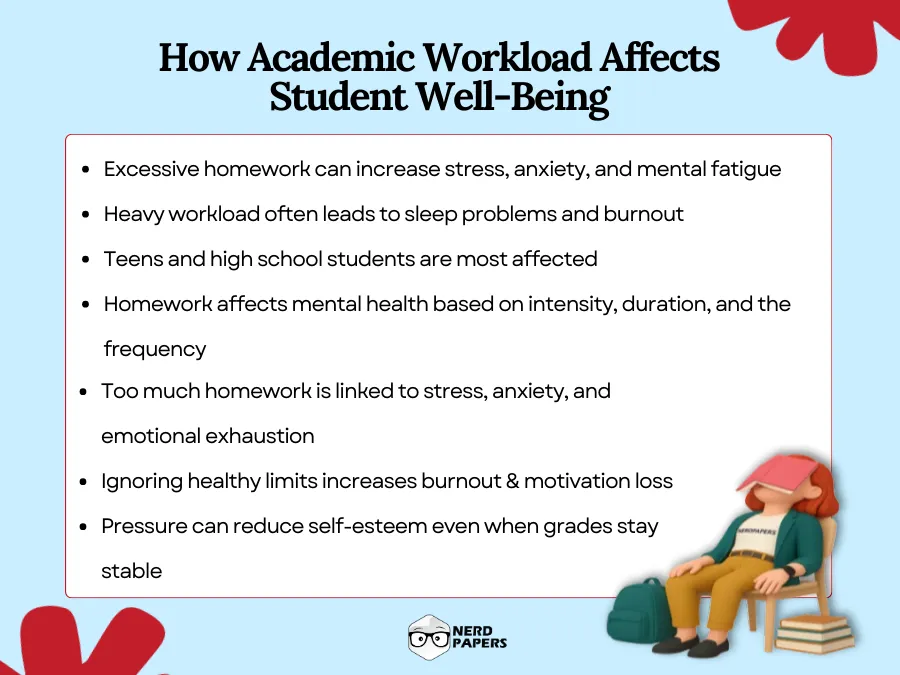
- Excessive homework is linked to stress, anxiety, emotional fatigue, and burnout, especially in teens.
- Heavy academic workload often reduces sleep quality, which worsens emotional regulation and focus.
- Age-appropriate, moderate homework can enhance learning without damaging students’ well-being.
- Mental health risks increase when the healthy limit of homework is ignored, such as the 10-minute rule.
- Even when grades stay consistent, students who are under constant pressure may experience a decline in motivation and self-esteem.
How Homework Impacts Student Mental Health
Homework affects mental health by causing stress and making students think too much. The link between homework and mental health depends on how much homework is assigned, how often it is due, and how much pressure students feel to do well in their tasks.
Emotional and Psychological Effects
When students have a lot of homework from different subjects, they usually feel stressed instead of just facing a temporary challenge. This stress causes anxiety, especially when deadlines are close together or when they don’t understand what is expected of them.
Common emotional effects include:
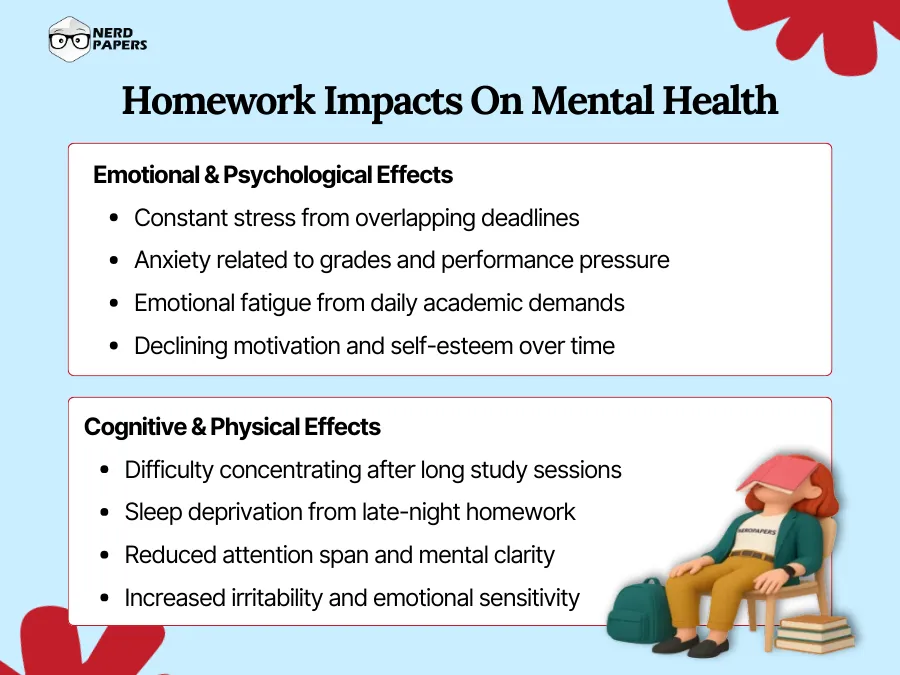
- Constant stress linked to workload intensity and deadline pressure
- Anxiety related to grades, performance, and fear of falling behind
- Emotional fatigue caused by constant academic demands
- Lower motivation and reduced self-esteem over time
When students have a lot of homework across different subjects, they often feel stressed for a long time rather than just facing a short challenge. This pressure can cause anxiety and mental fatigue.
Cognitive and Physical Effects
Homework can affect mental health by causing stress. Studying for a long time without taking breaks can make it hard to relax, which can result in too much stress and trouble sleeping.
Key cognitive and physical impacts include:
- Difficulty concentrating after extended homework sessions
- Sleep deprivation due to late-night studying
- Reduced attention span and mental clarity
- Increased irritability and emotional sensitivity
Losing sleep is a big problem. Research shows that not getting enough sleep increases stress, making it harder to focus. Students find it hard to remember and handle emotions, which makes homework feel tougher the next day.
Why These Effects Build Over Time
Stress related to homework doesn’t happen all at once. It increases when challenging expectations become routine instead of an obstacle for individuals, much like a usual activity in daily life. Even high achievers could end up with burnout and mental exhaustion as a result.
Students’ mental health suffers the most from imbalanced homework, not from limited, age-appropriate, and meaningful assignments.
Homework and Mental Health in Teens
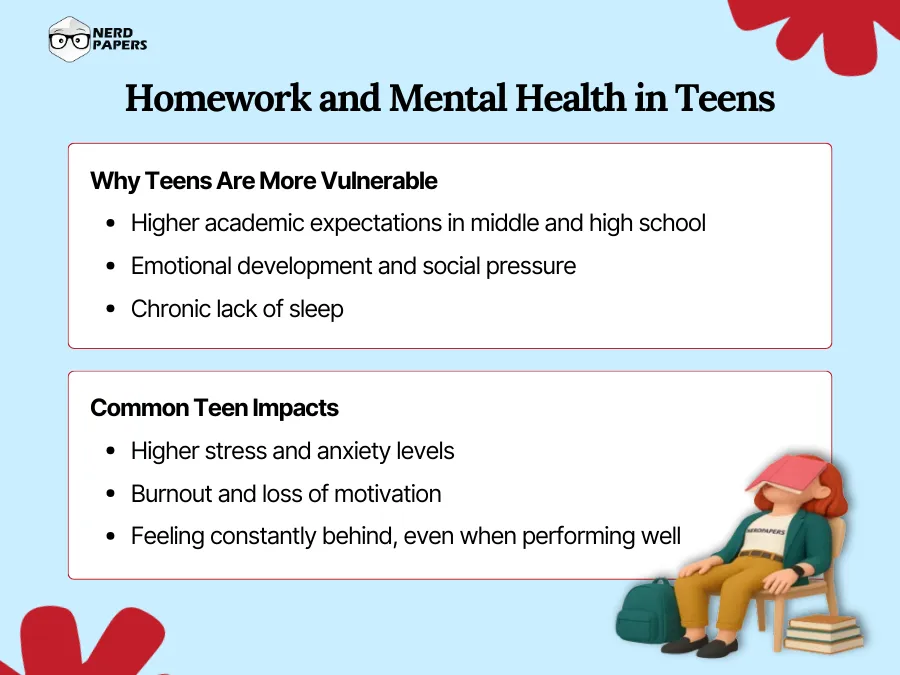
Teens feel homework pressure more than kids younger than them. As school demands grow in middle and high school, homework gets longer, more frequent, and harder. At the same time, teens deal with emotional changes, social pressures, and not enough sleep, making them more prone to mental health issues.
Research on homework and mental health in teens shows consistent patterns:
- More homework leads to higher stress and anxiety.
- Studying late at night causes lack of sleep, which makes mood and focus worse.
- Ongoing pressure can cause tiredness, burnout, and loss of motivation.
For many teens, the problem is not homework itself, but how much and how often it is given. When many subjects’ work is assigned at once, teens feel constant pressure and have little time to rest. This can hurt their self-esteem and make them feel like they are always behind, even if they do well in school.
Teen mental health is especially sensitive to:
- Too much homework at night.
- Frequent assignments from different subjects.
- Grading focused on performance instead of learning.
It’s important to understand how homework impacts teens because habits formed during these years can affect their long-term mental health, confidence in school, and attitudes towards learning.
Homework and Mental Health Statistics
Homework and students’ mental health are clearly related, according to research. Even though homework is designed to help students in learning, too much of it can cause stress, worry, and sleep issues, particularly in teenagers.
Key findings reported across multiple studies include:
- Over 60-70% of middle and high school students say homework is a big source of daily stress.
- Students who spend more than 2 hours on homework each night are more likely to feel very stressed and tired.
- Longer homework duration is linked to higher rates of anxiety symptoms, especially in adolescents managing multiple subjects.
- Students who have a lot of homework are more likely to experience sleep deprivation; on school nights, many of them get less than the recommended eight hours of sleep.
- When homework pressure is coupled with frequent deadlines and high-stakes grading instead of flexible or mastery-based assessment, mental health issues increase.
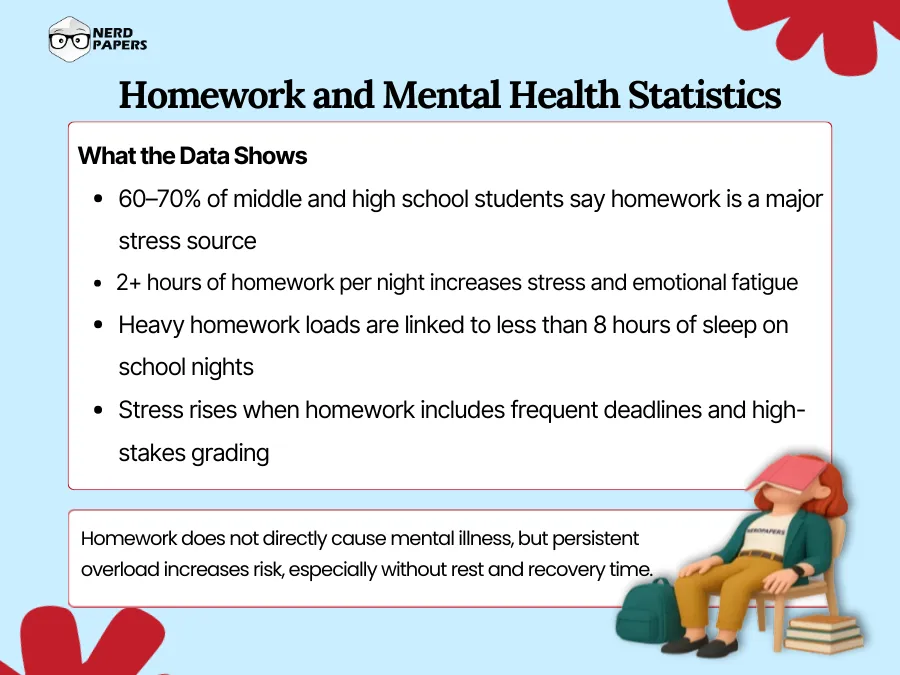
Researchers usually place a greater focus on connection than causality when analyzing schoolwork and mental health statistics. Anxiety and despair are not brought on by homework alone. Persistent overload, however, significantly raises the danger, especially when students don’t have enough time for rest, sleep, or emotional support.
Statistics also highlight an important balance:
- Academic performance and skill development can be supported by moderate homework, which is typically completed in less than 60 to 90 minutes per night.
- Excessive homework shows diminishing academic returns while increasing stress, burnout, motivation loss, and emotional exhaustion.
These trends contribute to the explanation of why discussions about homework regulations are still expanding. According to the findings, the important question is not whether or not children do homework, but rather how much of it is beneficial to their mental health.
What Psychologists Say About Homework
Psychologists mostly believe that homework isn’t harmful by itself, but too much or poorly planned homework can hurt mental health. The main worries are about how much work there is, the pressure to finish on time, and the emotional stress it causes.
According to advice from the American Psychological Association, ongoing school stress can lead to anxiety, trouble sleeping, and feeling tired emotionally. When homework gets in the way of rest, family time, or recovery, it can be more harmful than helpful.
Several well-known education researchers echo this view:
- Harris Cooper says that homework is helpful only in small amounts, especially for older students. According to his research, having too much homework might hinder learning and increase stress.
- Alfie Kohn claims that excessive homework might negatively impact kids’ curiosity, motivation, and emotional well-being. Especially if it is repetitive instead of important
From a psychological perspective, specialists point out a number of recurring issues:
- Homework can become mentally draining when it lacks a clear objective.
- Constant performance pressure worsens anxiety symptoms.
- Emotional exhaustion and burnout decrease long-term learning efficacy.
Psychologists often see a clear link between a student’s academic success and their happiness and health. If students study more but feel bad mentally, their focus, drive, and memory can get worse. These experts believe that both school work and emotional health should be considered when giving assignments.
Pros and Cons of Homework
Homework is still common because it can help students learn when used effectively. However, too much or poorly planned homework can hurt students’ mental health. This is why homework is a debated topic.
Pros of Homework (When Used in Moderation)
When homework is suitable for the student’s age and has a clear goal, it can:
- Reinforce what was taught in class.
- Help students learn responsibility and manage their time.
- Encourage independent thinking and problem-solving.
- Boost confidence when tasks are manageable.
Research shows that a reasonable amount of homework can be helpful, especially for older students, as long as it doesn’t affect their sleep or mental health.
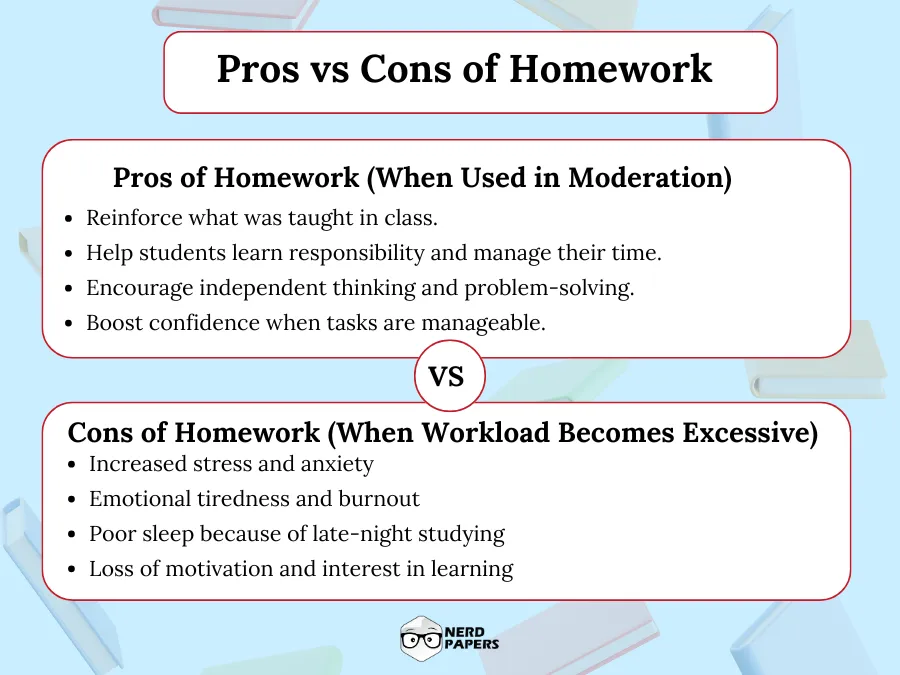
Cons of Homework (When Workload Becomes Excessive)
Homework can become a problem when there is too much work or when it is not coordinated between subjects. In these situations, students might face:
- Increased stress and anxiety
- Emotional tiredness and burnout
- Poor sleep because of late-night studying
- Loss of motivation and interest in learning
All of these arguments show why it’s important to find a balance that protects both learning and mental health, rather than just getting rid of homework altogether.
The 10-Minute Rule and Homework Limits
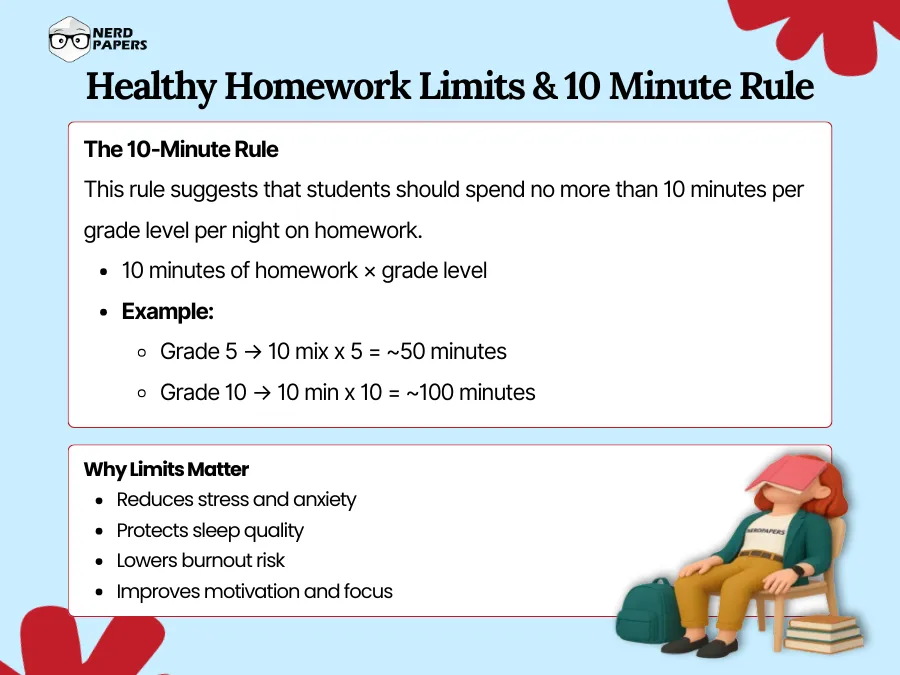
One of the most widely referenced guidelines for healthy homework is the 10-minute rule. This rule suggests that students should spend no more than 10 minutes per grade level per night on homework. For example, a fifth-grade student would have about 50 minutes of homework, while a tenth-grade student would have about 100 minutes.
Psychologists and education researchers support this rule because it helps balance academic expectations and mental health. When homework stays within these limits, students are more likely to maintain healthy sleep patterns, manage stress effectively, and stay engaged with learning.
Homework limits are important because they help with:
- Reducing stress by easing deadline pressure.
- Improving sleep, which helps with emotions and focus.
- Lowering the chance of burnout, especially in teens with many subjects.
- Boosting motivation and self-esteem by keeping tasks doable.
Problems happen when homework goes over these limits. Long hours of homework can lead to emotional exhaustion, anxiety, and too much stress, with little academic benefit. Because of this, many teachers and schools now support:
- Workloads that match students’ ages.
- Better coordination between subjects.
- Focused assignments instead of just lots of work.
The goal of the 10-minute rule is to ensure that homework supports learning without compromising students’ wellbeing, not to completely eliminate it.
Homework Bans, Myths, and Global Perspectives
Discussions about homework and mental health often include claims about bans, countries without homework, or historical decisions to eliminate it entirely. Many of these statements are partially true; some of them are misunderstood or taken out of context. Clarifying them helps separate fact from myth.
Common Myths About Homework Bans
- “Homework was banned in 1901.”
This claim is false. Early in the 20th century, there was discussion over how homework affected children’s health, particularly that of young children. While homework was temporarily restricted in some places, it was not outright prohibited. - “Some countries made homework illegal.”
No country has completely outlawed homework across all grades. What does exist are policy-based limits, pilot programs, or no-homework models at specific grade levels. - “Homework is being phased out everywhere.”
In reality, most education systems are changing homework rules, not getting rid of it. They want to reduce overload and protect students’ well-being.
Global Approaches to Homework
Different education systems handle homework in different ways:
- Some countries emphasize shorter school days and limited homework, especially in early grades
- Others place heavy emphasis on academic performance, resulting in higher homework volume.
- A growing number of schools experiment with no-homework or low-homework models to improve mental health and engagement.
These approaches reflect broader differences in how systems balance academic pressure and mental health, not a simple “homework vs no homework” choice.
The “Dead Homework Theory”
The dead homework theory argues that repetitive, low-impact assignments offer little learning value while increasing stress and burnout. This idea has influenced modern discussions about:
- Reducing busywork
- Replacing volume with meaningful practice
- Using alternative learning methods instead of nightly homework
Overall, global trends suggest that the debate is shifting away from whether homework should exist and toward how homework can be designed to support learning without harming mental health.
Is Homework Necessary in Modern Education?
Whether homework is necessary remains one of the most debated questions in modern education. Research and educational psychology suggest that homework itself is not the problem but the main issue lies in how much homework is assigned and how it is used.
Homework can support learning when it:
- Reinforces key concepts already taught in class
- Encourages independent thinking without excessive time demands
- Respects age-appropriate workload limits
However, homework becomes unnecessary or even harmful when it causes constant stress, disrupts sleep, or overwhelms students emotionally. In these cases, additional homework does not improve learning outcomes and may reduce motivation, focus, and mental well-being.
Many educators now argue that quality matters more than quantity. Short and purposeful assignments are often more effective than long, repetitive ones. Some schools also use alternative learning methods, such as in-class practice, project-based learning, or flexible assessments, to reduce homework pressure while maintaining academic standards.
Ongoing discussions around academic pressure and student well-being increasingly question whether homework is necessary in modern education, especially when learning outcomes can often be achieved through in-class practice, project-based learning, or reduced workloads without adding unnecessary stress.
Modern education systems increasingly recognize that student well-being and academic performance are interconnected. When homework policies align with this understanding, students are more likely to learn effectively without sacrificing their mental health.
How Students Can Reduce Homework-Related Stress
Homework-related stress often builds gradually and can start affecting sleep, mood, and motivation before students recognize it as a problem. Taking early, practical steps can help reduce pressure and protect mental well-being.
Use Planning to Reduce Cognitive Overload
Breaking homework into smaller, manageable tasks helps prevent cognitive overload. Prioritizing assignments by deadline and difficulty allows students to spread work across the week instead of cramming everything into one night. This approach lowers anxiety and makes heavy workloads feel more manageable.
Protect Sleep and Set Time Boundaries
Sleep deprivation is one of the strongest links between homework and declining mental health. Setting a consistent cutoff time for schoolwork, even when tasks are incomplete, helps preserve sleep quality and emotional stability. Students who protect their sleep tend to manage stress more effectively and maintain better focus.
Communicate When Workload Becomes Unmanageable
Students often hesitate to speak up, but early communication can prevent long-term stress. Letting teachers know when multiple deadlines overlap or when workload intensity becomes excessive may lead to adjusted expectations or extensions, particularly when concerns are raised responsibly.
Learn How to Manage Homework Effectively
When pressure continues despite good intentions, students benefit from learning how to manage homework in a structured way. Strategies such as realistic scheduling, task batching, and workload assessment can reduce emotional fatigue while keeping academic responsibilities on track.
Reducing homework-related stress is not about avoiding effort. It is about creating a sustainable balance where learning remains productive without harming mental health or emotional resilience.
When Homework Becomes a Mental Health Risk
Homework can cross from challenging to harmful when it consistently overwhelms a student’s emotional and cognitive capacity. At this stage, academic pressure no longer supports learning and instead begins to damage mental health, daily functioning, and overall well-being.
Warning Signs: Homework Is Affecting Mental Health
Students may be at risk when homework leads to:
- Persistent stress or anxiety, even on non-school days
- Ongoing sleep deprivation or difficulty falling asleep
- Emotional exhaustion, irritability, or frequent mood changes
- Loss of motivation or feelings of hopelessness about school
- Declining concentration despite spending more time studying
These signs often appear gradually, which is why they are frequently dismissed as “normal school stress.” In reality, sustained overload can increase vulnerability to anxiety and depression, particularly in teenagers.
Why Prolonged Homework Stress Is Harmful
When students are under constant academic pressure, their bodies remain in a heightened state of stress. Over time, this can reduce emotional resilience, weaken attention span, and make it harder to cope with even routine tasks. Homework that repeatedly exceeds healthy limits also increases the likelihood of burnout, where effort no longer leads to meaningful learning or progress.
Importantly, more time spent on homework does not always result in better outcomes. Once mental fatigue sets in, productivity and comprehension decline, even as students work longer hours.
When Additional Support Becomes Necessary
If homework stress doesn’t improve even after planning and making changes, extra help might be necessary. This could mean looking at the workload again, providing support for learning, or giving temporary help during stressful times.
The aim is to support mental health, not to stop learning, so students can get back on track. It’s important to notice when homework is harming mental health. Getting help early can stop long-term emotional problems and help find a better balance between schoolwork and student well-being.
Final Perspective
Homework can support learning, but its effect on homework and mental health depends on workload and structure. Moderate, purposeful assignments reinforce learning, while excessive homework is linked to higher stress, anxiety, sleep deprivation, and burnout.
Research shows that student well-being and academic performance are closely connected when homework exceeds healthy limits, focus, motivation, and long-term learning decline, even if study time increases.
The solution is not removing homework, but setting reasonable limits and prioritizing quality over quantity. Education works best when students are challenged without harming their mental health.
FAQs
Does homework have an effect on mental health?
Yes. Homework can affect mental health positively or negatively, depending on the workload. Moderate homework supports learning, while excessive homework is linked to stress, anxiety, emotional fatigue, and sleep problems.
Can homework cause stress, anxiety, or depression in students?
Homework does not directly cause mental health disorders, but heavy and prolonged homework loads increase the risk of stress, anxiety, and depressive symptoms, especially when combined with poor sleep and constant deadlines.
How does homework affect teenagers’ mental health specifically?
Teenagers are more vulnerable because of higher academic pressure, developing brains, and limited sleep. Excessive homework in teens is associated with higher stress levels, anxiety symptoms, burnout, and reduced emotional resilience.
Is homework mentally draining when students have too much of it?
Yes. When homework exceeds healthy time limits, it can become mentally draining by causing cognitive overload, emotional exhaustion, and reduced concentration, even if students continue working longer hours.
Does homework affect sleep, and how serious is the impact?
Homework often affects sleep when assignments push work late into the night. Sleep deprivation linked to homework can worsen mood, focus, memory, and stress regulation, making its impact on mental health significant.
What percentage of students report stress or depression related to homework?
Studies vary, but a large percentage of middle and high school students report homework as a major source of stress. Researchers emphasize correlation rather than direct causation between homework load and depression.
What do psychologists say about the impact of homework on student well-being?
Psychologists generally agree that homework should be limited and purposeful. Organizations such as the American Psychological Association warn that chronic academic stress can harm emotional health when homework interferes with sleep and recovery.
Is homework really necessary, or does it do more harm than good?
Homework is not inherently harmful, but it becomes unnecessary when it adds stress without improving learning. Evidence suggests that quality and balance matter more than quantity for both academic success and mental health.