
Key Points:
- Homework is not universally necessary. Whether it helps or harms depends on the student’s age, subject difficulty, workload, and the assignment’s purpose.
- Homework exists to reinforce classroom learning, build study habits, and support long-term retention, but modern workloads often exceed what was originally intended.
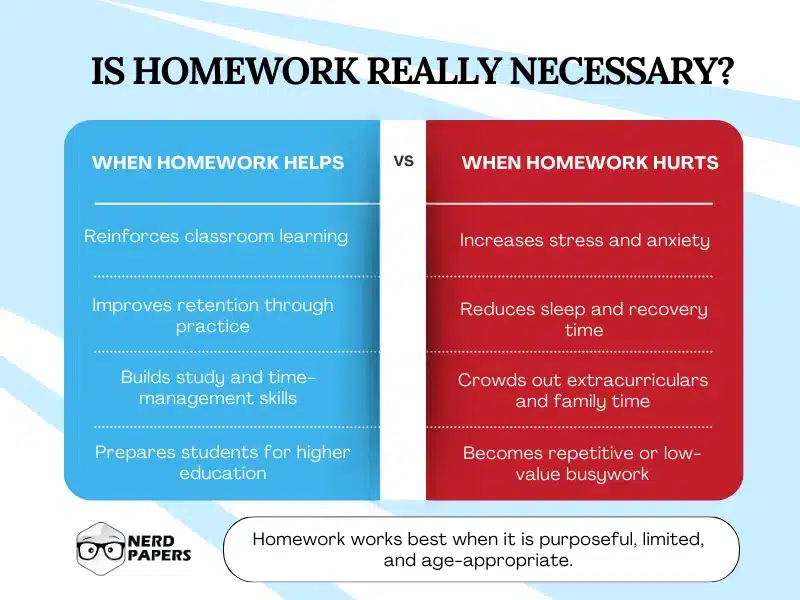
- Homework can be effective when it is purposeful and well-designed: it reinforces learning, improves retention, builds time-management skills, supports college readiness, and strengthens independent problem-solving.
- Homework becomes harmful when it prioritizes volume over value. Excessive workload is linked to higher stress, reduced sleep, lower motivation, and poorer academic engagement.
- Not all students face the same homework conditions. Homework can widen inequality when students lack quiet study space, time, or support at home.
- Research-based patterns show homework benefits are minimal in elementary school, moderate in middle school, and more meaningful in high school, but gains plateau after reasonable time limits.
- A practical tipping point appears when homework regularly exceeds healthy ranges (especially when it pushes beyond two hours nightly), where stress rises without proportional academic improvement.
- The real debate is not “homework vs. no homework,” but “smart homework vs. overload.” Quality and alignment matter more than quantity.
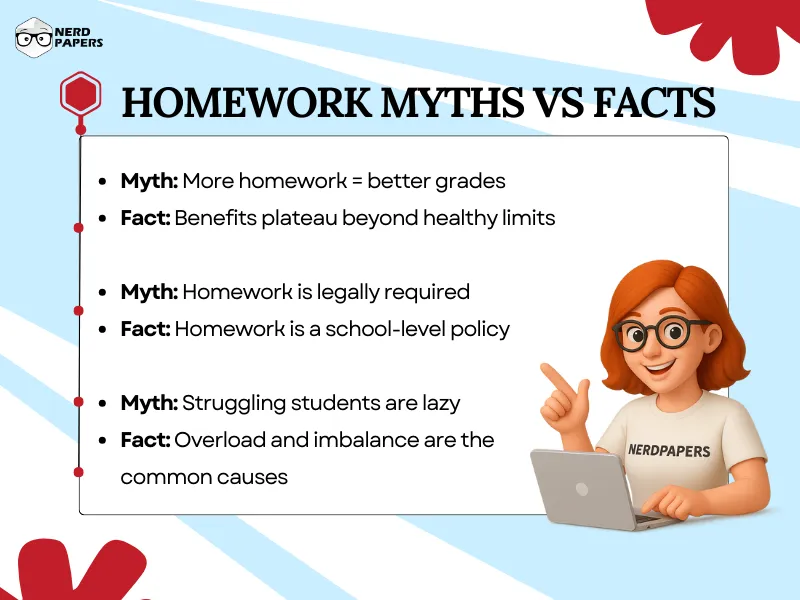
- Homework is not illegal and usually not required by law; it is a school-level policy choice, and adjustments are often possible through communication or accommodations.
- If homework consistently disrupts sleep or well-being, students should combine smarter study habits with responsible homework help to stay academically on track without sacrificing health.
Homework can help students learn, but only when it is purposeful, limited, and balanced with rest, mental health, and real life.
Is Homework a Learning Tool or an Unnecessary Burden?
Homework has been part of school life for generations, yet few academic topics divide students, parents, and educators as sharply. For some, homework is a necessary extension of classroom learning as a way to practice skills, reinforce concepts, and build discipline. For others, it is an outdated system that adds stress, reduces sleep, and leaves little room for personal growth.
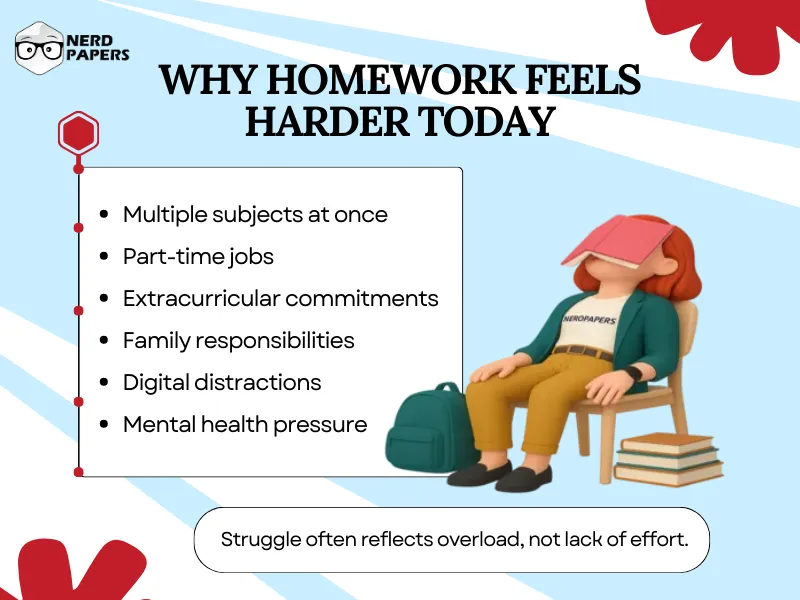
Today’s students are spending more time on school assignments than ever, often juggling multiple subjects, extracurricular activities, part-time jobs, and family responsibilities. At the same time, concerns about student mental health, burnout, and academic pressure are rising.
This has pushed a simple question into the spotlight:
Is homework really necessary, or is it doing more harm than good?
The debate is no longer just emotional. Researchers, educators, and school systems are actively examining:
- Whether homework actually improves academic performance
- How homework affects stress, sleep, and motivation
- At what point does homework stop helping and start hurting
- Whether age, subject, and workload change its effectiveness
Adding to the complexity, many students are now searching for alternatives when homework becomes overwhelming. Many of them search is there someone who can do my homework online. This reflects a deeper issue; it’s not laziness, but workload imbalance and pressure.
This article does not argue for or against homework blindly. Instead, it breaks down:
- Why homework exists
- The strongest arguments for and against it
- What research actually shows about its effectiveness
- How students and parents can make informed decisions based on real evidence
The main aim of this is the clarity, not guilt, not ideology, and not pressure. Homework should support learning, not dominate a student’s life. To understand whether it still serves that purpose, we need to look at the facts.
Why Does Homework Exist? Understanding Its Origins and Purpose
To evaluate whether homework is still necessary today, it is helpful to understand why it was introduced in the first place. Homework did not appear randomly, nor was it originally designed to overwhelm students. Its purpose has evolved alongside education systems, social structures, and expectations of schooling.
Why Was Homework Originally Invented?
Homework emerged as formal education systems began shifting from informal learning to structured, standardized instruction. Early schools needed a way to:
- Reinforce lessons taught in class
- Encourage repetition and memorization
- Extend learning beyond limited classroom hours
In its earliest form, homework was meant to support comprehension, not consume a student’s entire day. Assignments were typically short and focused on practicing core skills such as reading, writing, and arithmetic.
Despite popular myths, homework was not invented as a punishment. The goal was to reinforce and discipline academic routines, especially during limited classroom time.
The Role of Homework in Traditional Education Models
As education systems expanded, homework became embedded in schooling for several reasons:
- Large class sizes limited individual practice time
- Teachers needed a way to assess understanding outside exams
- Homework provided structure and routine for students
Over time, homework also became associated with responsibility, self-discipline, and preparation for future academic demands. Completing assignments independently was seen as a way to prepare students for exams, higher education, and professional expectations.
How Homework Became a Standard Requirement
During the 20th century, homework shifted from optional reinforcement to an expected norm. Several factors contributed:
- Standardized testing increased academic pressure
- Competitive college admissions raised expectations
- Curriculum expansion led to more content than could fit into school hours
As a result, homework volumes have often increased without reconsidering the age-appropriateness or effectiveness. What began as a learning aid slowly turned into a workload expectation.
Does the Original Purpose of Homework Still Apply Today?
This is where the modern debate begins.
The original purpose of homework was to:
- Reinforce learning
- Build study habits
- Support long-term retention
However, today’s students face:
- Heavier academic loads
- Digital distractions
- Increased mental health challenges
- Less recovery time outside school
This raises an important question:
If homework no longer serves its original purpose effectively, should it be restructured or reduced?
Understanding this historical context makes one thing clear:
The issue is not why homework exists, but whether its current form aligns with how students learn best today.
Why Homework Can Be Effective When Used Correctly
Despite growing criticism, homework has lasted for decades for a reason. When thoughtfully designed and assigned, homework can play a meaningful role in student learning. Research and classroom experience suggest that homework is most effective when it is purposeful, limited, and aligned with learning goals. Here are some of the reasons that homework is effective:
Reinforces Learning and Improves Retention
One of the strongest arguments for homework is that it reinforces what students learn in class. Repetition and practice help move information from short-term to long-term memory, especially in subjects that require skill-building, such as mathematics, writing, and foreign languages. When homework is designed to strengthen understanding rather than repeat tasks mechanically, it supports key benefits of homework, such as improved retention, accuracy, and confidence in applying concepts independently.
When students revisit concepts independently:
- They strengthen understanding through repetition
- They identify gaps in knowledge
- They gain confidence applying concepts without immediate teacher guidance
Studies consistently show that practice-based homework, rather than rote or repetitive tasks, is associated with better academic outcomes, particularly in secondary education.
Builds Responsibility and Time-Management Skills
Homework can help students develop non-academic skills that are essential for long-term success. These include:
- Planning and prioritization
- Meeting deadlines
- Working independently without supervision
Managing assignments alongside other responsibilities encourages students to organize their time and take ownership of their learning. These skills become increasingly important as students progress into higher grades, college, and professional environments.
However, this benefit appears only when workloads are realistic. Excessive homework undermines this goal by replacing skill development with stress.
Prepares Students for Higher Education
In high school and college, homework serves as preparation for:
- Independent study expectations
- Research-based assignments
- Long-term projects with minimal supervision
Higher education assumes students can manage learning outside the classroom. Homework helps bridge that transition by familiarizing students with:
- Self-directed learning
- Extended concentration
- Academic accountability
For older students, moderate homework loads are often linked to higher academic performance and readiness for advanced coursework.
Encourages Independent Problem-Solving
Homework creates opportunities for students to be productive and manage independent problem-solving, a key part of learning. Without immediate help, students must:
- Apply concepts independently
- Experiment with solutions
- Learn from mistakes
This process strengthens critical thinking and problem-solving skills. Well-designed homework pushes students to think, not just complete tasks.
That said, this benefit disappears when homework becomes:
- Overly repetitive
- Unclear or poorly explained
- Excessive in volume
In such cases, homework stops promoting independence and starts promoting avoidance.
Homework can be beneficial, but only under specific conditions:
- It must have a clear purpose
- It must match the student’s developmental level
- It must respect time, health, and balance
When these conditions are met, homework supports learning. When they are ignored, the same tool becomes counterproductive.
Arguments Against Homework: When It Becomes More Harm Than Help
While homework can support learning in certain situations, many students experience the opposite effect. Critics of homework argue that its widespread use often ignores student well-being, individual circumstances, and diminishing academic returns. When homework becomes excessive or poorly designed, it can undermine both learning and motivation. Here are some of the reasons why homework can be more harmful than helpful:
Increases Stress and Affects Mental Health
One of the most common concerns is the impact of homework on student’s mental health and stress levels. Large workloads, tight deadlines, and pressure to perform can contribute to anxiety, frustration, and emotional exhaustion, especially among high school and college students balancing multiple subjects.
For many students, homework does not end when school ends. Assignments frequently extend late into the evening, cutting into rest and recovery time. Over time, this constant pressure can negatively affect mental health, concentration, and overall academic engagement, particularly when homework volume outweighs its educational value.
Reduces Sleep and Physical Well-Being
Homework is also closely linked to reduced sleep. Students often stay up late to complete assignments, revise work, or juggle multiple deadlines. Chronic sleep deprivation has been associated with:
- Lower academic performance
- Reduced attention and memory
- Increased irritability and burnout
When homework consistently interferes with rest, it begins to harm the very learning outcomes it is meant to support.
Limits Time for Extracurriculars and Personal Development
Another argument against homework is the way it consumes time outside the classroom. Students benefit from activities beyond academics, such as:
- Sports and physical activity
- Creative pursuits
- Social interaction and family time
Heavy homework loads can crowd out these experiences, reducing opportunities for balanced development and increasing feelings of isolation or disengagement from school.
Can Be Ineffective or Redundant
Not all homework is high-quality. In many cases, assignments repeat material students already understand or focus on completion rather than comprehension. When homework lacks a clear purpose or meaningful challenge, it becomes busywork, encouraging avoidance rather than curiosity or growth.
This is one reason critics argue that more homework does not automatically lead to better learning.
Reinforces Inequality Between Students
Homework assumes that all students have access to:
- A quiet study space
- Time outside school
- Parental or external academic support
In reality, home environments vary widely. Students with limited resources or additional responsibilities may struggle disproportionately, widening achievement gaps and creating unfair academic pressure.
Homework becomes harmful when it:
- Prioritizes volume over value
- Disrupts sleep and mental health
- Ignores individual student circumstances
In these cases, homework stops reinforcing learning and starts contributing to stress, disengagement, and burnout, raising valid questions about how much is too much.
Is Homework Beneficial? What Research Actually Shows
The debate over homework often becomes emotional, but research provides a nuanced, evidence-based picture. Instead of a simple “homework is good” or “homework is bad” conclusion, large-scale studies indicate that homework effectiveness depends on student age, workload, and assignment design.
What Large-Scale Studies Say About Homework Effectiveness
Several meta-analyses and empirical reviews have examined homework’s relationship with student learning:
- A systematic meta-analysis of homework and academic achievement found that homework has a small but positive effect on overall academic performance. However, the effect is modest and varies by context.
- Research analyzing the relationship between homework time and academic outcomes suggests that academic performance can improve with homework up to a point. Still, additional homework beyond an optimal threshold does not yield further benefits.
- Multiple observational studies show a positive relationship between homework and student achievement, especially in foundational areas such as arithmetic and problem-solving, though the magnitude and conditions vary.
- A long-standing synthesis of homework research, led by educational psychologist Harris Cooper, concluded that homework shows a stronger benefit at the secondary school level than in the elementary grades.
These findings support the idea that homework can be beneficial, but the benefits are neither uniform nor automatic. More homework does not automatically mean better results. Benefits plateau quickly once assignments exceed a reasonable time threshold.
How Much Homework Is Too Much?
When evaluating homework effectiveness, researchers focus less on the number of assignments and more on the time spent. Decades of educational research suggest that homework is most effective within specific time ranges, beyond which academic benefits begin to level off—or decline.
Here is a framework that highlights how homework impact varies by education level:
| Education Level | Average Recommended Homework Time | Research Insight |
| Elementary School | 0–30 minutes per day | Minimal academic benefit |
| Middle School | 30–90 minutes per day | Moderate benefit when consistent |
| High School | 1–2 hours per day | Strongest correlation with performance |
| College | Varies by discipline | Quality and structure matter more than volume |
Studies consistently show that academic gains plateau once homework exceeds these ranges. Additional time spent does not translate into proportional improvements in learning or grades. Instead, excessive homework is frequently associated with higher stress levels, reduced sleep, and declining motivation.
Survey data reinforces this pattern. Students who spend more than two hours per night on homework report significantly higher rates of stress, fatigue, and health-related concerns. This suggests a clear tipping point: beyond a certain threshold, homework becomes counterproductive rather than supportive.
The key implication is balance. Homework can enhance learning when workloads are reasonable and purposeful, but more homework is not inherently better. The optimal approach is one that reinforces understanding without eroding well-being, sleep, or engagement.
Balancing Learning, Homework Quality, and Student Well-Being
Homework is most effective when it supports learning without compromising student well-being. Increasingly, educational discussions emphasize balance over volume, recognizing that learning outcomes are closely tied to sleep, mental health, and time for recovery. When homework pressure becomes constant, students may continue completing assignments, but their engagement, motivation, and overall academic connection often decline.
This dynamic helps explain why homework can appear effective in moderation yet harmful when overdone. Assignments that reinforce understanding within reasonable time limits tend to support learning, while excessive workloads introduce stress that undermines both performance and well-being.
Another consistent finding across education studies is that homework quality matters more than quantity. Homework is more effective when it:
- Reinforces specific concepts taught in class
- Has a clear purpose and learning objective
- Encourages application rather than repetition
- Aligns with students’ developmental levels
In contrast, repetitive, vague, or poorly aligned assignments offer limited educational value, regardless of how much time students spend completing them.
Taken together, the evidence points toward a balanced approach rather than extremes. Homework is neither inherently good nor inherently harmful. Its value depends on how it is designed, how much is assigned, and how well it aligns with student needs. When used strategically, homework can improve academic performance. When overused or poorly structured, it leads to diminishing returns and increased stress.
Understanding this balance shifts the conversation away from eliminating homework or defending unlimited workloads. Instead, it highlights the need for more innovative, student-centered homework practices that support learning while protecting well-being.
Legal and Policy Perspectives on Homework
As debates over homework intensify, many parents and students are beginning to ask whether homework is actually required or even allowed by law. These questions often stem from frustration with workload, stress, or perceived unfairness. While the concerns are understandable, the legal reality is more straightforward and less dramatic than online discussions sometimes suggest.
Is Homework Mandatory by Law?
In most education systems, homework is not mandated by national or federal law. Instead, decisions about homework are typically made at the:
- School district level
- Individual school level
- Classroom or teacher level
This means homework policies are shaped by curriculum standards, educational philosophy, and local administrative guidelines rather than legal statutes. Schools are generally granted broad discretion to decide whether to assign homework, how much to assign, and how it is evaluated.
As a result, homework is a policy choice, not a legal requirement imposed by governments.
Is Homework Illegal?
Homework itself is not illegal. However, this question often arises when parents believe assignments are excessive, developmentally inappropriate, or harmful to student well-being.
In rare cases, concerns around homework intersect with broader issues such as:
- Student health accommodations
- Disability or learning support plans
- Excessive workload conflicts with well-being policies
In these situations, schools may be required to adjust or limit homework expectations for individual students. This does not make homework illegal, but it does place responsibility on schools to act reasonably and inclusively.
In response to research on stress and well-being, some schools and districts have chosen to:
- Cap daily homework time
- Eliminate homework on weekends or holidays
- Reduce or remove homework in early grades
These decisions are typically based on educational outcomes and student health, not legal pressure. In many cases, schools that reduce homework aim to prioritize engagement, sleep, and family time while maintaining academic standards through in-class learning.
What This Means for Students and Parents
Because homework policies are set locally, students and parents who are concerned about workload usually have more success through:
- Communicating with teachers
- Discussing workload concerns with school administrators
- Exploring accommodations when homework impacts health or learning
Refusing homework outright rarely resolves the issue. Policy flexibility exists, but it operates through dialogue and adjustment rather than legal prohibition.
Homework is not illegal, and it is not universally mandated by law. It exists as an educational practice shaped by school policies rather than legal rules. When homework becomes problematic, solutions are typically found through policy changes, accommodations, or revised teaching approaches, not legal challenges.
What Happens If a Student Refuses to Do Homework?
When homework becomes overwhelming, some students reach a breaking point and stop completing assignments altogether. This raises common questions from both students and parents: What actually happens if homework isn’t done? Can a student refuse homework without consequences?
The answer depends on the context, but there are some predictable patterns.
Academic Consequences Students May Face
In most schools, homework contributes to grades in some form. When assignments are consistently missed, students may experience:
- Lower homework or participation grades
- Reduced overall course averages
- Difficulty keeping up with exams or cumulative assessments
Even in classrooms where homework is weighted lightly, missing assignments can create learning gaps that affect performance later.
School and Teacher Responses
Teachers typically respond to incomplete homework progressively rather than immediately resorting to punishment. Common responses include:
- Reminders or follow-ups
- Requests for makeup work
- Meetings with students to identify challenges
- Communication with parents or guardians
The goal is usually compliance and support, not discipline. However, repeated refusal without communication can escalate into formal consequences depending on the school policy.
When Refusal Signals a Deeper Issue
A consistent refusal to do homework often points to underlying problems rather than defiance. These may include:
- Academic overload
- Burnout or anxiety
- Sleep deprivation
- Learning difficulties
- External responsibilities at home
In these cases, refusing homework can be a symptom, not the root problem. Schools are increasingly aware of this and may respond with adjustments when concerns are raised early.
Can Parents Refuse Homework on Behalf of Their Child?
Parents cannot unilaterally opt a child out of homework across the board. However, they can:
- Request workload discussions with teachers
- Advocate for reasonable limits
- Seek accommodations when homework affects health or learning
Productive outcomes are far more likely when concerns are addressed through proper communication rather than outright refusal.
What Works Better Than Refusing Homework
Instead of refusing homework entirely, students and families tend to see better results when they:
- Track workload and stress patterns
- Communicate concerns early
- Ask for extensions or adjustments when overwhelmed
- Focus on completing high-value assignments rather than everything
These approaches acknowledge academic expectations while protecting well-being.
Refusing to do homework rarely solves the underlying issue. While consequences vary by school and situation, consistent non-completion usually affects grades and learning. In most cases, the most effective path forward is conversation, adjustment, and support, not silent refusal.
How Students Can Decide What Works for Them
There is no single homework rule that works for every student. Differences in academic level, course load, learning style, and personal responsibilities all affect how students experience homework. Rather than asking whether homework is necessary in general, students benefit more from asking a different question:
Is my current homework load helping me learn or holding me back?
Answering that question requires honest self-assessment. Here is how you can decide what works for you:
Evaluate Your Actual Workload
Many students underestimate how much time homework truly consumes. A helpful first step is to track:
- How many hours per day do you spend on homework
- Which subjects take up the most of your time
- Whether assignments feel purposeful or repetitive
If homework consistently extends late into the night or crowds out sleep and recovery, that is a significant signal, not of laziness, but of imbalance.
Pay Attention to Mental and Physical Signals
Homework becomes a problem when it begins to affect well-being. Warning signs include:
- Chronic fatigue or reduced sleep
- Increased anxiety or irritability
- Difficulty concentrating or retaining information
- Loss of motivation toward schoolwork
When these patterns persist, continuing to push through without adjustment often leads to burnout rather than improvement.
Use Smarter Study and Time-Management Strategies
Not all homework requires equal effort. Students often benefit from:
- Prioritizing assignments that reinforce core concepts
- Breaking large tasks into manageable sessions
- Using focused study blocks instead of multitasking
- Stopping work once learning effectiveness declines
The main goal is efficiency, not exhaustion. Learning improves when effort is intentional rather than prolonged.
Recognize When Support Is a Practical Choice
There are periods when homework demands spike, such as during midterms, finals, overlapping deadlines, or personal challenges. In these moments, seeking academic support can be a strategic decision, not a failure.
Support may help students:
- Stay on track during high-pressure periods
- Prevent missed deadlines from cascading
- Maintain academic performance without sacrificing health
The key is using support responsibly to manage workload, not to avoid learning.
Conclusion: Homework Isn’t the Problem, But Imbalance Is
So, is homework really necessary? The answer is not a simple yes or no.
Homework can support learning when it is purposeful, limited, and aligned with how students actually learn. Research and real-world experience show that moderate, well-designed homework can reinforce understanding, build study habits, and prepare students for higher academic demands, especially in middle school, high school, and beyond.
At the same time, excessive or poorly structured homework creates real problems. When assignments consistently interfere with sleep, mental health, and personal time, the educational benefits begin to fade. In those cases, homework stops reinforcing learning and starts contributing to stress, disengagement, and burnout.
What emerges from this debate is not an argument for eliminating homework entirely, nor a defense of unlimited workloads. Instead, the evidence points toward balance:
- Quality matters more than quantity
- Age and context matter
- Student well-being is inseparable from academic success
For students, the goal should not be to complete every assignment at any cost, but to engage with homework in a way that actually supports learning. For parents and educators, the focus should be on thoughtful workload design and open communication rather than rigid expectations.
Homework should help students’ learning, not overwhelm them.
When managing assignments becomes consistently stressful or unmanageable, it is reasonable to look for ways to reduce pressure while staying academically responsible. The proper support, used thoughtfully, can help students stay on track without sacrificing health or motivation.
In the end, the real question is not whether homework exists, but whether it is helping students learn, grow, and thrive.
Frequently Asked Questions About Homework
Is homework really necessary for students?
Homework is not universally necessary. Research shows it can support learning when it is age-appropriate, limited in time, and purposeful. Its effectiveness varies by grade level, subject, and workload design.
Is homework beneficial for students or does it cause more harm?
Homework can be beneficial in moderation, particularly for middle and high school students. However, excessive homework is linked to stress, reduced sleep, and burnout, which can outweigh academic benefits.
Why does homework exist in the first place?
Homework exists to reinforce classroom learning, build study habits, and encourage independent practice. Over time, its role expanded due to curriculum pressure and limited classroom hours.
Why do many students feel homework is bad?
Many students report that homework feels overwhelming because of heavy workloads, tight deadlines, and lack of balance. When homework becomes repetitive or excessive, it often feels unproductive rather than helpful.
Does homework actually improve grades?
Homework can improve grades when it reinforces key concepts and stays within reasonable time limits. Studies suggest that benefits plateau beyond certain thresholds, meaning more homework does not automatically lead to better performance.
Is homework illegal or mandatory by law?
Homework is not illegal, and it is generally not mandated by law. Homework policies are set by schools and teachers, not governments, and can vary widely by district and institution.
What happens if a student refuses to do homework?
Refusing homework typically leads to academic consequences, such as lower grades or follow-ups from teachers. In many cases, refusal signals overload or stress, which is best addressed through communication and adjustment rather than punishment.
How can students manage homework without burning out?
Students can reduce burnout by prioritizing high-value assignments, managing time intentionally, watching for stress signals, and seeking support during heavy workload periods. Balance and efficiency matter more than sheer hours spent.