
Homework helps students reinforce what they learn in class and build skills they need for long-term academic success. When assigned and completed correctly, homework strengthens understanding, encourages independent learning, and develops responsibility. For students who want to get the most value from their homework and stay consistent with their studies, structured homework support can be a helpful option alongside regular classroom learning.
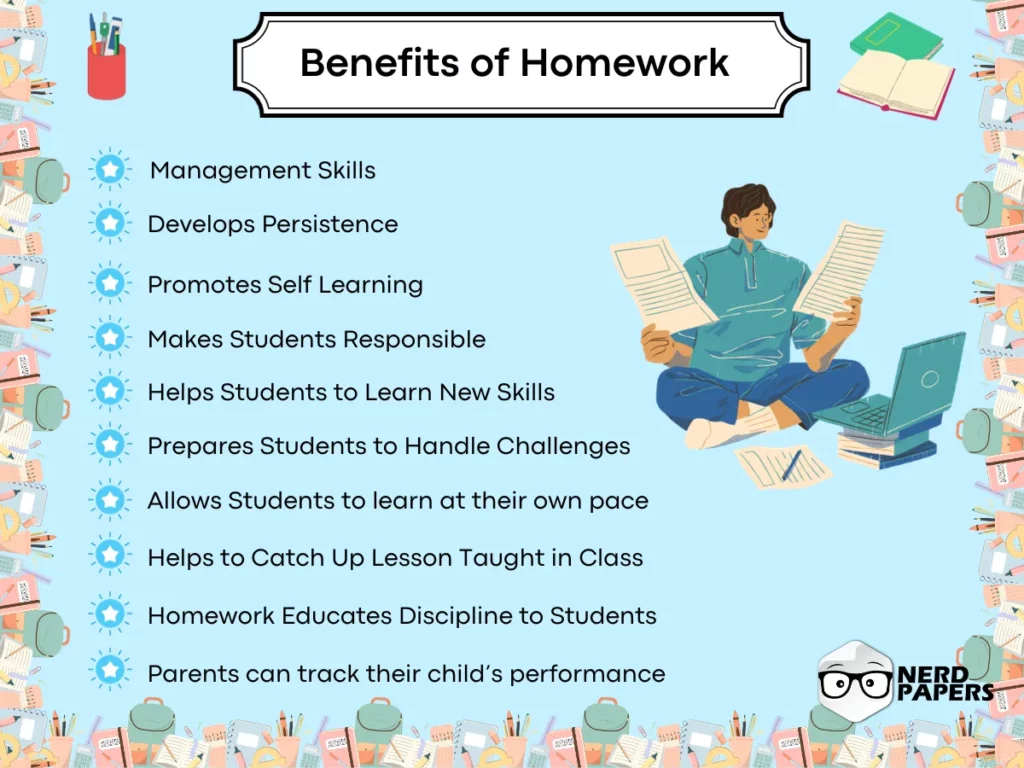
Top 10 Benefits of Homework (At a Glance):
- Reinforcing classroom learning through practice
- Improves understanding through regular practice
- Builds responsibility and self-discipline
- Develops time management and organization skills
- Encourages independent learning, thinking, and problem-solving
- Strengthens problem-solving abilities
- Helps teachers assess student progress
- Supports different learning speeds
- Prepares students for exams and assessments
- Builds long-term study habits for academic success
What Is Homework and What Is Its Purpose?
Homework refers to academic tasks that teachers assign for students to complete outside regular classroom hours. These tasks may include practice questions, reading assignments, short written responses, or preparation for upcoming lessons.
The purpose of homework is not to overload students or replace classroom teaching. Instead, homework exists to support learning by giving students additional time to practice and apply what they have already been taught. It allows students to review concepts independently, strengthen their understanding, and identify areas that may need further clarification.
Homework also serves an instructional role. By reviewing completed assignments, teachers can assess how well students understand the material and adjust future lessons accordingly. When homework is purposeful and aligned with classroom instruction, it becomes an extension of learning rather than an isolated task.
Primary Purposes of Homework
Homework is typically assigned to:
- Reinforce lessons covered in class
- Help students practice and apply new skills
- Encourage independent learning outside the classroom
- Support skill development through repetition and review
Why Homework Is Important for Students
Homework plays an important role in helping students connect classroom learning with independent study. While lessons introduce new concepts, homework allows students to practice and apply those concepts on their own, which strengthens understanding and improves retention.
Research supports the importance of homework in academic success. Harris Cooper, a professor of psychology and neuroscience at Duke University, examined the effects of homework on student achievement. His research found a clear positive relationship between homework completion and academic performance, particularly for middle school, high school, and college students. This shows that homework, when assigned appropriately, helps students perform better in their education.
Although homework is often unpopular because it takes up students’ free time, it serves an important instructional purpose. Homework helps teachers evaluate how well students understand the material covered in class. By reviewing assignments, teachers can identify learning gaps, adjust instruction, and provide targeted support where needed.
In this way, homework supports both students and teachers. It reinforces learning outside the classroom while helping educators ensure that students are progressing as expected.
How Homework Supports Learning Beyond the Classroom
Homework helps students:
- Practice and reinforce classroom instruction
- Improve academic performance through repetition and review
- Develop independent study habits
- Demonstrate understanding that teachers can assess and respond to
Core Benefits of Homework for Students
Homework provides several direct benefits that support academic growth and skill development of the students. When assignments are purposeful and aligned with classroom instruction, they help students strengthen learning habits that carry over into future education.
Below are the key benefits of homework, explained clearly and practically.
Reinforces Learning and Improves Understanding
One of the most important benefits of homework is that it reinforces what students learn in class. Lessons introduce new concepts, but homework gives students the opportunity to review and practice those concepts independently. This repetition helps students understand the material more deeply and remember it for longer periods.
By working through problems or revisiting lessons at home, students can identify areas where they feel confident and areas where they may need more clarification. This process strengthens comprehension and reduces confusion before the next class.
Builds Responsibility and Accountability
Homework teaches students to take responsibility for their own learning. Completing assignments on time requires students to follow instructions, manage expectations, and stay accountable for their work without constant supervision.
Over time, this responsibility helps students develop self-discipline and reliability. These skills are essential not only for academic success but also for future responsibilities in higher education and professional environments.
Improves Time Management Skills
Homework helps students learn how to manage their time effectively. Balancing assignments alongside school, activities, and personal time teaches students how to plan ahead and prioritize tasks.
As students become more familiar with deadlines and workload planning, they develop organizational habits that help them complete work more efficiently and avoid last-minute stress.
Encourages Independent Learning
Homework encourages students to work independently and take ownership of their learning. When students complete assignments on their own, they learn how to think through problems, follow instructions carefully, and make decisions without immediate guidance from teachers or classmates.
This independent learning process builds confidence. Students become more comfortable handling academic tasks on their own, which prepares them for exams, higher education, and situations where self-directed learning is required.
Develops Problem-Solving and Critical Thinking Skills
Many homework assignments require students to apply what they have learned rather than simply repeat information. This helps develop problem-solving and critical thinking skills as students analyze questions, explore solutions, and evaluate their answers.
By working through challenges independently, students learn how to approach unfamiliar problems logically. These skills are valuable across all subjects and remain useful well beyond the classroom.
Helps Teachers Assess Student Progress
Homework also benefits students indirectly by helping teachers better understand their learning progress. When teachers review homework, they can see which concepts students have mastered and where they may be struggling.
This feedback allows teachers to adjust lessons, revisit difficult topics, and provide additional support when needed. As a result, students receive more targeted instruction that improves overall learning outcomes.
Benefits of Homework by Education Level
The impact of homework changes as students progress through different stages of education. When assignments are age-appropriate, homework supports learning in specific and measurable ways at each level.
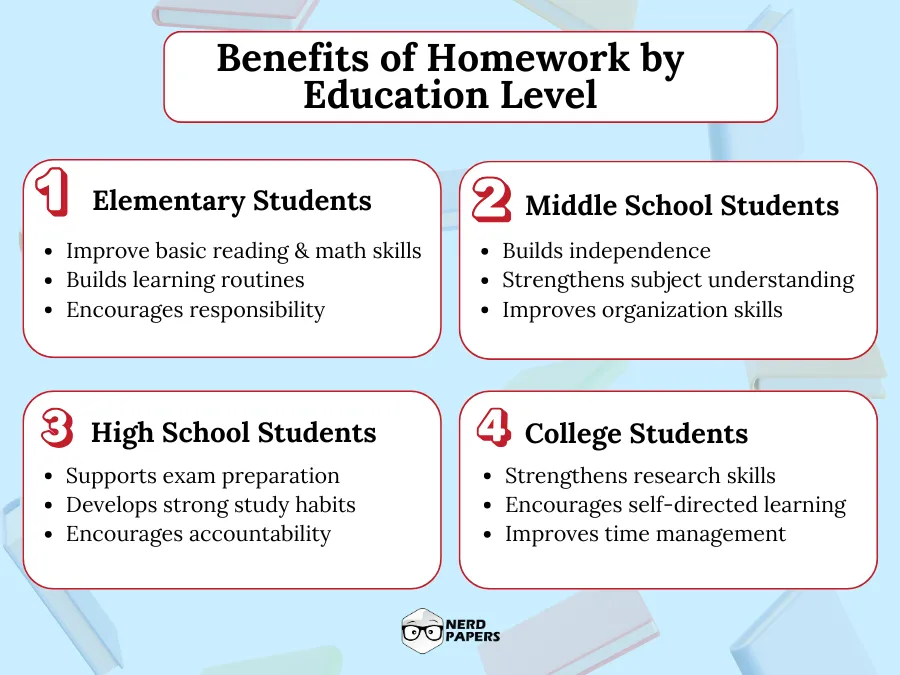
Benefits of Homework for Elementary Students
- Reinforces basic skills such as reading, writing, and simple problem-solving
- Helps children develop consistent learning routines
- Encourages responsibility through simple, manageable tasks
- Supports early understanding of classroom lessons
- Allows parents to observe learning progress at home
Benefits of Homework for Middle School Students
- Builds independence in completing assignments
- Strengthens understanding of core subjects
- Helps students learn how to manage multiple tasks
- Encourages responsibility for meeting deadlines
- Supports the transition from guided learning to self-study
Benefits of Homework for High School Students
- Reinforces complex academic concepts
- Supports exam preparation and assessment readiness
- Develops strong study habits and discipline
- Encourages accountability for academic performance
- Prepares students for college-level workloads
Benefits of Homework for College Students
- Strengthens research and analytical skills
- Encourages independent and self-directed learning
- Improves time management across multiple courses
- Develops writing and critical thinking abilities
- Builds habits essential for professional and academic success
Benefits of Homework for Parents (When Support Is Balanced)
Homework not only benefits students. When approached correctly, it also provides value for parents by offering insight into their child’s academic progress and learning needs.
- Helps parents understand what their child is learning in school
- Allows parents to identify academic strengths and areas that may need support
- Encourages communication between parents and teachers about student progress
- Supports the development of structured learning routines at home
- Creates opportunities for parents to guide rather than complete academic work
Should Parents Help With Homework? (Pros and Cons in Practice)
Parental involvement in homework can be helpful when it focuses on guidance rather than direct intervention. Understanding the benefits and limitations of parental help helps maintain healthy learning boundaries.
Pros of parental homework support
- Provides encouragement and motivation
- Helps students stay organized and focused
- Clarifies instructions or expectations when needed
Cons of excessive parental involvement
- Reduces student independence
- Limits problem-solving development
- Weakens learning outcomes when work is completed for the student
Research-Backed Benefits of Homework (High-Level Overview)
Educational research consistently shows that homework supports learning when it encourages review, connection, and application of knowledge. One of the primary reasons homework is effective is that it requires students to revisit and repeat what they have learned, which strengthens memory and long-term retention.
When students hear or read information only once, much of it is quickly forgotten. Homework changes this pattern by prompting repeated exposure to the same material. Research on learning and memory shows that reviewing content over time helps move information from short-term memory into long-term memory, improving recall and understanding.
Homework also supports a research-based learning process known as interleaving. Interleaving involves connecting new information with previously learned concepts rather than studying topics in isolation. By revisiting earlier lessons while learning new material, students develop a deeper and more flexible understanding of subjects. Homework naturally encourages this process by requiring students to apply knowledge across lessons and units.
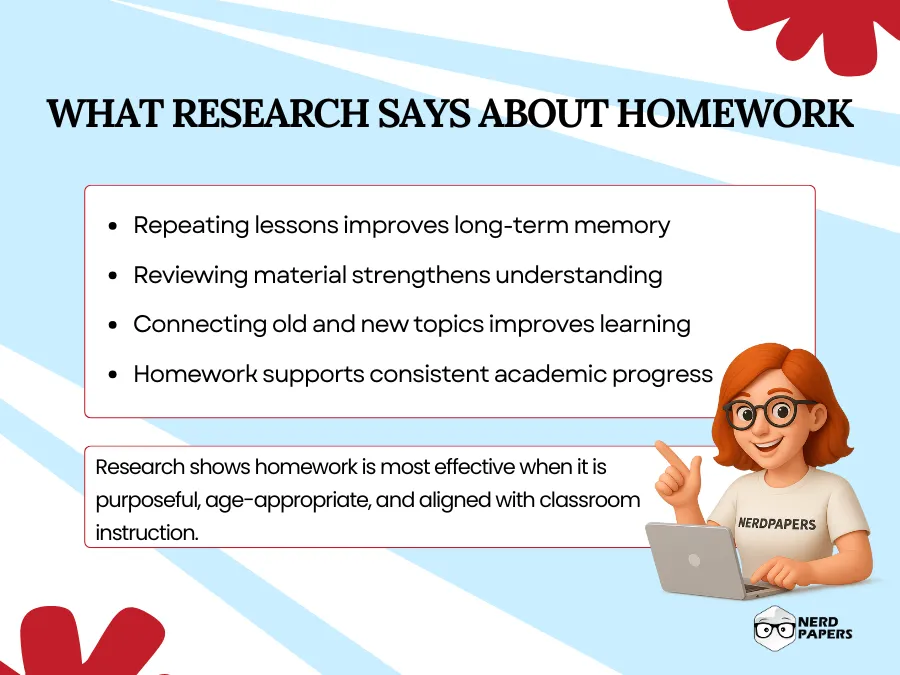
Studies summarized by educational researchers have found a measurable positive relationship between regular homework completion and academic performance, particularly for middle school, high school, and college students. These benefits are strongest when homework is purposeful, aligned with classroom instruction, and supported by feedback.
Another research-supported benefit of homework is its ability to engage different modes of thinking. Students often focus intensely while working on an assignment and continue processing the information in the background afterwards. Returning to the task later can make solutions clearer and strengthen problem-solving ability.
Overall, research indicates that homework is most beneficial when it is meaningful, age-appropriate, and designed to reinforce learning rather than simply increase workload.
When Homework Is Most Effective
Homework is most beneficial when it is designed with a clear purpose and reasonable expectations. Not all homework produces the same results, and research shows that the quality of assignments matters more than the quantity.
Homework is most effective when:
- Assignments are directly connected to lessons taught in class
- Instructions are clear and easy to follow
- The workload is appropriate for the student’s age and level
- Homework focuses on practice and understanding, not busywork
- Teachers review completed work and provide feedback
When these conditions are met, homework reinforces learning rather than creating confusion. Students are more likely to understand why they are completing assignments and how the work supports their academic progress.
Effective homework also respects students’ time. Reasonable workloads allow students to focus on quality work, develop good study habits, and stay engaged with learning without feeling overwhelmed.
How Homework Supports Long-Term Academic Success
Homework plays an important role in building habits that support students beyond individual lessons or grades. When completed consistently, homework helps students develop skills that contribute to long-term academic success.
Regular homework encourages students to practice self-discipline and maintain structured study routines. Over time, these routines help students approach learning more independently and manage academic responsibilities with greater confidence.
Homework also prepares students for future educational demands. As students progress to higher levels of education, they are expected to handle larger workloads, conduct independent research, and meet stricter deadlines. Homework introduces these expectations gradually, allowing students to build the necessary skills step by step.
In the long term, homework supports:
- Strong study habits that carry into higher education
- Improved organization and planning skills
- Greater independence in learning
- Readiness for college-level and professional tasks
By reinforcing these habits early and consistently, homework helps students develop the skills needed for sustained academic growth. Homework can support long-term academic success, but many students and parents still wonder how essential homework truly is in today’s learning environment. This question has become increasingly relevant as education continues to evolve.
Getting Support When Homework Needs Extra Guidance
Homework is designed to reinforce learning, but some assignments may require additional guidance to be completed effectively. More detailed topics, multi-step tasks, or tight schedules can sometimes benefit from extra structure and clarity.
In these situations, the purpose of support is to enhance understanding and consistency, not to replace learning. Students can strengthen their homework process by:
- Asking teachers for clarification on instructions or expectations
- Breaking assignments into smaller, well-organized steps
- Planning homework time to maintain steady progress
When further assistance is useful, structured homework support can help students organize tasks, follow academic requirements, and complete assignments accurately. Used responsibly, this type of support reinforces learning while helping students stay consistent with their academic goals.
Conclusion: Why Homework Still Matters
Homework remains an important part of education when it is purposeful, balanced, and aligned with classroom learning. It reinforces lessons, strengthens understanding, and helps students develop responsibility, independence, and long-term academic habits.
Beyond improving subject knowledge, homework prepares students for future challenges by teaching time management, problem-solving, and self-directed learning. It also helps teachers assess progress and allows parents to stay informed about their child’s education.
When designed thoughtfully and supported appropriately, homework continues to play a valuable role in helping students grow academically and develop skills that extend beyond the classroom.
Frequently Asked Questions
What are the main benefits of homework for students?
The main benefits of homework include reinforcing classroom learning, improving understanding through practice, and helping students build responsibility. Homework also supports time management, independent learning, and problem-solving skills, which are essential for long-term academic success.
Why is homework important for students at different education levels?
Homework is important because it supports learning in age-appropriate ways. For younger students, it builds routines and reinforces basic skills. For older students, it strengthens subject understanding, encourages independence, and prepares them for exams, college workloads, and future academic responsibilities.
Does homework really help students learn better?
Yes. Research shows that homework helps students retain information by requiring them to review and apply what they have learned. Repeated exposure to material improves memory, deepens understanding, and helps students connect new knowledge with previous lessons.
How does homework improve academic performance?
Homework improves academic performance by giving students additional practice time outside the classroom. This practice helps clarify difficult concepts, strengthens recall, and allows teachers to identify learning gaps and provide targeted support.
Is homework good for building responsibility and discipline?
Homework helps students develop responsibility by teaching them to manage deadlines, follow instructions, and complete tasks independently. Over time, these habits contribute to better self-discipline and stronger academic routines.
What skills does homework help students develop?
Homework helps students build essential skills such as time management, organization, independent learning, problem-solving, and critical thinking. These skills support both academic achievement and future educational or professional success.
Why do teachers assign homework?
Teachers assign homework to reinforce classroom instruction, assess student understanding, and provide opportunities for independent practice. Homework helps teachers identify areas where students may need additional explanation or support.
Is homework beneficial for parents as well as students?
Yes. Homework allows parents to see what their child is learning, monitor academic progress, and recognize strengths or challenges early. When support is balanced, homework helps parents stay informed without taking over the learning process.