

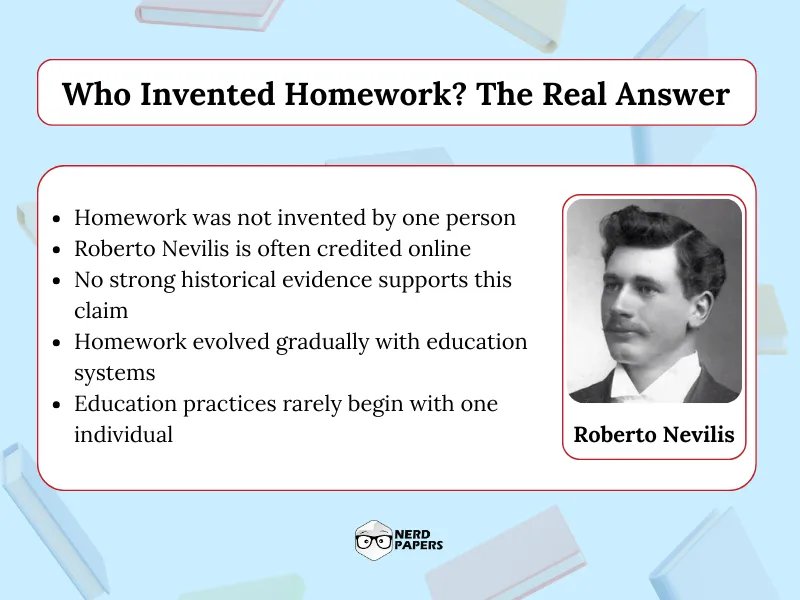
Homework was not invented by a single person. The concept of homework has ancient roots, but Roberto Nevilis, who is an Italian educator from the late 19th century, is often credited with formalizing it. However, Roberto Nevilis’ online mentions lack strong historical evidence of his creation of homework. Homework gradually developed as education systems expanded, reinforcing learning outside the classroom.
This is why the question: who invented homework? does not have a simple, one-name answer.
Why This Question Still Matters Today?
Understanding who invented homework naturally leads to a more critical question: why does homework exist at all? and whether homework is still necessary? Homework did not appear by chance. It developed as teaching methods changed, classrooms grew larger, and education systems adopted the idea that learning should continue beyond school hours.
This historical context is exactly why homework remains controversial today. Past factors like efficiency, reinforcement, and discipline continue to influence current homework practices. Modern education now prioritizes student well-being, highlighting concerns about workload, stress, and effectiveness.
Key Takeaways Before We Go Deeper
Before exploring the full history of homework, here are the essential points to keep in mind:
- Homework was not invented by one individual
- Early forms of homework existed long before modern schools
- Homework expanded with compulsory education systems
- Its purpose shifted from discipline to academic reinforcement
- The homework debate continues in modern education
These ideas clarify homework’s modern evolution from earlier education systems.
Why People Believe Homework Was “Invented” by One Person
Many people believe homework was invented by Roberto Nevilis because his name appears frequently in online explanations and short-form educational content. Over time, this claim spread without solid historical sources to support it.
In reality, this is an example of a homework invention myth. Education practices rarely begin with one person. Instead, they develop slowly as teaching needs change. Homework followed this same pattern, evolving alongside formal education rather than being suddenly introduced by a single educator.
This misunderstanding also explains why searches like “did Roberto Nevilis invent homework” and “where did homework come from” remain so common.
Homework Before Modern Schools: Early Education Practices
Long before modern schools existed, learning often continued outside the formal teaching spaces. In early societies, students practiced skills through repetition, memorization, oral recitation, and observation at home or under everyday guidance. These activities were not labeled as homework, but they served the same purpose, which was to support the learning outside direct instruction.
One of the earliest examples appears in the Ancient Greek education system (c. 800 BCE–323 BCE). Greek education highlights philosophy, rhetoric, and critical thinking, much of which relied on independent reflection and memorization outside the structured lessons. Learning was seen as a continuous process, not limited to the classroom.
This approach carried into the Roman education system (c. 500 BCE–476 CE). Roman students were expected to practice reading, writing, grammar, and rhetoric outside formal instruction to prepare for civic, legal, and political roles. Mastery required consistent practice beyond the teacher’s presence.
Outside Europe, similar expectations shaped education over long periods. In the Confucian education system (c. 200 BCE–1905 CE), students independently memorized classical texts while preparing for demanding civil service examinations. Self-directed study was essential to academic and social advancement.
During the medieval era, the Islamic madrasa system (c. 9th–15th centuries) also emphasized learning beyond instruction. Students engaged in extensive independent reading, memorization, and commentary alongside formal teaching in religious and scholarly subjects.
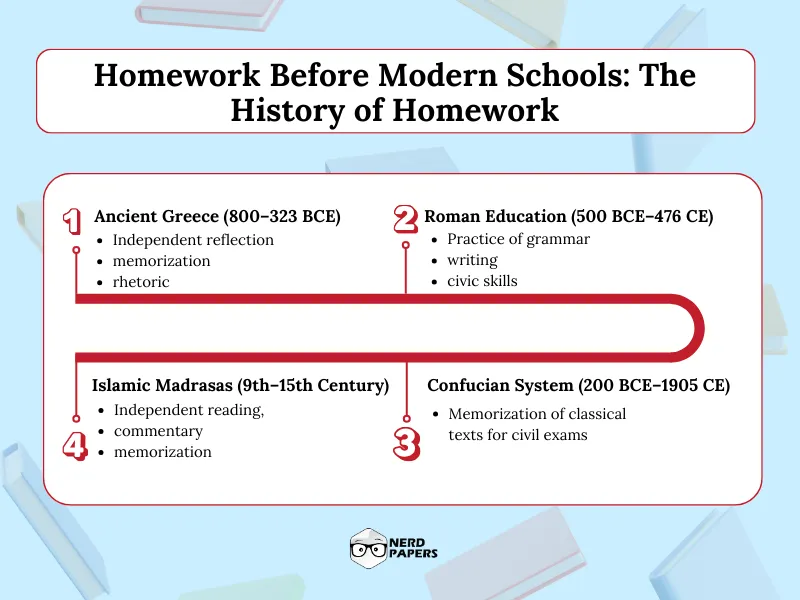
Across these education systems, learning beyond the classroom was expected rather than optional. These early practices show that the origin of homework lies in a long-standing belief that education continues outside formal instruction, not in a single invention or moment in history.
The Old Shape of Homework and How It Evolved
In its earliest form, homework was informal practice, not written assignments. Students memorized texts, rehearsed speeches, copied passages, or reflected on lessons. There were no deadlines, grades, or standardized tasks.
Homework began to change when education became mass, formal, and compulsory. Learning shifted from personal mastery to uniform progress. Assignments became structured, teacher-directed, and measurable.

This transition laid the foundation for homework as students recognize it today.
The Rise of Homework With Compulsory Schooling
Homework became more structured as education systems expanded. Schooling shifted from small, elite settings to large institutions for educating everyone.
The Prussian education system played a major role in this transformation. Schools introduced standardized curricula, fixed schedules, and measurable outcomes. Teachers required a method to strengthen lessons and enforce discipline in busy classrooms.
Homework emerged as a practical solution. It allowed students to practice skills, follow instructions independently, and meet classroom expectations. This period was pivotal for homework, making it a regular school activity.
Education Reformers and Changing Views on Homework
Expanding schooling led educators to question whether traditional assignments supported student learning. This period shifted the view of homework from discipline to learning and development.
One of the earliest voices in this discussion was Horace Mann. He backed structured education but cautioned against harmful workloads for students. He supported structured education but warned against excessive student workloads.
Building on this shift, educational thinking moved toward understanding how students process knowledge. Johann Heinrich Pestalozzi emphasized learning through understanding instead of memorization. He highlighted age-appropriate homework for deeper understanding, while avoiding mindless repetition.
Later educational reform further redefined the purpose of assignments. John Dewey argued that education should connect directly to real-life experiences. He questioned drills and encouraged activities for practical learning.
Together, these reformers reshaped how homework was viewed. Homework shifted from punishment to a supportive tool for learning, psychology, and understanding.
Johann Gottlieb Fichte and the Discipline Model
Johann Gottlieb Fichte did not design homework, but his ideas strongly influenced compulsory schooling. He supported disciplined, state-led education where learning extended beyond the classroom.
Fichte’s philosophy helped normalize homework as an obligation rather than a choice. This influence shaped rigid homework systems that still affect workload expectations today.
Is There a “Father of Modern Homework”?
There is no official father of homework. However, John Dewey is often considered the most influential figure behind modern homework philosophy.
Dewey did not invent homework, but he reshaped its purpose. His ideas moved homework toward reflection, application, and student-centered learning. Many modern debates about relevance and effectiveness trace back to this shift.
How the Purpose of Homework Changed Over Time
The purpose of homework has never been fixed. Instead, it shifted as educational goals changed.
In early systems, homework emphasized discipline and obedience. During the industrial era, schooling supported routine, consistency, and productivity. Homework evolved to reinforce academics and practice class concepts.
Modern approaches consider difficulty level, assignments, outcomes, and assessment roles. Homework today differs greatly from traditional educational discipline methods due to evolution.
Homework History: Myths vs. Facts
Homework mixes myth and history with simplified stories and viral claims. Easy explanations often don’t accurately show homework evolution.
Myth: Homework was invented by one person to punish students.
Fact: Homework did not originate as a punishment or as a tool created by a single individual. Education systems expanded, with teachers reinforcing learning beyond classrooms. Early assignments were primarily practical learning tools, not acts of punishment.
Myth: Homework began in modern schools.
Fact: Learning outside formal instruction existed long before modern education systems. Ancient schooling required students to independently practice essential skills.
Myth: Homework has always served the same purpose.
Fact: The purpose of homework has changed over time. It is used in education for discipline, routine, practice, and assessment.
Myth: More homework always leads to better academic results.
Fact: Research shows that homework effectiveness depends on quality, age-appropriateness, and workload balance. Excessive assignments can reduce motivation and increase stress without improving learning outcomes.
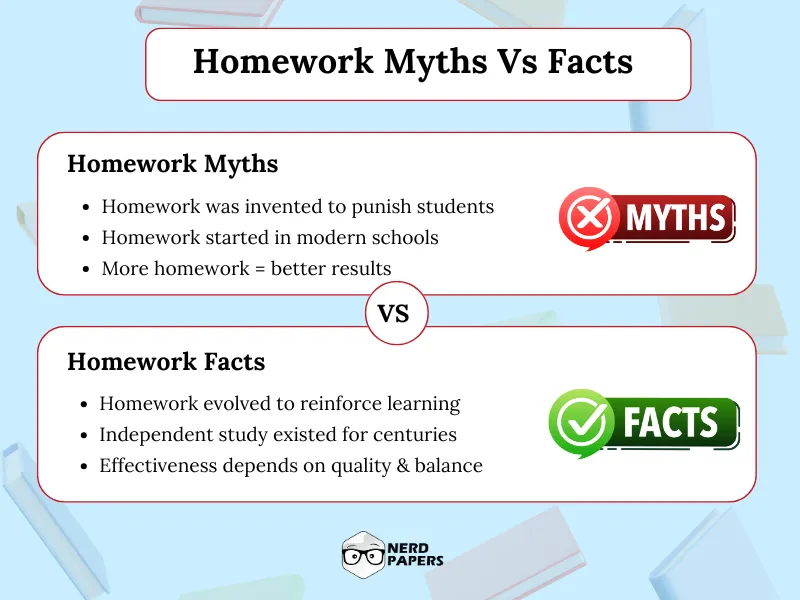
Differentiating myths from facts clarifies the homework debate today. Homework history reflects evolving views on student learning.
Homework in Modern Education
In the modern education system, homework continues to play a role, but it is often debated. Homework tools, online submissions, and remote learning have transformed assignment dynamics.
Concerns about student stress affecting parental involvement and academic performance are increasingly noticeable. Ongoing debates question homework’s effectiveness and role definition for students.
What This History Helps Us Understand
Looking at the full history of homework shows that homework was never meant to be static. It evolved alongside education systems, teaching philosophies, and social expectations.
Understanding where homework came from helps explain why opinions about it differ today. Homework complements classroom learning, yet its optimal role is still debated.
Final Thoughts on the History and Purpose of Homework
Homework was not invented by a single person or introduced as a fixed rule. It developed gradually as education systems expanded and learning extended beyond the classroom.
One person did not invent homework; it evolved from complex educational practices. Homework evolved with time, reflecting changing priorities.
What history makes clear is that homework exists for a reason, but that reason has changed. It supports education stages, sparking ongoing debates.
Rather than focusing only on who invented homework, the more useful question is how it should be used now. In short:
- Homework was not invented by one person
- It evolved with formal education
- Its purpose has changed over time
- Modern debates focus on balance and effectiveness
- Homework is a tool, not a rule
This perspective evaluates the role of homework in modern classrooms for educators, parents, and students.
Frequently Asked Questions
Who actually invented homework?
Homework was not invented by a single person. While Roberto Nevilis is often mentioned online, there is no reliable historical evidence proving he created homework. Homework developed gradually as education systems expanded and learning moved beyond classrooms.
Did Roberto Nevilis really invent homework?
There is no verified historical proof that Roberto Nevilis invented homework. The claim is widely shared online but lacks primary sources. Most historians agree that homework evolved over time rather than being introduced by one educator.
Where did homework originally come from?
Homework originated from early education practices where students practiced skills outside formal lessons. Ancient and early schooling systems encouraged learning beyond the classroom long before modern homework assignments existed.
When was homework first used in schools?
Homework became common during the 18th and 19th centuries, especially with the rise of compulsory education systems. As classrooms grew larger, teachers used homework to reinforce lessons and manage learning progress.
Why do teachers give homework?
Teachers give homework to help students practice skills, reinforce concepts taught in class, and develop independent learning habits. When well-designed, homework supports understanding rather than simply increasing the workload.
What is the purpose of homework in school?
The main purpose of homework is academic reinforcement outside school hours. It helps students review material, build consistency, and prepare for assessments. Its effectiveness depends on age, subject, and assignment quality.
Is homework effective for students?
Homework can be effective when used in moderation and aligned with learning goals. Research shows benefits vary by age and subject, while excessive homework may increase stress without improving performance.
Homework is still used in modern education, but its necessity is widely debated. Many educators now focus on quality over quantity, balancing learning outcomes with student well-being and mental health.
What is homework backwards?
“Homework” spelled backward is krowemoh. While a popular internet rumor claims that “krowemoh” means “child abuse” in Latin, this is false. “Krowemoh” is not a word in Latin: The letter ‘W’ was not part of the classical Latin alphabet.
Origin of the myth: The rumor originated from social media posts and is considered a made-up, humorous take on the stress of schoolwork, rather than a factual translation.