

Every day, thousands of opinions die in their first sentence, not because the idea was weak, but because the writer didn’t know how to start.
The opening of your persuasive essay is your one chance to grab attention, build trust, and spark curiosity all in a few lines. A strong start can turn a casual reader into an engaged one; a weak one can lose them before your argument even begins.
Knowing how to start a persuasive essay isn’t just about adding a flashy hook; it’s about setting the foundation for clear, convincing writing. The way you start shapes how the rest of your essay flows and how your arguments land, forming the groundwork for persuasion itself. Something that becomes clearer when you understand the broader process of writing a persuasive essay. In this guide, we’ll look at how to begin your essay with intention, from crafting a hook that draws readers in to building an introduction that naturally leads into your thesis and key arguments.
Why a Good Start of a Persuasive Essay Matters
The beginning of your persuasive essay does more than just open the discussion; it shapes the reader’s mindset for everything that follows. Just like in real life, first impressions count. If your essay starts weakly, readers are less likely to take your argument seriously, no matter how strong your points later are.
A good start sets the tone and rhythm. It signals confidence, direction, and intent, showing the reader that you’re not just sharing opinions, you’re leading them toward a conclusion worth considering.
Think of it like a lawyer’s opening statement in court. The way they start can sway the jury before any evidence is shown. Your essay’s introduction plays a similar role: it grabs attention, builds credibility, and sets the emotional and logical stage for persuasion to be effective.
Elements of a Strong Persuasive Essay Introduction
A strong introduction is where persuasion begins; it doesn’t just open the essay; it earns the reader’s attention and trust. Here’s what makes your persuasive essay introduction work:
1. The Hook
Your hook is the spark that draws readers in. It can be a thought-provoking question, a surprising fact, or even a short, vivid statement that makes the reader stop and think. The goal is to make them curious enough to keep reading, not to overwhelm them with drama, but to intrigue them with relevance.
2. Background Context
Once you’ve caught their attention, you need to give them a quick sense of what’s going on. Provide just enough context for readers to understand the issue or debate at hand. Think of it as setting the scene, who’s involved, why it matters, and what’s at stake without slipping into a full-blown history lesson.
3. Thesis Statement
This is the heart of your introduction. Your thesis clearly states your stance and the main argument you’ll be defending throughout the essay. A good thesis statement for persuasive essay is specific and assertive, not vague or indecisive. It tells the reader, “Here’s what I believe and here’s why it matters.”
4. Preview of Main Arguments
A quick roadmap of your key points helps the reader know what to expect. You don’t need to list them like bullet points; a single well-crafted sentence can show the flow of your reasoning. It builds anticipation while giving structure to what follows.
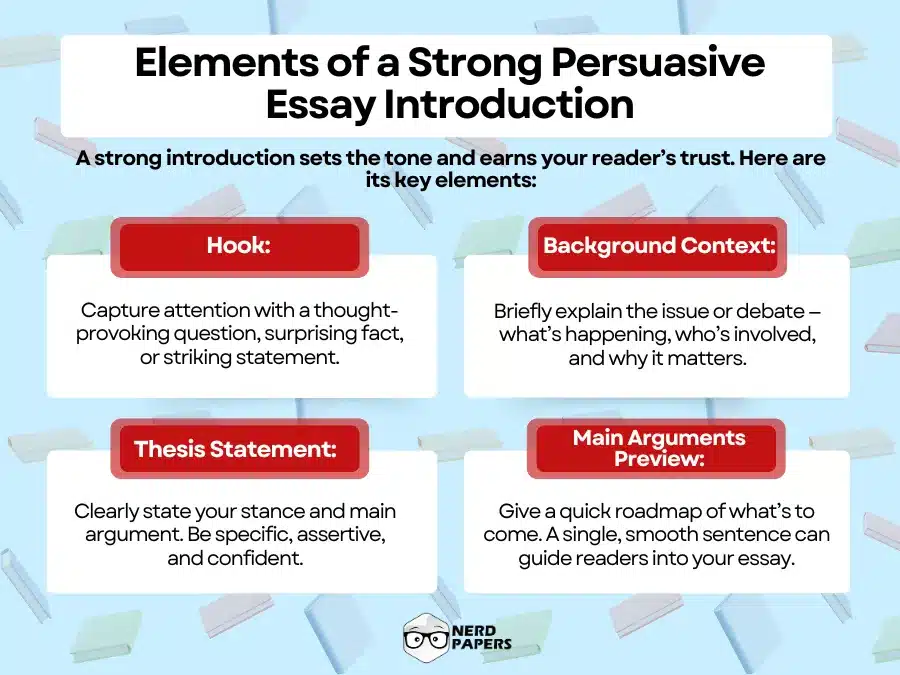
When these elements work together, your introduction becomes both engaging and purposeful. If you’re unsure how to organize these parts effectively, it is helpful to look back at your persuasive essay outline and see how each section is broken down into clear, logical steps. This structure makes writing feel far less overwhelming.
How to Start a Persuasive Essay (Step-by-Step Guide)
Starting a persuasive essay is less about typing the first sentence and more about setting the stage for persuasion. Each part of your persuasive essay introduction works together to pull your reader into your argument. Here’s how to do it right:
Step 1: Choose a Strong Stance
Before you can persuade anyone, you need to know where you stand on an issue. A stance is a viewpoint on a specific subject or debate. The central claim or viewpoint that the author adopts and upholds throughout the work serves as a guide for the tone and content. A strong stance is specific and debatable, not something everyone already agrees on.
Instead of “Education is important,” take a sharper position like “Schools should adopt later start times to improve student performance.”
Step 2: Craft a Compelling Hook
The hook is your attention grabber. It could be a surprising statistic, a short story, or a powerful question that sparks curiosity.
“If your alarm goes off before sunrise, you’re already losing the mental battle for focus, and so are millions of students forced to start school too early.”
Step 3: Add Context and Credibility
After grabbing attention, give readers a quick snapshot of the issue. Show that you understand both sides and why your viewpoint matters. This builds trust and helps readers see the bigger picture before you make your claim.
“While some argue early start times build discipline, research shows chronic sleep deprivation reduces academic performance and increases stress among teenagers.”
Step 4: End with a Clear, Confident Thesis
Your thesis should be bold, precise, and ready to lead the essay. It tells readers exactly what you’re arguing and sets the tone for everything that follows.
“To support healthier learning and stronger outcomes, schools should shift to later start times that align with students’ natural sleep cycles.”
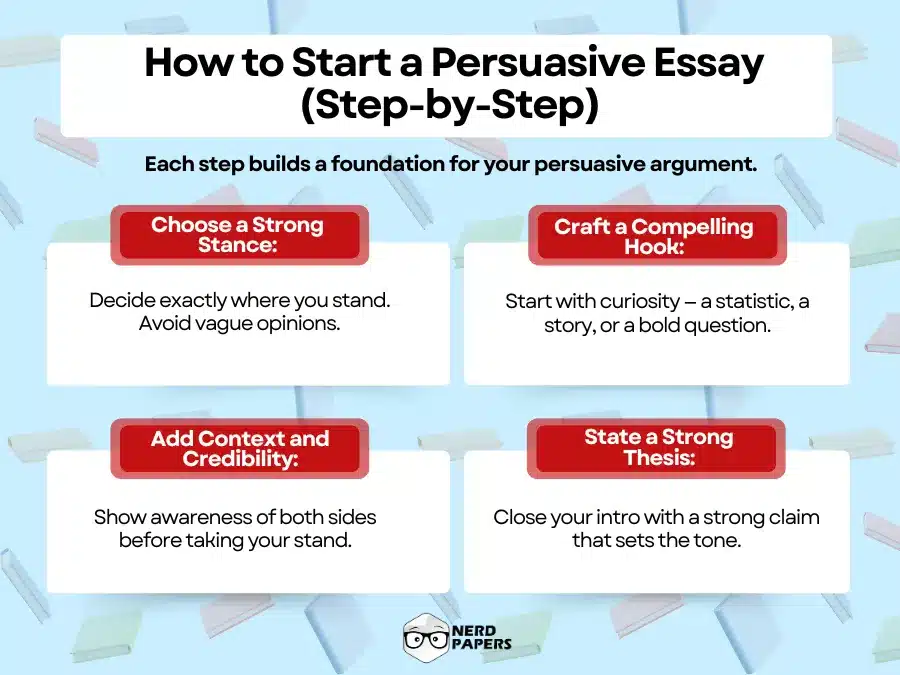
Each step builds momentum, guiding your reader from curiosity to conviction and laying the foundation for an essay that feels deliberate, structured, and persuasive.
Examples: How to Start Off a Persuasive Essay
Seeing real examples can make it much easier to understand how a persuasive essay should begin. Below are three different persuasive essay introduction examples, each one tailored for a specific tone and topic, but all following the same pattern: hook, context, and thesis.
Example 1: Academic Topic – School Uniforms
Hook: Every morning, students spend precious minutes debating what to wear—time that could be better spent preparing for the school day ahead.
Background: The discussion over whether schools should implement uniforms isn’t just about fashion; it’s about equality, focus, and identity.
Thesis: Mandatory school uniforms promote discipline and reduce socioeconomic divisions among students, creating a more focused and inclusive learning environment.
Example 2: Social Issue – Social Media and Mental Health
Hook: We check our phones an average of 144 times a day—yet somehow, we still feel disconnected.
Background: While social media platforms claim to bring people closer, growing research links their overuse to anxiety, self-doubt, and loneliness.
Thesis: Limiting social media use among teenagers is essential to protect mental health and foster genuine, offline social interaction.
Example 3: Light / Humorous Example – The Case for Longer Weekends
Hook: If Mondays had a face, most of us would block it.
Background: The traditional five-day workweek was designed a century ago for industrial labor—not for the modern, digitally drained workforce.
Thesis: A three-day weekend wouldn’t just boost morale; it could actually increase productivity, creativity, and overall job satisfaction.
Each of these intros follows the same logic: they grab attention, ground the topic in reality, and clearly present a stance. Whether serious or playful, a persuasive essay always begins by making readers want to listen.
Common Mistakes to Avoid When Starting a Persuasive Essay
Even a strong argument can fall flat if your opening goes wrong. Here are the most common pitfalls students make when starting a persuasive essay and how to avoid them.
Starting with a Cliché
Mistake:
“Since the beginning of time, people have debated…”
This kind of opener sounds generic and overused. It doesn’t grab attention or show originality.
Fix:
Use a fresh hook, statistics, an anecdote, or a thought-provoking statement related directly to your topic.
Example: “Every ping, buzz, and notification chips away at our focus, yet we call it ‘staying connected.’”
Being Too Vague
Mistake:
“Education is important for everyone.”
Sure, but that’s too broad to be persuasive.
Fix:
Be specific. Define the focus right away, for example, “why practical skills should be taught alongside academics in schools.”
Stating Your Opinion Without Context
Mistake:
“I believe school uniforms are bad.”
That’s a thesis, but it lacks background or reasoning.
Fix:
First, frame the issue. Then introduce your stance logically:
“While uniforms are meant to promote equality, they often restrict personal expression and ignore individual comfort.”
Using a Question as a Hook (Poorly)
Mistake:
“Do you like social media?”
This is too direct and doesn’t invite thought; it just sounds like a survey.
Fix:
Turn your question into something more reflective:
“What if the very apps designed to connect us are the ones making us feel most alone?”
Overloading the Introduction
Mistake:
Stuffing too many facts or long definitions at the start.
For example: “Technology is defined as the application of scientific knowledge for practical purposes. Over the years, technology has evolved from simple tools like the wheel to complex systems such as artificial intelligence, which has revolutionized industries including healthcare, education, and business.”
This kind of introduction feels like a textbook, overloaded with facts and definitions instead of persuasion.
Fix:
Think of your introduction as a trailer, not the full movie. Give readers enough to care but leave the detailed argument for later sections.
For example: “Technology shapes everything we do, how we learn, work, and even think. But as our screens get smarter, our attention seems to fade.”
Quick Tips to Make Your Persuasive Essay Introduction Stand Out
A persuasive essay’s intro isn’t just a warm-up; it’s your first impression, sales pitch, and confidence test all rolled into one. Here’s how to make it stand out for the right reasons:
1. Start Bold, Not Loud
Grab attention, but with intent. Instead of shock value, go for clarity that cuts through noise.
Example: “Banning social media for teens won’t fix their mental health, understanding it might.”
2. Keep It Short and Strategic
A persuasive introduction isn’t a history lesson. Aim for 120–150 words max, just enough to set context, state your stance, and preview your logic.
3. Use Active Voice
Make every sentence sound confident.
Weak: “It can be said that video games are sometimes blamed for aggression.”
Strong: “Video games are unfairly blamed for aggression.”
4. Balance Emotion with Evidence
Appeal to feelings, but anchor them in facts. Emotion draws attention, logic seals the deal. You have to balance both elements here for a good impact.
5. End with Purpose
Your thesis should sound like a statement that’s ready to be defended, not a personal opinion.
Instead of: “I think uniforms are bad.”
Try: “School uniforms restrict individuality without solving the problems they claim to fix.”
6. Revisit After Writing the Body
Your perspective often sharpens as you write. Revisit the intro after finishing your essay, tighten, clarify, or rephrase to ensure it reflects the final direction of your argument.
Bringing It All Together
Starting a persuasive essay isn’t just about filling space before your arguments; it’s about setting the stage for conviction. A strong opening defines how your readers will see your stance, your logic, and even your credibility.
The good news? Like any skill, it gets easier with practice. The more you experiment with hooks, refine your thesis, and learn to balance tone with clarity, the more natural it becomes.
Think of your persuasive essay introduction as a handshake, firm, confident, and memorable. Whether you’re writing for class, a blog, or a cause you believe in, how you start determines how strongly your message lands.
So next time you sit down to write, don’t just begin, but begin with purpose.
Frequently Asked Questions
How do you start a persuasive essay introduction?
Begin with a hook that instantly grabs attention, a surprising fact, a relatable question, or a bold statement. Then provide a brief background context and clearly state your thesis.
What is a good hook for a persuasive essay introduction?
A good hook makes readers stop and think. For example, “Every wasted meal could feed a child, so why does food waste remain acceptable?” works better than starting with a definition or generic line.
How long should an introduction for a persuasive essay be?
Usually, 3–5 sentences. Long enough to introduce your stance and tone, but short enough to make readers want more.
Should I include my arguments in the introduction?
Briefly preview your key points, but don’t explain them yet. The introduction’s job is to hook, orient, and state your thesis, not unpack your reasoning.
How do you start a persuasive essay with confidence?
Know your stance before you write. Avoid “I think” or “maybe.” Use assertive language that shows you’re convinced and your readers should be, too.
Can I use a quote to start my persuasive essay?
Yes, if it adds genuine value. The quote should reinforce your argument, not replace your voice. Always connect it back to your thesis.
What’s the biggest mistake when starting a persuasive essay?
Sounding like you’re writing a summary instead of an argument. Skip the filler and start strong. Readers should feel your conviction right from the first line.
How to start a sentence in a persuasive essay?
Start each sentence with a purpose. Use transitions like “Clearly,” “For example,” “However,” “Therefore,” or “This proves that…” to maintain logical flow and build momentum in your argument. Each new line should feel like a continuation of your conviction, not a reset.