
Think about the last time you tried to win someone over to your side—debating a friend, convincing your parents, or defending your opinion in class. That back-and-forth of logic, emotion, and evidence?
That’s exactly what a persuasive essay is built on. And understanding how to write a persuasive essay answer all of your questions.
At its core, persuasive writing is more than just sharing an opinion. It’s a structured argument designed to change minds through reasoning, credibility, and emotional connection. But learning how to write one effectively can feel overwhelming:
Where do you start? How do you organize your thoughts? What’s the right tone?
If you ever feel stuck while building strong arguments or organizing your ideas, professional persuasive essay assistance can help you refine your writing, strengthen your thesis, and craft essays that truly convince.
In this guide, you’ll learn what a persuasive essay is and how to write one step by step — with structure, flow, and strategy that convince readers and leave a lasting impression.
What Is a Persuasive Essay?
A persuasive essay is a type of academic writing that uses logic (logos), credibility (ethos), and emotion (pathos) to convince readers to accept your viewpoint or take a specific action.
Unlike a simple opinion piece, a persuasive essay relies on evidence, reasoning, and rhetorical appeal to make arguments believable. Its main goal is not just to inform—but to move the reader toward agreement.
Purpose
The purpose of a persuasive essay is to:
- Present a clear stance on an issue
- Support that stance with facts, examples, and reasoning
- Appeal to the reader’s logic, emotions, and trust
- Inspire action or reinforce existing beliefs
Persuasive vs. Argumentative Essays
It’s easy to confuse a persuasive essay with an argumentative essay, but the two aren’t identical. An argumentative essay is more like a courtroom debate: it presents both sides of an issue, weighs the evidence, and then proves why one side is stronger. A persuasive essay, on the other hand, is more like a personal appeal: it focuses mainly on one side of the issue and uses logic, credibility, and emotion to push the reader toward agreement.
These two essay types often overlap, but they’re not identical:
| Type | Focus | Tone | Strategy |
| Argumentative Essay | Objective reasoning presents both sides | Logical & evidence-heavy | Prove which side is stronger |
| Persuasive Essay | Subjective appeal focuses on one side | Credible yet emotional | Move the reader through reasoning and emotion |
Why Learning How to Write a Persuasive Essay Matters
Learning how to write a persuasive essay goes beyond passing an assignment. It builds skills that are valuable both in academics and in everyday life.
In school, persuasive essays help you practice presenting ideas clearly, backing them up with evidence, and organizing your thoughts in a logical way. These are the very skills professors and teachers look for when grading your work.
But the importance doesn’t stop at the classroom. Persuasive writing mirrors real-world situations, whether you’re pitching an idea in a meeting, negotiating with a colleague, or even trying to convince friends of your plans. The ability to present your arguments persuasively makes you more effective in almost any setting.
By practicing persuasive essays, you gain:
- Critical thinking – evaluating information and identifying the strongest arguments.
- Reasoning – connecting ideas in a logical, convincing way.
- Communication skills – expressing your viewpoint so it resonates with others.
In short, learning how to write a persuasive essay trains you not just to write better, but to think and communicate in ways that open doors academically, professionally, and personally.
Persuasive Essay Format and Structure
A persuasive essay isn’t just a collection of arguments; it follows a structured format that makes your message clear and convincing. Think of it as a roadmap with three main stops: the introduction, the body, and the conclusion. Each one plays a unique role in guiding your reader toward agreement.
1. Introduction
The introduction is your essay’s first impression, and it should capture attention immediately. A strong introduction usually includes three elements:
- Hook: Something engaging to draw the reader in, such as a surprising fact, a thought-provoking question, or a short anecdote.
- Background context: A brief setup that explains the issue at hand and why it matters.
- Thesis statement: Your main argument in one clear, concise sentence. This is the claim your entire essay will defend.
2. Body Paragraphs
The body is the heart of your persuasive essay. It’s where you present your reasoning, evidence, and examples. A solid body section typically:
- Develops one main point per paragraph, so your ideas don’t blur together.
- Supports each point with credible evidence, statistics, research findings, real-world examples, or expert opinions.
- Uses logic and reasoning to show how the evidence supports your thesis.
- Addresses counterarguments: acknowledging the opposing view and showing why your argument is stronger builds credibility and trust with the reader.
3. Conclusion
The conclusion is your final chance to make an impact. Instead of simply repeating your thesis, it should:
- Restate the argument in a fresh way that reinforces its importance.
- Summarize key points without going into too much detail.
- End with a call to action or memorable closing thought, something that leaves the reader reflecting on your message or motivated to act.
When your essay follows this format, it doesn’t just present information; it builds momentum, guiding the reader from curiosity in the introduction to conviction in the conclusion.
How to Write and Organize a Good Persuasive Essay
Good persuasion depends not only on strong arguments but also on how well those arguments are structured, supported, and presented to the reader.
A persuasive essay isn’t just about expressing your opinion — it’s about leading your reader from understanding to agreement through logic, emotion, and credibility. To do that effectively, you need both organization and persuasive technique working hand in hand.
Here’s how to structure and write a persuasive essay that feels organized, convincing, and professional.
1. Organize with Logic and Flow
Before you start writing, plan your essay like a roadmap. Outline your main arguments, supporting evidence, and at least one counterargument.
Each paragraph should lead smoothly to the next — like steps in a logical sequence. Use transitions such as “however,” “in addition,” and “for instance” to guide your reader.
2. Craft a Strong, Specific Thesis
Your thesis statement is the backbone of your essay. It defines your stance and gives direction to every argument that follows. A vague or indecisive thesis weakens your writing, while a precise, arguable claim keeps it focused and compelling.
“School uniforms promote equality and reduce distractions among students.”
Your thesis should be specific, debatable, and defensible, not just an observation, but a claim you can support with logic and evidence.
3. Support Every Point with Evidence
Persuasion relies on credibility. Each claim you make should be backed by facts, research, statistics, or expert opinions — not just personal belief. Blend quantitative evidence (data, surveys, studies) with qualitative examples (quotes, experiences, or logical reasoning) to make your essay well-rounded.
4. Understand Your Audience
A persuasive essay succeeds only when it resonates with its readers.
Think about who your audience is, what they value, and what objections they might have. Tailor your tone and examples accordingly.
- Writing for classmates? Use relatable examples and conversational clarity.
- Writing for professors or professionals? Keep the tone formal, logical, and well-referenced.
5. Maintain a Confident, Professional Tone
Tone shapes how your message is received. Be confident but respectful — assertive, not aggressive. Avoid emotional overstatements or dismissing opposing views. A professional, balanced tone establishes ethos (credibility) and makes readers more willing to consider your perspective.
6. Use Rhetorical Appeals and Devices
A good persuasive essay uses a mix of logos, ethos, and pathos:
- Logos (Logic): Use reasoning and facts to support your stance.
- Ethos (Credibility): Reference reliable sources and show understanding of opposing views.
- Pathos (Emotion): Use relatable examples and emotional resonance to engage your reader.
Add rhetorical tools such as repetition, analogies, and rhetorical questions to keep your essay engaging — but use them intentionally, not excessively.
7. Ensure Smooth Transitions and Coherent Flow
Each paragraph should connect naturally to the next, forming one continuous argument instead of disconnected points. Transition phrases, parallel structures, and clear topic sentences make your writing easy to follow and more persuasive.
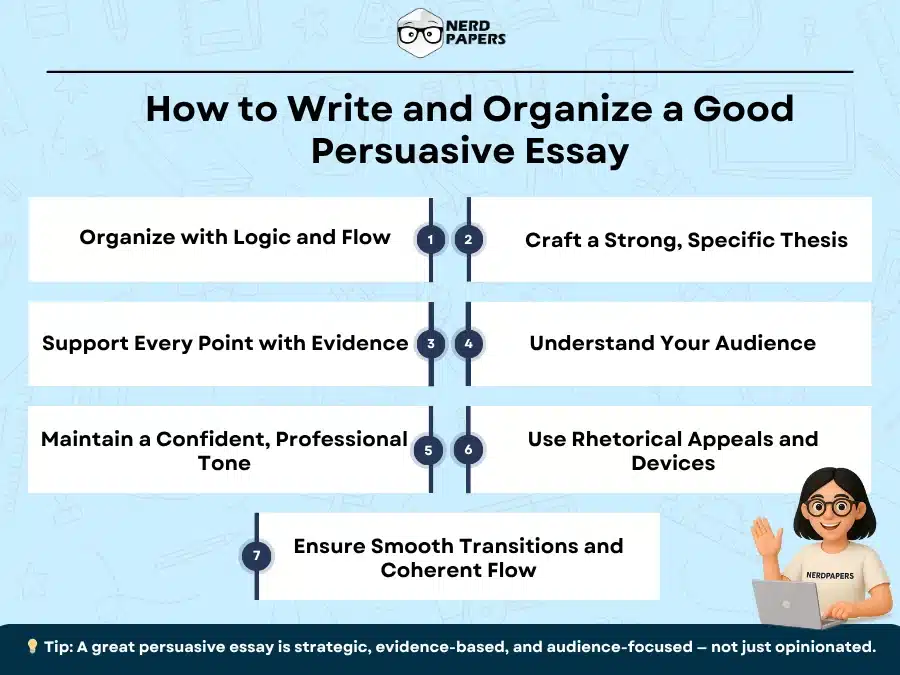
A well-organized essay doesn’t force the reader to agree — it guides them there naturally. A good persuasive essay is strategic, structured, and reader-focused.
It combines organization (logic and flow) with persuasive elements (thesis, tone, audience, and rhetoric) to make your ideas convincing and coherent.
Common Mistakes to Avoid in a Persuasive Essay
Even well-written essays can lose their impact when they fall into avoidable traps. Watch out for these common issues that weaken your arguments and credibility:
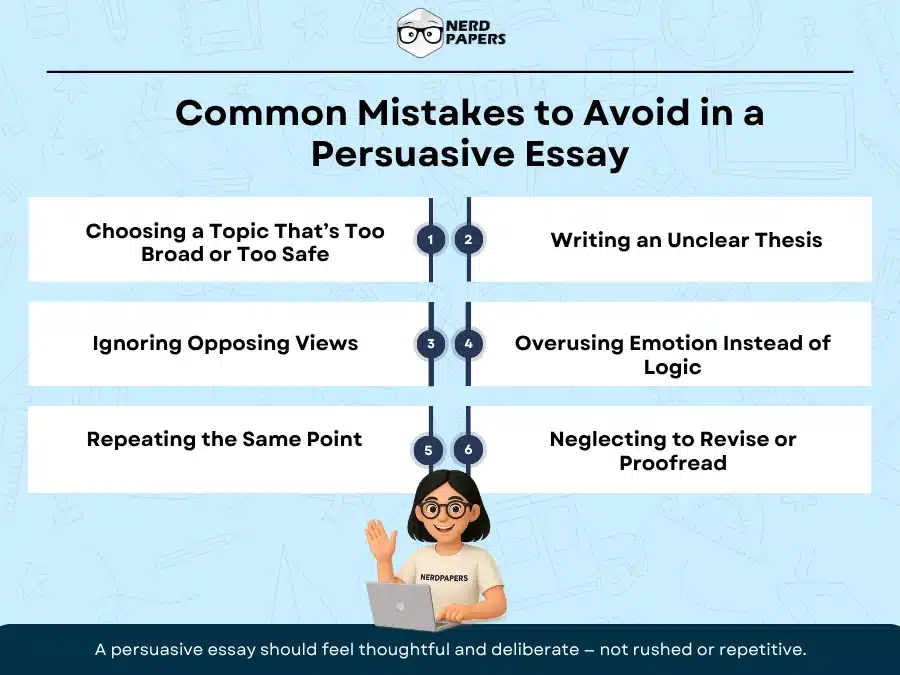
- Choosing a Topic That’s Too Broad or Too Safe
Narrow your focus to a specific issue that can be supported with evidence. Broad topics make it harder to form a clear stance. - Writing an Unclear Thesis
Your essay’s purpose should never be a mystery. If your thesis doesn’t clearly state your position, revise it for focus and strength. - Ignoring Opposing Views
Skipping counterarguments weakens your credibility. Acknowledge different perspectives — then show logically why yours is stronger. - Overusing Emotion Instead of Logic
Emotional appeals are powerful, but without facts, they can come across as manipulative. Balance passion with reasoning and evidence. - Repeating the Same Point
Each paragraph should introduce a distinct idea. Repetition signals weak structure and distracts from your main message. - Neglecting to Revise or Proofread
Errors in grammar, flow, or citation formatting reduce your essay’s authority. Always polish your draft before submission.
Tips for Writing a Persuasive Essay
Once your structure is in place, these practical tips can help you elevate your essay from good to exceptional:
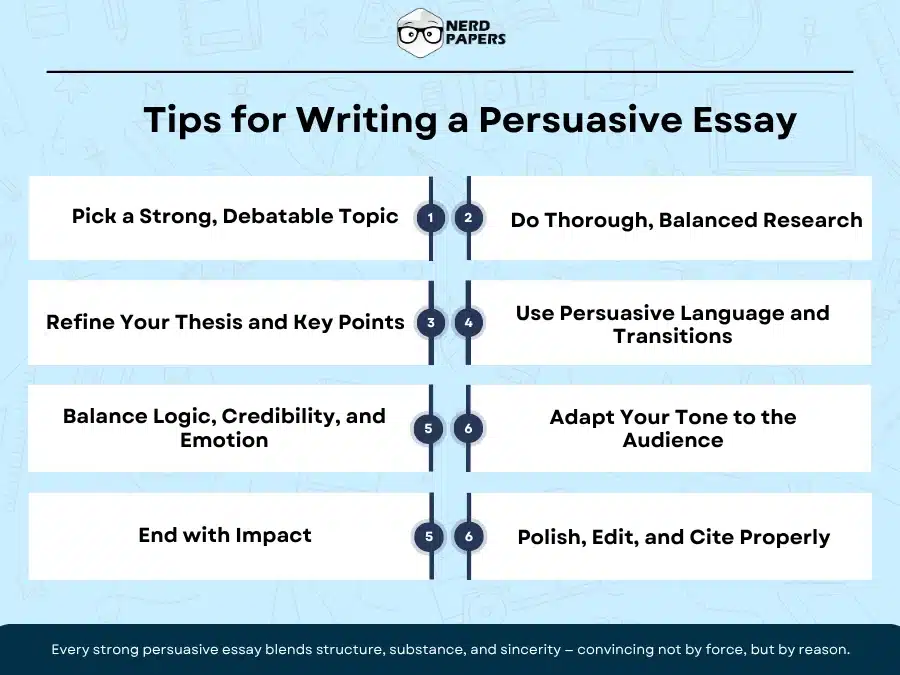
- Pick a Strong, Debatable Topic
Choose a subject you care about and that invites discussion. Passion fuels conviction. - Do Thorough, Balanced Research
Support your stance with data, studies, and credible references — and familiarize yourself with opposing arguments to strengthen your response. - Refine Your Thesis and Key Points
Keep them sharp, specific, and evidence-driven. Avoid vague statements or emotional generalizations. - Use Persuasive Language and Transitions
Employ clear, confident phrasing and link ideas smoothly using connectors like “however,” “for instance,” and “in contrast.” - Balance Logic, Credibility, and Emotion
- Logos: Ground your essay in logic and facts.
- Ethos: Cite reliable sources to establish authority.
- Pathos: Use emotional appeal strategically to connect with readers.
- Logos: Ground your essay in logic and facts.
- Adapt Your Tone to the Audience
Match your formality and examples to your reader’s level of expertise — academic for instructors, relatable for peers. - End with Impact
Conclude with a strong restatement of your thesis and a thought-provoking final insight or call to action. - Polish, Edit, and Cite Properly
Reread your essay for clarity, grammar, and flow. Use the appropriate citation style (APA, MLA, or Chicago) to reinforce academic credibility.
Strengthening Your Persuasive Voice
Writing a convincing essay is a survival skill, but it takes time to perfect. It’s not just about putting together an opening, body, and closing; it’s about making ideas flow together logically and convincingly. Every stage helps you to get sharper, whether you are choosing a strong topic or building a case with strong evidence and arguing against opposing views in verbal expression and critical thinking.
With more practice, your persuasive writing will seem more natural. Every essay gives you the chance to improve your writing, develop a stronger grasp of communication, and discover more clearly how to obtain a hearing. These abilities will help you negotiate arguments, debates, and real-world decision-making throughout time and far beyond the classroom. With consistent effort, anyone can move from simply stating opinions to crafting arguments that truly persuade.
Frequently Asked Questions
What is the main goal of a persuasive essay?
The main goal of a persuasive essay is to convince the reader to accept your viewpoint or take a specific action. It uses logical reasoning, evidence, and sometimes emotional appeal to build a strong case.
How is a persuasive essay different from an argumentative essay?
While both aim to convince, a persuasive essay often appeals to emotions and personal connection in addition to logic, whereas an argumentative essay relies more heavily on evidence and structured reasoning.
How long should a persuasive essay be?
There’s no fixed length, but most persuasive essays are between 500–1,500 words depending on academic level or assignment requirements. What matters most is that your arguments are clear, well-structured, and fully supported.
Can I use personal opinions in a persuasive essay?
Yes, but they should be backed by logic or evidence. A persuasive essay becomes stronger when personal viewpoints are supported by credible facts, statistics, or examples.
What makes a persuasive essay effective?
An effective persuasive essay has a clear thesis, strong evidence, acknowledgment of counterarguments, smooth transitions, and a confident tone. Together, these elements keep the reader engaged and make your argument convincing.
What is the correct structure of a persuasive essay?
A persuasive essay usually follows a clear three-part structure: Introduction, Body Paragraphs, and Conclusion.
The introduction grabs attention and presents your thesis.
The body paragraphs each focus on one argument supported by evidence and reasoning.
The conclusion restates your thesis and leaves readers with a final thought or call to action.
Following this structure ensures your essay is logical, cohesive, and easy to follow.
What are some tips for choosing the right persuasive essay topic?
When selecting a persuasive essay topic, look for issues that are specific, debatable, and personally engaging. A strong topic allows you to explore both sides while clearly defending one.
Avoid overly broad subjects like “education” or “technology.” Instead, focus on focused themes such as “Should schools ban cell phones?” or “Is renewable energy the key to a sustainable future?”
Choosing a topic that genuinely interests you will make your arguments more authentic and convincing.
Do I need to include citations in a persuasive essay?
Yes. Credibility matters in persuasive writing. Always cite your sources when you reference data, quotes, or expert opinions. Using proper academic citation styles (APA, MLA, or Chicago) not only strengthens your arguments but also avoids plagiarism and builds reader trust.