
Every persuasive essay lives or dies by a single sentence, the thesis statement. It’s not just a line that introduces your topic; it’s the compass that keeps your entire argument pointed in the right direction. Without it, even the most passionate opinions collapse into scattered points and disconnected logic.
When writing a persuasive essay, think of the thesis as the “central claim” your essay promises to defend. It tells the reader what you believe, why it matters, and hints at how you’ll prove it. Whether you’re arguing for environmental policy or debating the benefits of online education, your thesis sets the foundation for everything that follows.
In this guide, we’ll break down what makes a thesis statement persuasive, how to write one that anchors your essay, and the common mistakes that weaken even strong arguments.
What Is a Thesis Statement in a Persuasive Essay?
A thesis statement in a persuasive essay is more than just a summary of your topic; it’s a clear declaration of your stance on an issue and the main reasons you’ll use to support it. Think of it as the essay’s command center: everything you write connects back to this central idea. Before even starting your persuasive essay’s introduction, you should be clear on the position you will be defending because a great thesis leads to a strong beginning.
How It Differs from Other Thesis Statements
In analytical or expository essays, a thesis usually explains or analyzes something. For example, an analytical thesis might explore why a character behaves a certain way or how a process works.
But in a persuasive essay, your thesis takes a side it doesn’t just explain, it argues. It tells readers exactly what you believe and why they should agree.
The Three Core Components
A strong, persuasive thesis statement has three parts:
- Stance – What you believe or the position you’re defending.
- Reasoning – The “why” behind your stance.
- Direction – The roadmap for your arguments, showing readers what points you’ll cover.
Example Breakdown of Persuasive Essay Thesis Statement
“Social media use among teenagers should be limited because it affects mental health, reduces face-to-face interaction, and harms academic focus.”
- Stance: Social media use among teenagers should be limited.
- Reasoning: It affects mental health, reduces real-world social interaction, and harms academic focus.
- Direction: Each reason previews a body paragraph, first discussing mental health impacts, then social disconnection, and finally academic performance, creating a clear, persuasive flow.
That’s the persuasive power; it’s not just a statement, it’s a promise your essay fulfills.
Why the Thesis Statement Is the Core of Persuasion
If your essay were a debate, the thesis statement would be your opening argument, the one line that decides whether your audience listens or tunes out. It’s not just a formality; it’s the heartbeat of your persuasive writing.
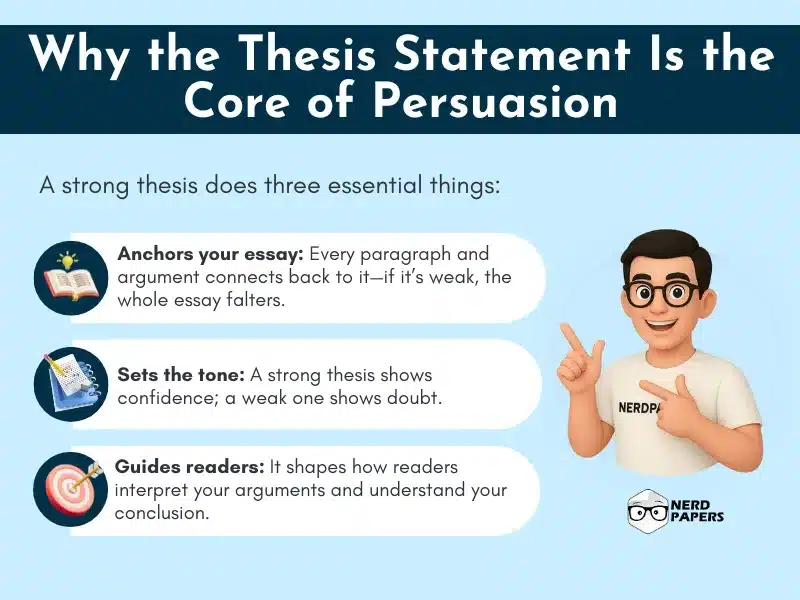
A strong thesis does three essential things:
- Anchors your essay. Every paragraph, every piece of evidence, every emotional appeal traces back to it. If your thesis wobbles, the entire essay loses balance.
- Sets the tone. A confident thesis signals authority; a hesitant one sounds like you’re unsure of your own argument. Readers pick up on that immediately.
- Guides interpretation. Your thesis quietly shapes how readers process every argument that follows. It explains why your points are important and what conclusion they should draw.
A Real-World Analogy
Think of your thesis as the GPS of your essay. Without it, your reader isn’t following your argument; they’re just wandering through your thoughts. A GPS doesn’t describe the scenery; it gives direction. So your thesis should do the same.
- Weak: There are both positive and negative aspects to social media.
→ Vague, neutral, and leaves the reader wondering, “So… what’s your point?” - Strong: Social media does more harm than good because it amplifies misinformation, damages self-esteem, and reduces genuine human connection.
→ Clear stance, focused reasoning, and a built-in roadmap for your essay.
That’s the difference between a thesis that floats and one that leads. The second doesn’t just say something; it directs everything.
How to Write a Thesis Statement for a Persuasive Essay (Step-by-Step)
Now that you know why the thesis statement matters, it’s time to build one that actually holds up under pressure. Think of this section like a blueprint; each step stacks on top of the last until your argument stands firm.
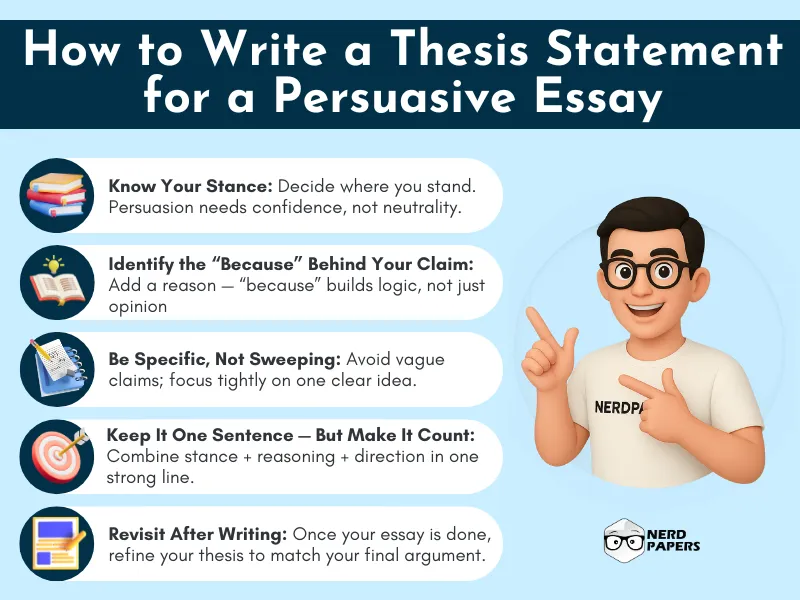
Step 1: Know Your Stance (No Sitting on the Fence)
Before you write a single word, decide exactly where you stand. Persuasion doesn’t work if you sound uncertain. Your thesis isn’t meant to explore both sides; it’s meant to take a side and defend it.
- Instead of: Homework can be both helpful and stressful for students.
- Go with: Homework should be limited to reinforce learning rather than overwhelm students, allowing more time for creativity and rest.
The second version doesn’t hide behind balance; it owns a perspective.
Step 2: Identify the “Because” Behind Your Claim
A persuasive thesis isn’t just what you believe; it’s why you believe it.
The word “because” is your shortcut to clarity. It forces you to give reasoning that anchors your argument in logic, not just opinion.
“Fast food advertising should be restricted because it targets children and promotes unhealthy habits.”
Notice how that single “because” transforms a statement into a conviction.
Step 3: Be Specific, Not Sweeping
Broad claims sound bold but crumble under scrutiny. A solid thesis narrows the focus so your essay doesn’t drift. The more specific you are, the easier it is to prove your point.
- Weak: Technology affects communication.
- Strong: Social media platforms have reduced meaningful face-to-face interaction, replacing empathy with instant validation.
Specificity = credibility.
Step 4: Keep It One Sentence, But Make It Count
A thesis isn’t a paragraph, and it’s not a slogan either. It’s one sharp, balanced line that threads ‘stance + reasoning + direction’ together. Every word should earn its place.
Formula you can follow:
[Your position] because [main reason 1], [reason 2], and [reason 3].
Homework should be limited because this reduces student stress, allows more time for family and hobbies, and encourages better focus during school hours.
Clean, persuasive, and instantly tells the reader where the essay is headed.
Step 5: Revisit It After Writing the Body
Your thesis is your essay’s anchor, but it doesn’t have to be carved in stone. Once you’ve written your supporting paragraphs, refine the thesis to match the direction your argument actually took. This makes it stronger and more cohesive.
Good Thesis Statement Examples for Persuasive Essays
A good thesis doesn’t just tell, it convinces. Below are examples that show how tone, precision, and direction work together across different types of persuasive essays.
1. Academic Topic (Formal & Logical)
- Topic: The use of standardized testing in education.
- Example: Standardized tests should be replaced with project-based assessments because they better measure real-world skills, reduce test anxiety, and encourage creative problem-solving.
Why it works: It’s assertive, logical, and provides a clear roadmap; each reason naturally sets up a body paragraph.
2. Social Issue (Balanced Yet Firm)
- Topic: The impact of social media on teenager
- Example: Social media platforms should enforce stricter age verification because unfiltered exposure contributes to anxiety, distorted self-image, and addictive behavior among teenagers.
Why it works: It blends social responsibility with emotional reasoning, persuasive, but still rational.
3. Ethical or Moral Debate
- Topic: Animal testing for scientific purposes.
- Example: Animal testing should be banned for cosmetic products because it’s unethical, unnecessary given modern alternatives, and promotes consumer cruelty.
Why it works: It uses moral conviction while staying fact-based, exactly the balance persuasive essays need.
4. Everyday / Relatable Issue
- Topic:Remote work vs. office work.
- Example: Remote work should remain a permanent option because it improves productivity, work-life balance, and employee satisfaction.
Why it works: It appeals to logic and modern context, practical persuasion at its best.
5. Creative / Light-Hearted Topic
- Topic: Why pizza is better than burgers.
- Example: Pizza is better than burgers because it offers endless topping combinations, feeds more people at once, and tastes just as good cold as it does fresh.
Why it works: It’s playful but structurally sound stance, reasoning, and flow all in one.
Each of these examples shows that your thesis statement should fit the tone and intent of your essay; academic doesn’t mean dull, and emotional doesn’t mean irrational.
Common Mistakes to Avoid in Persuasive Essay Thesis Statements
Even the strongest ideas can fall flat if your thesis statement is built wrong. Here are the most common traps and how to dodge them.
Being Too Vague
❌ “Pollution is bad and needs to stop.”
This says nothing new and gives your reader zero direction.
✅ “Governments should impose stricter industrial regulations because factory emissions are the leading cause of urban air pollution.”
Specific → Actionable → Persuasive.
Turning It Into a Fact Statement
❌ “People use social media every day.”
That’s just an observation — not an argument.
✅ “Social media use should be limited for minors because it harms focus, confidence, and mental health.”
A thesis must take a stand, not just state a truth.
Listing Without Logic
❌ “Exercise is good because it’s healthy, fun, and easy.”
Sure, but what’s your reasoning? It sounds like a grocery list.
✅ “Regular exercise should be part of school curricula because it improves physical health, sharpens focus, and builds lifelong discipline.”
Structured reasoning makes a difference.
Being Too Wordy or Overcomplicated
❌ “It is highly advisable and socially significant to acknowledge that implementing policies for environmental protection can indeed yield long-term sustainability.”
Your reader is already asleep.
✅ “Environmental policies should prioritize sustainability because it ensures economic stability and a livable future.”
Simple language → stronger persuasion.
Sitting on the Fence
❌ “There are pros and cons to remote work.”
If you don’t believe in your stance, your reader won’t either.
✅ “Remote work should be a permanent option for employees because it enhances productivity and well-being.”
Commit to your argument; neutrality kills persuasion.
Refining Your Thesis: From Draft to Final Version
A persuasive thesis isn’t written once it’s sculpted.
As your essay takes shape, your arguments will evolve, and so should your thesis. Many students write their thesis too early and never revisit it, which leads to a mismatch between what they intended to argue and what they actually wrote. The secret? Refinement.
Before you finalize, pause and ask yourself a few crucial questions:
- Is it arguable?
If everyone already agrees with it, it’s not persuasion, it’s common sense. - Is it specific?
Broad claims feel hollow. Your thesis should narrow down to a clear angle or claim. - Does it give direction?
A thesis should hint at how you’ll defend your point, not just what your point is. - Does it reflect my main arguments?
After outlining your essay, check if your thesis still aligns with the body paragraphs. If it doesn’t, rewrite it.
Example: Refining a Weak Thesis
❌ “School lunches should be better.”
That’s vague and emotional, but not persuasive.
✅ “School lunches should meet higher nutritional standards because balanced meals improve student focus, health, and long-term academic performance.”
Now it’s clear, specific, and direction-driven, everything a persuasive thesis should be.
From Clarity to Conviction: The Final Word on Persuasive Thesis Statements
A strong persuasive essay begins and ends with one thing: clarity of conviction.
Your thesis isn’t just a sentence at the end of your introduction; it’s the backbone of your entire argument. It guides your reasoning, shapes your tone, and ensures every paragraph works toward one clear goal: changing the reader’s mind.
The best persuasive writers don’t just state opinions; they build them on logic, emotion, and credibility, all anchored by a thesis that evolves with the writing process. So before you hit “submit,” ask yourself: Does your thesis sound like something worth defending? If yes, you’ve already done the hardest part, making your reader believe you know exactly what you’re talking about.
FAQs on Thesis Statement for Persuasive Essay
What is a thesis statement in a persuasive essay?
A thesis statement in a persuasive essay clearly states the writer’s position on an issue and briefly outlines the main arguments. It’s the central idea your entire essay supports.
How is a persuasive thesis different from other types of thesis statements?
Unlike an analytical or expository thesis that focuses on explanation or analysis, a persuasive thesis takes a stance and tries to convince the reader to agree with your viewpoint.
What makes a good thesis statement for a persuasive essay?
A good thesis is specific, arguable, and confident. It should express a clear opinion that can be debated, not a fact everyone already agrees with.
What are examples of a good thesis statement?
Here are a few examples:
“Schools should implement financial literacy classes to prepare students for real-world responsibilities.”
“Fast fashion harms both the environment and workers, and consumers should shift toward sustainable clothing.”
“Social media companies must take responsibility for misinformation spread on their platforms.”
Each example takes a clear stance, provides focus, and sets up supporting arguments, key traits of an effective persuasive thesis.
Where should the thesis statement go in a persuasive essay?
It usually appears at the end of your introduction paragraph. This placement helps transition from the hook and background to the main argument you’ll defend.
Can a persuasive essay have more than one thesis statement?
No, it should only have one main thesis. You can support that thesis with multiple arguments, but having more than one main claim confuses the reader and weakens your essay’s focus.
How long should a persuasive thesis statement be?
Generally, one to two sentences are enough. It should be concise but complete, long enough to express your stance and main points without overwhelming the reader.
Can I revise my thesis statement while writing the essay?
Absolutely. In fact, you should. Once you finish your first draft, revisit your thesis to make sure it still matches your refined arguments and direction.