

Every persuasive essay succeeds or fails based on its elements. Persuasive essay elements are the building blocks that turn simple opinions into convincing arguments. Without these elements, an essay risks sounding one-sided or unfocused; with them, it gains clarity, credibility, and real impact.
Understanding the broader process of writing a persuasive essay gives useful context, but the real strength of your writing comes from mastering the individual elements that shape an argument. That’s what this blog focuses on: thesis, organization, and the classic appeals of ethos, pathos, and logos, so you can see exactly what makes persuasive writing effective.
What Are the Elements of a Persuasive Essay?
When we talk about the “elements” of a persuasive essay, we mean the essential parts that work together to make an argument convincing. Just like a house needs a foundation, walls, and a roof, a persuasive essay needs certain components, such as a clear thesis, credible evidence, emotional appeal, and logical organization, to stand strong.
Breaking persuasion down into elements helps students see persuasive writing as more than simply stating an opinion. When an essay is viewed as a set of purposeful parts rather than one continuous block of text, it becomes easier to understand what each component contributes—some build credibility, others appeal to emotion, and others rely on clear logical reasoning.
This is exactly why using a persuasive essay outline is so effective. An outline helps organize these persuasive elements in a clear order, showing where to introduce credibility, how to develop emotional appeal, and where to reinforce logical arguments so each part works together to create a strong, convincing essay.
The Core Elements of a Persuasive Essay
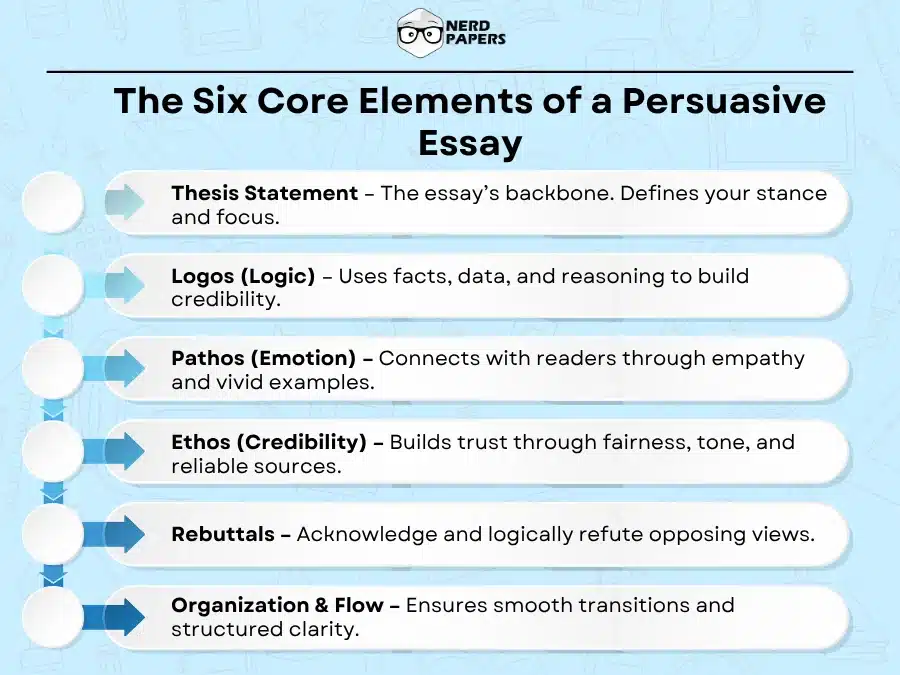
Any persuasive essay has a collection of main elements that ensure that the argument is coherent. Each has its own purpose and when they are intertwined, they produce a logical, credible, and engaging writing.
A Clear and Strong Thesis Statement
A persuasive essay is based on its thesis. It makes it very clear what you are and serves as a guideline to the whole work. A vague thesis is against strong essays, whereas a specific thesis offers focus and purpose. As an example, as opposed to saying Homework isn’t useful, a more precise thesis, such as ‘Excessive homework kills motivation in middle school students and should be limited‘, is more precise and has intent.
Logical Reasoning and Evidence (Logos)
Logos is the appeal to logic. Powerful essays do not rely solely on opinion to prove their claims but they use facts, examples, and reliable sources. When you base your position on data, research or expert opinion, it becomes more difficult to reject your position and demonstrates that it is based on sound arguments.
Emotional Appeal for Connection (Pathos)
Pathos brings in emotion to make the essay resonate. Relatable stories, vivid language, or scenarios that highlight the human side of an issue help readers connect personally. While emotion should not replace logic, it strengthens the argument when used carefully.
Credibility and Trustworthiness (Ethos)
Ethos is about building trust with your audience. A respectful tone, balanced reasoning, and reliable sources establish credibility. Readers are more likely to be persuaded when they believe the writer is fair-minded and informed.
Counterarguments and Rebuttals
Acknowledging opposing views makes your essay more thoughtful and balanced. A strong rebuttal doesn’t dismiss the other side but explains logically why your stance is stronger. This shows depth and strengthens your position.
Organization and Flow
Even solid points fall apart without structure. A persuasive essay should have a clear introduction, body, and conclusion, with smooth transitions between ideas. Logical flow keeps readers engaged and makes the overall argument convincing. You can convince the user to make a decision if you know how to end a persuasive essay effectively.
Additional Elements of a Good Persuasive Essay
Beyond the core structure, certain elements elevate a persuasive essay from simply good to highly effective. These added layers make your writing sharper, more engaging, and harder to ignore.
Audience Awareness
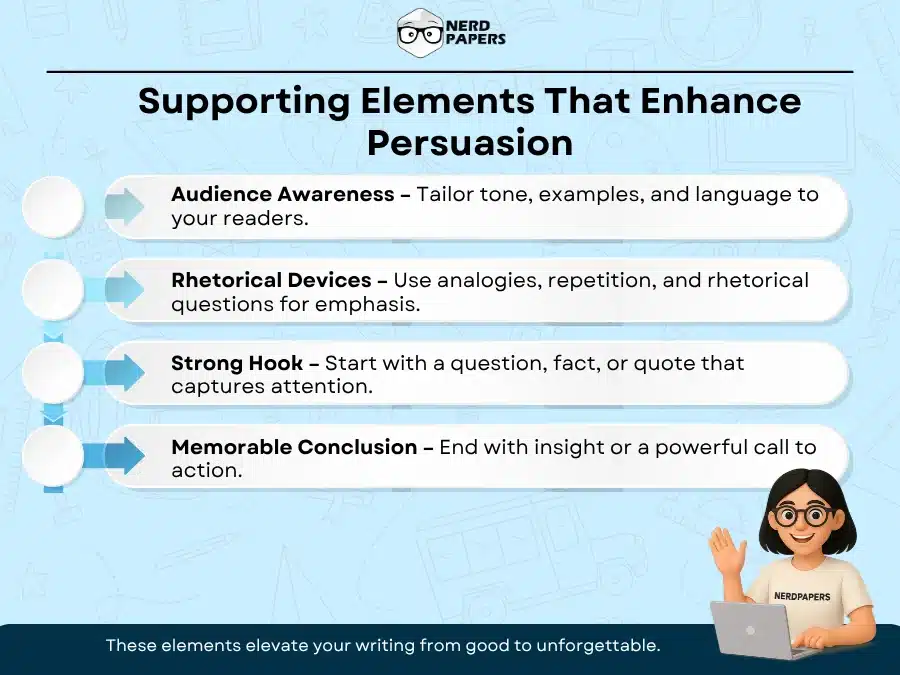
Every powerful essay is composed for a particular audience, be it friends, a teacher, or a wider public. It is more effective to vary your tone. examples, and style your presentation to fit the audience and enhance the power of your case. An example is a formal essay to academics that may be based on data and research, whereas a formal essay to peers may be based on familiar scenarios and conversational language.
Persuasive Language and Rhetorical Devices
Though the method of delivery counts, the material of the essay is quite significant. Rhetorical questions, analogies, and repetition are used to draw attention to important ideas and help with better recall. These devices can provide your writing with rhythm and power, but without artificiality when used in a strategic manner.
Strong Opening Hook
The initial impression preconditions. The first hook, which grabs the reader into the poem, is an interesting fact, a thought-provoking question or an interesting situation or scenario that makes the reader pick up the poem and read more.
Memorable Conclusion
One needs to conclude a persuasive essay not with a summary but with strength. An effective conclusion will strengthen your thesis and leave those reading to consider what you have just read; be it a call to action, an eye-opening conclusion or a rhetorical question that stays in their mind even after they have read your essay.
The Lasting Value of Persuasive Essay Elements
The elements of persuasive essay not only serve a purpose of holding a paper together but also enable the writers to acquire skills that can be useful well after the assignment is completed. Learning how to argue in a clear and credible and effective way is mastering them.
Combining Elements for Stronger Essays
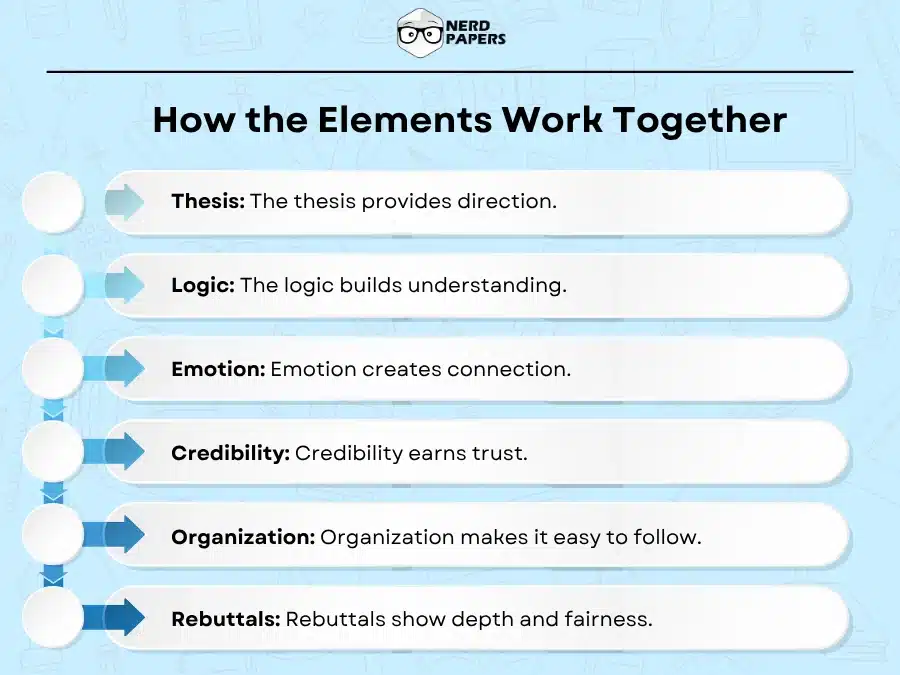
The components of a persuasive essay do not produce on their own the elements that are boxes to be ticked but rather combine to produce a clear, credible, and effective writing. A good thesis provides a focus, logical evidence helps build trust, emotions help build connection and good structure helps everything move smoothly. Combined they make an argument that cannot be overlooked.
Real-World Applications
These elements don’t stop at essays. The same skills are used in speeches, debates, opinion pieces, and workplace communication, like proposals or presentations. Anytime you’re trying to influence or convince someone, you’re relying on the same building blocks.
Transferable Communication Skills
Mastering persuasive essay elements sharpens communication overall. Balancing logic, emotion, and credibility makes it easier to present ideas clearly, argue effectively, and adapt to different audiences’ abilities that remain useful far beyond the classroom.
Bringing It All Together
The strength of a persuasive essay lies in its core elements: a clear thesis, logical reasoning, emotional connection, credibility, counterarguments, and smooth organization. Each plays its role, but together they create writing that feels convincing and complete.
Like any skill, mastering persuasion takes practice. The more you pay attention to how these elements work, the more naturally they’ll come together in your writing. Over time, you’ll develop a persuasive voice that not only works in essays but also strengthens the way you communicate in everyday life.
Frequently Asked Questions
What are the key elements of a persuasive essay?
The main elements include a clear thesis, logical reasoning (logos), emotional appeal (pathos), credibility (ethos), rebuttals, and a smooth flow of ideas.
How many elements are in a persuasive essay?
Most persuasive essays rely on six essential elements: thesis, logos, pathos, ethos, rebuttals, and flow. Some guides also add audience awareness, strong hooks, and rhetorical devices as supporting elements.
Why are persuasive essay elements important?
They help structure arguments in a way that convinces readers. Without these elements, essays often lack clarity, depth, and impact.
How can I make my persuasive essay more effective?
Practice applying all the elements together. Back your thesis with logic and evidence, appeal to emotions, establish credibility, and anticipate counterarguments.
Can persuasive essay skills help outside academics?
Yes. These skills transfer to speeches, debates, workplace communication, and everyday discussions where persuasion is key.
What’s the most common mistake in persuasive essays?
Students often overlook rebuttals. Ignoring counterarguments weakens credibility. Addressing them shows awareness and strengthens your position.
How to remember ethos, pathos, and logos?
If you want to remember these, try this: Ethos is related to “ethics”; the person is being asked to act in an ethical and responsible way. Being close to “logic” means appealing to reason and logic. In English, “pathetic” is a word that sounds a lot like “pathos.”
What are the themes of ethos pathos and logos?
Each category makes the speaker and the listener feel a different way. When someone talks, their ethics, or beliefs, come up. Through pathos, you can make people feel things. One last thing is that a logo uses reasoning by using proof and facts.