
Picture this: you’ve delivered a flawless courtroom argument. Every piece of evidence supports your claim, your logic is airtight, and the jury seems convinced.
But then, when it’s time for your closing statement, you mumble a few weak lines, shuffle your papers, and walk off. Suddenly, all that persuasion evaporates.
That’s exactly what happens when a persuasive essay ends without impact.
The conclusion isn’t just where you stop writing, it’s where you seal your argument. It’s your final opportunity to reinforce your stance, appeal to the reader’s reasoning or emotions, and leave them convinced that your point isn’t just valid, it’s undeniable.
Of course, a conclusion can only be as strong as the argument it’s built on. Suppose your reasoning wavers or your essay’s structure isn’t cohesive. In that case, even the best closing line won’t save it, which is why mastering the method to write a persuasive essay from the ground up naturally sets you up for a stronger finish.
In this guide, we’ll break down exactly how to end a persuasive essay, from restating your thesis effectively to writing that final sentence that lingers long after your reader’s done.
The Real Purpose of a Persuasive Essay Conclusion
Most students treat the conclusion like a summary, a quick recap before signing off. But that’s not its real job. The conclusion isn’t there to repeat your argument; it’s there to strengthen it.
Think of it as the echo that remains after your argument ends. A strong persuasive essay conclusion doesn’t just remind the reader what you said; it reminds them why it matters. It strengthens your position, ties your reasoning into one coherent idea, and makes the reader feel that changing their mind isn’t just an option, it’s the only logical outcome.
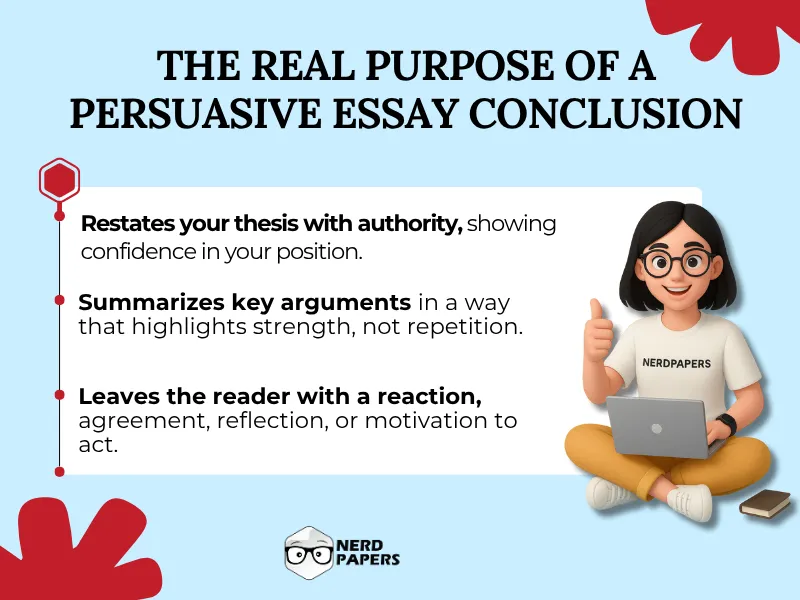
Here’s what a good persuasive essay conclusion actually does:
- Restates your thesis with authority, showing confidence in your position.
- Summarizes key arguments in a way that highlights strength, not repetition.
- Leaves the reader with a reaction, agreement, reflection, or motivation to act.
It’s not about closure. It’s about impact. If the body of your essay is the argument, the conclusion is the verdict—the final statement that defines what the reader walks away believing. Like the last scene of a movie, it shouldn’t introduce new twists; it should make you feel the weight of everything that’s come before.
This role only works because persuasion depends on distinct elements working together. Each part of a persuasive essay—from credibility-building to logical reasoning to emotional reinforcement—serves a specific purpose, and the conclusion brings those elements into focus. Understanding these persuasive essay elements helps explain why a strong ending feels convincing rather than repetitive.
How to Write a Good Conclusion for a Persuasive Essay
There’s no magic sentence that instantly makes your conclusion powerful; it’s about how each part connects to develop your argument.
A good persuasive essay ending follows a logical sequence: remind, reinforce, and resonate.
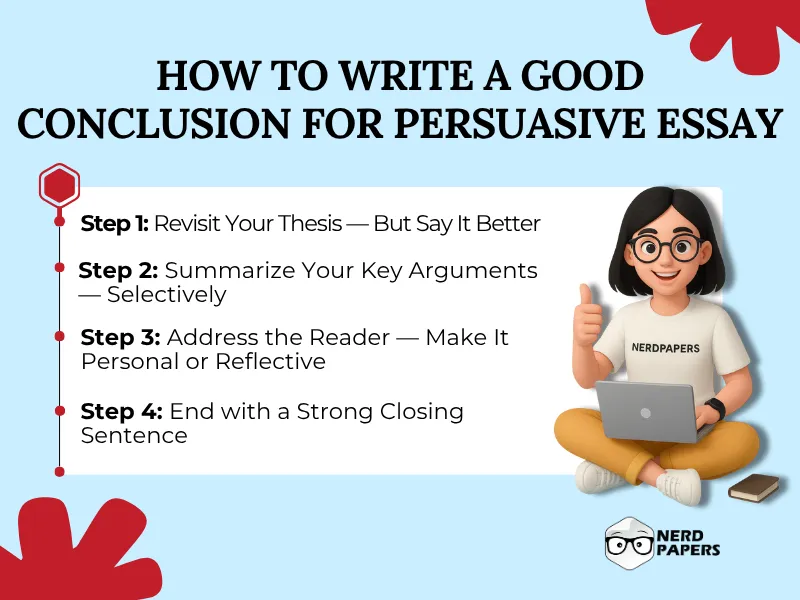
Here’s how to do it step by step:
Step 1: Revisit Your Thesis — But Say It Better
The biggest mistake students make is copying and pasting their thesis from the introduction without modification. That’s not restating, that’s recycling.
A strong conclusion revisits your thesis through the lens of the argument you’ve just proven.
Weak restatement:
“School uniforms should be mandatory because they create equality and discipline.”
Stronger restatement:
“By promoting discipline and reducing social pressure, school uniforms give students the freedom to focus on learning, not appearances.”
See the difference? The second one assumes you’ve proven your point; it sounds confident, not repetitive.
Step 2: Summarize Your Key Arguments — Selectively
Don’t summarize everything. Pick the arguments that made your stance strongest, and rephrase them in a single, cohesive flow.
This shows that your essay wasn’t just a list of points; it was a persuasive narrative.
“From academic focus to reduced peer pressure, the benefits of a uniform policy extend beyond clothing; they shape a school’s culture.”
Short, clean, and conclusive.
Step 3: Address the Reader — Make It Personal or Reflective
In persuasive writing, your audience isn’t passive; they’re the ones deciding if your point is valid. So end by speaking to them directly, even subtly.
Pose a reflective question or challenge their perspective in a calm, reasoned tone.
“The real question isn’t whether uniforms restrict individuality, it’s whether we’re willing to let appearances outweigh education.”
That single line shifts the burden of thought onto the reader, and that’s what persuasion looks like at the finish line.
Step 4: End with a Strong Closing Sentence
This is the essential, the sentence that lasts. It should feel final, not abrupt.
Avoid filler phrases like “in conclusion” or “to summarize.” Instead, close with a statement that echoes your essay’s tone and goal.
“Therefore, schools should have uniforms.”
“Uniforms don’t erase identity, they make space for it to grow where it matters most: the mind.”
That’s the kind of line that doesn’t just end an essay; it ends an argument. Together, these steps show how to write a conclusion paragraph for a persuasive essay that’s confident, clear, and convincing. You’re not summarizing your essay; you’re finishing your case.
Different Ways to End a Persuasive Essay (With Examples)
There’s no single formula for how to end a persuasive essay, only different approaches that can fit your topic, tone, and intent. Some essays call for calm reflection; others need a bolder call to action.
Here are four proven ways to close your essay with conviction, along with short conclusion paragraph examples for persuasive essays you can model.
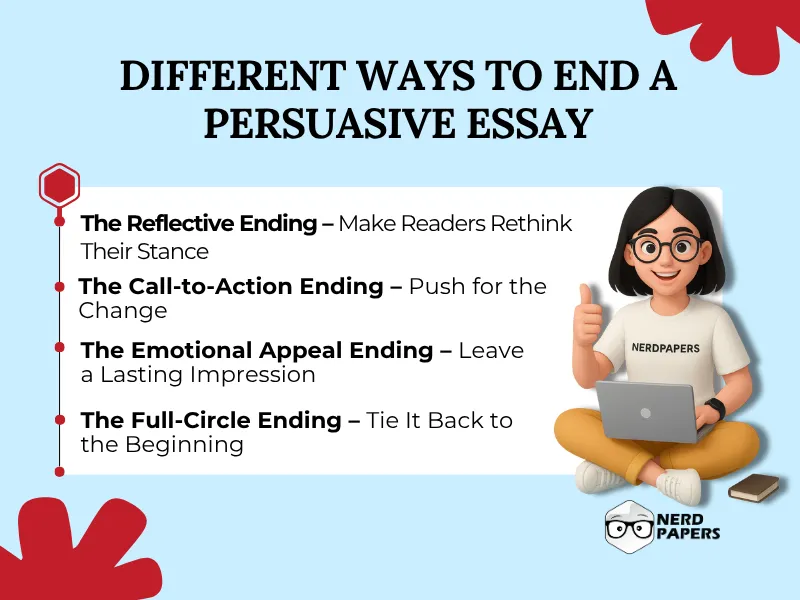
1. The Reflective Ending – Make Readers Rethink Their Stance
This type of conclusion works when your essay relies on logic or moral reasoning.
You don’t tell readers what to do; you make them think differently.
“True education doesn’t happen between bells or inside classrooms; it happens when curiosity is valued more than compliance. Maybe that’s what schools should be grading instead.”
This kind of ending feels reflective, yet powerful. It doesn’t push; it invites reflection.
2. The Call-to-Action Ending – Push for Change
If your essay argues for a specific policy, decision, or behavioral shift, this ending works best. It converts your persuasion into momentum.
“If we want a cleaner planet, the time for discussion is over; it’s time to act, one conscious choice at a time.”
This approach turns your essay from a conversation into a movement. It’s also a natural fit for topics about social issues, environment, education reform, or civic responsibility.
3. The Emotional Appeal Ending – Leave a Lasting Impression
Some essays persuade not by logic, but by empathy.
This style uses emotion carefully, not manipulation, but resonance.
“Every pet in a shelter once belonged to someone who thought they didn’t have time to care. Maybe the smallest act of kindness today saves a life tomorrow.”
Here, the conclusion sentence for a persuasive essay isn’t about being dramatic; it’s about being human.
4. The Full-Circle Ending – Tie It Back to the Beginning
A full-circle conclusion reconnects your essay’s final idea to the opening hook or metaphor.
It creates cohesion and closure, the satisfying “aha” moment for readers.
“Like the courtroom argument that started this essay, persuasion isn’t about who talks the loudest; it’s about who leaves the room remembered.”
This approach gives your essay symmetry and makes it feel intentional from start to finish.
There’s no rule saying you have to stick to one. A great persuasive essay conclusion often blends these styles, reflective yet firm, emotional yet reasoned.
The goal isn’t just to end, it’s to make readers carry your point with them.
Common Mistakes to Avoid When Ending a Persuasive Essay
Even strong essays can fall apart in the final paragraph, not because the writer ran out of ideas, but because they ran out of intent. Your conclusion isn’t an afterthought; it’s the deal closer.
Here’s what to stop doing if you actually want your essay to leave an impression.
1. Repeating Your Thesis Word-for-Word
You’ve already lost the reader’s interest if your conclusion appears incredibly familiar. Restating your thesis involves reframing it in light of the arguments you have presented, not simply copying it.
If your thesis is “School uniforms should be mandatory because they create equality and discipline.”
Instead of:
“School uniforms should be mandatory because they create equality and discipline.”
Try:
“When every student dresses the same, the focus shifts from competition to character, proving that discipline and equality start with shared standards.”
That’s what’s called progression. You’re restating your stance, but with finality and force.
2. Introducing New Ideas or Evidence
Your conclusion isn’t a new paragraph; it’s a closing argument. Bringing in new statistics or fresh arguments here only makes you look unsure about your case.
If you discover a brilliant new point halfway through your conclusion?
Tough luck. That belongs in the body, not the finale.
3. Ending with Generic Phrases
Phrases like “In conclusion,” “To sum up,” or “As I have shown” are lazy transitions.
They tell the reader you’re ending, but they don’t make them care that you are.
Replace them with sentences that feel like endings:
“The choice isn’t whether we act, it’s when.”
“The evidence is clear, but conviction takes courage.”
That’s how to end a conclusion in a persuasive essay by sounding decisive, not decorative.
4. Leaving the Reader Emotionally Flat
Your essay may be logical, but persuasion also depends on emotional memory.
If your conclusion doesn’t make the reader feel something- respect, curiosity, responsibility- it won’t stick.
Even a single, well-placed line of empathy or insight can turn a bland ending into a memorable one.
5. Forgetting the Reader
Some conclusions sound like they’re written for a wall, not a person.
A persuasive essay always has a target, a mind you’re trying to change. Speak to it.
Ask, challenge, or remind your reader why your point matters. That’s what a good conclusion for a persuasive essay does: it leaves no room for indifference.
Fine-Tuning Your Conclusion: Tone, Flow, and Last Impression
A persuasive essay doesn’t truly end when you stop writing; it ends when the reader stops thinking about it. Your conclusion is that echo. It’s the last chance to show that your argument didn’t just hold up; it mattered.
Keep the Tone Consistent
Your conclusion should sound like the same person who wrote your introduction, not someone who switched personalities halfway through.
If your essay leaned on logic and clarity, keep your final words steady and reflective.
If it leaned on emotion, carry that energy just without turning the last paragraph into a speech. The goal is alignment: your ending should feel like a natural resolution, not a tonal detour.
Balance Emotion and Composure
Persuasion isn’t about drama; it’s about truthfulness. A conclusion that’s too intense feels like exaggeration, while one that’s too flat fades out.
Find your midpoint measured but confident. Think of it like landing a plane: steady descent, smooth touch, no turbulence.
Read It Aloud for Flow
Reading your conclusion aloud is one of the quickest ways to test its rhythm.
If it flows easily and sounds like something you’d actually say, you’re in the right zone. If it feels forced or abrupt, trim or rephrase until the logic and emotion blend naturally.
Manage the flow of the content
Sometimes the problem isn’t in your conclusion, it’s in the foundation.
A weak close usually traces back to an uneven structure or rushed transitions earlier in the essay. Strengthening your outline or revisiting how each section builds toward the end can make your conclusion fall into place almost automatically. After all, a strong ending usually begins with a well-mapped outline for the persuasive essay.
7. Quick Checklist: Before You Hit Submit
Before you call it done, run your conclusion through a quick self-check. Think of this as your five-second quality test: short, sharp, and brutally honest.
- ✅ Did I restate my thesis persuasively?
Not word-for-word, but with evolved confidence as if your essay proved it. - ✅ Did I avoid introducing new arguments?
Your conclusion should close the loop, not open another one. - ✅ Does my final sentence leave a strong impact?
Ask yourself if it lingers, would someone remember your point an hour later? - ✅ Is the tone consistent and confident?
No sudden switches from academic to emotional keep the voice steady and self-assured. - ✅ Would I be convinced if I were the reader?
If not, something’s off. Rework it until it sounds like the version of you that knows what they’re talking about.
Conclusion Paragraph Example for a Persuasive Essay
Once you’ve run through that checklist and tightened every line, the next step is simple: see it in action. Let’s look at how all these elements come together in a real example conclusion.
Here’s a model conclusion for the topic:
Example Topic: “Why schools should prioritize mental health education.”
Example Paragraph:When students understand their emotions as well as their equations, real learning begins. Prioritizing mental health education isn’t an optional reform; it’s the foundation of healthier, more focused classrooms. By teaching emotional literacy, normalizing help-seeking, and reducing stigma, schools can raise not just test scores, but also stronger individuals.It’s time education systems treat mental wellness with the same urgency they give to academics because a healthy mind is where every lesson truly starts.
Breakdown of Why It Works
- Restated Thesis:
“Prioritizing mental health education isn’t an optional reform; it’s the foundation of healthier, more focused classrooms.”
The stance is revisited, but with finality and broader framing, not repetition. - Summary of Key Points:
“By teaching emotional literacy, normalizing help-seeking, and reducing stigma…”
Condenses the body arguments into one fluid, rhythmic line. - Closing Appeal:
“It’s time education systems treat mental wellness with the same urgency they give to academics…”
A call to action that’s assertive yet balanced, wrapping logic and empathy together.
Why It Feels Complete
This paragraph works because it circles back to the essay’s core idea with resolution, not redundancy. It mirrors the tone of the essay (compassionate but reasoned), keeps the rhythm tight, and leaves the reader with a sense of direction, not just agreement. The message doesn’t fade; it lingers.
Final Thoughts: The Art of Leaving Readers Thinking
A good persuasive essay doesn’t end with a period; it ends with an echo. Your conclusion is more than a wrap-up—it’s the point where logic meets resonance, where your argument stops speaking but keeps echoing in the reader’s head.
Treated this way, the conclusion becomes the emotional and logical peak of the essay, not an afterthought rushed through before hitting “submit.” The most effective endings feel inevitable, not improvised. They remind readers that what they’ve just read wasn’t a collection of points, but a journey toward conviction.
This effect becomes easier to recognize when you read strong persuasive essay examples. Seeing how real essays close with clarity and quiet confidence helps students understand why the best conclusions linger—long after the final sentence.
FAQs About Persuasive Essay Conclusion
How do you end a persuasive essay effectively?
End with purpose, restate your thesis confidently, summarize key points, and leave readers with a thought-provoking final line that reinforces your stance.
What is the best closing line for a persuasive essay?
A strong closing line either calls for action, evokes emotion, or paints a lasting image that keeps your argument alive in the reader’s mind.
How can I make my conclusion memorable?
Use a short story, a powerful quote, or a metaphor that circles back to your essay’s theme; it’s about resonance, not repetition.
Should I restate my thesis in the conclusion?
Yes, but rephrase it. Don’t copy your introduction; show how your argument evolved and why it matters now.
What mistakes should I avoid in a persuasive essay conclusion?
Avoid introducing new arguments, using clichés like “in conclusion,” or ending abruptly without emotional or logical closure.
How long should a persuasive essay conclusion be?
Usually, 3–5 sentences are long enough to tie everything together, but short enough to stay impactful.
What tone should a persuasive essay conclusion have?
Confident, reflective, and final like a well-argued case closing, not a casual sign-off.
What is another way to say “in conclusion” in a persuasive essay?
You don’t always need to say “in conclusion.” Try alternatives that sound more natural and confident, such as
To sum up,
Ultimately,
In essence,
All things considered,
As we’ve seen,
To wrap it up,
At its core,
Looking at the bigger picture,
or even a seamless transition sentence that implies finality without using any phrase at all.