Staring at a blank Google Doc, trying to figure out how to start a narrative essay, is honestly one of the most annoying parts of writing. You know exactly what happened in your story… but somehow that first sentence feels like it has to be perfect. And when it’s not, you suddenly start doubting the whole essay.
The good news? Narrative intros don’t need to be fancy or dramatic. They just need to pull the reader into a moment. It’s kind of like opening a door and saying, “Hey, come see what happened.”
In this guide, I’ll break down super simple ways to start your narrative essay, show you real introduction examples, and help you avoid the boring, overdone openings teachers see a million times. And if you’re working on the whole essay, you might also want to know about how to write a strong narrative essay, for a bigger picture of the full writing process. Don’t worry, we have covered that as well in another blog, which you can read on our website. So without any further delay, let’s jump right into the narrative essay intro.
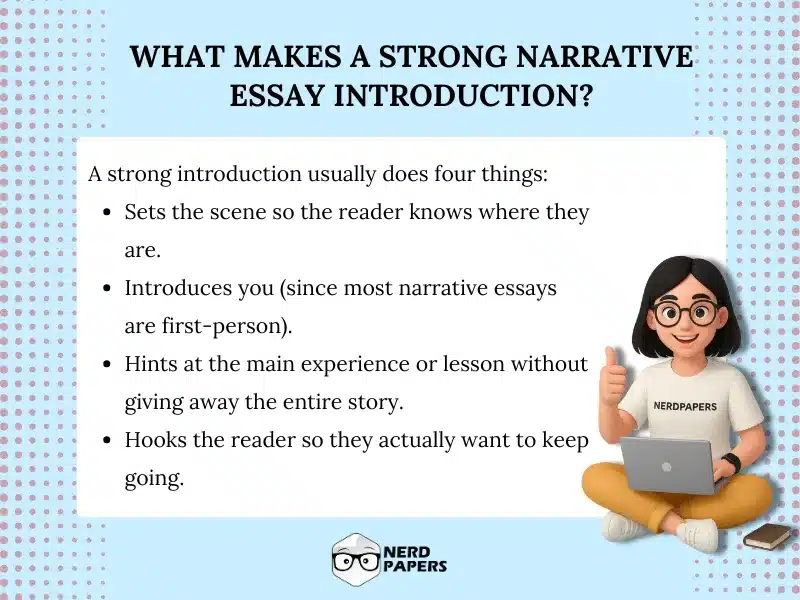
What Makes a Strong Narrative Essay Introduction?
If you’ve ever read a story that grabbed you from the first line, that’s basically the goal of a narrative essay introduction. You want your reader to feel like they’ve stepped right into the moment with you, not like they’re reading a dry school assignment. A good intro sets the vibe, hints at where the story is headed, and shows a little bit of your personality.
A strong introduction usually does four things:
- Sets the scene so the reader knows where they are.
- Introduces you (since most narrative essays are first-person).
- Hints at the main experience or lesson without giving away the entire story.
- Hooks the reader so they actually want to keep going.
Honestly, that last part (the hook) is what makes or breaks the opening. If your first sentence feels flat or confusing, the reader disconnects immediately. But if you start with something vivid, emotional, or intriguing, you’re already ahead of most students. This is where techniques like starting with a memory, a quick line of dialogue, or a relatable thought can make your intro feel alive.
Your introduction doesn’t need to be long or dramatic. It just needs to feel like the beginning of a real moment. When you can do that, the rest of the story becomes way easier to tell.
How to Start a Narrative Essay (Simple Steps)
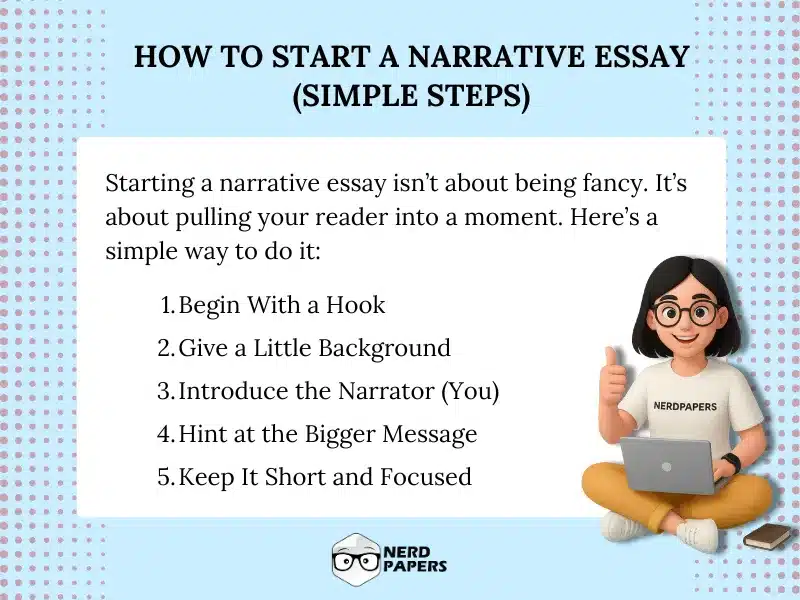
Starting a narrative essay isn’t about being fancy. It’s about pulling your reader into a moment. Think of it like opening a scene in a movie. You want them to see something, feel something, or at least wonder, “Okay… what’s happening next?” Before you even write your first sentence, it actually helps to have a loose plan for your story. If you’re someone who likes having a roadmap, creating a narrative essay outline can make starting the intro a lot less stressful.
Here’s a simple way to build your narrative essay opening paragraph without overthinking it:
1. Begin With a Hook
Your hook is the first line, and honestly, it’s the part most students stress about. It doesn’t have to be perfect; it just needs to grab attention.
A hook can be:
- Dialogue (“‘Hurry up!’ my brother yelled as I tripped over the suitcase.”)
- A vivid memory (a smell, sound, or tiny detail)
- A quick flashback
- A surprising or awkward moment
- A relatable thought (“I had no idea that one text message would ruin my whole afternoon.”)
These are all creative ways to start a narrative essay and instantly make your reader curious.
2. Give a Little Background
You don’t need a full backstory, just enough to ground the reader.
Think of it as answering the basics:
- Where are you?
- What’s happening?
- Who’s around you?
This tiny bit of context keeps your introduction clear without slowing the story down.
3. Introduce the Narrator (You)
Most narrative essays are written in the first person, so your voice matters. Make sure your personality shows through right away, whether you’re nervous, excited, annoyed, or confused.
A simple line like “I remember feeling like my stomach dropped to the floor” already gives readers a sense of who you are in that moment.
4. Hint at the Bigger Message
Good narrative essay beginnings give the reader a clue about the theme, lesson, or emotional direction — without spoiling the whole story.
“I didn’t realize it then, but that morning taught me way more than I expected.”
It’s subtle, but it tells the reader that something meaningful is coming.
5. Keep It Short and Focused
A narrative essay intro doesn’t need to be long. Sometimes the best openings are just 4–6 lines that set up the moment and lead smoothly into the action.
If your introduction feels clear, grounded, and emotionally honest, you’re good.
And once your introduction feels solid, it’s worth thinking about how you’re going to wrap up the story, too. A strong narrative essay ending really pulls the whole story together and helps you to land your final moment.
Best Ways to Start a Narrative Essay (With Examples)
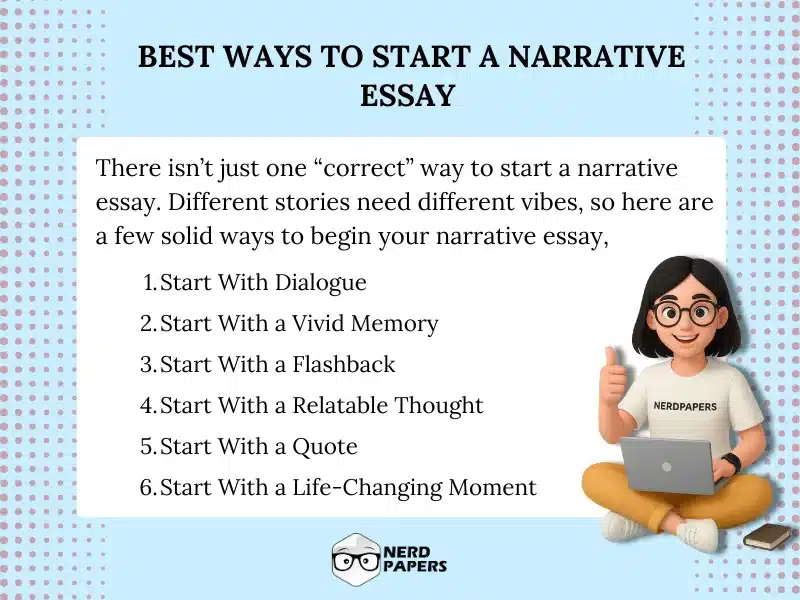
There isn’t just one “correct” way to start a narrative essay. Honestly, the best openings are the ones that feel like you’re pulling someone straight into a real moment, not giving them a dry summary of your life. Different stories need different vibes, so here are a few solid ways to begin your narrative essay, along with examples that actually sound like a student wrote them.
1. Start With Dialogue
Dialogue drops the reader right into the scene, almost like they’re overhearing something.
Why it works:
It feels fast, personal, and natural, perfect for stories involving conflict or a memorable moment.
“‘You seriously forgot the keys again?’ my mom sighed as we stood outside the locked car in the pouring rain.”
You can already feel the mood: stressful, a little funny, very real.
2. Start With a Vivid Memory
If your story has a strong sensory moment: a smell, a sound, or something visual, this is a perfect way to open.
Why it works:
It paints a picture instantly and gets the reader curious about what’s happening.
“The gym smelled like rubber and nerves the morning of my first basketball tryout.”
Short, simple, and it sets the scene without over-explaining.
3. Start With a Flashback
Flashbacks are great for deeper or more emotional stories.
Why it works:
It creates a little time jump that makes readers want to know how things connect.
“Before that day, I’d never spoken in front of more than three people, and even that made my hands shake.”
You can already sense the fear and the growth coming later.
4. Start With a Relatable Thought
This is one of the easiest ways to begin a narrative essay because you just… say what you were thinking.
Why it works:
Everyone has internal monologues, so it feels personal right away.
“I knew I should’ve left the house earlier, but convincing myself to get out of bed on a Monday is a whole different battle.”
This type of opening works especially well for stories about everyday experiences.
5. Start With a Quote
Only use a quote if it’s genuinely connected to your story, not a random inspirational line.
Why it works:
It sets a theme, especially for stories involving lessons or personal growth.
“My coach always said, ‘Pressure makes diamonds,’ but that didn’t help much when I was staring at the ball rolling the wrong way.”
Funny + meaningful is a nice combo.
6. Start With a Life-Changing Moment
Some stories begin in the middle of the action, the moment everything shifted.
Why it works:
It’s dramatic without being forced, and it immediately signals that the story matters.
“The phone rang at exactly 3:12 a.m., and I knew before answering that something was wrong.”
It builds tension right away.
Narrative Essay Introduction Examples (Full Paragraphs)
Sometimes it’s easier to understand how to start a narrative essay by actually seeing how different openings work. Here are a few intro styles you can borrow from, depending on the mood of your story. Each one feels like something a real student would write, not a stiff, overly “perfect” academic intro.
1. The Funny or Lighthearted Intro
“I knew the day was going to be chaotic the second my alarm didn’t go off. By the time I sprinted out the door with mismatched socks and a half-burnt waffle in my hand, I had already accepted defeat. What I didn’t expect, though, was that my biggest disaster of the morning wasn’t even my fault.”
This kind of intro works well for stories that are embarrassing, chaotic, or just plain funny.
2. The Serious, Emotional Intro
“The hospital room was too quiet, the kind of quiet that makes you feel like you’re breathing too loudly. I remember standing in the doorway, unsure if I should walk in or turn around. At sixteen, I wasn’t prepared for how much that moment would change the way I saw my family.”
This version is better for deeper, more personal experiences.
3. The Reflective / Life Lesson Intro
“I used to think confidence was something people were just born with. Then came the day my teacher called on me to present first, completely unprepared and everything about that belief started to shift.”
This intro hints at a lesson without revealing it too early.
4. The College Application–Style Intro
“The smell of engine oil and metal shavings never bothered me; in fact, they reminded me of every Saturday morning spent in my uncle’s garage. What began as simple curiosity about how machines worked slowly turned into something that shaped my entire academic path.”
This style works if your story connects to personal growth, hobbies, or future goals.
5. The Action-Focused Intro
“My foot slipped before I even realized the rock was loose. One second, I was laughing with my friends, and the next, I was sliding down the trail, grabbing at branches that snapped in my hands.”
Great for stories that start with movement or tension.
What to Avoid When Starting a Narrative Essay
Even though there are tons of great ways to begin a narrative essay, there are also a few openings that instantly make your intro feel boring or confusing. Most of these are super common, and honestly, teachers see them so often that they stop paying attention after the first line. Here’s what you’ll want to avoid:
1. Starting Too Vague
Intros like “Since the beginning of time…” or “Everyone goes through challenges” don’t actually say anything. Narrative essays are personal; your intro should be specific enough for the reader to picture something.
2. Explaining the Whole Story in the First Paragraph
If you give away the ending immediately, there’s no reason for anyone to keep reading. You don’t need the full background, the lesson, or every detail right away. Save that for the body paragraphs.
3. Overloading the Intro With Details
Some students try to describe everything, the weather, their outfit, the entire setting, all in the first few lines. Too much detail makes the intro feel slow and cluttered.
Your job is to set the scene, not write the whole movie script.
4. Using a Stiff, Formal Tone
A narrative essay is a story, not a research paper. You don’t need phrases like “in this essay, I will discuss…” or overly academic vocabulary. Write like a human being, not a textbook.
5. Starting With a Cliché
Lines like “It was a dark and stormy night” or “I’ll never forget the day…” sound generic because they’ve been used a million times. Make your intro personal and original.
6. Beginning With Random Quotes
A motivational quote at the top of your essay usually feels disconnected. If you’re going to use a quote, it needs to tie directly into your story, not just be something inspirational you found on Pinterest.
Quick Checklist Before You Start Writing
Before you dive into the rest of your story, run your introduction through this quick checklist. It’ll save you from awkward or confusing openings and make sure your first paragraph is actually doing its job.
- Does your first sentence hook the reader or at least spark curiosity?
- Did you set the scene without dumping too many details at once?
- Is it clear who the narrator is (your voice, your perspective)?
- Do you hint at the bigger meaning or lesson without spoiling the entire story?
- Does the intro flow naturally into the next moment?
- Is it short, clean, and focused?
- Does it feel like something you would say, not a stiff academic intro?
- Would you keep reading if someone else wrote it? Be honest.
If you check most of these boxes, your introduction is basically ready.
Conclusion
Starting a narrative essay doesn’t have to feel like some huge creative challenge. Once you focus on the moment, the emotion, and the hook, the first paragraph starts to come together pretty naturally. And honestly, the intro doesn’t need to be perfect, it just needs to pull the reader into your story and make them want to stick around for what happens next.
Try out a few different openings, play with your tone, and choose the one that feels the most “you.” The more real your voice sounds, the stronger your narrative becomes.
FAQs
What’s the best way to start a narrative essay?
Honestly, the best way is to open with a moment that feels real, a line of dialogue, a quick memory, or a thought that jumps straight into your story. Anything that makes the reader curious works.
Can I start a narrative essay with dialogue?
Yes, definitely. Dialogue is one of the easiest ways to drop the reader right into the scene. Just make sure it connects directly to the story you’re about to tell.
Should my narrative essay introduction explain the whole story?
Nope. Your intro should only set the scene and give readers a sense of what’s happening. Save the full details and the lesson for later.
How long should a narrative essay introduction be?
Usually, a short paragraph is enough, around 4–6 lines. As long as it hooks the reader and sets the moment, you’re good.
What if my narrative essay intro sounds boring?
Try switching your opening style. Start with a memory, a sound, a flashback, or a feeling. Sometimes changing the first sentence makes the whole paragraph feel better.
Can I start a narrative essay with a question?
Yes, as long as the question leads into your story naturally. It should make the reader think or set up the moment you’re about to describe.
Do I need a thesis statement in a narrative essay?
Not a formal one. But it helps to hint at the message or lesson your story will eventually reveal. Keep it subtle, not like a research essay.
How do I know if my intro is effective?
Read it out loud. If it flows smoothly, feels like your voice, and makes you want to keep reading, it’s probably working. If you get bored halfway through… rewrite it.