Writing a narrative essay is one of the most creative ways to use storytelling to share your thoughts and experiences. It is not the same as expository or descriptive essays that focus on details. In a narrative essay, you can share a personal story that conveys your emotions, realizations, or lessons. It blends creativity with structure, helping you turn real-life events into meaningful reflections.
However, learning how to write a narrative essay can feel tricky at first. You must find a balance between academic structure and narrative. It is necessary to maintain readers’ interest and make sure your essay has a clear goal or message. Of course, turning your story into a well-structured essay takes skill and effort. Many students turn to custom narrative essay writing help for this purpose. But if you want to improve your writing skills and compose your own narrative essay, then don’t worry. This guide will coach you through the entire process.
This blog will cover all you need to know about how to write a narrative essay that impresses and conveys your story properly. From its definition and structure, to step-by-step instructions for turning your story into an engaging academic essay.
What Is a Narrative Essay? (Definition & Meaning)
Understanding the Concept
A narrative essay is a type of academic writing that tells a story. That story is often based on the author’s personal experiences, ideas, or significant events. Unlike analytical or persuasive essays, which focus on arguments and supporting details. Narrative essays focus on meaning, emotions, and storytelling. It allows the writer to articulate their ideas while captivating readers with creative yet systematic language and striking imagery.
In basic terms, a narrative essay transforms significant life events into educational opportunities. It is more than just recounting incidents. It involves going into great detail on the importance of such interactions and what they reveal about you or your perspective.
Narrative Essay Definition
A narrative essay definition can be summarized as:
“A structured piece of writing that shares a real or imagined story to convey a message, moral, or personal insight.”
This type of essay usually presents the events as they occurred in chronological order. This makes it easier for the reader to follow the plot. Pronouns like “I,” “me,” or “my,” are suitable because it is usually written in the first person. As a result, the story feels more real and personal.
Purpose of a Narrative Essay
The main objective of a narrative essay is to entertain, inform, or inspire the reader by sharing a significant story. It usually brings out:
- A lesson learned from experience
- A transformation or self-discovery
- One particular instance that changed your viewpoint
The goal of every narrative essay is to engage your readers along with you. Whether it is about overcoming fear, learning a life lesson, or undergoing personal growth.
Types of Narrative Essays
Depending on the topic and context, narrative essays are of different types. Some of the most common types are:
- Personal Narrative Essay: These essays are based on real-life experiences or memories that had an emotional impact on the author.
- Fictional Narrative Essay: These are the imaginative stories structured to mimic real-life events.
- Anecdotal Narrative Essay: This type of essay highlights a particular idea or theme using short stories.
All types of narrative essays still have the same storytelling components. These components include: a clear theme, an engaging flow, and a well-crafted conclusion.
Narrative Essay Format and Structure
Why Structure Matters
Despite emphasizing storytelling, a narrative essay follows a specific academic format. If you format your essay correctly, it will effectively communicate its main idea. The right arrangement keeps readers interested in your essay. It also facilitates the natural flow of your story. A well-structured essay also makes it easier for your teacher to evaluate your originality and consistency.
Standard Narrative Essay Format
Most narrative essays follow the classic three-part essay structure:
- Introduce the topic or story idea.
- Provide background context (where, when, who).
- End with a strong thesis statement that reflects the theme or lesson.
- Present events in chronological order (beginning → middle → end).
- Use transitions like first, next, then, and finally to maintain flow.
- Include dialogue, imagery, and emotions to bring your story to life.
- Focus each paragraph on a specific stage of the story or a key turning point.
- Reflect on what you learned or how the event changed you.
- Tie the reflection back to your thesis statement.
- Leave the reader with a meaningful or emotional takeaway.
Narrative Essay Outline Example
Here’s a quick outline you can follow when structuring your own essay:
| Section | Purpose | Example |
| Introduction | Hook + background + thesis | “The day I moved to a new city taught me more about courage than I expected.” |
| Body Paragraph 1 | Beginning of the story | Describe the setting and characters. |
| Body Paragraph 2 | Rising action | Present the main challenge or event. |
| Body Paragraph 3 | Climax and resolution | Show how the event unfolded and ended. |
| Conclusion | Reflection | Share the lesson or moral learned. |
Writing Perspective and Style
Most narrative essays are written in the first person using the pronouns “I” or “me.” However, you can also use the third person if you want a tone that is more objective. It’s very important to keep the essay consistent throughout.
- Tense: Usually written in the past tense unless describing an ongoing reflection.
- Tone: Personal, honest, and expressive.
- Transitions: Maintain flow with linking words like meanwhile, afterward, and in the end.
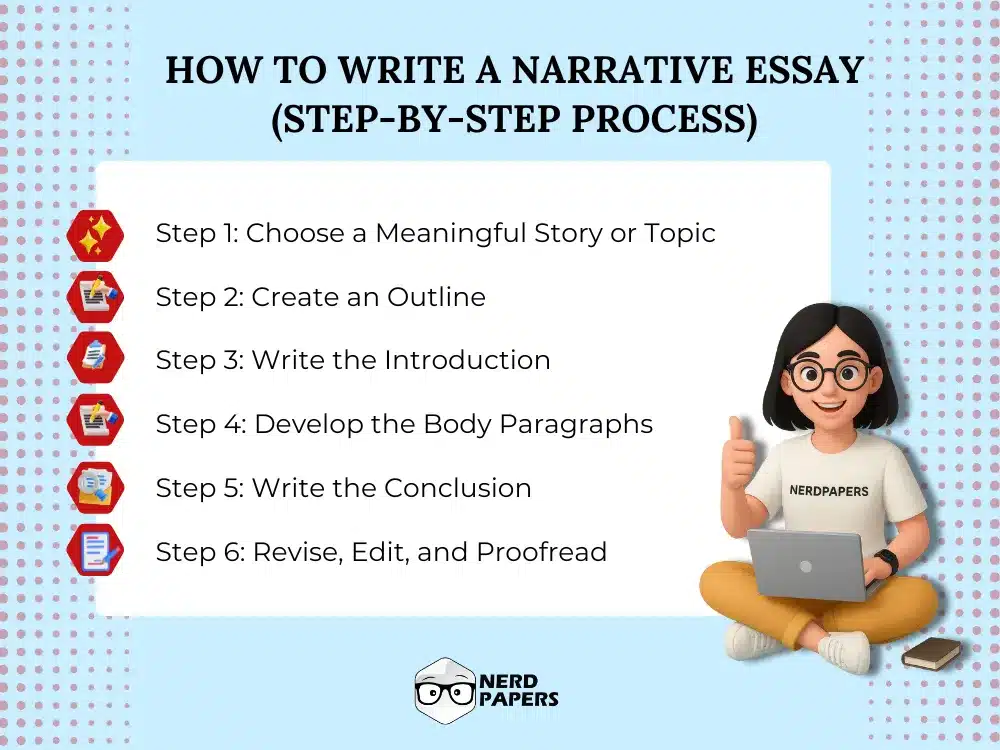
How to Write a Narrative Essay (Step-by-Step Process)
Writing a narrative essay involves more than just telling a story. It entails giving the reader something to think about. Your goal is to make it emotionally engaging, well-structured, and meaningful. Regardless of whether it’s a fictional situation or a personal experience.
Here’s a simple step-by-step process on how to write a narrative essay effectively.
Step 1: Choose a Meaningful Story or Topic
Start with a story that holds great significance for you. It could be a life-changing experience, a challenge you overcame, or an event you will never forget. Your feelings naturally increase the impact and relatability of the story. Because you are writing about something personal.
Step 2: Create an Outline
Before you start writing, create an outline for your narrative essay. An outline helps you organize your thoughts and ensures that your story flows naturally from beginning to end.
A simple structure could look like this:
- Introduction: Hook, context, and thesis statement.
- Body Paragraphs: Events arranged in chronological order.
- Conclusion: Reflection and lessons learned.
Step 3: Write the Introduction
Your introduction sets the tone for the entire essay. Start with an attention-grabbing question, quote, or anecdote that serves as a hook. Before stating your thesis, provide some background information. Your narrative essay thesis refers to the lesson or revelation of your story.
“I never realized how powerful silence could be until the day I faced an entire auditorium.”
Step 4: Develop the Body Paragraphs
Your essay’s narrative takes place in the body. Make sure each paragraph focuses on a distinct aspect of your story and adheres to a logical beginning, middle, and end.
Include:
- Vivid details to paint a clear picture.
- Dialogue to add realism.
- Transitions to connect events smoothly (first, then, later, finally).
Make use of vivid language and emotional depth to help your readers experience what you personally experienced.
Step 5: Write the Conclusion
Your conclusion must have a strong impact. Reflect on the things you learned or how the experience changed you. Link your ideas to the thesis to give your writing a feeling of completion and direction.
“That day didn’t just test my confidence, it helped me discover it.”
Step 6: Revise, Edit, and Proofread
Once your first draft is complete, take time to review it. Check for:
- Grammar and spelling mistakes
- Flow and transitions
- Consistency in tense and tone
Read your essay aloud or ask someone else to review it, sometimes an outside perspective helps spot unclear sections.
Key Elements of a Strong Narrative Essay
A great narrative essay is not just about what happened, but also about how you tell the story. The quality of your essay depends on how well you define its key elements. These components help readers understand your feelings, visualize the events, and connect to the meaning of your story.
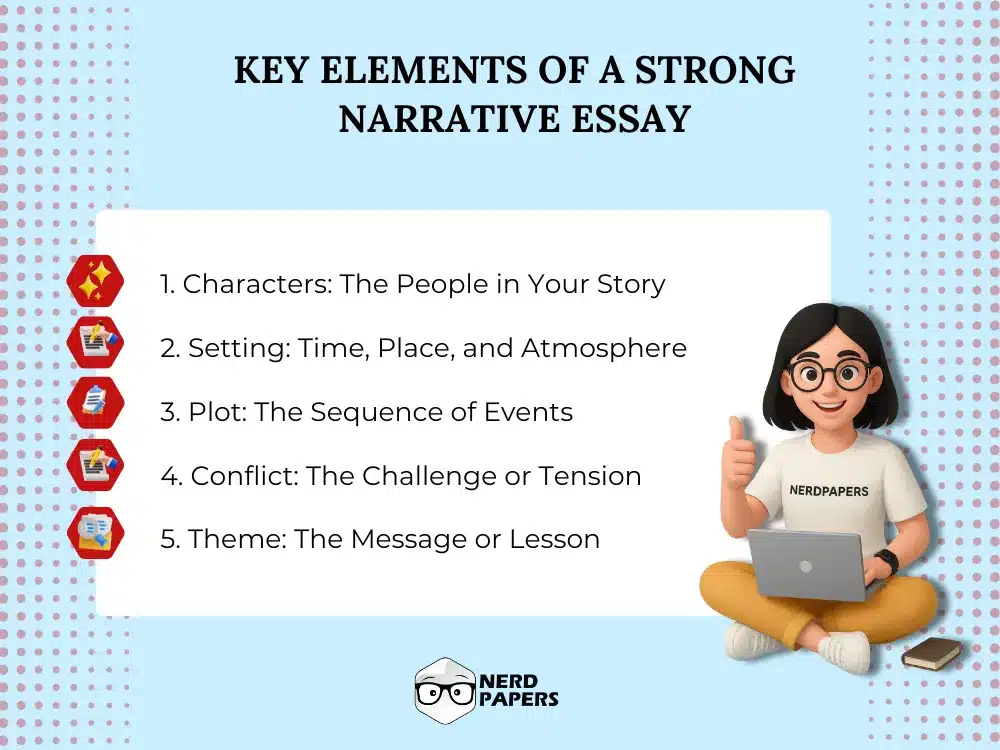
These are the fundamental elements of an engaging narrative essay.
1. Characters: The People in Your Story
Every narrative essay revolves around people, even if it is about you. Characters give your story life and help readers relate to real emotions and actions.
- Introduce the main characters early in the essay.
- Describe their traits, motivations, or relationships briefly.
- Show character growth or change by the end of the story.
“At first, I didn’t understand my coach’s strictness, but by the end of the season, I realized it shaped my discipline.”
2. Setting: Time, Place, and Atmosphere
Your setting provides context for your story. It tells readers where and when the events happened and sets the mood for the entire narrative.
- Mention location, season, or time of day.
- Use sensory details like sight, sound, touch, to immerse readers.
- Keep it brief but vivid.
“The classroom was quiet except for the faint buzz of the ceiling fan, and my hands trembled as I held the paper.”
3. Plot: The Sequence of Events
The plot is the backbone of your narrative. It follows a logical flow that takes the reader on a journey from the beginning to the resolution.
Most narrative essays follow this structure:
- Exposition: Introduction of characters and setting.
- Rising Action: Build-up of tension or conflict.
- Climax: The turning point or most intense moment.
- Falling Action: Events following the climax.
- Resolution: The conclusion or reflection.
4. Conflict: The Challenge or Tension
Every story needs conflict. It is the problem, struggle, or tension that drives the plot forward. It can be:
- Internal conflict: A personal challenge, fear, or emotional struggle.
- External conflict: A situation involving other people or circumstances.
“I wasn’t battling my classmates that day, I was battling my own fear of failure.”
Conflict adds depth to your essay and makes the lesson or outcome more impactful.
5. Theme: The Message or Lesson
The theme is the heart of your narrative essay. It’s what you want your readers to learn or feel by the end. It could be a moral, a realization, or a reflection about life, growth, or human nature.
Ask yourself:
- What is my essay really about beneath the story?
- What emotion or thought should the reader take away?
“Through that failure, I learned that courage isn’t the absence of fear, it’s moving forward despite it.”
Putting It All Together
When these five elements: characters, setting, plot, conflict, and theme, work together, your narrative essay becomes more than just a story. It transforms into a meaningful experience that engages, teaches, and resonates with the reader.
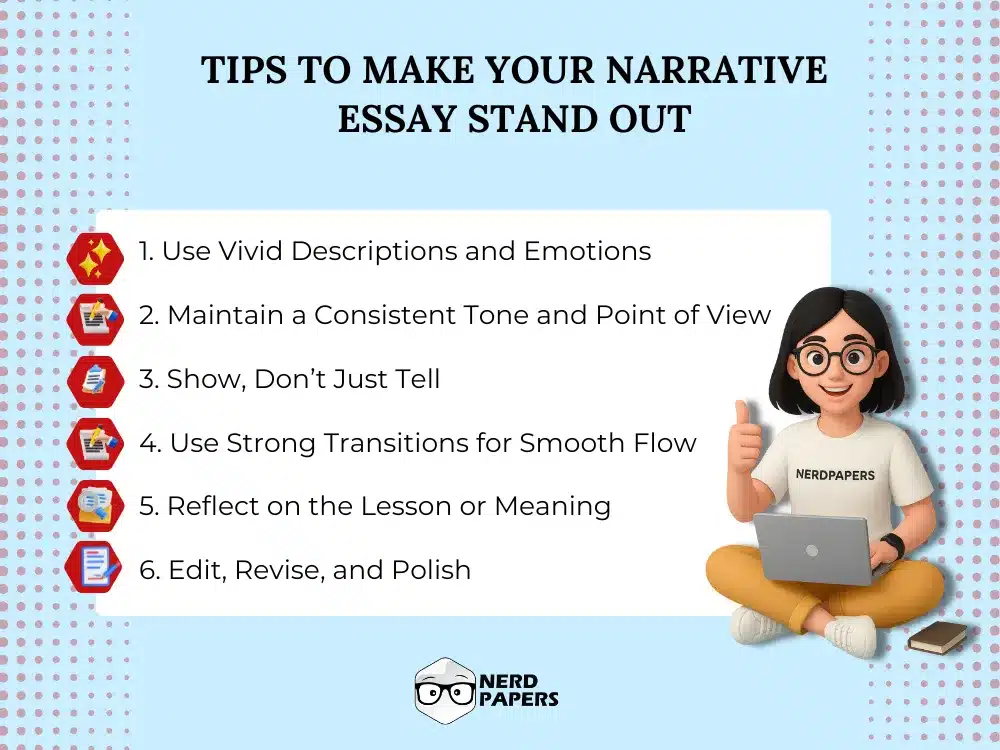
Tips to Make Your Narrative Essay Stand Out
It’s a fact that writing a narrative essay is more than just telling a story. The main objective is to make someone feel it. Instead of just summarizing what happened, a captivating narrative essay immerses readers in the action. The way you plan, explain, and reflect on an ordinary event can turn it into something remarkable.
These are some tried-and-true techniques to help your audience connect with your story.
1. Use Vivid Descriptions and Emotions
If you want your essay to come to life, show rather than tell. As if you were witnessing a scene from your past, describe what you heard, saw, or felt. Instead of using adjectives like lovely or good, use something more precise. Use sensory details, analogies, or even a little humor when appropriate.
“The sound of my name echoing in the auditorium made my heart race faster than I thought possible.”
That one line tells readers more than a whole paragraph of explanation ever could.
2. Maintain a Consistent Tone and Point of View
Choose whether to write in the first person (“I,” “me”) or third person (“he,” “she”) and stick to it. Random switching may confuse readers. Your tone is no different. Regardless of whether your story comes across as reflective, anxious, or hopeful, maintain that energy so that everything flows naturally. Being consistent doesn’t mean being boring. It simply keeps your story focused and realistic.
3. Show, Don’t Just Tell
Even though you’ve heard this rule a hundred times, there’s a reason it’s so well-known. Instead of verbally expressing your feelings, let your actions or speech do the talking.
❌ “I was nervous.”
✅ “My palms were sweating, and my voice cracked as I spoke.”
This small shift makes the reader feel your emotions rather than simply reading them.
4. Use Strong Transitions for Smooth Flow
An effective narrative is more similar to a dialogue than a list. Use transitional words such as first, meanwhile, after a while, suddenly, or eventually to link ideas. Think of them as the invisible threads that maintain the concentration of your reader from one scene to the next. With this simple solution, your story will continue to be easy to follow and far more enjoyable to read.
5. Reflect on the Lesson or Meaning
There should be a takeaway in every narrative essay. It can be something you learned, learned, or came to understand in a different way. Because of that reflection, your story becomes more than just an entertaining one.
“That small failure taught me that every setback is just a lesson in disguise.”
Without this final reflection, even a great story can feel unfinished.
6. Edit, Revise, and Polish
Once you’ve written your first draft, leave it for some time. Then read it again out loud if you can. You’ll catch awkward phrasing, grammar slips, or parts that drag your story.
While revising, focus on:
- Grammar and sentence flow
- Paragraph transitions
- Word variety and clarity
- Emotional impact
Polishing isn’t about perfection. It’s about making your essay sound like you on your best writing day.
Quick Recap:
- Be descriptive, not wordy.
- Keep your tone consistent.
- Let emotions show naturally.
- Add smooth transitions.
- Reflect on what the story means.
That’s the secret to writing a narrative essay that doesn’t just meet the assignment but actually stands out.
Common Mistakes to Avoid in a Narrative Essay
Even the best stories can fall behind if they’re not written carefully. Honestly, I’ve seen a lot of students write something interesting but still miss the mark because of a few simple mistakes. So, before you hit submit, double-check that your narrative essay avoids these common pitfalls.
1. Writing Without a Clear Theme or Purpose
A narrative essay isn’t just “something that happened.” It’s a story with meaning. If your essay doesn’t have a clear theme or takeaway, it might feel more like a diary entry than an academic story.
Before you even start writing, ask yourself:
“What’s the one lesson or message I want my reader to remember?”
Once you’ve got that, make sure every part of your essay supports it, from your introduction to your final reflection.
2. Including Unnecessary Details
IWe all do this, you start writing, get caught up in the moment, and suddenly your essay has three side stories and a random weather report. Too many details can drown your main point. Keep it focused. Only describe scenes or emotions that actually move your story forward.
3. Weak or Missing Thesis Statement
Even though it’s storytelling, your narrative essay still needs a thesis statement. The thesis statement is a single line that hints at the heart of your story. It’s like your essay’s compass; without it, readers might wonder where it’s all heading.
“The day I stood up for myself taught me that confidence begins with courage.”
That one line sets the tone, message, and direction for everything that follows.
4. Poor Transitions Between Events
Have you ever encountered a text that shifts abruptly from one scene to another, resembling a malfunctioning film? This is precisely what happens when transitions are overlooked. Incorporating linking words such as then, afterward, meanwhile, later on, or finally can significantly assist in directing your reader through the timeline of your narrative. Seamless transitions not only enhance the natural flow of your story but also give a sense of structure to your essay.
5. Ignoring Grammar and Sentence Variety
Even the most powerful story can lose its impact if it’s full of typos or repetitive sentence patterns. Editing isn’t just about fixing commas; it’s about creating a proper rhythm. If every sentence feels the same, your writing can start to sound robotic. Read your essay out loud. You’ll instantly spot where it feels too stiff or too long. Improve sentences, vary structure, and clean up small grammar errors.
6. Losing Focus on the Story’s Reflection
This one’s a classic mistake. Some writers stop right after the big moment, but the reflection is the moment that makes your essay meaningful.
Ask yourself at the end:
“So what? What did this experience actually teach me?”
Your answer is your reflection. That’s what turns your story into something readers connect with, not just something they read.
Narrative Essay in Action (A Short Illustration)
Understanding the structure of a narrative essay becomes easier when you see how each part connects. Below is a brief illustration (not a full essay) to show how introduction, body, and conclusion work together to tell a cohesive story.
I still remember standing on the stage for the first time, the spotlight blinding and the audience silent. My voice trembled, but somewhere in that silence, I found the courage to begin.
Body (Excerpt):Each word came out with hesitation, then strength. By the time I finished, the fear that once held me back was replaced by relief and pride.
Conclusion:That moment taught me that courage doesn’t always roar; sometimes, it whispers just loud enough to move you forward.
What This Shows
This short illustration highlights how an effective narrative essay:
- Starts with an engaging hook
- Builds emotion and tension in the body
- Ends with reflection and a lesson learned
It’s not about length, it’s about connection, meaning, and structure.
Conclusion
Writing a narrative essay isn’t just another classroom task. It’s honestly one of the few chances you get to write about yourself. It’s where structure meets storytelling, and emotion meets clarity. You’re not just putting words on paper; you’re shaping an experience into something readers can feel, understand, and maybe even relate But here a question comes into mind of many students, “how to write a good narrative essay?”.
When you sit down to write, think about what the story really means. What moment changed you? What lesson stuck with you afterward? Those are the stories that hit hardest, not because they’re perfect, but because they’re real.
A good narrative essay has rhythm: a hook that draws readers in, a body that builds emotion and flow, and a reflection that lingers long after the last line. From developing your plot and describing your characters to showing honest emotions, every piece plays its part in making your essay come alive.
So yeah, be creative, be honest, and don’t overthink every line. If it feels genuine, it’ll read genuine. With a bit of structure, some thoughtful reflection, and your own voice leading the way, you’ll learn how to write a narrative essay that’s more than just an assignment. It’s a story worth remembering.
Frequently Asked Questions About Narrative Essays
What is a narrative essay?
A narrative essay is basically a form of writing that tells a story. It is usually something that happened to you or taught you a lesson. It’s less about facts and more about emotions, reflection, and meaning. The goal is to engage readers through storytelling while maintaining a clear structure. That means you’re not arguing a point like in a persuasive essay. You’re sharing an experience that shows what you learned or realized.
What is the purpose of a narrative essay?
The goal is simple: to share a personal experience in a way that connects with readers. It’s about helping them see what you saw, feel what you felt, and understand how that moment changed you. Every strong narrative essay leaves readers with a takeaway or message that sticks.
How is a narrative essay different from a descriptive essay?
A descriptive essay focuses on painting a vivid picture like the sights, sounds, or feelings of a scene. A narrative essay, on the other hand, tells a whole story with a beginning, middle, and end. It includes characters, a conflict, and a reflection at the end that explains why the story matters.
What is the correct format for a narrative essay?
A good narrative essay format follows the classic three-part structure:
Introduction: Set the scene, add a hook, and hint at your main idea or lesson.
Body paragraphs: Tell the story in chronological order, with emotions, actions, and transitions.
Conclusion: Reflect on what you learned or how the event changed you.
Most students write in first person (“I,” “me”) since it feels more personal and direct.
Can a narrative essay be written in third person?
Yep, you can especially if you’re writing a fictional or creative story. Just make sure to stay consistent with your point of view. Switching back and forth between “I” and “he/she” can confuse readers and break the flow.
How do I start a narrative essay?
Start with a hook that instantly grabs attention maybe a quick scene, a question, or even a bold statement. Then give a little background and introduce your main theme or lesson.
Example:
“The moment I stepped off the plane, I knew my life was about to change.” That single line makes readers want to know what happens next.
What should a narrative essay include?
A strong narrative essay has a few must-haves:
A clear theme or takeaway
Real or well-developed characters
A logical structure (beginning → middle → end)
Vivid descriptions and emotions
A reflective conclusion that ties everything together
If you’ve got all that, you’re in great shape.
How long should a narrative essay be?
Most college narrative essays fall between 600 and 1000 words unless your professor says otherwise. That’s long enough to develop your story but short enough to keep readers engaged. The key is to stay focused; every paragraph should add something meaningful.