Ever started writing a story for class and halfway through realized you had no idea where it was going? Yeah, same. That’s exactly why a narrative essay outline exists to keep your story organized, meaningful, and actually fun to write.
A narrative essay isn’t just about retelling what happened; it’s about how you tell it. Think of the outline as your essay’s story map. It helps you decide where to begin, what details to include, and how to wrap everything up with a lesson or reflection that sticks. If you’re still figuring out the full writing process and wondering how to write a narrative essay, then you should master the process of creating the outline first. Once you understand that, you will be able to write good-quality narrative essays.
Honestly, once you’ve got your outline down, writing the essay feels way smoother. You don’t waste time figuring out what comes next or worry about losing your point halfway through. In this guide, I’ll show you exactly how to create a solid narrative essay outline (with examples and tips) so you can write your story like a pro without the stress.
What Is a Narrative Essay Outline?
Okay, so what exactly is a narrative essay outline?
Think of it as a blueprint for your story, a simple plan that helps you keep your ideas in order before you start writing. Instead of diving straight into paragraphs and hoping the story makes sense later, the outline gives you a clear picture of how everything fits together.
In most cases, a narrative essay follows a pretty familiar structure: introduction, body, and conclusion. But the magic is in how you arrange your story within that structure. Your outline acts like a story map — it helps you decide:
- Where your story begins
- Which events matter most
- How to transition between moments smoothly
- And how to end with a strong reflection or takeaway
Basically, it’s the difference between wandering around with a cool story idea and actually writing something that flows and keeps your reader interested from start to finish. If you are still looking for the perfect story to tell, start by browsing our narrative essay topics for students to find an idea that resonates with you.
If you’ve ever done a “plot outline” in creative writing or English class, this is kinda similar, just a bit more academic. You’re still writing about real experiences, but your outline ensures those experiences connect to a theme, emotion, or lesson learned.
Here’s a quick way to picture it:
Your narrative essay outline = a roadmap where each stop (intro, events, and conclusion) builds toward your destination, the main message you want readers to remember.
So before you even write that first line of dialogue or set the scene, it’s worth sketching out your outline. Trust me, it saves you from rewriting half your essay later.
Why You Need an Outline Before Writing
Honestly, skipping the outline is like showing up to a road trip without a map or GPS. You might get there eventually, but you’ll probably take a bunch of wrong turns first.
When you’re planning a narrative essay, it’s super tempting to just start writing the story in your head, wondering how to start a narrative essay. But that’s usually where things start to fall apart, scenes get mixed up, the tone shifts halfway through, and by the end, you’re not even sure what point you were trying to make. That’s why the outline matters way more than most people think.
A good narrative essay outline helps you:
- Keep your story in logical order (so events make sense).
- Make sure your theme or reflection actually shows up throughout the essay.
- Balance out your paragraphs so your intro isn’t three lines and your middle isn’t five pages.
- Stay focused on your main lesson or takeaway.
Plus, it saves a ton of time when editing later. Instead of fixing random sections or rewriting the whole essay, you’ll already have a clear essay organization from the start.
Here’s the thing: outlining doesn’t kill creativity. It just gives it direction. You can still add emotion, dialogue, and all those small details later, but the outline makes sure every part of your story leads somewhere meaningful.
So yeah, if you’ve ever written an essay that felt like it went off the rails halfway through, this is your sign to start with the outline next time. Your future self will thank you.
Basic Structure of a Narrative Essay Outline
Alright, let’s break down what your narrative essay outline actually looks like. The good news? It’s not complicated. You’re just giving shape to your story using the classic introduction–body–conclusion format. Think of it as setting up a solid frame before you fill in all the creative details.
1. Introduction
Your intro sets the stage kind of like the opening scene of a movie. It’s where you grab attention, give a little background, and drop your thesis statement (aka, the main point or lesson your story will show).
Here’s a simple way to think about it:
- Hook: Start with something that pulls readers in, a vivid moment, a question, or a feeling.
- Context: Give just enough background to make sense of what’s coming.
- Thesis: End the intro with what you learned or the main takeaway.
“When I moved to a new city for college, I thought I was ready for anything. Turns out, learning to be alone taught me way more about friendship than I expected.”
That single sentence sets up the story’s theme and gives the essay direction, exactly what your intro should do.
2. Body Paragraphs
This is the heart of your story, where the action happens. Each paragraph usually covers one key event or moment that moves the story forward.
A good rule of thumb is to follow chronological order (start to finish), unless you’re using flashbacks or creative sequencing. Within each paragraph, try to include:
- A topic sentence that signals the main event.
- Details and descriptions that help readers feel what you felt.
- Dialogue or thoughts to add emotion and realism.
- A short reflection or reaction so it ties back to your thesis.
You can think of your body like a story arc:
Beginning → Conflict → Climax → Resolution.
Paragraph 1 – The move and initial excitement
Paragraph 2 – Feeling out of place and lonely
Paragraph 3 – Finding connection and learning the lesson
By mapping out your essay body this way, you make sure every part of your essay actually connects to the main message.
3. Conclusion
Your conclusion brings everything full circle. It’s where you reflect, summarize what the experience taught you, and leave the reader with something to think about.
Avoid just repeating your thesis word-for-word. Instead, show growth or change. Maybe you started scared and ended confident, or you went from clueless to clear.
“Now, when I think about that first semester, it’s not the homesickness I remember, it’s how learning to be on my own helped me find the kind of friends who feel like home.”
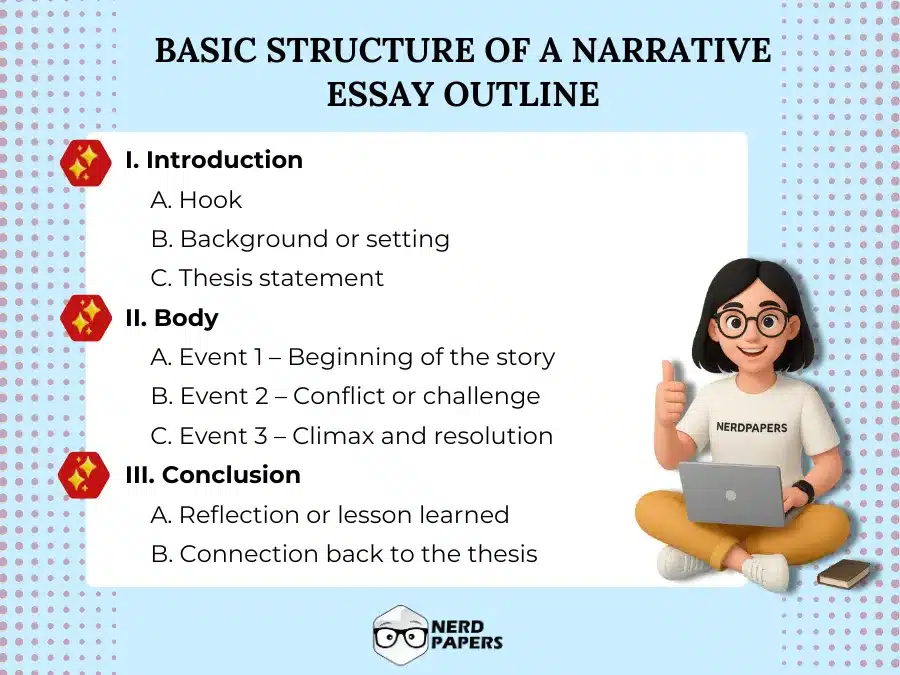
Sample Narrative Essay Outline Layout
I. Introduction
- A. Hook
- B. Background or setting
- C. Thesis statement
II. Body
- A. Event 1 – Beginning of the story
- B. Event 2 – Conflict or challenge
- C. Event 3 – Climax and resolution
III. Conclusion
- A. Reflection or lesson learned
- B. Connection back to the thesis
That’s your basic narrative essay structure: simple, flexible, and perfect for both high school and college essays. Once this is in place, writing becomes way more about creativity than chaos.
How to Create a Narrative Essay Outline (Step by Step)
So now that you know what a narrative essay outline looks like, let’s get into how to actually make one. Don’t worry, it’s not one of those painful, overcomplicated writing tasks. Once you get the hang of it, outlining your story becomes almost automatic.
Here’s a simple step-by-step guide you can follow, whether you’re writing a personal story, a college application essay, or just something for class.
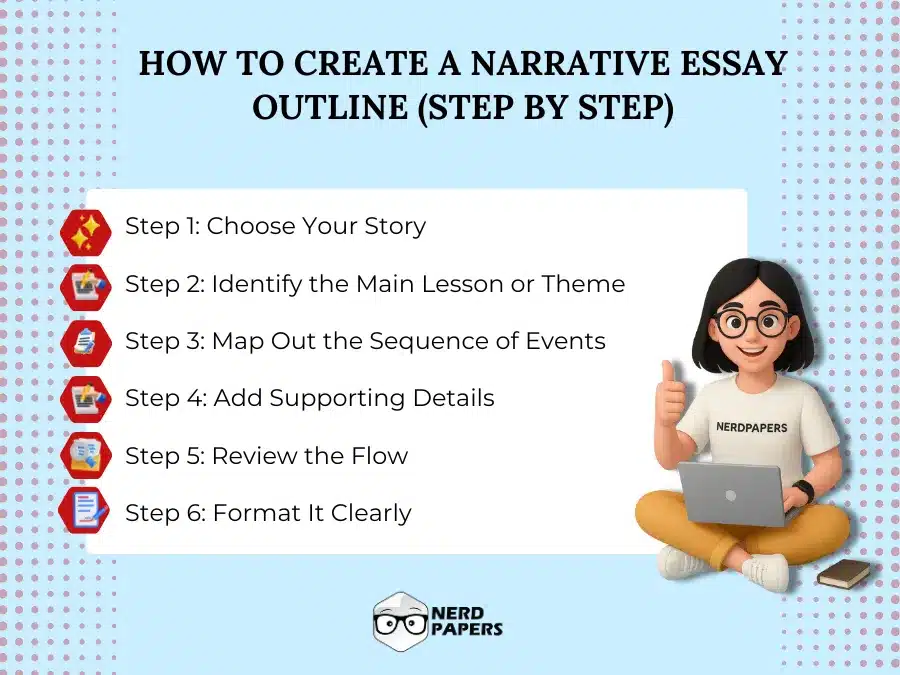
Step 1: Choose Your Story
Pick something that actually matters to you, like a small but meaningful experience. It doesn’t have to be dramatic. It could be the time you failed a test, got lost on campus, or made a tough decision.
What matters is that there’s a lesson or reflection behind it.
“The day I missed my bus and realized I needed to slow down.”
Step 2: Identify the Main Lesson or Theme
Ask yourself, What’s the point of my story?
Your answer becomes the thesis statement; it’s what ties the whole essay together.
“Sometimes the moments that frustrate us most are the ones that end up teaching us patience.”
Keep this sentence in mind while you outline everything else; it’s your essay’s “north star.”
Step 3: Map Out the Sequence of Events
Now it’s time to plan the flow of your story.
List out your key moments in order: beginning, middle, end.
Try this format:
- Start with where and when it happened.
- Then note down the main conflict or turning point.
- End with the resolution or reflection.
This is the part that keeps your story from jumping all over the place. A clear sequence = an essay that makes sense.
Step 4: Add Supporting Details
Here’s where your creativity kicks in. For each event, jot down:
- Sensory details (what you saw, felt, heard, or even smelled)
- Dialogue or thoughts that add emotion
- Actions or reactions that show growth
These will become the body paragraphs of your essay later on. Basically, this is where you turn plain storytelling into something your reader can feel.
Step 5: Review the Flow
Once your outline’s filled out, read through it like you’re watching a movie. Does everything connect smoothly? Is there a clear beginning, middle, and end? Does your main point still come through?
If not, shuffle things around. Don’t be afraid to move a moment or cut a detail that doesn’t serve your main theme. This part is about refining the narrative structure until it feels natural.
Step 6: Format It Clearly
Finally, clean up your outline so it’s easy to follow.
You can use:
- Roman numerals (I, II, III) for main sections
- Bullets or letters (A, B, C) for smaller details
I. Introduction – When I moved out for the first time
II. Body – Challenges, homesickness, growth
III. Conclusion – Learning independence and gratitude
Neat formatting might not seem like a big deal, but it saves you time when you actually start writing your essay later.
Narrative Essay Outline Example (for College Students)
Alright, let’s put all this into action. Here’s what a narrative essay outline example might look like for a typical college student.
Let’s say your story is about “the day I bombed a presentation but ended up learning how to handle failure.” It’s personal, reflective, and something most of us can relate to.
Topic: The Presentation That Went Wrong
Theme: Growth comes from embarrassment and self-awareness
Essay Type: College Narrative Essay
Sample Narrative Essay Outline
I. Introduction
- Hook: “My palms were sweaty, the slides weren’t loading, and I could literally hear my heartbeat in my ears.”
- Background: Talk about why this presentation mattered (maybe it was for a major grade or your first big college class).
- Thesis: “Failing that presentation was humiliating, but it ended up teaching me confidence in the weirdest way.”
II. Body Paragraphs
- A. Paragraph 1 – The Build-Up
- Introduce the class, your nerves, and how much effort you put into preparing.
- Show your expectations vs. what actually happened.
- Add sensory details: your shaking hands, the silence in the room, the click that didn’t work.
- B. Paragraph 2 – The Failure
- Describe the moment things went wrong (slides freezing, losing your spot, forgetting lines).
- Show emotion through dialogue or thoughts: “I could feel everyone’s eyes on me, and all I wanted was for the floor to open up.”
- Reflect briefly: how it felt in that moment, what went through your mind.
- C. Paragraph 3 – The Reflection
- Explain what happened after talking to your professor, realizing it wasn’t the end of the world.
- Add a realization: “I realized I wasn’t afraid of public speaking. I was afraid of not being perfect.”
- Show how you grew or changed after the experience.
III. Conclusion
- Tie it all back to your thesis.
- End with a reflective thought or image: “Now, when I present in class, I still get nervous, but it’s the good kind. The kind that means I care.”
- Optional: mention how that experience changed your approach to future challenges.
Quick Breakdown
| Section | Purpose | Example Focus |
| Introduction | Grab attention & show what the story’s about | “The day everything went wrong” |
| Body | Build the story through 3–4 events | Prep → Mistake → Lesson |
| Conclusion | Reflect and show growth | Confidence through failure |
That’s your go-to college narrative essay outline example. It’s real, emotional, and structured, but still sounds like something you’d actually write, not something a robot would. You can swap in your own story (like learning independence, taking risks, or making tough choices) and use this same framework.
Tips for Making Your Narrative Essay Outline Stand Out
Alright, you’ve got your structure and even a narrative essay outline example to follow, but how do you make your story stand out instead of sounding like everyone else’s “lesson learned” essay? Here’s the deal: good storytelling is less about fancy words and more about how real it feels.
Here are some tried-and-true tips that’ll take your outline (and essay) from “meh” to memorable:
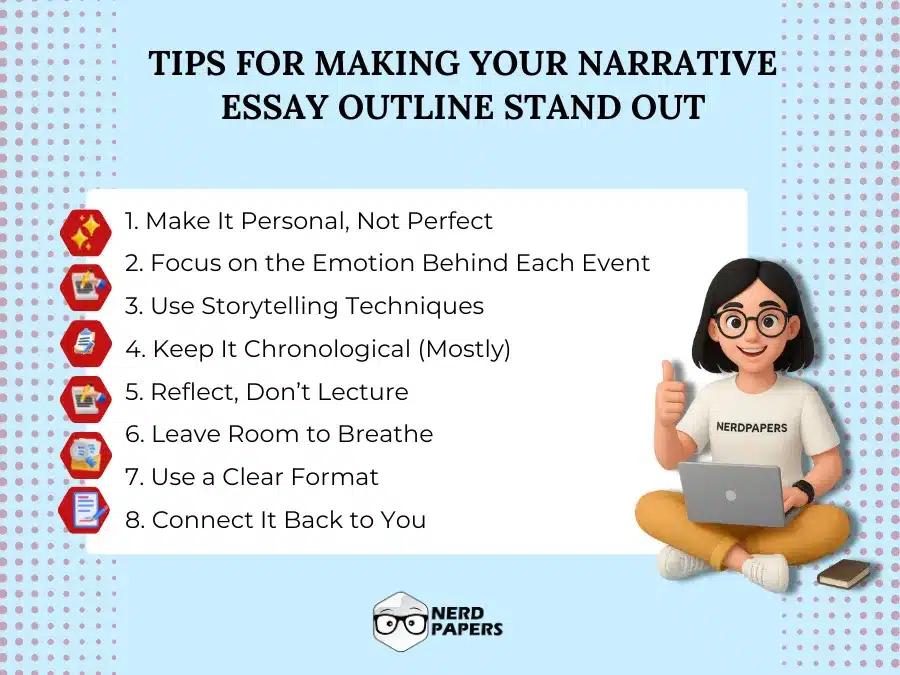
1. Make It Personal, Not Perfect
Don’t try to sound like a philosopher. Just be real. The best college narrative essays usually come from honest moments, things you actually felt, not what you think sounds deep. Even a small story (like missing a bus or failing a quiz) can hit hard if it feels genuine.
2. Focus on the Emotion Behind Each Event
When outlining, jot down how you felt during each key moment: nervous, hopeful, embarrassed, relieved. These emotional cues guide how you’ll write your body paragraphs later and help readers connect.
3. Use Storytelling Techniques
Great essays borrow tricks from good stories. Add:
- Imagery (“The cafeteria smelled like burnt coffee and nerves”)
- Dialogue (“‘You’ll do fine,’ my roommate whispered, even though she didn’t sound convinced”)
- Sensory details (what you saw, heard, or even thought at the time)
These bring your essay to life without overdoing it.
4. Keep It Chronological (Mostly)
Unless you’re super confident with structure, stick to a simple timeline. It keeps your story easy to follow and prevents readers from getting lost. Save creative flashbacks or nonlinear writing for when you’re more experienced.
5. Reflect, Don’t Lecture
The reflection in your outline that (final takeaway) shouldn’t sound like a moral lesson. Instead of saying, “I learned that teamwork is important,” show how the experience changed your perspective.
“After that group project, I stopped waiting for others to lead and I became the kind of person who does.”
That subtle shift makes a huge difference.
6. Leave Room to Breathe
Don’t overstuff your outline. You’re just setting the path, not writing the full essay yet. It’s okay to leave space for new ideas or emotions that come up once you start writing. Flexibility is key.
7. Use a Clear Format
Whether it’s a narrative essay template or your own bullet-point style, make sure your outline is easy to skim. Your future self (the one writing at 2 a.m. before the deadline) will seriously appreciate it.
8. Connect It Back to You
Every great narrative essay comes full circle. It starts with an event and ends with reflection. Make sure your outline shows that transformation clearly. That’s what turns a story into a lesson.
Basically, your outline isn’t just notes; it’s the foundation of your story’s meaning. The more intention you put into it now, the easier it’ll be to write something that actually sounds like you.
Common Mistakes Students Make
Let’s be real. Most of us mess up our first few narrative essays. It’s not because we can’t write; it’s usually because we get so caught up in telling the story that we forget about structure.
Here are some of the most common mistakes students make when creating a narrative essay outline (and how to avoid them).
1. Writing Without a Point
You can tell an amazing story, but if there’s no lesson or reflection, it just feels incomplete. Your essay shouldn’t just say what happened. It should show why it mattered.
Fix it: Before writing, figure out your core message in one line. That’s your compass.
2. Dumping Every Detail
We’ve all done it, trying to include everything that happened, down to what color shoes someone was wearing. But too many random details bury your main story.
Fix it: Only keep details that build the mood, show emotion, or connect to the theme. If it doesn’t move the story forward, it can go.
3. Losing Chronological Order
Sometimes essays jump around so much they start to feel like a time-travel movie gone wrong.
Fix it: Stick to a clear essay organization, beginning, middle, and end. You can get creative later, but first, nail the timeline.
4. Weak Introductions
Your intro is the hook. If it’s bland, readers check out fast.
Fix it: Start with a moment of action or tension, something that instantly sets the scene.
“The clock hit 8:30 a.m., and I realized I’d just slept through my final exam.”
Now that gets attention.
5. Forgetting the Reflection
The conclusion of a narrative essay is more than just wrapping up the story; it’s where you show growth.
Fix it: Always circle back to your thesis or main insight. How did this moment change you? What did you learn?
6. Overexplaining the Lesson
You don’t need to end your essay with, “And that’s how I learned…” It feels forced.
Fix it: Let your reflection feel natural. Subtlety hits harder than spelling it out.
7. Not Revisiting the Outline
A lot of students make an outline and then never look at it again.
Fix it: As you write, use your narrative essay outline as a checkpoint. It keeps you on track, especially when your draft starts drifting.
Basically, most narrative essay problems come down to organization and focus. If your outline is tight, your essay usually will be too. And honestly, learning to organize your thoughts this way helps way beyond English class; it’s the same skill you’ll use in college applications, speeches, and even job interviews.
Conclusion
At the end of the day, a narrative essay outline isn’t some boring assignment’s honestly, it’s your secret weapon for writing stories that make sense and hit hard. It’s what keeps your essay from turning into a random stream of thoughts and helps you actually say something that matters.
When you take a few minutes to plan out your introduction, body, and conclusion, you’re not just organizing words—you’re shaping your story into something that flows, connects, and reflects who you are. Whether you’re writing about a life-changing moment or something small that taught you a lesson, the outline makes sure your message comes through clearly.
FAQs About Narrative Essay Outlines
What is a narrative essay outline?
It’s basically a plan or framework for your story. A narrative essay outline helps you organize your thoughts so your essay has a clear beginning, middle, and end instead of feeling all over the place.
How do I write a narrative essay outline?
Start by picking your story, identifying the main lesson, and listing the events in order. Then break it into sections: introduction, body, and conclusion. It’s like sketching your story before painting it.
What should be included in each part of the outline?
Your introduction should have a hook and thesis, the body paragraphs should describe events in order, and the conclusion should reflect on what you learned. Keep it simple and natural.
How many paragraphs should a narrative essay outline have?
Most college narrative essays have 4–6 paragraphs: one intro, two or three body paragraphs, and one conclusion. But it’s okay to add more if your story needs extra space.
Can I write a narrative essay without an outline?
You can, but it’s risky. Without an outline, it’s easy to lose focus or forget your main point halfway through. The outline saves time and makes your story flow smoothly.
What’s the difference between a story and a narrative essay?
A story can just entertain. A narrative essay does that and teaches something. It’s about sharing a real experience that reveals a personal insight or change.
How long should a narrative essay outline be?
Usually, just one page is enough. It doesn’t need full sentences — short notes or bullet points work best. Think clarity, not perfection.
Do college essays follow the same outline format?
Yep! A college narrative essay outline follows the same structure: intro, body, conclusion, just with a more mature reflection or theme. The storytelling vibe stays the same.