Have you ever finished writing a narrative essay but run into trouble with the final paragraph? Deciding how to end a narrative essay can sometimes become more difficult than actually crafting the narrative. The conclusion should be powerful without becoming overdone. Reflective, but not to the extent of teaching a life lesson that your teacher never asked you to teach them.
In reality a strong narrative essay conclusion doesn’t have to be lengthy or dramatic. It just needs to give your reader a sense of completion. Think of it like taking a step back from your own experience for a second and saying, “Okay, here’s what that moment really meant.” When you do that, the whole essay feels complete.
If you’re still learning the basics of writing a narrative essay, it might be useful to start with the bigger picture. You first have to learn how to write a narrative essay. This will help you understand the full process from start to finish.
You will know exactly how to wrap up a narrative essay in a way that is truly comprehensive, meaningful, and appears natural by the time you have finished reading. I’ll cover the different types of endings you can use when writing your narrative essay conclusion.
We will also discuss how to write a strong conclusion, and some examples you can use as a reference. By the end of the blog, you will be able to identify the typical errors students make when completing their stories. It’s all simple, practical, and stuff you can use immediately. It does not matter whether your essay is personal, emotional, or just a funny story for class.
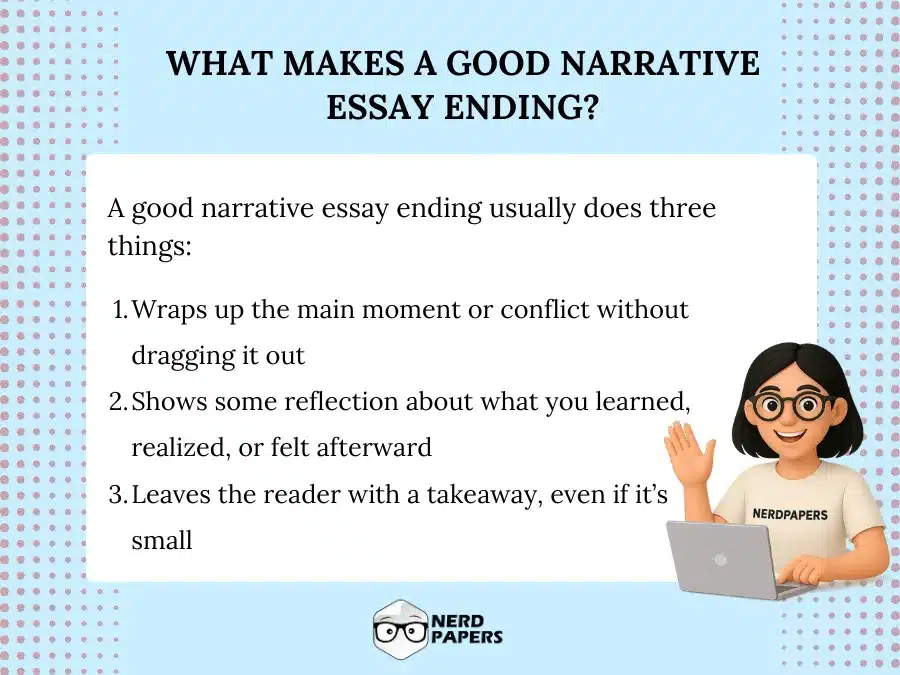
What Makes a Good Narrative Essay Ending?
A strong ending isn’t about sounding dramatic or dropping some mind-blowing quote. It’s really about closure. Your reader should get the impression that the story has naturally ended. This shows that you have stepped back to highlight the significance of the whole incident.
A good narrative essay ending usually does three things:
- Wraps up the main moment or conflict without dragging it out
- Shows some reflection about what you learned, realized, or felt afterward
- Leaves the reader with a takeaway, even if it’s small
Picture it this way: the introduction of a narrative essay draws the reader in, the body leads them through the experience, and the conclusion informs them of the story’s significance. When you accomplish those three objectives, your narrative essay’s conclusion feels completed rather than rushed or scattered.
Types of Narrative Essay Endings (With Examples)
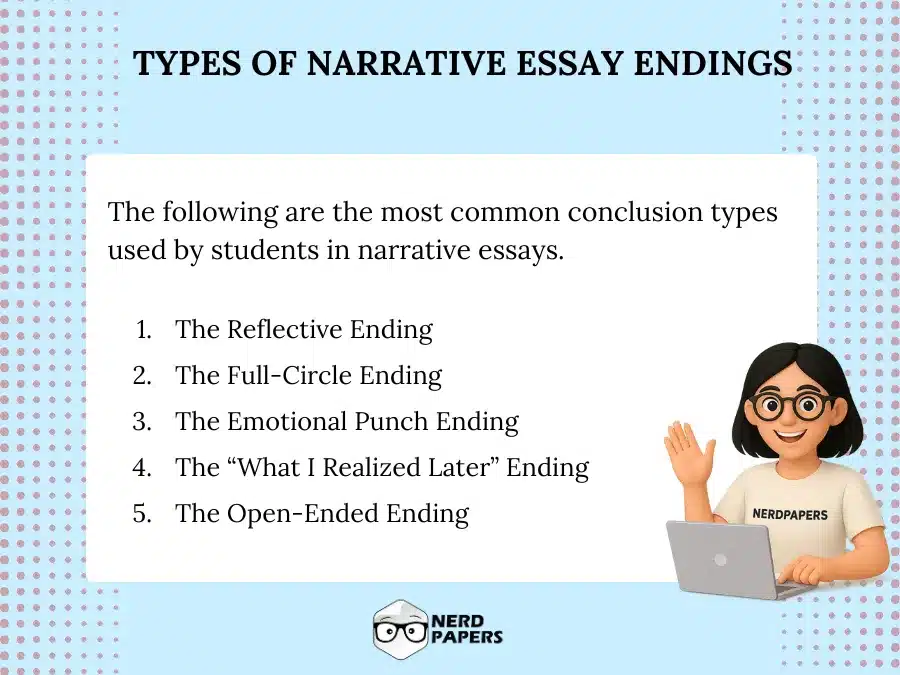
There are several ways to wrap up a story. Different endings evoke different emotions. Any experience you choose will depend on what you’re writing about. The following are the most common conclusion types used by students in narrative essays. And, to be honest, the ones that teachers find most enjoyable to read:
1. The Reflective Ending
This is the classic “here’s what I learned” ending. It’s not meant to sound self-righteous. It’s just you looking back at the moment from a slightly older, slightly wiser angle.
“Looking back, I didn’t realize that saying ‘yes’ to that last-minute volunteer shift would end up being the moment I found the career I actually wanted.”
2. The Full-Circle Ending
The full-circle ending brings the story back to something from the introduction. This can be an image, a line of dialogue, a question, or even a small detail you mentioned early on.
If your intro started with you staring at a blank stage, the ending might be:
“And just like at the beginning, I found myself standing on an empty stage, but this time, I wasn’t scared anymore.”
3. The Emotional Punch Ending
The emotional punch ending is short, simple, and hits the reader with a feeling. The feeling can be of hope, sadness, relief, realization, or anything.
“I didn’t say anything to my mom. I just hugged her, finally understanding what she had been trying to tell me all along.”
4. The “What I Realized Later” Ending
This one takes a slight leap forward in time. It works well for tales in which the lesson wasn’t immediately clear.
“At the time, it felt like a normal Tuesday. It wasn’t until months later that I realized it was the day everything quietly shifted.”
5. The Open-Ended Ending
The open-ended ending leaves a little bit of mystery or room for imagination. This type of ending is perfect for stories that don’t need a neat ribbon tied around them.
“I still don’t know what will happen next, but for once, I’m okay with that.”
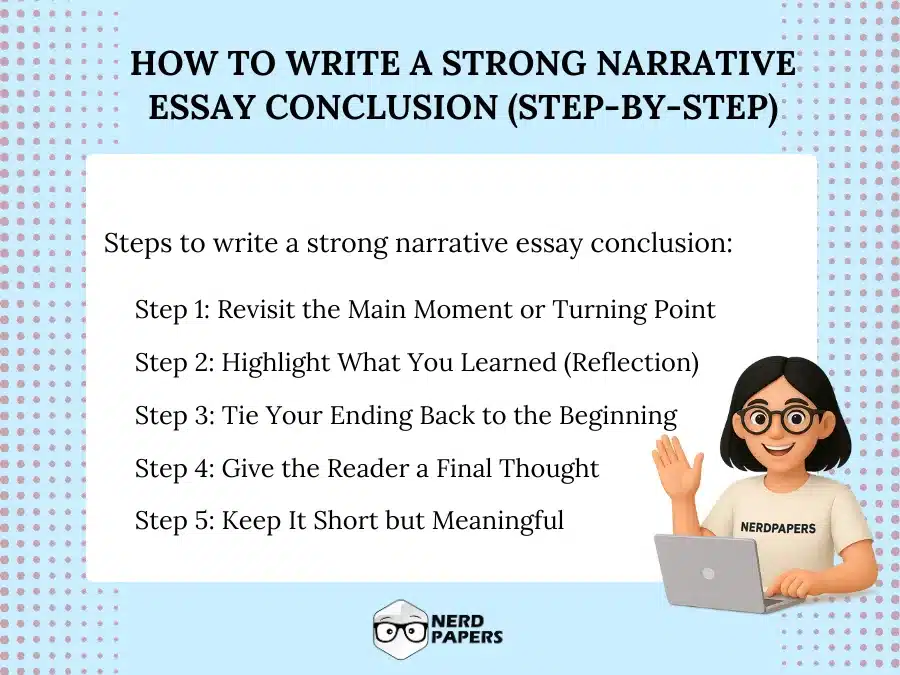
How to Write a Strong Narrative Essay Conclusion (Step-by-Step)
It’s not the goal of your narrative essay conclusion to tell the whole story again. The ending of your narrative essay gives you some room to convey the importance and a concise overview of your story. Here’s a quick and easy way to do it without thinking too much.
Step 1: Revisit the Main Moment or Turning Point
Remember the moment that changed your life, whether it was the debate, the surprise, the challenge, or the decision. Bring the reader back to that particular time to make everything feel connected.
“When I think about that night again, it’s the look on my brother’s face that I keep returning to.”
Step 2: Highlight What You Learned (Reflection)
This doesn’t have to be a completely life changing lesson. A tiny insight is important. Simply describe how the experience changed your viewpoint.
“It sounds small, but that day taught me how much slowing down actually matters.”
Step 3: Tie Your Ending Back to the Beginning
Tie Your Ending Back to the Beginning. This is a straightforward method that gives your essay a sense of purpose. To see this technique used effectively, look at these detailed narrative essay examples for students. You will notice how the writers revisit a line or image from their introduction to make the whole story feel like a complete circle.”
Example:
If you started with losing your balance on a skateboard, the ending might be:
“I’m still not great at skating, but I’ve learned how to stay balanced in other ways.”
Step 4: Give the Reader a Final Thought
Leave them with a feeling, takeaway, or small insight. It doesn’t need to sound like a lesson, just genuine reflection.
“Sometimes the hardest decisions end up being the ones that move you forward the most.”
Step 5: Keep It Short but Meaningful
Your conclusion shouldn’t be longer than the body paragraphs. A few thoughtful lines are enough. Don’t retell the whole story.
Quick reminder:
- No new characters
- No new events
- No sudden plot twists
Just clean, simple closure.
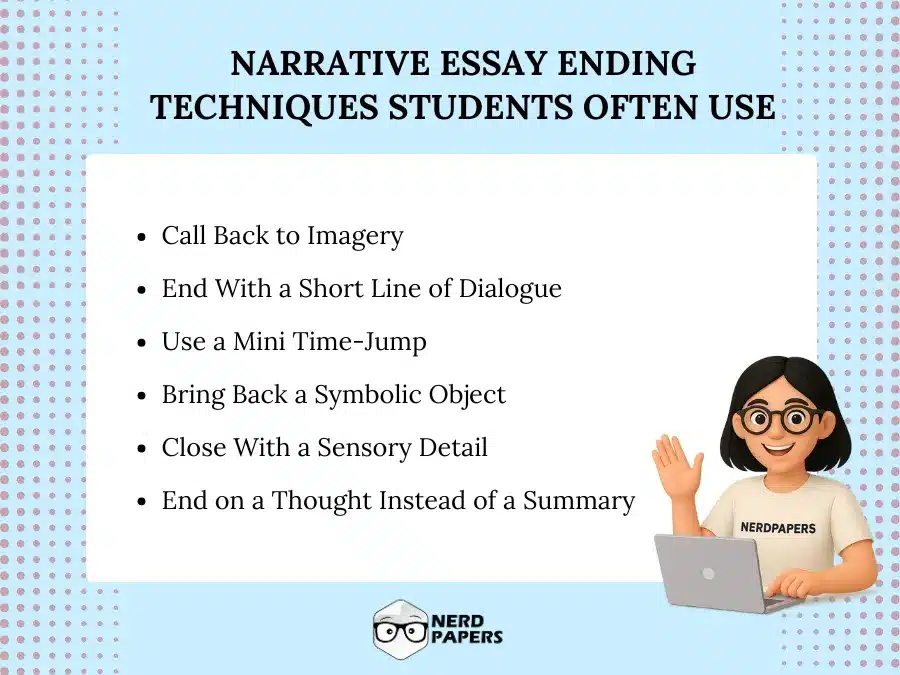
Narrative Essay Ending Techniques Students Often Use (That Actually Work)
Writing a narrative essay conclusion doesn’t require many advanced skills. Most great endings start with basic storytelling techniques. These techniques give your final paragraph a feeling of purpose and connection to the rest of your narrative essay. These are a few that almost always work:
Call Back to Imagery
Reusing a small detail from earlier in your essay makes the ending feel smooth and complete.
Mentioning the same song, object, or place from your intro.
End With a Short Line of Dialogue
Your story’s emotion or message can be briefly expressed in a single line of dialogue without going into too much detail.
A final “You did great” from someone important in the story.
Use a Mini Time-Jump
A slight forward step, such as “months later” or “senior year,” can occasionally add a more reflective tone to the conclusion without dragging it.
Bring Back a Symbolic Object
In your story, small objects can represent more complex meanings. These items could be anything from a broken pencil to a pair of shoes, a backpack, or a bracelet. It can make your conclusion feel strong to finish with the same item, like your inro.
Close With a Sensory Detail
Readers can benefit in “feeling” the conclusion by a scent, sound, or visual moment, which makes it seem as the story ends organically.
End on a Thought Instead of a Summary
Instead of rewriting your story, end with a simple reflective thought that hints at what the experience meant to you.
Mistakes to Avoid When Ending a Narrative Essay
Many students find it difficult to wrap up a narrative essay. When they write the conclusion of their narrative essay, they unknowingly make a lot of mistakes. Because of this, many narrative essays lose their impact in the last paragraph. The ending seemed rushed or forced, but that doesn’t mean the story wasn’t good. Here are some things to be aware of:
Over-Explaining the Lesson
You don’t need to state the lesson explicitly, such as “The moral of this story is…” Allow the reflection to unfold organically. It only takes a simple thought.
Adding New Information
Your conclusion isn’t the place to introduce a new character, a new scene, or a twist. That just confuses the reader and feels disconnected.
Making the Ending Too Long
A narrative essay ending should be short and meaningful. If it’s longer than your body paragraphs, it starts sounding repetitive.
Ending Abruptly
Don’t stop the essay right after the climax. Give the reader a moment to breathe and see what the event meant to you.
Repeating the Intro Word-for-Word
Bringing back an idea from the beginning is good. Copy-pasting the whole thing? Not so much. It should feel intentional, not recycled.
Short Narrative Essay Conclusion Examples (Student-Friendly)
Sometimes it’s simpler to grasp how to end a narrative essay when you watch it in action. Here are some examples of narrative essays for your better understanding. These brief examples are prepared precisely as a learner would wrap up a narrative.
1. Reflective Ending Example
“I didn’t think a simple group project would change anything, but it honestly taught me how much patience I was missing. Now, every time I work with new people, I remind myself of that day and try to be the version of me I needed back then.”
2. Full-Circle Ending Example
“In the beginning, I couldn’t even make myself step onto the field without shaking. But standing there after the final whistle, sweaty and smiling, I realized I wasn’t afraid anymore. The same field that once terrified me ended up feeling like home.”
3. Emotional Punch Ending Example
“When she finally let go of my hand, I knew things wouldn’t ever be the same, but for once, I was okay with that.”
4. ‘What I Realized Later’ Ending Example
“At the time, I didn’t understand why that conversation mattered. But looking back now, I can see it was the moment I started growing into a completely different version of myself.”
5. Open-Ended Ending Example
“I still don’t know exactly where that choice will lead me, but I’m finally willing to see what happens next.”
The examples above show different strategies for writing a conclusion without coming across as inflexible or overly “essay-like.”
Conclusion
A narrative essay doesn’t need to have a spectacular ending. Saying, “This is why this story was important,” is essentially what it requires. But you should know how to end a narrative essay with impact. It does not matter whether you conclude with a thought, a full-circle moment, or a brief takeaway. The main goal is to make your reader feel as if the story truly went somewhere.
And once you get the hang of it, writing the conclusion ultimately turns out to be one of the easiest parts. This is your chance to pause, think back on the past, and show that you have changed, even if it is only just a little.
FAQs
What’s the main purpose of a narrative essay conclusion?
A narrative essay conclusion gives your story meaning. It helps the reader understand what the experience taught you or why it mattered, without turning it into a lecture.
How long should the ending of a narrative essay be?
Usually just a short paragraph, around 3–5 sentences. The goal is reflection and closure, not repeating your whole story.
Can I use dialogue in the conclusion for my narrative essay?
Absolutely. A quick line of dialogue can be a powerful way to wrap up the moment, especially if it connects back to something earlier in the story.
Should I restate the thesis in a narrative essay ending?
Not in a formal way. Narrative essays are more personal, so focus on the lesson or insight instead of a textbook-style thesis restatement.
How do I show what I learned in my narrative essay conclusion without sounding cheesy?
Keep it simple and honest. Instead of forcing a “moral,” just explain what changed for you even if it’s something small.
How can I make my narrative essay ending emotional?
Use imagery, a quick moment of reflection, or a short memory that captures how you felt. Emotional endings usually come from real, specific details.
Can a narrative essay end with a question?
Yes, especially for open-ended conclusions. A thoughtful question can leave the reader thinking without feeling unfinished.
What are some easy techniques to end a narrative essay?
Try calling back to an earlier detail, using a reflective sentence, adding a symbolic object, or doing a small time jump. These techniques help your final paragraph feel natural and complete.