

Ever stared at a blank page wondering where to begin? You’re not alone. Most students struggle not because they don’t have ideas, but because they don’t know how to organize them. That’s where an essay outline comes in—it’s your writing roadmap, guiding every paragraph from introduction to conclusion.
Think of it this way: if writing an essay is like building a house, your outline is the blueprint. Without it, things fall apart. With it, everything fits together smoothly.
Before you dive into writing, it’s important to understand what an essay outline is, why it matters, and how to create one that actually helps you write faster and better.
If you’re still working on planning or structuring your essay overall—like deciding on sections or refining your thesis—make sure you start with our complete guide on How to Write an Essay first. It will give you the foundation you need to build a great outline.
In this blog, you’ll learn:
- What an essay outline is (with simple examples)
- The key components every outline should include
- The most common outline formats (and how to use them)
- Outline templates for different essay types
- Step-by-step guide to creating your own essay outline
- Smart tips to make your outline actually useful
What Is an Essay Outline and Why It’s Essential
An essay outline is a simple plan that organizes your ideas before you start writing. It’s like a map that shows where your essay is going—from the introduction to the conclusion—and helps you stay on track while writing.
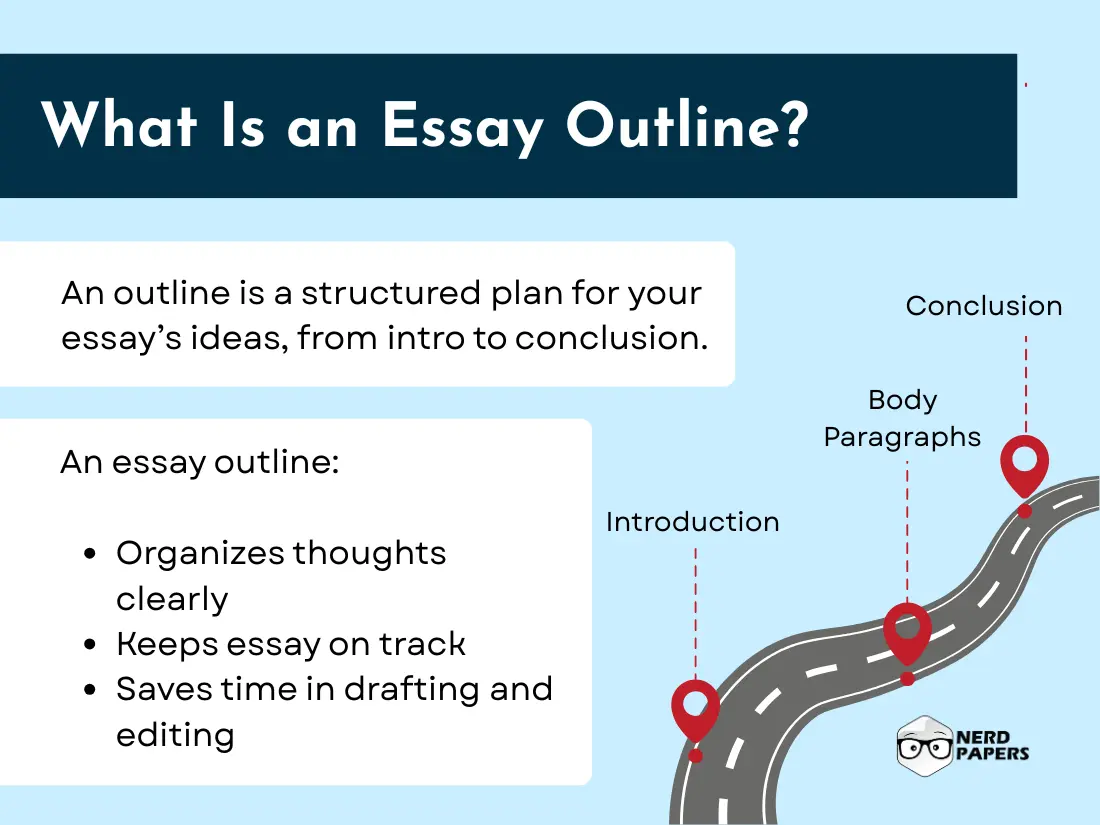
Instead of jumping straight into paragraphs, an outline lets you:
- Arrange your thoughts logically
- Group similar ideas together
- Avoid forgetting key points
- Create smoother transitions between sections
- Save time when writing and editing
Without an outline, your essay might feel disorganized or hard to follow. But with one, everything flows in the right order—making your argument clearer and your writing stronger.
In academic writing, outlines are often part of the prewriting process. Research shows that outlining improves content structure, strengthens argument development, and reduces writer’s block (Patterson & McMahan, 2016). It’s not just about planning—it’s about writing smarter.
Let’s say you’re writing an essay about climate change. Without an outline, you might jump from causes to solutions to statistics in a random order. But with an outline, each section is planned ahead:
- Introduction with your thesis
- Paragraph 1: Causes
- Paragraph 2: Effects
- Paragraph 3: Possible Solutions
- Conclusion to wrap it up
That structure makes your essay easier to write and easier to read.
Key Components of a Strong Essay Outline
A solid essay outline breaks your ideas into three main sections: the introduction, body paragraphs, and conclusion. Each part has a specific role—and knowing what to include helps you stay organized and focused.
Let’s look at each component in detail:
1. Introduction
This is where your essay begins—and it sets the tone for everything that follows.
Your outline should include:
- Hook – A sentence that grabs the reader’s attention
- Background info – Brief context about the topic
- Thesis statement – Your main argument or central idea
2. Body Paragraphs
These are the core of your essay. Each paragraph should focus on a single idea that supports your thesis.
For each body paragraph, outline:
- Topic sentence – Introduces the paragraph’s main point
- Supporting evidence – Facts, examples, or quotes that back up your point
- Analysis or explanation – Explains how the evidence supports your thesis
- Transition – A sentence that connects this paragraph to the next
3. Conclusion
The conclusion wraps up your essay and reinforces your main idea without adding new information.
Outline the following:
- Restated thesis – Reword your original thesis in a new way
- Summary of key points – Brief recap of your arguments
- Final insight or reflection – End with a powerful thought, takeaway, or call to action
By outlining each of these parts clearly, you’ll have a roadmap to follow when it’s time to write. It’s not just about listing ideas—it’s about structuring your thoughts so your essay is clear, convincing, and easy to read.
Common Essay Outline Formats (With Examples)
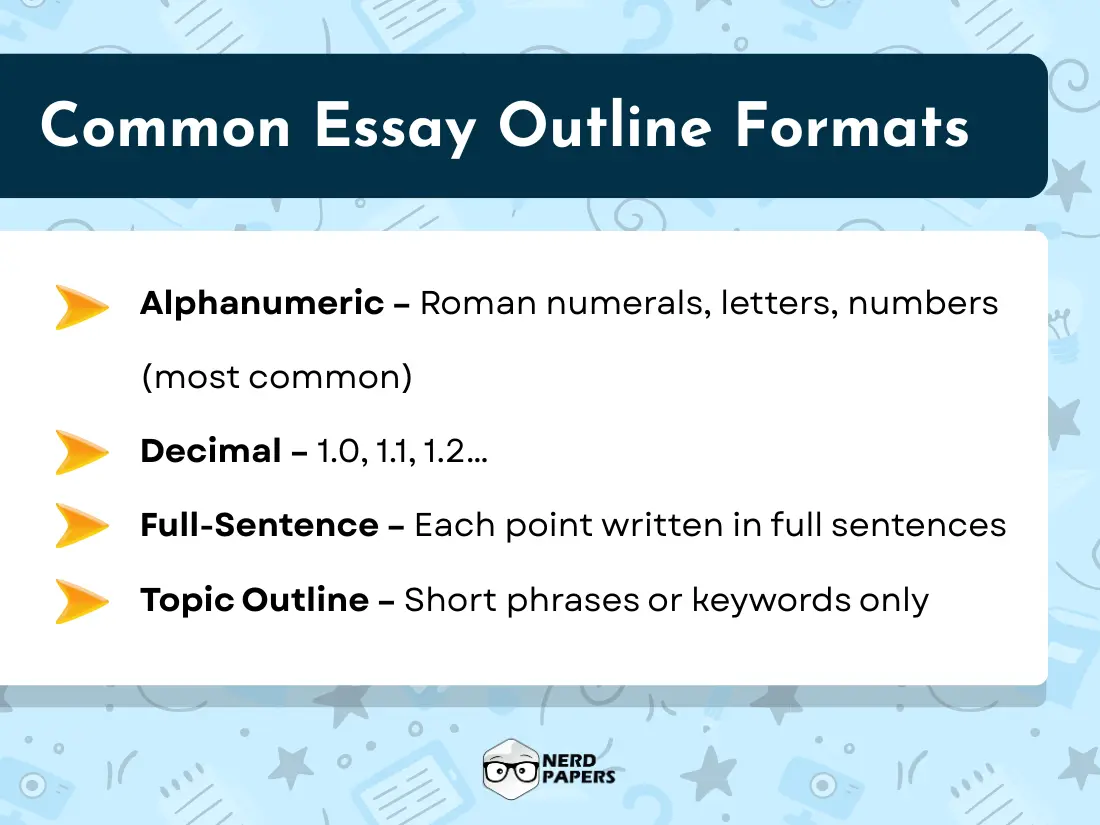
There’s no one-size-fits-all approach to outlining, but most academic essays follow one of these common formats. Choosing the right one depends on your assignment, essay type, and personal writing style.
1. Alphanumeric Outline (Most Common)
This is the standard outline used in schools and colleges. It uses Roman numerals, capital letters, numbers, and lowercase letters.
I. Introduction
A. Hook
B. Background
C. Thesis
II. Body Paragraph 1
A. Topic Sentence
B. Evidence
C. Analysis
III. Body Paragraph 2
A. Topic Sentence
B. Evidence
C. Analysis
IV. Conclusion
A. Restate Thesis
B. Summary
C. Final Thought
This outline is best for Standard essays, school assignments, and research papers.
2. Decimal Outline
This format replaces Roman numerals with decimal notations, which some find easier to organize and expand.
1.0 Introduction
1.1 Hook
1.2 Background
1.3 Thesis
2.0 Body Paragraph 1
2.1 Topic Sentence
2.2 Evidence
2.3 Explanation
3.0 Conclusion
3.1 Restate Thesis
3.2 Summary
3.3 Final Reflection
This outline is best for Technical essays or complex assignments where deep sub-sections are needed.
3. Full-Sentence Outline
Each section and subpoint is written as a full sentence, not just a short phrase.
I. The internet has changed the way students conduct research.
A. Many students now rely on digital libraries instead of physical ones.
B. Online databases make sources more accessible.
II. Teachers are adapting assignments to prevent overuse of AI tools.
This outline is best for Detailed planning or when you want your outline to double as a rough draft.
4. Topic Outline
This is the simplest format—just short phrases or keywords to organize your ideas.
I. Essay writing challenges
II. Outline as a planning tool
III. Parts of an essay
IV. Example outline formats
This outline is best for Quick brainstorming or casual assignments.
Different essays call for different structures. Whether you’re writing a personal story or building a strong argument, your outline should match the essay’s purpose and tone.
How to Write an Essay Outline: Step-by-Step Process
Creating an outline is easier when you follow a clear process. Think of it as building the foundation of your essay—once it’s solid, the rest comes together smoothly.
Now that you know what goes into a good outline and what formats to use, let’s break down exactly how to create one from scratch—in just five clear steps.
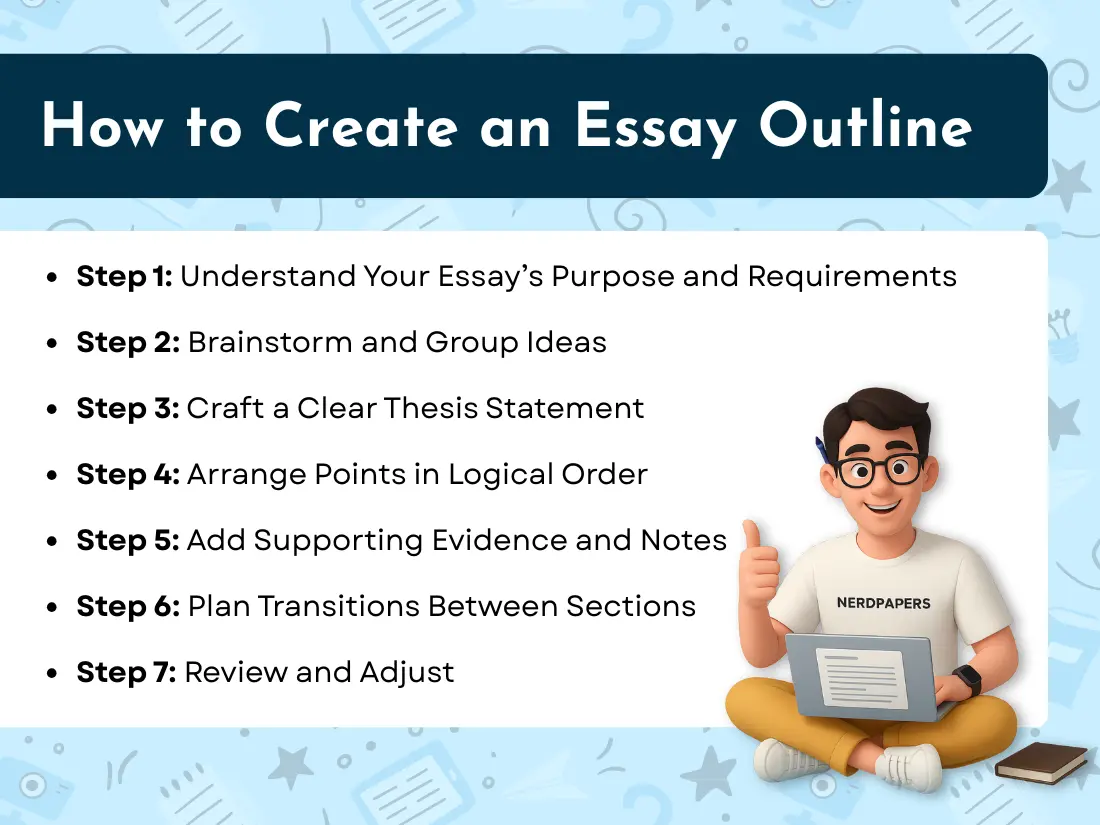
Step 1: Understand Your Essay’s Purpose and Requirements
Before planning, review your assignment guidelines. Note:
- Essay type (argumentative, narrative, analytical, expository)
- Required word count
- Formatting style (APA, MLA, Chicago)
- Deadline and research scope
Step 2: Brainstorm and Group Ideas
List all possible points, arguments, or examples. Then group similar ideas together under potential paragraph topics.
Step 3: Craft a Clear Thesis Statement
This is the heart of your essay—a single sentence that sums up your main argument. Place it at the end of your introduction section in the outline.
Step 4: Arrange Points in Logical Order
Decide the sequence of paragraphs. Common approaches include:
- Chronological order (events in time order)
- Order of importance (strongest points first or last)
- Cause and effect (causes first, effects second)
Step 5: Add Supporting Evidence and Notes
For each main point, jot down evidence you’ll use—quotes, statistics, or examples—so you’re not scrambling during drafting.
Step 6: Plan Transitions Between Sections
Mark how each paragraph will connect to the next. Smooth transitions keep your reader engaged and prevent sudden topic jumps.
Step 7: Review and Adjust
Read through your outline. Ask yourself:
- Does it align with my thesis?
- Does each section flow logically?
- Am I covering all assignment requirements?
Once your outline is set, the next step is drafting. As you write, you’ll start to see your main theme more clearly — which is when you can craft a title that fits perfectly. Our guide on how to title an essay shows you how to create a headline that captures attention and reflects your main idea.
Example Essay Outline (With Visual Breakdown)
Let’s put everything together with a sample outline for a basic academic essay.
Essay Topic: “The Impact of Social Media on Teen Mental Health”
Essay Type: Argumentative
Word Count Target: ~1000 words
Format: Alphanumeric Outline
I. Introduction
A. Hook: Scrolling through social media can feel like second nature to teens—but at what cost?
B. Background: With over 90% of teens using social platforms, concerns about their mental well-being are rising.
C. Thesis: While social media offers connection and self-expression, it significantly contributes to increased anxiety, low self-esteem, and sleep disruption among teenagers.
II. Body Paragraph 1 – Anxiety
A. Topic Sentence: Constant exposure to idealized lifestyles triggers comparison-based anxiety.
B. Evidence: A 2023 Pew Research study found 59% of teens feel pressure to appear perfect online.
C. Explanation: Social comparison theory explains why curated posts affect self-image.
D. Transition: Beyond anxiety, self-esteem is also deeply impacted.
III. Body Paragraph 2 – Self-Esteem Issues
A. Topic Sentence: Likes, comments, and followers create a sense of worth tied to online validation.
B. Evidence: Studies show teens link self-worth to social metrics (APA, 2022).
C. Explanation: Teens may internalize online attention as proof of their value.
D. Transition: These effects don’t end with emotional distress—they impact sleep, too.
IV. Body Paragraph 3 – Sleep Disruption
A. Topic Sentence: Excessive nighttime screen time interferes with sleep cycles.
B. Evidence: CDC data reveals teens using phones after 10 PM sleep 1.5 hours less on average.
C. Explanation: Poor sleep worsens mood and mental health outcomes.
D. Transition: These three effects show a strong pattern of harm.
V. Conclusion
A. Restate Thesis: Despite its benefits, social media is a major contributor to teen mental health challenges.
B. Summary: It fosters anxiety, lowers self-esteem, and disrupts sleep.
C. Final Insight: Schools and parents must promote healthy screen habits and offline time.
Common Mistakes to Avoid When Outlining an Essay
Even the best writers make mistakes when creating outlines. Knowing what to watch out for can save you time—and improve your final essay.
Skipping the Outline Entirely
Jumping straight into writing might feel faster, but it often leads to disorganized arguments and repeated ideas. Without a roadmap, you risk going off-topic.
Writing a Vague or Overly Detailed Outline
- Too vague? You’ll get stuck figuring out details later.
- Too detailed? You might spend more time outlining than writing.
Ignoring the Thesis Statement
Your thesis is the centerpiece of your essay. If your outline doesn’t clearly support it, your writing will feel scattered.
Poor Paragraph Order
Putting points in a random order can confuse readers. Arrange ideas so each paragraph naturally flows into the next. This is where understanding essay structure becomes crucial.
Forgetting Transitions
Transitions are the bridges between ideas. Without them, your essay feels choppy and disconnected. Include transition words in your essay outline to make drafting smoother.
Not Considering the Essay Type
Argumentative essays need strong evidence. Narrative essays need a clear sequence of events. Tailor your outline to your essay type for the best results.
Tips to Make Your Essay Outline More Effective
A strong outline doesn’t just map your essay—it makes writing faster and clearer. Here are some proven ways to make yours work harder for you:
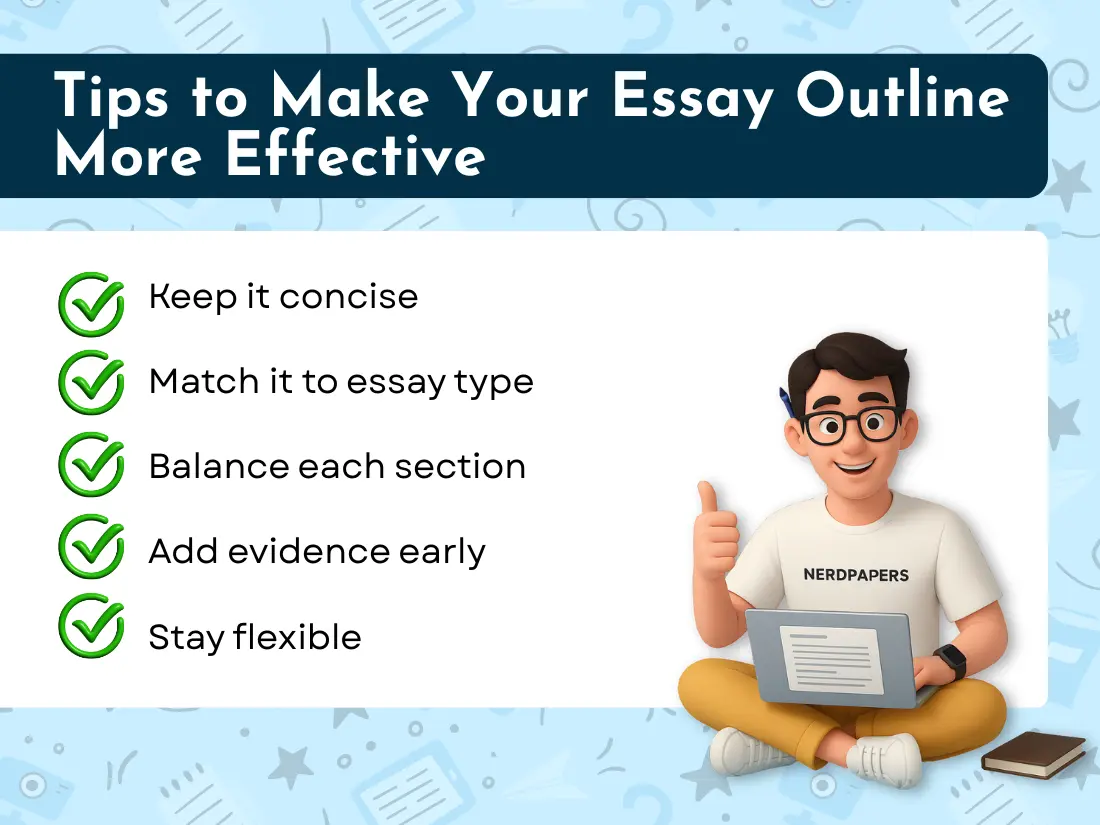
1. Keep It Clear and Concise
Avoid long sentences in your outline. Use short phrases or bullet points so you can quickly see your main ideas at a glance.
2. Match It to Your Essay Type
Argumentative essays may need sections for counterarguments, while narrative essays focus more on story flow.
For an argumentative essay, add a sub-point for “Opposing View + Rebuttal” under each major argument.
3. Balance the Sections
If your body paragraphs are uneven, your essay might feel lopsided. Aim for roughly equal detail in each main point.
4. Include Evidence in the Outline
Don’t wait until the writing stage to think about examples or data. Place your quotes, stats, or case studies right under the point they support. This saves time later.
5. Use Your Thesis as a Checkpoint
After adding each section, ask: Does this connect back to my thesis? If it doesn’t, consider cutting or revising it.
6. Stay Flexible
Your outline should guide you, not trap you. It’s okay to adjust it as new ideas emerge during drafting.
7. Leverage Visual Tools
If you’re a visual learner, turn your outline into a diagram, mind map, or table.
Using AI Tools to Create an Essay Outline — The Right Way
AI essay outline generators are everywhere—from ChatGPT to Scribbr AI and EssayGPT—but should you rely on them entirely? The short answer: use them as a guide, not a replacement.
Where AI Fits In
AI can be a helpful tool in the early planning stages of an essay. With the right prompt, it can produce a basic structure that follows common academic formats like alphanumeric or decimal outlines. This can save time, help you brainstorm ideas, and inspire ways to organize your points.
Examples of what AI can do:
- Save time: Generate an outline in seconds based on your topic.
- Inspire ideas: Provide a starting point when you’re unsure where to begin.
- Improve formatting: Suggest standard structures for clear organization.
What to Watch Out For
While convenient, AI comes with risks if you lean on it too heavily:
- Generic content: AI often uses common phrases or broad points that may weaken your essay.
- Lack of nuance: It can’t fully understand your tone, perspective, or context-specific details.
- No critical thinking: Outlining is a thinking process—skip it, and your writing may lack depth.
Best Practices for Ethical and Effective Use
If you use AI tools, always apply your own judgment:
- Cross-check facts and sources to ensure accuracy.
- Refine the outline with your thesis, arguments, and specific evidence.
- Ensure originality—don’t just copy and paste.
- Match your style and tone to the assignment’s purpose.
Conclusion: Your Outline Is the Bridge Between Ideas and Impact
Creating an essay outline isn’t just a box to tick before writing — it’s the step that transforms scattered thoughts into a clear, logical, and persuasive piece of writing. By planning your structure in advance, you make the drafting stage faster, reduce stress, and set yourself up for stronger arguments and smoother flow.
Think of your outline as a promise to your reader: every point will have its place, every idea will connect, and nothing important will get lost along the way. Whether you prefer a classic alphanumeric structure, a visual mind map, or a custom format, the goal is the same — clarity and confidence in your writing process.
If you’ve followed the steps in this guide, you now have everything you need to create outlines that work for any topic or academic level. Your next step is to put these principles into practice on your own assignments and refine them as you go. Over time, outlining will feel less like a task and more like your personal writing superpower.
Frequently Asked Questions About Essay Outlines
Still have questions about creating an essay outline? You’re not alone — here are answers to some of the most common questions students ask when planning and structuring their essays.
What is the purpose of an essay outline?
An essay outline helps you organize your ideas before you start writing. It ensures that your points flow logically, supports your thesis, and prevents you from forgetting key information. Outlines also save time during drafting and editing.
How detailed should my essay outline be?
Your outline should be detailed enough to guide your writing but flexible enough to adjust as your ideas develop. Include your main sections (introduction, body, conclusion), key points, and any supporting evidence you plan to use.
Do all essays need an outline?
While short essays or personal reflections might not require one, most academic essays — especially argumentative or research-based papers — benefit greatly from a structured outline. Many professors expect one as part of the writing process.
What’s the best format for an essay outline?
The most common is the alphanumeric format, which uses Roman numerals, capital letters, and numbers. However, you can also use decimal outlines or full-sentence outlines depending on your preference and assignment requirements.
Can I change my outline while writing?
Yes. An outline is a planning tool, not a rigid contract. As you research and draft, you might discover new evidence or realize a different structure works better — and that’s fine.
Should I include evidence and sources in my outline?
Absolutely. Adding evidence under each point ensures your essay is well-supported and helps you avoid scrambling for citations later. Just remember to note the source for easy reference.
How can I make my outline more effective?
Keep your thesis in mind, ensure each point supports your main argument, and use clear transitions between sections. For more on improving your writing flow, check out our Effective Essay Writing Tips guide.
Do I need to follow the same outline style for every essay?
Not necessarily. Your outline should match your essay type and assignment requirements. For example, a narrative essay might focus more on sequence of events, while an argumentative essay emphasizes claims and counterclaims.
Can AI tools help create essay outlines?
Yes, AI tools can suggest a starting structure or help brainstorm points. However, you should always personalize and fact-check the results to ensure originality and accuracy.