
Choosing the right title for your essay isn’t just a finishing touch — it’s the first impression your reader will have. A well-crafted title can grab attention, hint at your topic, and set the tone for everything that follows. On the other hand, a weak or generic title can make your work easy to overlook, no matter how strong the content is.
In this guide, you’ll learn how to title an essay so it reflects your main idea, connects with your audience, and follows proper academic formatting. We’ll explore different types of titles, proven brainstorming techniques, formatting rules, and real examples you can adapt for your own writing.
If you’re just starting your paper, you may want to check out our how to write an essay guide first — it walks you through the entire writing process so your title matches the structure and message of your essay perfectly.
Why Your Essay Title Matters
Your essay title is more than just a label — it’s your opportunity to grab the reader’s attention, reflect the essay topic, and set the right tone before they even read the first sentence. A strong title can spark curiosity, create a clear expectation, and give your work a professional, polished feel.
In academic writing, a well-chosen title also helps your paper stand out in a stack of submissions or search results. Whether it’s a narrative essay, a college admission piece, or a research paper, the right title signals that your content is relevant, well-structured, and worth reading.
Weak vs. Strong Title Example
| Weak Title | Why It Fails | Strong Title | Why It Works |
| My Trip | Too vague, no clear focus or hook | From City Streets to Mountain Peaks: A Journey of Self-Discovery | Specific, engaging, hints at theme |
| Essay on Climate Change | Generic, sounds like a placeholder | Melting Futures: How Climate Change Is Reshaping Our World | Descriptive, uses emotional and topic keywords |
When you choose a title that matches your essay tone, clarifies your subject, and piques interest, you set the stage for a more engaged and receptive reader.
Understanding Different Types of Essay Titles
Not all essay titles serve the same purpose. The right title type depends on your essay style, audience, and tone. Understanding these categories will help you choose a title that both informs and intrigues your readers.
1. Descriptive Titles
- Purpose: Clearly state the topic without unnecessary flair.
- Best for: Research papers, expository essays, and academic reports.
- Example: The Impact of Renewable Energy on Urban Development
2. Creative Titles
- Purpose: Use wordplay, metaphors, or unusual phrasing to spark curiosity.
- Best for: Narrative essays, personal reflections, and creative writing assignments.
- Example: Dancing with Shadows: My Journey Through Stage Fright
3. Informative Titles
- Purpose: Present the main idea and scope of the essay upfront.
- Best for: Analytical essays, informative papers, and explanatory pieces.
- Example: Causes and Consequences of the Industrial Revolution
4. Persuasive Titles
- Purpose: Encourage agreement or action from the reader.
- Best for: Argumentative essays, opinion pieces, and persuasive speeches.
- Example: Why Every City Should Invest in Green Public Transport
5. Analytical Titles
- Purpose: Indicate a deeper breakdown or critique of a topic.
- Best for: Literary analysis, critical reviews, and thematic essays.
- Example: Unpacking the American Dream in Fitzgerald’s The Great Gatsby
6. Question Titles
- Purpose: Engage the reader by posing a thought-provoking question.
- Best for: Opinion essays, reflective writing, or papers exploring unresolved issues.
- Example: Can Artificial Intelligence Ever Truly Think?
7. Literary Titles
- Purpose: Reference or adapt literary works or phrases for thematic resonance.
- Best for: Literary analysis essays, book reviews, and cultural critique papers.
- Example: Brave New Words: Language in the Digital Era
When you match the title type to your essay’s purpose and tone, you increase its appeal and relevance. For example, a creative essay title might captivate a narrative audience, while an academic essay title works better for formal research.
How to Come Up with an Essay Title
Creating the perfect essay title can feel overwhelming — but with the right approach, it becomes a clear, step-by-step process. The goal is to create a title that captures your topic, matches your tone, and draws the reader in without giving everything away.
1. Start with Your Thesis Statement
Your title should be rooted in your main idea. Look at your thesis and identify key words or themes that can guide your title choice.
2. Identify the Tone of Your Essay
A humorous or creative essay might use playful language, while an academic paper requires a professional and concise title. Matching tone builds reader trust and sets the right expectation.
3. Use Brainstorming Techniques
- Mind Mapping: Write down your main topic in the center, then branch out to related ideas, themes, and keywords.
- Title Generators: Tools like Portent’s Idea Generator or HubSpot’s Blog Topic Generator can spark ideas.
- Keyword Research Tools: See what phrases are commonly searched for your topic.
- Headline Analyzers: Tools like CoSchedule can help refine the impact of your title.
4. Experiment with Hook Words
Incorporate strong, emotional, or action-oriented words to make your title more compelling. Examples: Unveiling, Unlocking, Mastering, Transforming.
5. Refine with Keywords (Without Stuffing)
Naturally integrate your main keyword, such as how to title an essay, to help search engines understand your topic without making the title sound forced.
Imagine you’ve just finished your research and are eager to start writing — but you’re stuck on the title. Instead of forcing one, start by mapping out your essay’s structure. When you create an outline, you’ll naturally identify the key points, tone, and main theme, which makes brainstorming titles much easier.
For example, a student writing about the effects of social media on mental health might outline sections on statistics, case studies, and possible solutions. By the time the outline is complete, they might realize their focus is more on solutions than problems, leading to a stronger, more accurate title like Mind Over Media: Reclaiming Mental Health in the Digital Age. If you’re in this stage, our Essay Outline guide will walk you through structuring your essay so your title practically writes itself.
When to Finalize Your Essay Title
One of the most common questions students ask is: Should I choose my essay title before or after I write?
The answer depends on your writing style and how much clarity you have about your topic.
Before Writing
- Helps guide your tone and focus from the start.
- Useful if your assignment prompt is very specific.
- Risk: Your final essay may shift direction, making the title less accurate.
After Writing
- Ensures the title perfectly matches your essay’s final argument, tone, and structure.
- Allows more creativity once the content is fully developed.
- Risk: May take longer because you have to revisit and brainstorm fresh ideas.
Best Practice:
Start with a working title that keeps you focused while writing. Then refine it after you finish your draft so it captures your main idea and tone perfectly.
Step-by-Step Process to Write a Good Essay Title
Coming up with the right essay title isn’t about waiting for a flash of inspiration — it’s about following a smart, repeatable process. Here’s how to go from a blank page to a title that’s both engaging and accurate:
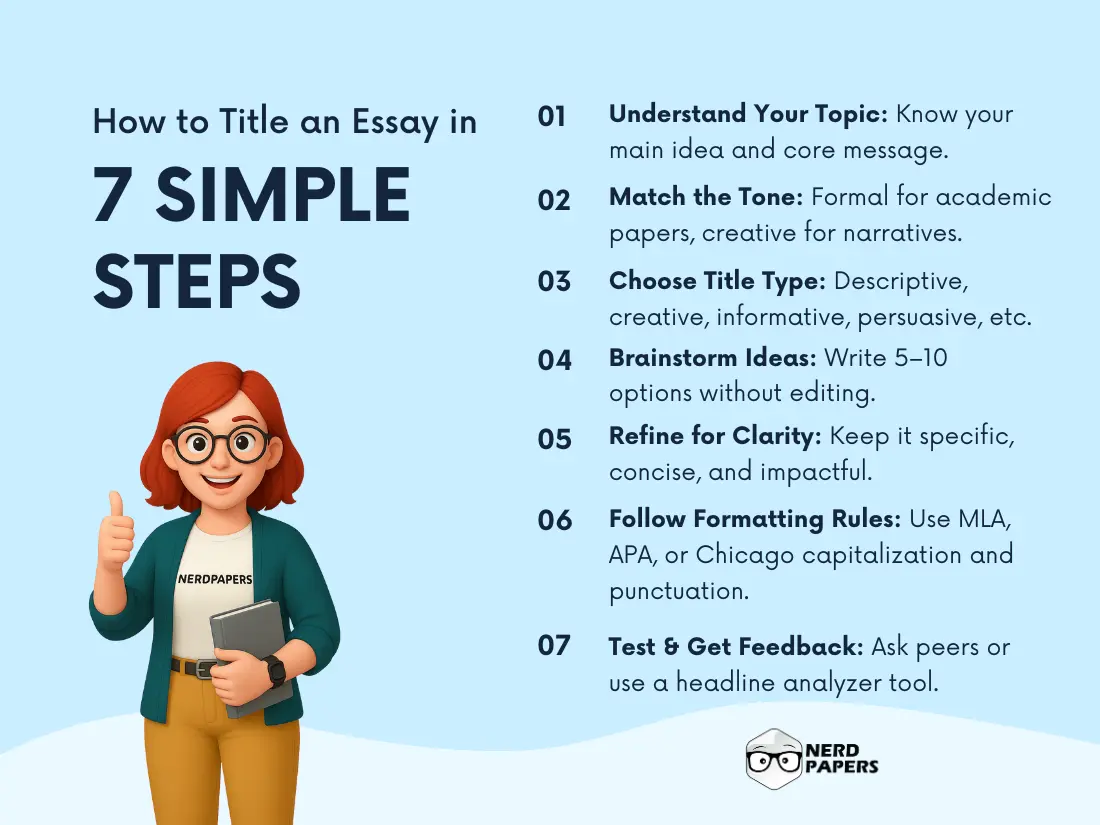
Step 1: Get Clear on Your Essay’s Focus
Before naming your essay, know exactly what it’s about.
- Review your thesis statement and main argument.
- Ask yourself: If someone read only the title, what core idea should they take away?
Step 2: Match the Title to Your Audience & Tone
Your title should “sound” like the type of essay you’ve written.
- Formal tone → For research papers, argumentative essays, and academic assignments.
- Creative tone → For narratives, personal reflections, or literary essays.
Step 3: Choose the Most Suitable Title Type
Look back at the types of essay titles(descriptive, creative, informative, persuasive, analytical, question, or literary) and decide which one fits your essay’s purpose best.
Step 4: Brainstorm Without Editing
Write down 5–10 title ideas quickly. Don’t stop to critique — the goal here is to get your creative energy flowing.
Step 5: Polish for Clarity, Specificity & Impact
- Cut out filler words and vague phrases.
- Make it specific — avoid titles that could apply to dozens of essays.
- Keep it short — ideally under 10–12 words.
Step 6: Format It Correctly
Different academic styles have different rules:
- MLA: Capitalize all principal words; no italics or quotes unless part of the title.
- APA: Title case; avoid underlining; italics only for certain works.
- Chicago: Title case; subtitles allowed with a colon.
Step 7: Test & Get Feedback
- Read the title out loud — does it sound smooth and memorable?
- Ask a peer or teacher which version sparks the most interest.
- If possible, A/B test in a small group to see which gets more engagement.
Real-Life Examples: Title Transformations
Small changes can completely transform a title’s impact. Here are examples of weak titles turned into strong, engaging ones:
| Weak Title | Why It Doesn’t Work | Strong Title | Why It Works |
| Pollution | Too vague; no context or hook | Silent Cities: How Air Pollution Is Changing Urban Life | Specific, emotional, and topical |
| Social Media and Teens | Too broad and generic | Scroll and Sleep: The Link Between Social Media and Teen Sleep Patterns | Focused and intriguing |
| Shakespeare | Doesn’t tell the reader the essay’s angle | Shakespeare’s Women: Power, Agency, and Rebellion | Gives a clear theme and scope |
Formatting Your Essay Title Correctly
Even the most creative or informative title can lose impact if it’s not formatted correctly. Academic writing has clear style guidelines — and following them not only makes your work look polished but also shows attention to detail (something professors appreciate).
Here’s how to format your essay title depending on the style you’re using.
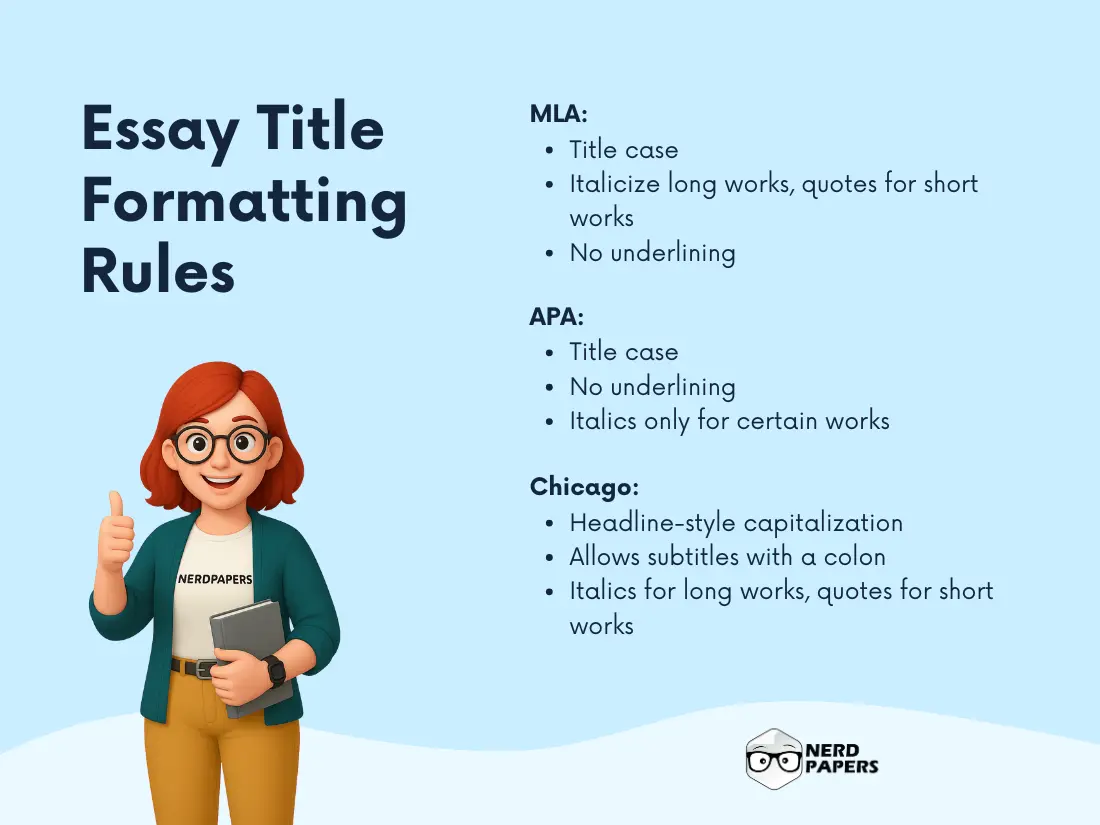
MLA Format (Modern Language Association)
- Capitalization: Use title case — capitalize the first and last words, plus all major words in between.
- Italics & Quotation Marks: Italicize titles of longer works (books, films, plays) if they appear in your essay title; use quotation marks for shorter works (poems, articles, short stories).
- No Underlining: Underlining is outdated in MLA unless handwriting.
Exploring Identity in “The Road Not Taken” by Robert Frost
APA Format (American Psychological Association)
- Capitalization: Use title case — first word, last word, and all major words capitalized.
- Italics & Quotation Marks: Italicize the names of books, journals, or films; use quotation marks for shorter works.
- No Period at the End: Titles in APA are not followed by a period unless they include abbreviations that require one.
The Effects of Social Media on Teen Mental Health
Chicago Style
- Capitalization: Use headline-style capitalization — capitalize major words, lowercase articles, conjunctions, and prepositions unless they’re the first or last word.
- Subtitles: Often uses a colon to separate the main title from a descriptive subtitle.
- Italics & Quotation Marks: Same rules as MLA for longer and shorter works.
Brave New Words: Language and Communication in the Digital Era
Quick Formatting Checklist
- Follow the capitalization rules for your style guide.
- Apply italics or quotation marks correctly for referenced works.
- Avoid unnecessary punctuation or special symbols unless required for meaning.
- Make sure your title is centered on the page in the final document.
Common Mistakes to Avoid
Even a strong essay can lose impact if the title misses the mark. Here are some of the most frequent title mistakes students make — and how to fix them.
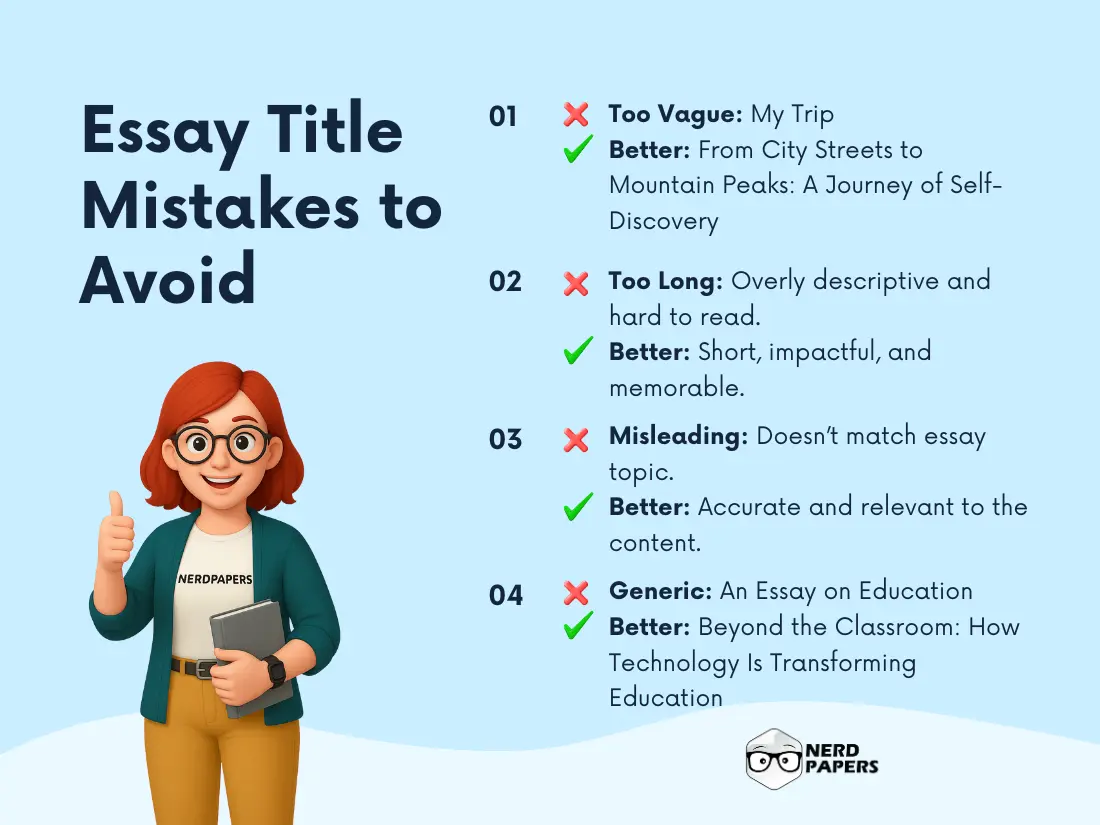
1. Being Too Vague
Mistake: My Trip
- Doesn’t tell the reader anything specific.
- Could refer to any kind of trip, for any purpose.
Fix: From City Streets to Mountain Peaks: A Journey of Self-Discovery
- Specific, descriptive, and hints at the essay’s theme.
2. Making It Overly Long
Mistake: An In-Depth and Comprehensive Analysis of the Many Different Ways in Which Climate Change Impacts Communities Around the World in the 21st Century
- Hard to read, overwhelming, and not memorable.
Fix: Melting Futures: How Climate Change Is Reshaping Our World
- Concise, impactful, and still informative.
3. Misleading the Reader
Mistake: 10 Tips for Better Sleep (but the essay is actually about caffeine addiction)
- Creates false expectations and damages credibility.
Fix: Awake All Night: The Hidden Cost of Caffeine on Sleep
- Matches the essay’s real focus while still drawing interest.
4. Using Generic Language
Mistake: An Essay on Education
- Too broad and unoriginal.
Fix: Beyond the Classroom: How Technology Is Transforming Education
- Adds specificity and freshness.
5. Ignoring the Essay’s Tone
Mistake: LOL, School Is Crazy (for a formal research paper)
- Inappropriate for an academic context.
Fix: The Modern Student Experience: Balancing Academics and Mental Health
- Professional and aligned with the essay’s tone.
Creative Essay Title Examples
Sometimes the best way to learn how to craft a title is to see great ones in action. Below are examples for different types of essays — use them as inspiration, but make sure to adapt them to your own topic and voice.
Narrative Essay Titles
- Lost in Translation: My Semester Abroad in Tokyo
- A Seat by the Window: Lessons from a Cross-Country Train Ride
- Dancing with Shadows: Overcoming Stage Fright
Argumentative Essay Titles
- Ban the Bottle: Why Single-Use Plastics Have No Place in Our Future
- Breaking the Algorithm: Regulating Social Media for Mental Health
- The Case for Free Public Transit in Urban Areas
Literary Analysis Essay Titles
- Symbols in Silence: The Power of the Unspoken in Of Mice and Men
- A Poisoned Crown: Corruption and Power in Macbeth
- Unveiling the American Dream: Themes in The Great Gatsby
College Admission Essay Titles
- Mind Over Marathon: How Running Taught Me Discipline
- From Kitchen Chaos to Culinary Confidence
- Stitch by Stitch: Sewing My Way to Self-Expression
Tools & Resources for Better Titles
Even the most creative minds sometimes need a little boost. These tools and resources can help you brainstorm, refine, and test your essay titles.
1. Title Generators
Quickly spark ideas with online tools that mix keywords and creative phrasing.
- Portent’s Content Idea Generator – Great for playful, curiosity-driven titles.
- Tweak Your Biz Title Generator – Generates hundreds of variations for inspiration.
2. Headline Analyzers
Evaluate your title for emotional impact, clarity, and readability.
- CoSchedule Headline Analyzer – Scores your title and suggests improvements.
- Sharethrough Headline Analyzer – Gives an engagement rating and word balance tips.
3. Keyword Research Tools
Find relevant search terms to naturally include in your title.
- Google Keyword Planner – See search volumes for related keywords.
- Ubersuggest – Suggests keyword variations with SEO insights.
4. Brainstorming Worksheets
Organize your ideas before settling on a final title.
- Mind-mapping templates for visual thinkers.
- Bullet list brainstorm sheets to capture all possible ideas in one place.
5. Academic Writing Guides
For style-specific formatting help.
- Purdue OWL (Online Writing Lab) – Free MLA, APA, and Chicago formatting guides.
- University writing center resources for discipline-specific standards.
Conclusion
A great essay title does more than sit at the top of the page — it captures attention, sets the tone, and tells the reader exactly what to expect. By understanding title types, using brainstorming techniques, and following formatting rules, you can master how to title an essay in a way that’s both engaging and accurate.
Remember, your title should work in harmony with your essay’s content. The right title not only draws readers in but also reflects the structure and flow of your ideas. When you take the time to craft a title that truly represents your work, you give your essay the best possible first impression.
Frequently Asked Questions About How to Title an Essay
What is the difference between an essay title and a heading?
An essay title is the main name of your work that appears at the top of the page and reflects the central idea. A heading is used inside the essay to label sections or subtopics.
How long should an essay title be?
The best essay titles are short and specific — usually between 5 and 12 words. This length makes them clear, memorable, and easy to read.
Can you use a question as an essay title?
Yes. A question can be an effective essay title if it matches the topic and encourages the reader to think about your subject.
Is it better to write the title before or after the essay?
Many writers create the title after writing the essay, when the main argument and tone are clear. However, you can start with a working title and refine it later.
How do you format an essay title in MLA or APA?
In MLA, use title case and capitalize main words, with italics or quotation marks for works mentioned in the title. In APA, also use title case, avoid underlining, and follow style-specific punctuation rules.
How to Make a Title Stand Out?
Use unique word choices and consider visual elements like italics or bold to make your title visually appealing.