How to write an essay? It’s a question most students ask at some point — whether you’re in middle school, high school, or starting college. And honestly, learning how to write an essay properly isn’t just about getting good grades — it’s a skill that will help you express your ideas clearly in school, in life, and even in your future job.
In this step-by-step guide, we’ll walk you through the full essay writing process, from the very first idea to the final edit. You’ll learn how to:
- Understand the assignment
- Plan and organize your thoughts
- Structure your essay correctly
- Avoid common mistakes
- Edit and proofread like a pro
We’ll also explore different essay types and show you how to keep your structure clear, logical, and focused. But before diving into techniques, it’s important to understand the foundation — what an essay really is, why it matters, and how it has evolved in academic writing.
If you’re new to essay writing, start with our complete guide: What Is an Essay? — it breaks down the definition, purpose, and key components so you’ll have a solid base before applying these tips.
Understanding the Essay Writing Process
Before you start writing, it helps to understand that a good essay doesn’t just happen — it follows a step-by-step process. When you follow the right process, writing becomes easier, more organized, and less stressful.
What Is the Essay Writing Process?
The essay writing process is a set of steps that guide you from the moment you get your topic to the final draft. It helps you plan, structure, write, and polish your essay so that it’s clear, focused, and complete.
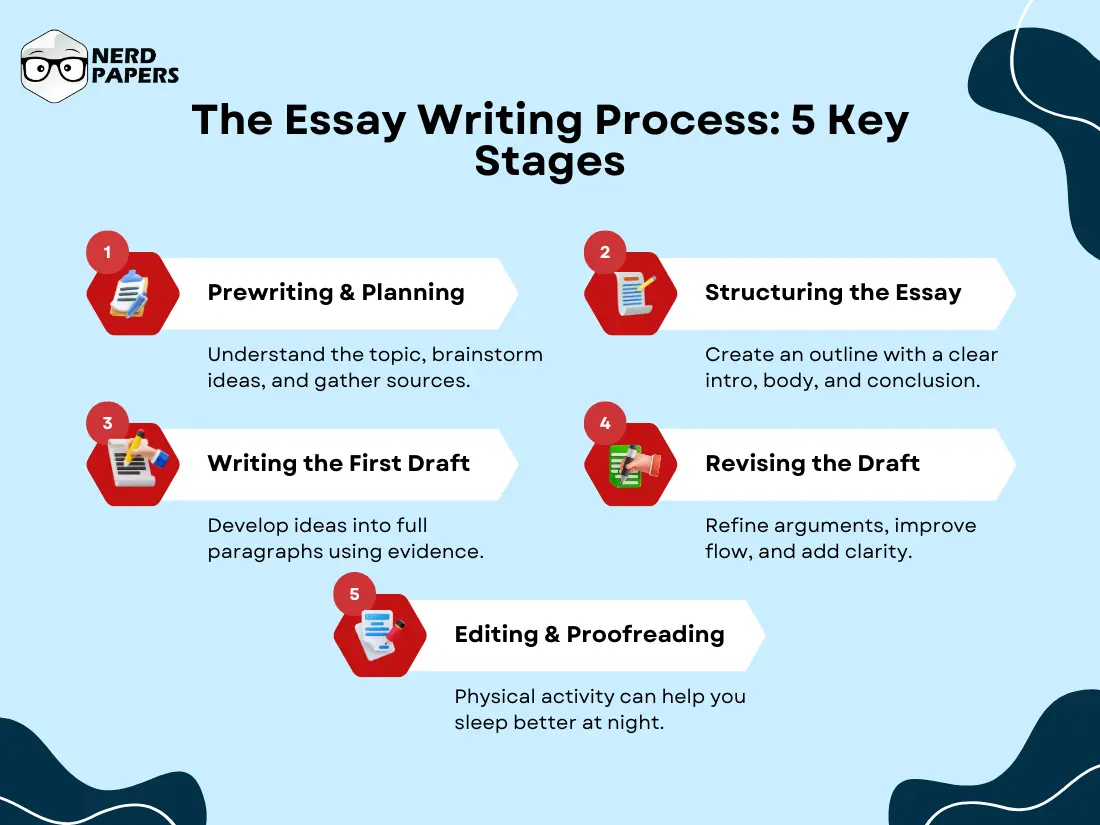
The 5 Core Stages of Essay Writing
Here are the five main stages you’ll follow:
- Prewriting and Planning – Choose a topic, brainstorm ideas, research, and decide on your purpose.
- Structuring the Essay – Create a clear outline and organize your thoughts.
- Writing the First Draft – Write your introduction, body paragraphs, and conclusion.
- Revising – Improve the content, flow, and logic of your essay.
- Editing and Proofreading – Check for grammar mistakes, punctuation, spelling, and formatting.
Each step builds on the one before it. Skipping a stage or rushing can lead to weak essays that feel disorganized or unclear.
Stage 1 – Prewriting and Planning
Before you write a single sentence, it’s important to plan. This stage helps you understand what you’re being asked to do, choose the right topic, and gather ideas. Think of it as getting your tools ready before building something.
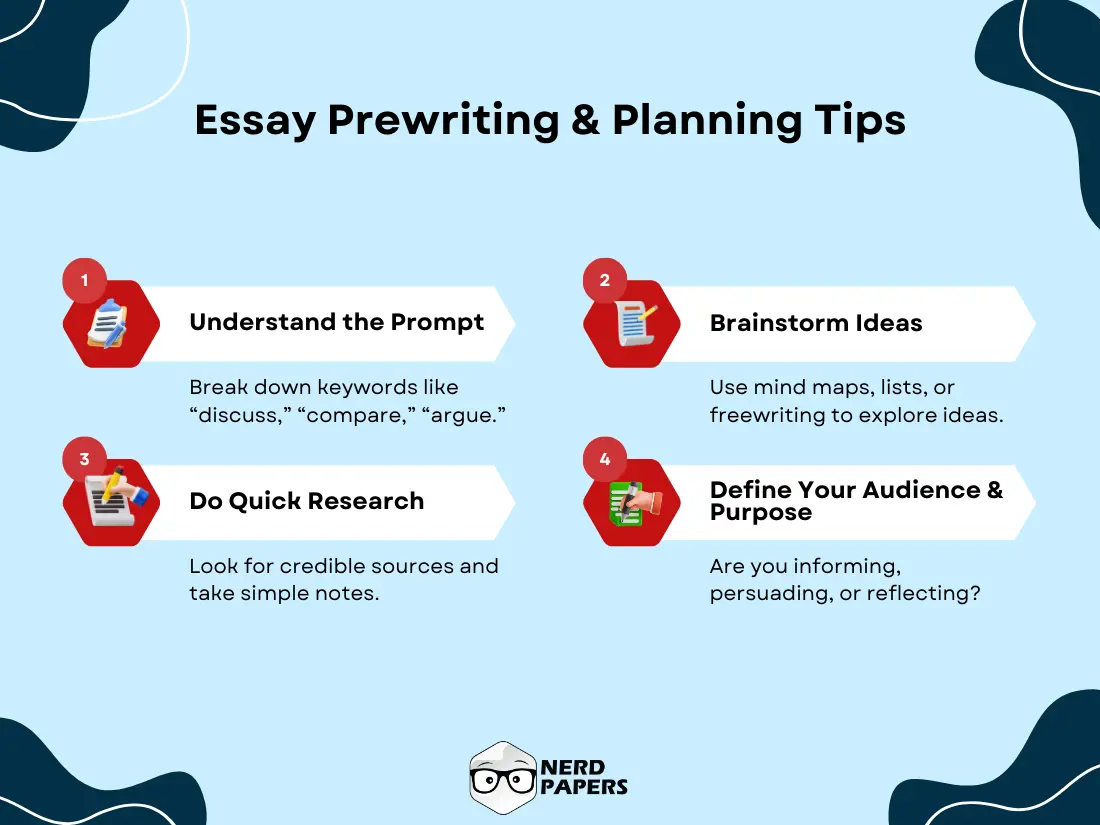
Understand the Prompt or Question
Start by reading the essay prompt carefully. Look for keywords like:
- “Compare” – Show how things are alike or different
- “Analyze” – Break the topic into parts and explain
- “Discuss” – Give reasons, facts, and opinions
Also, figure out what type of essay you need to write:
Narrative? Expository? Argumentative? This will shape how you write.
Brainstorm & Choose a Topic
Don’t rush your topic. Use simple brainstorming tools like:
- Mind mapping – Write your main idea in the center and branch out related thoughts
- Lists – Make a list of everything that comes to mind
- Clustering – Group similar ideas together
Then, narrow it down. For example, instead of “Pollution,” choose “How plastic pollution affects ocean life.”
Conduct Preliminary Research
Start looking for facts, quotes, or examples from trusted sources. These might include:
- School textbooks
- Educational websites (.edu, .org)
- Library databases
Define Purpose and Audience
Ask yourself:
- Am I trying to inform, explain, or persuade?
- Who will read my essay — a teacher, classmate, or general audience?
Your tone and word choice depend on your purpose and audience. A persuasive essay sounds different than a narrative one.
Stage 2 – Structuring the Essay
Once you’ve planned your ideas, the next step is structuring your essay — this means organizing everything in a clear and logical way. A well-structured essay not only makes it easier for your teacher or reader to follow your thoughts, but it also helps you write faster and stay focused.
Outline Your Essay
Think of an outline as your essay’s blueprint. It gives you a clear plan to follow, so your writing doesn’t go off track. Even a simple outline can save you time and help your essay feel more connected and complete.
Here’s a basic outline most essays follow:
- Introduction – Start your essay and introduce your topic
- Body Paragraph 1 – First main idea with explanation and evidence
- Body Paragraph 2 – Second main idea with explanation and evidence
- Body Paragraph 3 – (Optional) Third idea or counterpoint
- Conclusion – Wrap up and leave a final impression
Understand Essay Components
Every strong essay has three main parts: the introduction, the body paragraphs, and the conclusion. Each one plays a unique role in delivering your message clearly.
Introduction
Your introduction is like a first impression — it should grab the reader’s attention and tell them what your essay is about.
- Hook – Start with something interesting: a question, a fact, or a bold statement to get your reader’s attention
- Background – Give a little context about the topic (why it matters or what it’s about)
- Thesis Statement – A one-sentence summary of your main point or argument. This is the most important sentence in your essay.
“Social media affects how teens communicate.” → This is a clear thesis that tells the reader what the essay will explain.
Body Paragraphs
Each paragraph in the body supports your thesis. A good body paragraph is like a mini-essay of its own.
- Topic Sentence – The first sentence that explains what this paragraph is about
- Evidence/Examples – Facts, quotes, stats, or real-life examples that support your point
- Analysis/Explanation – Your own words explaining how the evidence supports your thesis
- Transition – A sentence that smoothly connects one paragraph to the next
“Teens often use social media to stay connected, especially during long school breaks.”
Conclusion
The conclusion brings your essay to a strong close. It’s not just a summary — it’s your chance to remind the reader why your point matters.
- Restate the Thesis – Say your main idea again using different words
- Summarize Key Points – Briefly go over the most important things you said
- Final Thought – End with something strong: a lesson, a call to action, or a thoughtful question
“While social media helps teens stay connected, it’s important to balance screen time with real-life conversations.”
Your conclusion ties the essay together, but its strength depends on the overall framework. If you want to see how each section — introduction, body, and conclusion — fits into a clear flow, check out our detailed guide on Essay Structure.
Stage 3 – Writing the First Draft
Now that you have outlined your essay and understand its structure, you already know what goes into an introduction, body, and conclusion. It is time to start writing your first draft now. At this stage, your goal is not perfection — it is to get your ideas down on paper. You will fix the quality later.
Focus on Flow, Not Flawless
Don’t overthink grammar, spelling, or word choice right now. Just follow your outline and write each section one step at a time:
- Turn your introduction outline into a clear opening paragraph.
- Expand each body point into a full paragraph with examples, facts, or explanations.
- Wrap up with a conclusion that brings everything together.
It’s okay if things don’t sound perfect yet — you’ll revise and polish later.
Write Freely, Stay Focused
Use your topic sentences as guides for each paragraph. If you get stuck, try:
- Freewriting for a few minutes to break through blocks
- Skipping a difficult part and returning to it later
- Writing as if you’re explaining your point to a classmate
Keep your thesis and purpose in mind to stay on track.
Use Simple Transitions (For Now)
Don’t worry about fancy transitions — even basic words like first, next, also, and finally can help guide your reader. You can always improve them during revision.
Stage 4 – Revising the Draft
Writing your first draft is only half the job — the real magic happens during revision. This is where you shape your rough ideas into a strong, clear, and well-organized essay.
Improve Clarity and Flow
Read your essay from start to finish. Does it make sense? Do your points connect well? Focus on:
- Making sure each paragraph supports the thesis
- Reordering ideas if something feels out of place
- Adding or removing content to strengthen your argument
Strengthen Your Argument
Ask yourself:
- Is my thesis clear and well-supported?
- Have I included enough examples or evidence?
- Are my explanations strong and easy to follow?
If not, revise to add more support or make your point clearer.
Cut the Fluff
Look for words or sentences that don’t add value:
- Repetitive ideas
- Off-topic details
- Unnecessary long phrases
Keep your writing focused and concise.
Stage 5 – Editing and Proofreading
Once your essay is revised for structure and clarity, it’s time to polish it. This stage focuses on fixing surface-level mistakes and making sure your writing is clean, clear, and error-free.
Check for Grammar, Spelling, and Punctuation
Carefully read through your essay and correct:
- Spelling mistakes
- Run-on or incomplete sentences
- Grammar errors (subject-verb agreement, verb tense, etc.)
- Punctuation issues like missing commas or extra periods
Improve Sentence Structure and Word Choice
Make your writing easier to read by:
- Fixing awkward or confusing sentences
- Replacing repeated words with better alternatives
- Using clear, direct language instead of overly complex phrases
- Avoiding passive voice unless necessary
Use Helpful Tools
Try using editing tools like:
- Grammarly – for grammar and clarity suggestions
- Hemingway Editor – for simplifying complex sentences
- Quillbot or Wordtune – for rewriting and improving phrasing
Ask for Feedback
If possible, have someone else read your essay. A teacher, classmate, or family member can point out mistakes you may have missed.
Common Mistakes to Avoid
Even strong writers make mistakes — but knowing what to look out for can save you from losing marks or confusing your reader.
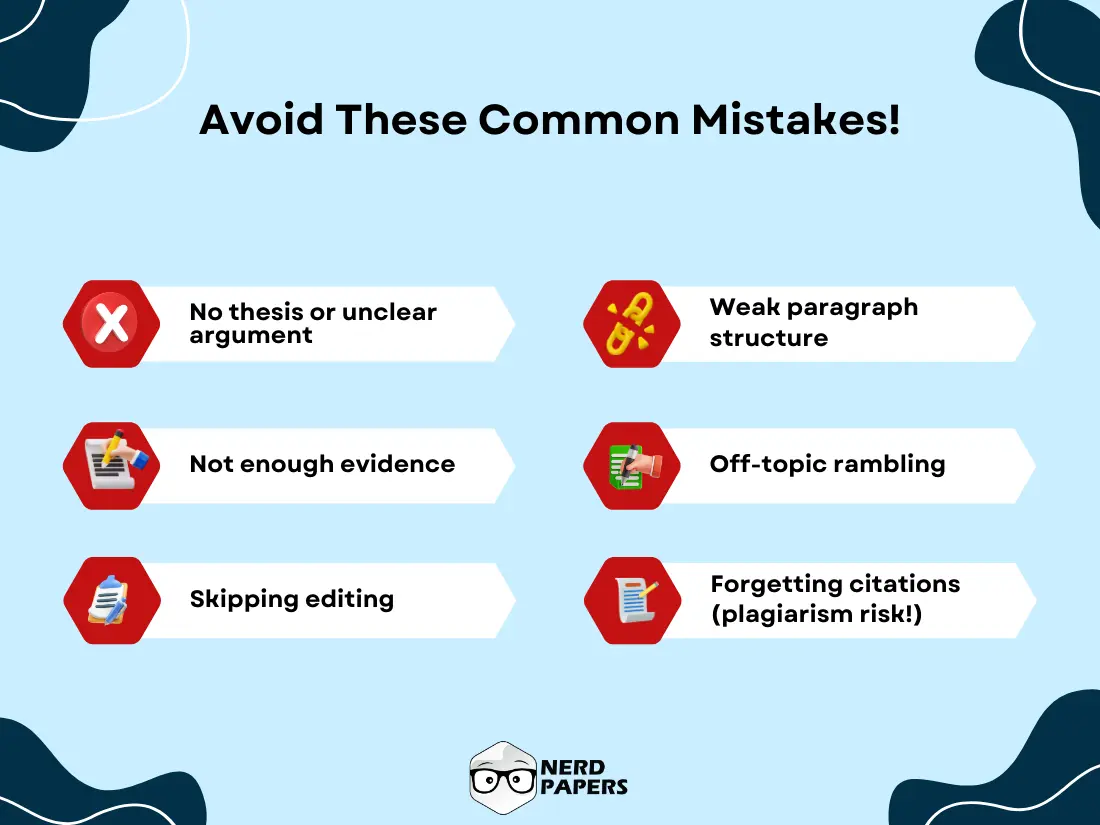
Here are some of the most common essay writing mistakes and how to avoid them:
Weak or Missing Thesis Statement
Your thesis is the heart of your essay. Without a clear, strong thesis, the reader won’t understand your main point.
Fix: Make sure your thesis clearly states your main idea and appears at the end of your introduction.
Poor Paragraph Structure
Each paragraph should focus on one clear idea. Mixing too many ideas can confuse your reader.
Fix: Start with a topic sentence, add supporting evidence, and explain how it connects to your thesis.
Not Enough Evidence
Making claims without examples or proof weakens your argument.
Fix: Support your points with facts, examples, or quotes from reliable sources.
Plagiarism
Copying someone else’s work without giving credit is a serious academic offense.
Fix: Always cite your sources using the correct format (APA, MLA, etc.).
Going Off-Topic or Rambling
If your writing wanders or includes unrelated details, your message gets lost.
Fix: Re-read your paragraphs to make sure every sentence supports your main point.
Skipping the Proofreading Step
Even small errors can distract readers and lower your grade.
Fix: Always review your work for spelling, grammar, and clarity.
Essay Writing Checklist
Before you hit “submit,” go through this quick checklist to make sure your essay is strong, clear, and ready to impress. You can even print this out or keep it by your desk!
Content & Structure
- Does your essay answer the prompt or question clearly?
- Do you have a strong thesis statement that explains your main idea?
- Is your introduction engaging and informative?
- Do your body paragraphs each focus on one clear idea?
- Have you used enough evidence to support your points?
- Is your conclusion a good summary of your essay?
Clarity & Flow
- Do your ideas follow a logical order?
- Have you used transition words between sentences and paragraphs?
- Did you avoid off-topic or repetitive sentences?
Style & Tone
- Is your language clear and easy to understand?
- Have you avoided slang, contractions, and overly casual phrases (if academic)?
- Is your tone consistent throughout the essay?
Grammar & Formatting
- Have you checked for spelling and grammar mistakes?
- Did you use the right format (APA, MLA, Chicago, etc.)?
- Did you include in-text citations and a bibliography or reference list?
Final Review
- Did you proofread or use a tool like Grammarly or Hemingway?
- Does your essay meet the word count and assignment instructions?
- Would someone else understand your points easily?
Formatting and Referencing
Once you’ve finished writing your essay, it’s important to format and reference it correctly. This shows that you take your work seriously and helps your teacher or professor understand where your information came from.
Basic Formatting Rules
Most schools or teachers will ask you to follow a specific format. Here are a few common guidelines:
- Use a clear, readable font like Times New Roman or Arial (usually size 12)
- Double-space your text
- Keep 1-inch margins on all sides
- Add page numbers (usually in the top right corner)
- Include a title centered at the top of the first page
Popular Referencing Styles
Academic essays usually require you to cite your sources. This means giving credit to the books, articles, or websites you used for information. Here are the most common styles:
| Style | Used In | Key Features |
| APA | Psychology, Education, Sciences | In-text: (Author, Year)Reference List |
| MLA | Literature, Arts, Humanities | In-text: (Author Page)Works Cited Page |
| Chicago | History, Philosophy | Footnotes or EndnotesBibliography |
| Harvard | General Academic Use | In-text: (Author, Year)Reference List |
Choose the one your school or teacher prefers and follow the rules for that style.
Referencing Tools That Help
You don’t have to do it all by hand. Here are a few tools that can help you format citations correctly:
- Citation Machine
- Zotero
- EasyBib
- Grammarly (premium version)
- Google Docs’ built-in citation tool
Why Referencing Matters
- It shows you’ve done research
- It helps readers find your sources
- It prevents plagiarism (copying without credit)
Sample Essay: Should Schools Start Later in the Day to Help Students?
Should Schools Start Later in the Day to Help Students?
Introduction
Many students struggle to stay awake and concentrate during early morning classes — but is the real issue the school schedule itself? Educators and researchers are increasingly exploring whether schools should begin later in the day to support student well-being and academic success. Studies show that teenagers have different sleep needs than younger children, and early start times may interfere with their ability to learn. This essay argues that starting school later can significantly improve student health, learning, and performance.
Body Paragraph 1 – Students Need More Sleep
According to the Centers for Disease Control and Prevention (2019), teenagers require 8 to 10 hours of sleep each night. However, most are not getting enough due to early school start times. This sleep deficit negatively affects attention, memory, mood, and physical health. Research shows that delayed start times help teens get more rest, arrive at school more alert, and perform better throughout the day (CDC, 2019).
Body Paragraph 2 – Academic Benefits
Better sleep leads to better academic results. A study from the University of Washington observed that when high schools in Seattle moved their start times 55 minutes later, students’ grades improved by 4.5%, and attendance also increased (Dunster et al., 2018). Well-rested students are more likely to focus, retain information, and contribute meaningfully in class, which supports their academic growth.
Body Paragraph 3 – Common Concerns
Some parents and school officials worry that later start times could disrupt after-school sports, part-time jobs, or family routines. However, the American Academy of Pediatrics (2014) asserts that the long-term academic and health benefits far outweigh the inconvenience. Districts that have already made this change have found students adjusted well, and logistical concerns were manageable with proper planning.
Conclusion
In conclusion, shifting school start times to later in the morning is a practical way to help students thrive. It allows teens to get the rest they need, improves their focus and performance, and supports their overall well-being. While adjustments may be necessary, the benefits to students’ health and learning make it a worthwhile step for schools to take.
References
American Academy of Pediatrics. (2014). School start times for adolescents. Pediatrics, 134(3), 642–649. https://doi.org/10.1542/peds.2014-1697
Centers for Disease Control and Prevention. (2019, November 4). Schools start too early. https://core-docs.s3.amazonaws.com/documents/asset/uploaded_file/599330/Schools_Start_Too_Early__CDC_.pdf
Dunster, G. P., de la Iglesia, L., Ben-Hamo, M., Nave, C., Fleischer, J. G., Panda, S., & de la Iglesia, H. O. (2018). Sleepmore in Seattle: Later school start times are associated with more sleep and better performance in high school students. Science Advances, 4(12), eaau6200. https://doi.org/10.1126/sciadv.aau6200
Final Tips for Essay Success
Writing a strong essay doesn’t just happen — it takes planning, focus, and a little patience. Here are some final tips to help you write better essays every time:
Start Early
Give yourself enough time. Rushing leads to sloppy ideas, weak arguments, and lots of stress. Starting early gives you room to think clearly and revise properly.
Outline Before You Write
Even a simple list of your main points will help. Outlines keep your ideas in order so you don’t get lost halfway through.
Stay Focused on the Prompt
Always come back to the question or topic you were given. Make sure each paragraph supports your main idea and doesn’t wander off.
Vary Your Sentences
Mix short and long sentences. Use transitions like “however,” “in addition,” and “for example” to guide your reader through your points.
Get Feedback
Ask a classmate, teacher, or parent to read your essay. A fresh set of eyes can help you catch mistakes or confusing spots you missed.
Use Writing Tools Wisely
Online tools like Grammarly or Hemingway Editor can help you fix grammar, sentence structure, and readability. Just don’t rely on them completely — use your judgment too.
Keep Practicing
The more essays you write, the easier it gets. Each one teaches you something new — whether it’s how to build a better argument or how to manage your time.
Conclusion
Learning how to write an essay doesn’t have to feel overwhelming. Like any skill, it gets easier with practice, a clear structure, and the right approach. Whether you’re writing for school, a college application, or an exam, following a proven writing process helps you stay focused, organized, and confident.
In this guide, you’ve learned:
- How to understand the essay prompt and plan your ideas
- The five key stages of the essay writing process
- Common writing mistakes to avoid
- A helpful checklist to stay on track
- Tools and tips to make your writing clearer and stronger
Writing a great essay isn’t about using big words — it’s about expressing your ideas clearly, supporting them with evidence, and organizing your thoughts in a way that’s easy to follow.
Frequently Asked Questions (FAQs)
To wrap things up, here are some quick answers to common questions students often ask about writing essays:
How do I start writing an essay?
Begin by understanding your topic or prompt. Then brainstorm ideas, pick a main point (thesis), and create a simple outline.
What are the 5 steps to writing an essay?
Prewriting and planning
Structuring the essay
Writing the first draft
Revising the draft
Editing and proofreading
How can I write an essay fast?
Stay focused. Use a timer, follow a clear outline, and avoid distractions. Having a structure before you begin saves time during writing.
What is the format of an essay?
A basic essay includes:
Introduction (hook + thesis)
Body Paragraphs (with evidence and analysis)
Conclusion (restating main points and final thought)
What makes a good thesis statement?
A good thesis clearly states your main idea and takes a position. It should be specific, focused, and answer the essay prompt.
How do I choose a topic for my essay?
Pick something that interests you and fits the assignment. Make sure it’s not too broad or too narrow.
How do I avoid plagiarism in my essay?
Always give credit when you use someone else’s ideas. Use quotation marks for direct quotes and cite your sources properly.
What tools help with proofreading?
Try:
Grammarly for grammar and clarity
Hemingway App for readability
Quillbot for paraphrasing
Google Docs spelling/grammar suggestions
What’s the difference between editing and revising?
Revising is about improving the content and structure.
Editing is about fixing grammar, punctuation, and spelling.