If you’re a high school student starting your first assignment or a college learner aiming to improve your writing, the question “What is an essay?” has probably crossed your mind. At its core, an essay is a structured form of writing that helps organize your ideas around a specific message or purpose. It’s more than just a simple write-up; it’s a purposeful form of communication that helps organize your thoughts and present them clearly to your reader.
But essays aren’t limited to the classroom. They appear in college applications, opinion pieces, personal blogs, and even professional reports. Whether you’re crafting a persuasive argument or reflecting on a personal experience, writing an essay challenges you to think critically, express ideas with clarity, and structure your message for maximum impact.
In this guide, we’ll explore:
- The exact definition and purpose of an essay
- The key components that make up a strong essay
- A brief look at the history behind this versatile form
- The different types of essays you may encounter
- And common misconceptions about what essays should or shouldn’t be
Whether you’re just beginning or looking to sharpen your writing skills, this guide will help you understand exactly what an essay is — and why it’s such an essential tool in both academic and real-world communication. But if you’re overwhelmed with deadlines or need a fully customized essay that meets specific requirements, you can always order a custom essay from our experts and save time while still getting top-quality work.
Definition and Purpose of an Essay
What Is the Definition of an Essay?
An essay is a short, structured piece of writing that explores a specific topic, idea, or question. It typically follows a clear format — beginning with an introduction, followed by body paragraphs that develop the argument or explanation, and ending with a conclusion that summarizes key points.
At its foundation, an essay is more than just a group of paragraphs. It’s a deliberate composition that presents a thesis — a central claim or perspective — and supports it through logic, evidence, and reasoning. Whether it’s written to inform, reflect, analyze, or persuade, every essay is designed to lead the reader through a clear and organized line of thought.
Essays can vary in tone and style depending on their type, but most share these common features:
- A thesis statement that defines the essay’s main idea
- Body paragraphs with topic sentences, evidence, and analysis
- Transitions that guide the reader between ideas
- A conclusion that wraps up the discussion and reinforces the thesis
So, if you’re wondering what is considered an essay — it’s any written composition that communicates a focused idea through structured, coherent writing.
What Is the Purpose of an Essay?
The purpose of an essay depends on its type, but at its core, an essay is a tool for organizing and communicating ideas clearly. Writers use essays to express viewpoints, explore questions, or reflect on experiences — all while guiding the reader from one idea to the next.
Here are the four most common purposes an essay might serve:
- To inform – Explain a topic or concept with clarity
- To persuade – Convince the reader of a particular point of view
- To analyze – Break down a subject into parts and examine how they work together
- To reflect – Explore personal thoughts, experiences, or observations
Essays are not just about stating opinions — they are about building and supporting ideas with logic, structure, and intent. Whether you’re crafting a descriptive scene or making a persuasive case, the essay gives your thoughts a shape that others can follow.
Key Characteristics and Components of an Essay
An effective essay is more than just a collection of paragraphs — it’s a structured composition with a clear purpose, logical flow, and evidence-based support. While the tone, length, and subject may vary depending on the essay type, most essays share a common set of structural elements and writing characteristics.
1. Structured Format
A typical essay includes three main parts:
- Introduction
This is where the topic is introduced, context is provided, and the thesis statement is presented — the central idea that the rest of the essay will develop. - Body Paragraphs
Each body paragraph starts with a clear topic sentence, followed by explanations, examples, and evidence that support the thesis. This is where the main argument or discussion unfolds in a logical sequence. - Conclusion
The conclusion summarizes the key points, reinforces the thesis, and may offer a final insight, reflection, or takeaway for the reader.
2. Coherence and Clarity
Essays must be easy to follow, both in structure and language. A strong essay maintains:
- Logical transitions between paragraphs and sections
- Consistent tone and purpose throughout
- Focused paragraphs that each serve a distinct role in supporting the thesis
Even the most insightful ideas lose impact if they’re buried under vague language or poorly structured arguments. That’s why clarity, precision, and organization are essential.
3. Evidence and Support
Strong essays back up their claims. Whether you’re writing an informative piece or a persuasive one, your ideas should be supported by:
- Examples
- Facts or statistics
- Personal experience
- Quotes or references (if applicable)
The goal is to show — not just tell — your reader why your perspective matters.
4. Thesis-Driven Focus
Every strong essay is centered around a thesis statement — a single, clear sentence that outlines the main idea or argument. The rest of the essay should consistently support or explore this core message.
While every part plays a role, the thesis statement is often considered the most important. It defines your main idea and shapes the direction of the entire essay.
In short, when people ask “what is in an essay?” or “what is considered an essay?”, the answer lies in its design and intent.
A well-written essay isn’t just a string of paragraphs — it’s a deliberate, structured, and purpose-driven composition crafted to guide the reader through a clear idea or argument.
A Brief History of Essay Writing
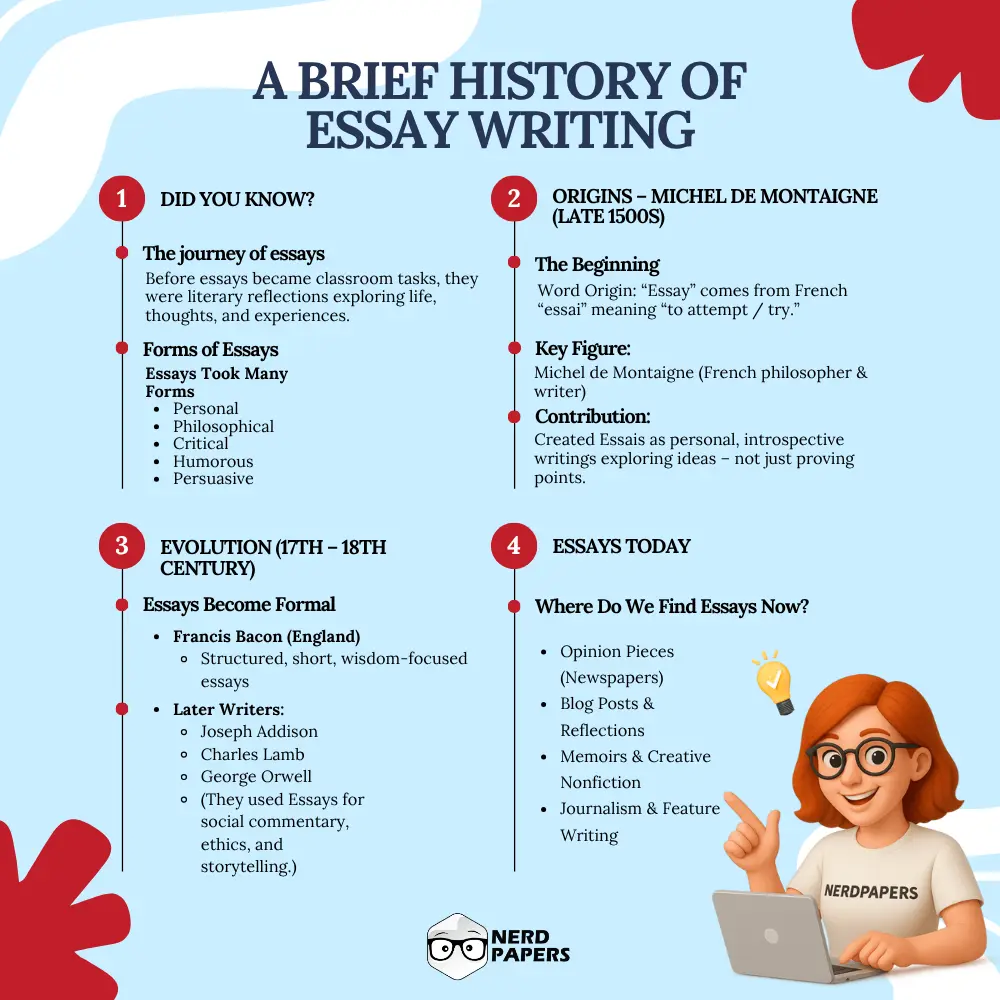
Before essays became the standard classroom assignment, they had a rich literary history rooted in reflection, experimentation, and personal insight. Understanding where essays come from can help you appreciate them not just as a school task — but as a powerful form of communication used for centuries.
The Origins – Michel de Montaigne
The word “essay” comes from the French term essai, meaning “to attempt” or “to try.” That definition captures the spirit behind the first modern essays — attempts to explore thoughts, reflect on life, and better understand the world.
The form was popularized in the late 1500s by Michel de Montaigne, a French philosopher and writer. His collection Essais introduced the essay as a personal, introspective style of writing that focused on self-discovery rather than strict conclusions. Montaigne wasn’t trying to prove a point — he was trying to figure one out.
The Evolution of the Essay
In the 17th and 18th centuries, English writers like Francis Bacon adapted the essay into a more formal and analytical tool. Bacon’s essays were shorter, structured, and focused on delivering wisdom and observation.
Later, authors like Joseph Addison, Charles Lamb, and George Orwell used the essay as a vehicle for social commentary, ethics, and storytelling — blending literary art with clear reasoning.
As essays evolved, they took on many forms: personal, philosophical, critical, humorous, and persuasive — often published in magazines, newspapers, and literary journals.
Modern Essay Usage Beyond Academics
Today, essays are everywhere — not just in schools. You’ll find them in:
- Opinion pieces in newspapers
- Blog posts and personal reflections
- Memoirs and creative nonfiction
- Journalism and feature writing
While the essay has become a cornerstone of education, it still serves a wide variety of purposes outside the classroom. Whether you’re trying to explain a concept, reflect on a life experience, or persuade someone to see your point of view, the essay remains a flexible and powerful format.
Types of Essays
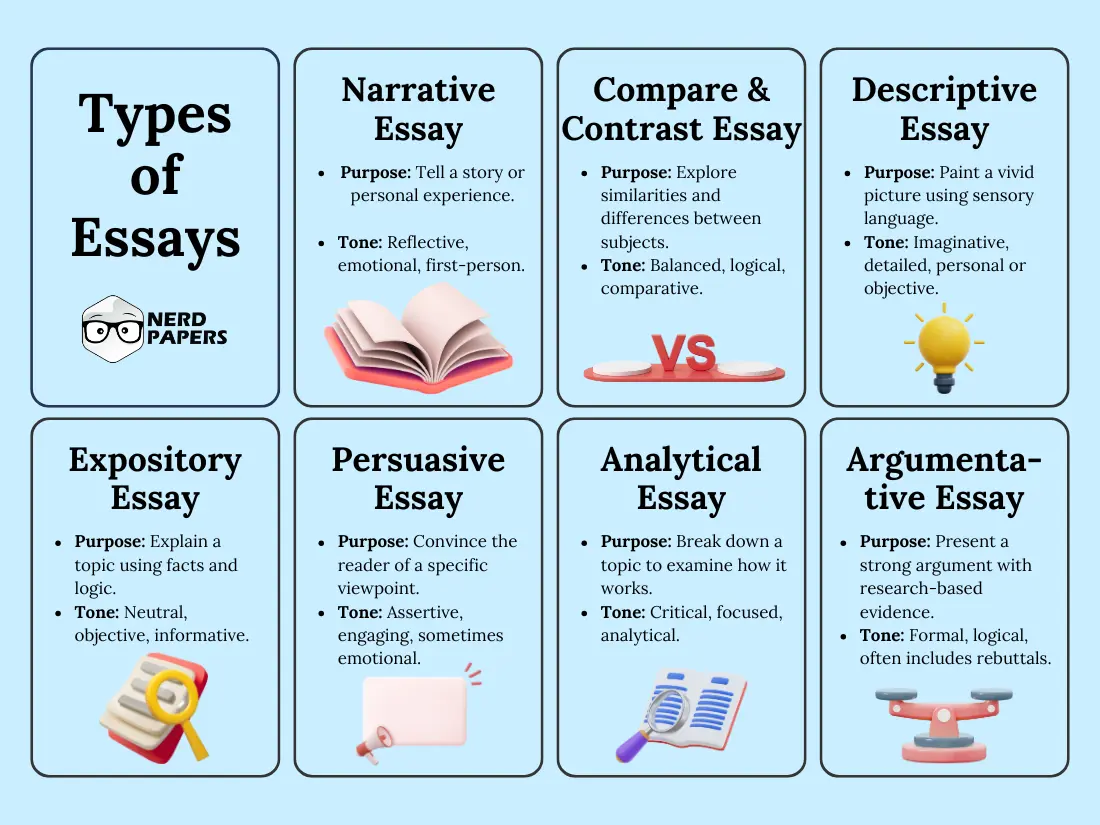
Essays come in different forms, each serving a unique purpose and writing style. Some are written to share stories, others to explain ideas, and many to convince readers of a particular viewpoint. While some of these types appear in academic settings, they’re also common in personal writing, blogs, and everyday communication.
Here are the most common types of essays:
Narrative Essay
A narrative essay tells a story from the writer’s perspective. It’s often written in the first person and focuses on personal experiences, emotions, and moments that matter.
Describe a lesson you learned from a major life event.
Descriptive Essay
This type of essay aims to create a vivid picture of a person, place, object, or experience using sensory details and rich language.
Paint a scene of your favorite place using sound, sight, and smell.
Expository Essay
An expository essay explains a concept, idea, or process in a clear and logical way. It is objective, straightforward, and based on facts — not opinions.
Explain how a bill becomes a law.
Persuasive Essay
A persuasive essay attempts to convince the reader to accept a particular opinion or take action. It uses logical arguments, emotional appeals, or a mix of both.
Argue why school uniforms should (or shouldn’t) be required.
Analytical Essay
Analytical essays examine a subject closely — such as a book, event, or idea — and break it down into parts to understand how it works or what it means.
Analyze how a film uses symbolism to convey a deeper theme.
Compare and Contrast Essay
This format highlights the similarities and differences between two or more subjects. It’s useful for examining opposing ideas, theories, or objects side by side.
Compare online learning and in-person classes.
Argumentative Essay
An argumentative essay presents a strong, evidence-based case for one side of an issue. It discusses opposing views but focuses on defending a specific argument through research and logic.
Make a case for or against banning plastic bags.
Each essay type offers a different way to communicate ideas. Choosing the right format depends on your topic, goal, and audience. Whether you’re writing to tell a story, explain a topic, or support an opinion, understanding these types will help you write with clarity and purpose.
Common Misconceptions About Essays
Many students — especially those just starting out — approach essay writing with assumptions that can lead to confusion or mistakes. Clearing up these misconceptions helps you write with more confidence and accuracy.
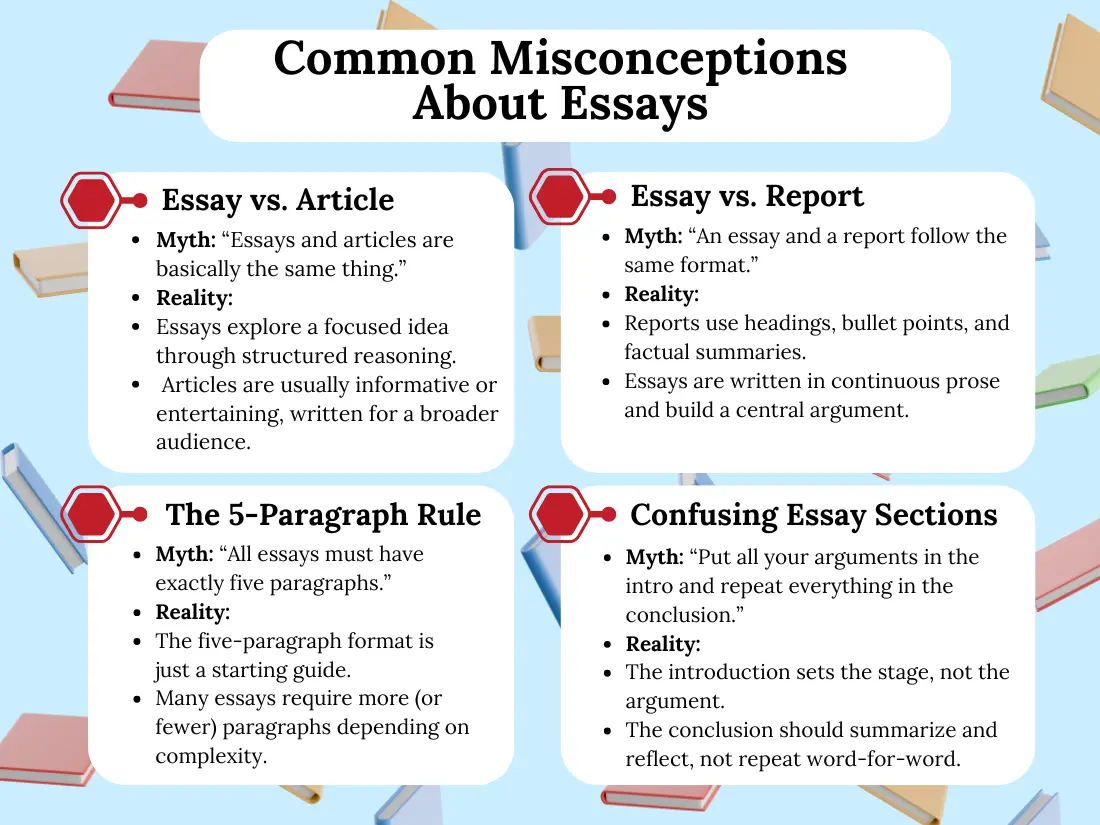
Let’s debunk some of the most common myths about what an essay is (and isn’t):
Essay vs. Article
At first glance, essays and articles might seem similar — they both share ideas and are structured in paragraphs. But their purpose and tone are different.
- An article is usually written for a wide audience and appears in newspapers, magazines, or websites. It tends to be more informative, entertaining, or promotional.
- An essay, on the other hand, is more focused and intentional. It often presents a specific viewpoint or explores a topic in depth, using structure and logical flow to guide the reader.
Think of it this way: an article delivers information, while an essay develops an idea.
Essay vs. Report
Another mix-up happens between essays and reports — especially in school settings.
- A report is typically factual and highly structured. It includes clear sections (like headings, subheadings, bullet points, or data tables) and is often used in science, business, or technical writing.
- An essay is written in continuous prose and focuses on building a reasoned argument or exploring a concept, guided by a thesis.
If your assignment has charts, headings, or a results section — it’s probably a report.
The “5-Paragraph Essay” Myth
Many students are taught to write essays with five paragraphs: one intro, three body paragraphs, and a conclusion. This model is a good starting point — but it’s not a rule.
Not every essay needs to fit that exact structure. Some topics require more depth and discussion, which may mean more paragraphs. The goal is clarity and flow, not sticking to a rigid format.
It’s not about counting paragraphs — it’s about making your ideas clear and well-supported.
Confusing Essay Sections
Students often mix up what belongs in different parts of an essay. Here are some common mistakes:
- Putting too much analysis or argument in the introduction
- Using the conclusion to simply repeat points instead of summarizing and reflecting
- Writing a vague or overly broad thesis statement that doesn’t guide the rest of the essay
A clear structure — introduction, thesis, body, conclusion — helps your essay stay focused and effective.
By understanding what essays are (and what they’re not), you’ll be able to approach your writing with more clarity, confidence, and purpose.
Why Essays Still Matter
So — what is an essay, really?
It’s far more than just a school assignment or a series of paragraphs. An essay is a structured way to express ideas, explore topics, and communicate with clarity and purpose. Whether you’re telling a story, analyzing a concept, or building an argument, essay writing sharpens your thinking and strengthens your voice.
In this guide, we explored:
- What defines an essay and why it matters
- The key elements that make essays effective
- A brief history of essay writing and how it evolved
- The main types of essays you’re likely to encounter
- Common misconceptions that often confuse new writers
Essays remain one of the most versatile forms of writing — not just in education, but also in journalism, professional communication, and personal expression. Their ability to organize thought, convey arguments, and connect with readers makes essay writing a vital skill in both academic and real-world settings.
Ready to write your own?
Check out our complete guide on how to write an essay — from brainstorming and outlining to revising your final draft.
No matter your topic, purpose, or audience, understanding the essay writing process gives you the confidence and clarity to express your ideas effectively.
Frequently Asked Questions (FAQ)
What is an essay?
An essay is a structured piece of writing that explores, explains, or argues a specific idea. It typically includes an introduction, body paragraphs, and a conclusion, all focused around a central thesis or message.
What is in an essay?
An essay usually contains:
An introduction with a thesis statement
Body paragraphs with evidence and analysis
A conclusion that summarizes and reflects on the main idea
What is the purpose of the essay?
The purpose of an essay is to inform, explain, reflect, or persuade. It helps writers organize their thoughts and communicate clearly with readers.
What is the most important part of an essay?
The thesis statement is often considered the most important part. It defines the main point of the essay and guides the structure and content that follows.
What is the difference between an essay and an article?
An essay presents a focused argument or exploration, often in a more formal or reflective tone. An article is usually written for a broader audience and may be more informative, casual, or journalistic in nature.
How is an essay different from a report?
A report uses sections, headings, and data to present factual information. An essay uses continuous prose to build and support a central idea or argument.
Is every essay supposed to have five paragraphs?
No — while the five-paragraph format is a useful starting point for beginners, many essays require more (or fewer) paragraphs depending on the topic, depth, and purpose.