When it comes to writing an essay, structure is everything. A well-structured essay helps your ideas flow clearly from one point to the next. It guides the reader through your argument or explanation, making your message easier to understand.
Think of essay structure like a roadmap. Without it, your thoughts might feel scattered or confusing—even if they’re great ideas. But with the right structure, your writing becomes more organized, focused, and convincing.
Teachers and professors also look at structure when grading your work — so getting it right can help boost your marks.
In this blog, you’ll learn:
- What the basic structure of an essay looks like (intro, body, conclusion)
- How to make sure your ideas flow smoothly from one paragraph to the next
- Why outlines and planning help keep your essay organized
- How formatting styles like APA and MLA affect your structure
- Common structure mistakes to avoid — and how to fix them
Essay structure is easier to master once you understand the basics of essays themselves. If you’re still getting started, our detailed guide on What Is an Essay explains the purpose, types, and key components of essays — the perfect starting point before focusing on structure.
What Is Essay Structure?
Essay structure is the way your essay is organized — how the introduction, body paragraphs, and conclusion work together to present your ideas clearly. Think of it like building a house: each part has a role, and they all need to be in the right place for the whole thing to make sense.
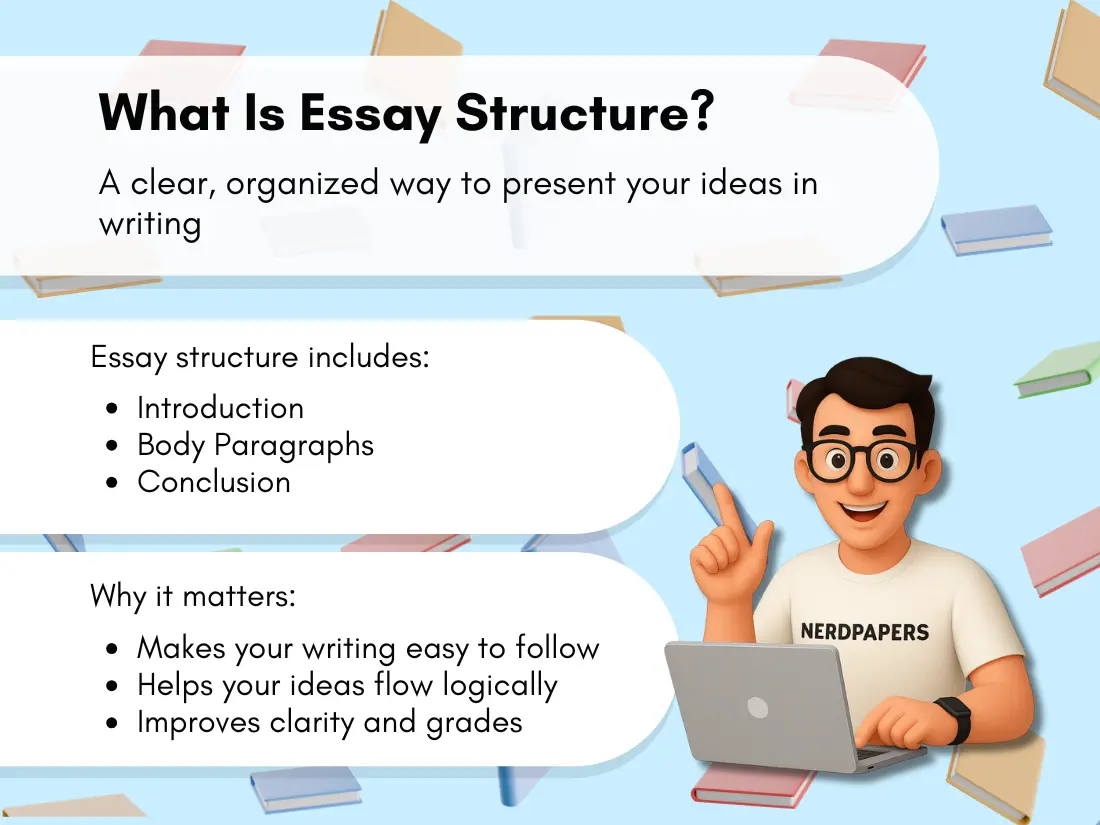
A good structure helps:
- 🧠 Your ideas flow in a clear, logical order
- 📚 The reader follow and understand your argument
- 📝 You meet the expectations on most academic rubrics
No matter the topic or type of essay, having a strong structure improves clarity, keeps your writing focused, and increases your chances of getting a better grade.
Core Components of Every Essay
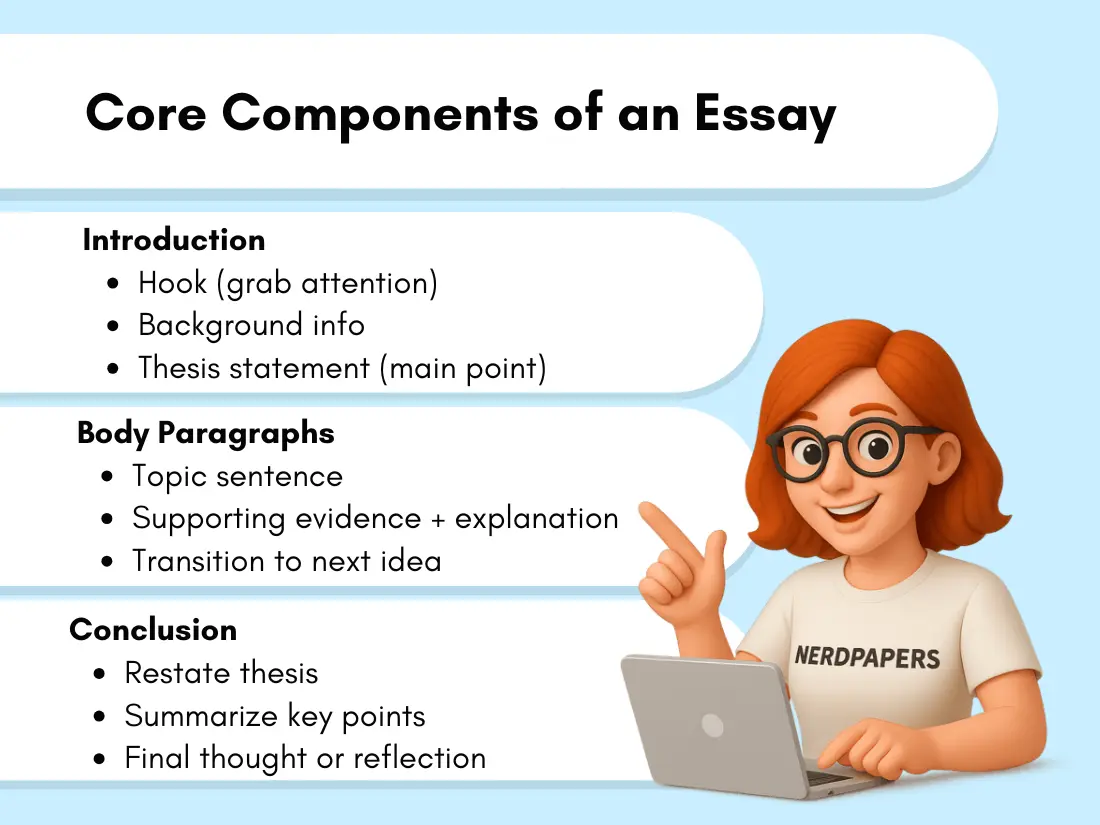
Every well-structured essay follows a basic framework with three main parts: the introduction, the body paragraphs, and the conclusion. Each part has a clear role and works together to guide the reader through your ideas.
Introduction
The introduction sets the stage for your essay. It should:
- Grab attention with a hook — a question, quote, or interesting fact
- Give background to help the reader understand the topic
- End with a thesis statement that clearly states your main point
Body Paragraphs
This is the heart of your essay. Each paragraph should:
- Start with a topic sentence that introduces the main idea
- Include supporting evidence like facts, examples, or quotes
- Follow with your explanation or analysis of that evidence
- Finish with a transition to smoothly lead into the next paragraph
Conclusion
The conclusion wraps up your essay. It should:
- Restate the thesis in a fresh way
- Summarize your main points without repeating word-for-word
- End with a final thought — a reflection, insight, or call to action
Planning Your Essay Structure
A strong essay doesn’t start with writing — it starts with planning. Before you begin your first sentence, it’s important to think about how you’ll organize your ideas. Good planning helps you stay focused, avoid repetition, and create a clear, logical flow from start to finish.
This section will walk you through how to create an outline, choose the right organizational pattern, and keep your essay coherent and well-connected.
Create an Essay Outline
An essay outline is a simple blueprint of your ideas. It shows where each major point will go and what each paragraph will cover. Outlining helps prevent disorganized ideas, fragmented thoughts, and unsupported claims—common issues that lower the quality of writing.
Benefits of outlining:
- Helps with paragraph unity and logical progression
- Makes the writing process faster and easier
- Keeps your thesis and main points in focus
- Introduction
- Hook
- Background information
- Thesis statement
- Body Paragraph 1
- Topic sentence
- Supporting evidence + explanation
- Transition
- Body Paragraph 2
- Topic sentence
- Supporting evidence + explanation
- Transition
- Body Paragraph 3
- Topic sentence
- Supporting evidence + explanation
- Transition
- Conclusion
- Restate thesis
- Summarize main points
- Final thought
Logical Flow & Coherence
Once you’ve outlined your structure and chosen an organization style, the next step is making sure your essay flows naturally. This is where coherence comes in — it’s about keeping your writing smooth and connected.
Tips for better coherence:
- Use transition words (however, therefore, in contrast) to link ideas
- Begin each paragraph with a clear topic sentence
- Avoid sudden shifts or unrelated points
- Maintain sentence structure variety to keep the reader engaged
Strong transitions and paragraph unity prevent run-on sentences, fragmented ideas, and confusing progression — common structural mistakes in essays.
Not Sure How to Organize Your Essay?
Different topics and goals call for different ways to structure your essay. In the next section, we’ll walk through common organizational styles like chronological order, compare and contrast, and problem-solution — so you can choose the one that fits your purpose best.
Common Organizational Styles in Essay Writing
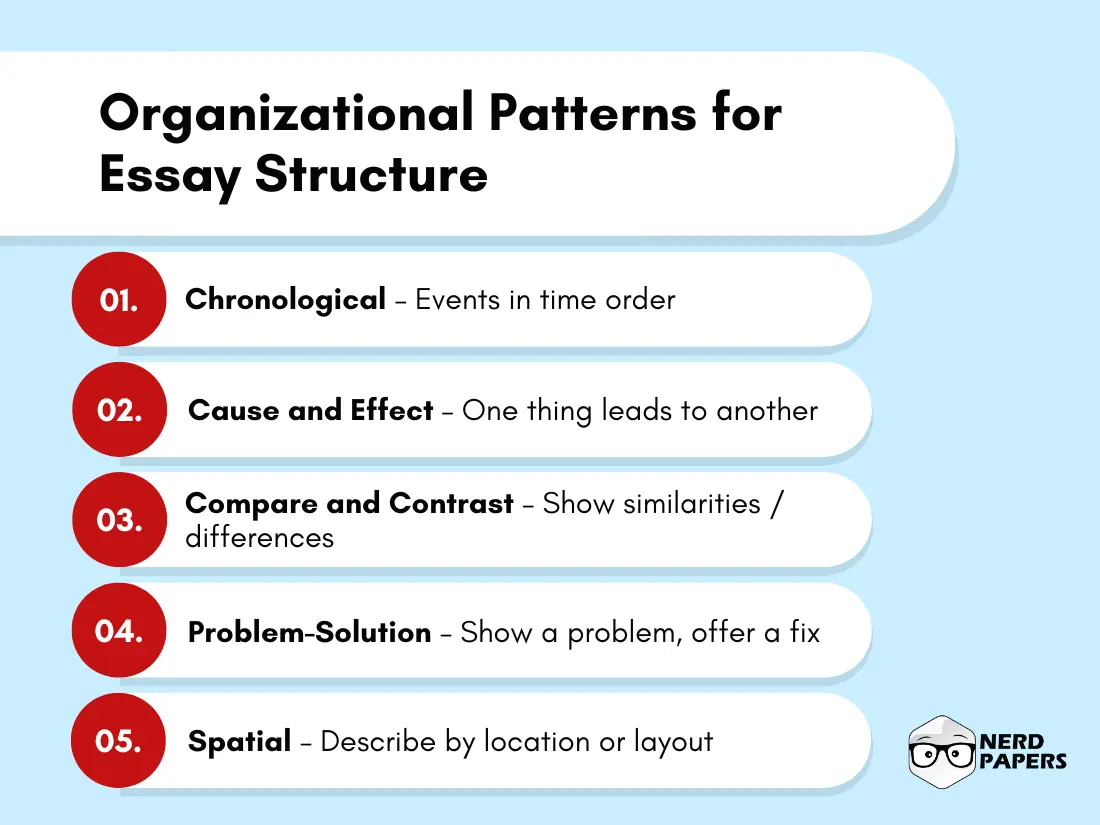
Once you’ve outlined your essay and planned your points, the next step is choosing how to arrange them. Different types of essays require different organizational patterns. The structure you choose should match your essay’s purpose — whether you’re explaining a process, comparing ideas, telling a story, or solving a problem.
Below are the most common organizational styles, along with templates and examples to help you get started.
Chronological Essay Structure
This structure presents events or steps in the order they happened. It’s great for narrative essays, historical analysis, or explaining processes.
Best for:
- Personal narratives
- History essays
- Step-by-step explanations
Structure:
- Introduction
- Set the scene, provide context, state the thesis
- Set the scene, provide context, state the thesis
- Body Paragraphs
- Describe each event or step in order
- Include evidence and details for each part
- Conclusion
- Recap the sequence and reflect on its meaning or outcome
- Recap the sequence and reflect on its meaning or outcome
Writing about the stages of a scientific experiment or a major life event
Cause and Effect Essay Structure
This pattern shows how one thing leads to another. It’s ideal for analytical, expository, or persuasive essays where you’re explaining impacts or consequences.
Best for:
- Social issues
- Scientific or health-related topics
- Explaining outcomes
Structure:
- Introduction
- State the main issue and thesis
- State the main issue and thesis
- Body Paragraphs
- Cause(s) → Effect(s)
- Support each point with evidence and explanation
- Conclusion
- Summarize cause-effect relationships and provide insights
- Summarize cause-effect relationships and provide insights
Discussing how screen time affects mental health in teenagers
Compare and Contrast Essay Structure
Use this when you’re showing similarities and/or differences between two or more ideas. You can organize it in two different ways:
Method 1: Alternating
Each paragraph compares a specific aspect across both subjects.
Template:
- Introduction
- Point 1: Subject A vs. Subject B
- Point 2: Subject A vs. Subject B
- Point 3: Subject A vs. Subject B
- Conclusion
Method 2: Block
Discuss all details of one subject first, then all details of the second.
Template:
- Introduction
- Subject A (all main points)
- Subject B (same points in contrast)
- Conclusion
Best for:
- Literary analysis
- Argument evaluation
- Topic comparisons (ex: online vs. in-person classes)
Problem-Solution Essay Structure
This style focuses on presenting an issue and offering a solution. It’s common in argumentative and policy-based essays.
Best for:
- Real-world challenges
- Social or environmental issues
- Proposal-style essays
Structure:
- Introduction
- Introduce the issue and your thesis
- Introduce the issue and your thesis
- Problems
- Explain the problem with examples or data
- Explain the problem with examples or data
- Methods
- Discuss any current or past attempts to solve it
- Discuss any current or past attempts to solve it
- Solutions
- Present your proposed solution and support it
- Present your proposed solution and support it
- Conclusion
- Restate your position and suggest future direction
- Restate your position and suggest future direction
Exploring how to reduce food waste in schools
Spatial Order Essay Structure
This pattern organizes information based on physical location or layout. It’s often used in descriptive writing or when explaining how something looks or functions in space.
Best for:
- Descriptive essays
- Travel writing
- Design or layout analysis
Structure:
- Introduction
- Set the scene
- Set the scene
- Body Paragraphs
- Move from top to bottom, near to far, left to right, etc.
- Describe each section clearly with sensory details
- Conclusion
- Recap the overall image or atmosphere
- Recap the overall image or atmosphere
Describing your childhood bedroom or a historical landmark
Paragraph-Level Structure
Even with a solid outline and a clear overall structure, each individual paragraph must be well-built. Think of each paragraph as a small building block of your essay — it should support your main argument and stand strong on its own.
This section will show you how to structure paragraphs for clarity, unity, and logical flow.
Paragraph Unity
Each paragraph should focus on one main idea that supports your thesis. Mixing multiple unrelated ideas in one paragraph confuses readers and weakens your argument.
To keep unity in your paragraph:
- Start with a topic sentence that clearly introduces the main point
- Support it with relevant evidence or examples
- Explain the evidence in your own words (don’t just quote it)
- End with a transition or closing sentence that leads to the next idea
Sentence Structure and Clarity
Good sentence structure makes your writing easier to follow. Aim for a balance of short and long sentences, and make sure each one adds to your point.
Tips for clearer writing:
- Avoid long, run-on sentences
- Don’t start too many sentences the same way (“This means…”)
- Use active voice (e.g., “The author argues…” instead of “It is argued…”)
- Use transition words like however, for example, in contrast to connect thoughts
Example: Strong Paragraph Breakdown
Here’s a mini example of a well-structured body paragraph:
Topic Sentence:
Social media has changed the way students communicate in and outside the classroom.
Evidence:
According to a 2023 Pew Research study, 85% of teens say they use messaging apps to discuss homework and group projects.
Explanation:
This shows that social media isn’t just a distraction — it can be a useful academic tool when used correctly.
Transition:
However, not all effects of social media on student life are positive.
This format keeps the paragraph focused, evidence-backed, and smoothly connected to the next idea.
Formatting & Academic Conventions
While structure is about organizing ideas, formatting deals with how your essay looks and follows academic rules. Each formatting style — APA, MLA, Chicago, Harvard — has its own guidelines for headings, citations, and page layout. Using the correct format not only improves your essay’s presentation but also helps you avoid plagiarism.
Why Formatting Matters
- It shows that you follow academic writing standards
- Helps instructors easily find your sources and arguments
- Keeps your essay organized and professional-looking
- Reduces the chance of unintentional plagiarism through proper citation
Common Formatting Styles
APA (American Psychological Association)
- Used in: Psychology, education, social sciences
- Features: Title page, running head, in-text citations (Author, Year), reference page
MLA (Modern Language Association)
- Used in: Literature, arts, humanities
- Features: No title page (usually), in-text citations with author/page number, Works Cited page
Chicago Style
- Used in: History, fine arts
- Features: Footnotes or endnotes, bibliography, flexible structure based on preference
Harvard Referencing
- Used in: Many UK universities and global academic institutions
- Features: In-text citations with author/date, alphabetical reference list
Formatting and Structure Connection
Formatting also influences your structural layout, including:
- Heading levels: Helps guide the reader and separate sections clearly
- Paragraph spacing and indentation: Keeps each point visually clear
- Citations and footnotes: Show where evidence comes from
- Title placement and font styles: Affect readability and professionalism
Adapting Structure for Different Essay Types
Not all essays follow the exact same structure. While the basic framework (introduction, body, conclusion) stays the same, each essay type has its own structural needs depending on its purpose.
In this section, you’ll see how different essay types adjust their structure — along with quick examples to make it easier to understand.
Argumentative Essays
- Still follow intro → body → conclusion
- But often include:
- A paragraph for the counterargument
- Rebuttal to strengthen your own thesis
In an essay on why school should start later, you might include a paragraph explaining the opposing viewpoint (that early schedules teach discipline) — and then respond with evidence on teen sleep needs.
Expository Essays
- Structure is divided by sub-topics or categories
- Each paragraph explains a different part of the concept
An essay about climate change may have one paragraph on causes, one on effects, and one on possible solutions.
Narrative Essays
- Use a chronological structure to tell a story
- Include key narrative elements: setting, characters, conflict, resolution
A travel story may start with leaving home, continue with key events during the trip, and end with a lesson or reflection.
Descriptive Essays
- Use spatial order to guide the reader through a scene or object
- Focus on sensory details (what you see, hear, smell, etc.)
Describing a bedroom from the doorway to the far corner, adding detail layer by layer to create a vivid picture.
Different essay types may need slight changes in structure — but all still benefit from clear organization, logical flow, and focused paragraphs.
Common Structure Mistakes to Avoid
Even if you understand essay structure, small mistakes can weaken your writing and confuse your reader. This section covers the most common structure-related problems — and how to fix them.
1. Missing or Weak Thesis Statement
Problem: The essay doesn’t clearly state its main idea.
Fix: Always include a focused, arguable thesis in the last sentence of your introduction.
2. Disorganized Paragraphs
Problem: Ideas jump around or don’t follow a clear order.
Fix: Use an outline before writing, and follow a consistent organizational pattern (like chronological or problem-solution).
3. Run-On Paragraphs
Problem: Paragraphs contain too many ideas without clear breaks.
Fix: Stick to one idea per paragraph. Start with a topic sentence and build around it.
4. Weak or Missing Transitions
Problem: Paragraphs and sentences feel disconnected.
Fix: Use transition words (however, for example, in contrast) to guide your reader through the flow of ideas.
5. Unsupported Claims
Problem: Statements are made without examples or evidence.
Fix: Back up each point with quotes, data, or examples, followed by your explanation.
6. Fragmented Ideas
Problem: Sentences are incomplete or break the flow.
Fix: Read your essay aloud to catch sentence fragments and check for subject-verb agreement.
7. Poor Citation Placement
Problem: Evidence is included without proper citation, risking plagiarism.
Fix: Use the correct format (APA, MLA, etc.) and always cite after quoting or paraphrasing.
Avoiding these mistakes will make your essay easier to read — and more effective overall.
Essay Structure Checklist
Before you submit your essay, use this quick checklist to make sure your structure is clear, complete, and well-organized. It’s a simple way to catch common issues and improve your overall flow.
Introduction
- Does it start with a hook that grabs attention?
- Have you included background information to introduce the topic?
- Is there a clear thesis statement at the end?
Body Paragraphs
- Does each paragraph start with a topic sentence?
- Have you included evidence, examples, or data to support your point?
- Do you explain or analyze the evidence in your own words?
- Are transition words or phrases used to link ideas smoothly?
Conclusion
- Did you restate the thesis without repeating it exactly?
- Have you summarized the main points of the essay?
- Does your final sentence offer a strong closing thought?
Formatting & Flow
- Is the essay in the correct formatting style (APA, MLA, etc.)?
- Are citations and references properly placed?
- Does the essay follow a logical order from beginning to end?
- Have you used a consistent organizational pattern (e.g., chronological, compare-contrast)?
Checking off these boxes helps ensure that your essay is well-structured, readable, and ready to impress.
Essay Structure Example (Mini Outline)
To help you see how everything fits together, here’s a simple outline of a five-paragraph argumentative essay. This example follows the basic structure we’ve covered throughout the guide.
Essay Topic:
Should schools start later in the day for teenagers?
Introduction
- Hook: “Every morning, millions of teens start school before the sun rises—often sleep-deprived and unfocused.”
- Background info: Brief overview of school start times and growing concerns
- Thesis statement: Schools should start later to support teen health, improve academic performance, and reduce mental health risks.
Body Paragraph 1 – Health Benefits
- Topic sentence: Teenagers need more sleep for healthy development.
- Evidence: Cite studies from sleep experts or the CDC
- Explanation: Explain how lack of sleep affects growth and alertness
- Transition: Beyond health, sleep also affects students’ grades.
Body Paragraph 2 – Academic Performance
- Topic sentence: Later start times improve focus and test scores.
- Evidence: Mention results from schools that shifted start times
- Explanation: Show the link between sleep and memory or focus
- Transition: Some argue that changing start times disrupts routines.
Body Paragraph 3 – Addressing Counterarguments
- Topic sentence: Opponents say late start times cause scheduling problems.
- Rebuttal: Show how schools adjusted bus routes or extracurriculars successfully
- Evidence: Real-world case study (e.g., Seattle Public Schools)
- Closing: Overall, the benefits outweigh the challenges.
Conclusion
- Restate thesis: Later school start times are better for teen health and learning.
- Summary: Health, academics, and mental well-being
- Final thought: If we want students to succeed, we must let them sleep.
This outline shows how each part of an essay fits into a clear, effective structure — with purpose, flow, and support at every stage.
Conclusion
A well-structured essay does more than just organize your thoughts — it strengthens your message, improves clarity, and helps you communicate with confidence. Whether you’re writing a short classroom assignment or a longer academic paper, structure gives your ideas the support they need to stand strong.
To recap, every strong essay includes:
- A clear introduction with a focused thesis
- Well-organized body paragraphs that follow a logical flow
- A thoughtful conclusion that ties everything together
- Proper formatting and transitions to guide the reader
Now that you know how to structure essays clearly, the next step is putting everything into practice. From brainstorming topics to polishing the final draft, each stage builds on structure. To see how it all comes together, check out our full writing process in How to Write an Essay
FAQs About Essay Structure
Below are answers to some of the most common questions students have about essay structure. These quick explanations will help clarify key points and clear up confusion.
What is the basic structure of an essay?
Most essays follow a three-part structure: introduction, body paragraphs, and conclusion. The introduction sets up the topic and thesis, body paragraphs present your main points with evidence, and the conclusion wraps everything up.
How long should each paragraph be?
There’s no exact word count, but a good paragraph usually has 4–6 sentences. Focus on one idea per paragraph, and make sure it’s supported with explanation or evidence.
Can I use more than five paragraphs in an essay?
Yes! The five-paragraph format is common for short essays, but longer assignments often require more paragraphs to fully develop your points. Just make sure each one serves a purpose and supports your thesis.
What makes a good topic sentence?
A good topic sentence clearly states the main idea of the paragraph. It connects back to your thesis and sets up what the paragraph will discuss. Avoid vague or overly general statements.
Do all essays need a conclusion?
Absolutely. Even short essays should end with a conclusion that restates the thesis, summarizes key points, and leaves the reader with a final thought or reflection.