Have you ever read an essay that felt like a pile of puzzle pieces that didn’t quite fit together? The ideas might be solid, but without smooth connections, the reading experience feels disjointed. That’s where transition words for essays work their magic.
These small but powerful words act like bridges, guiding your reader from one thought to the next and ensuring your essay flows logically from start to finish. Whether you’re working on a school paper, a college assignment, or a persuasive article, mastering transitions can turn your writing from “good” to “compelling.”
If you’re still planning your paper, our guide on How to Write an Essay explains the full writing process — from brainstorming to editing — and shows where transitions fit in for maximum impact.
What You’ll Learn in This Blog
In this guide, we’ll break down:
- What transition words are and why they’re essential.
- Different types of transitions and when to use them.
- Practical examples for essays of all kinds.
- Common mistakes to avoid.
- Best practices to make your writing smoother and more persuasive.
By the end, you’ll know exactly how to choose and use the right transition words to make your essays clear, cohesive, and impactful.
What Are Transition Words for Essays?
The term transition comes from the Latin transītiō, meaning “to carry across.” In writing, transition words and phrases serve exactly that purpose — carrying your reader smoothly between ideas, sentences, and paragraphs.
Think of them as signposts on a road trip:
- They tell the reader where you’re headed next.
- They explain the relationship between two points.
- They prevent your writing from feeling abrupt or disconnected.
Without transitions, your essay can read like a series of unrelated statements. With them, your argument becomes cohesive, persuasive, and easy to follow.
Why They Matter
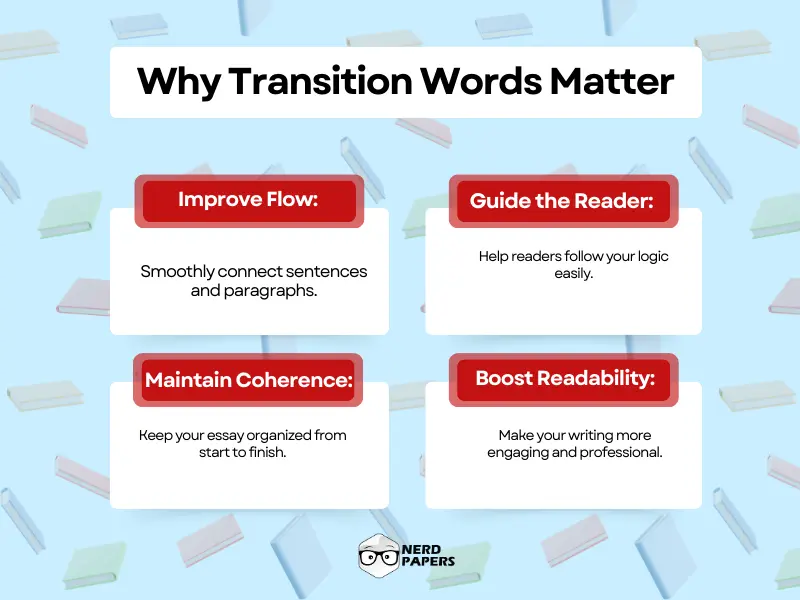
Transition words aren’t just for polish — they are essential for:
- Clarity – showing exactly how ideas relate.
- Coherence – ensuring smooth flow between points.
- Impact – making arguments stronger and more convincing.
When used well, transition words help you guide your reader, maintain interest, and leave a lasting impression.
Why Transition Words Matter in Essay Writing
Transition words are more than decorative additions to your sentences — they are functional tools that keep your essay cohesive and reader-friendly. In academic writing, their main purposes are to:
- Improve essay flow so ideas move naturally from one to the next
Connect ideas between sentences and paragraphs - Maintain coherence by showing relationships between points
- Guide the reader through your argument or narrative
- Ensure logical progression so your essay doesn’t feel disjointed
When used correctly, transitions act as signposts for your readers. They clarify how each piece of information relates to the next, making your essay easier to understand and more persuasive.
Example: With and Without Transitions
Without Transitions
The Industrial Revolution began in Britain in the late 18th century. Many people moved from rural areas to cities. Factories created new job opportunities. Working conditions were often poor.
This version feels like a bullet list—factual but disconnected.
With Transitions
The Industrial Revolution began in Britain in the late 18th century. As a result, many people moved from rural areas to cities in search of work. While factories created new job opportunities, they also introduced working conditions that were often poor.
Here, transitions like ‘as a result’, ‘while’, and ‘they also’ show cause-and-effect, contrast, and connection. The passage now reads more fluidly and logically.
If you’re structuring your essay from the start, you’ll find it easier to place transitions exactly where they’re needed. That’s why an essay outline is a critical first step before finalizing your wording.
3. Types of Transition Words for Essays
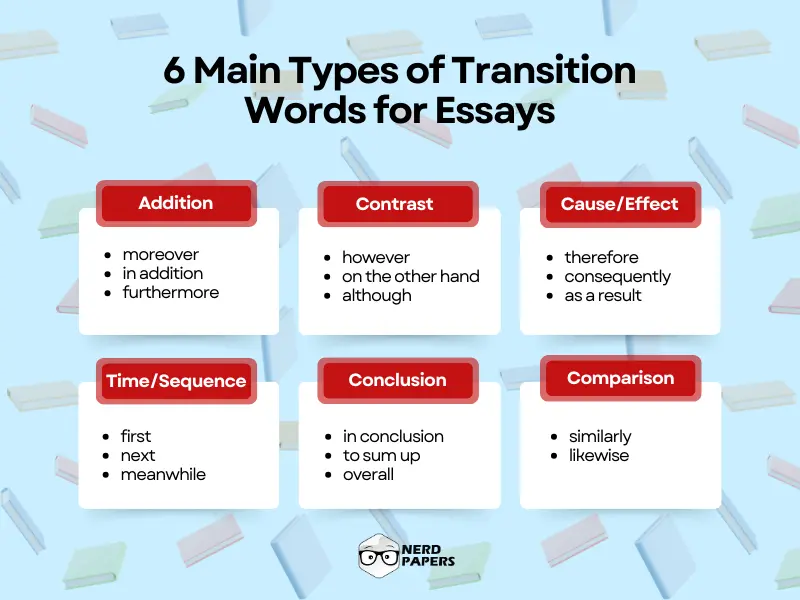
Not all transition words serve the same purpose. The right choice depends on what you’re trying to communicate and the type of essay you’re writing. Below are the main categories, with examples and suggested use cases.
1. Addition Transitions
Purpose: Add supporting points or reinforce an argument.
Examples: in addition, moreover, furthermore, also, as well as, not only… but also
Best for:
- Argumentative essays – to strengthen a claim with more evidence
- Expository essays – to build on facts logically
2. Contrast Transitions
Purpose: Show differences or opposing ideas.
Examples: however, on the other hand, although, yet, whereas, instead
Best for:
- Argumentative essays – to counter opposing viewpoints
- Analytical essays – to compare two theories or interpretations
3. Cause-and-Effect Transitions
Purpose: Explain reasons, results, or consequences.
Examples: therefore, consequently, as a result, hence, because, due to
Best for:
- Research papers – to show logical outcomes from data
- Persuasive essays – to link cause and solution
4. Time Order & Sequence Transitions
Purpose: Show chronological order or steps in a process.
Examples: first, next, then, afterwards, meanwhile, eventually
Best for:
- Narrative essays – to guide the reader through events
- Process essays – to explain steps clearly
5. Conclusion Transitions
Purpose: Signal the end of a section or the essay as a whole.
Examples: in conclusion, to sum up, overall, in summary, finally
Best for:
- All essay types – to wrap up ideas cohesively without abrupt endings
6. Comparison Transitions
Purpose: Highlight similarities.
Examples: similarly, likewise, in the same way, just as
Best for:
- Literary analysis – to compare themes or characters
- Analytical essays – to link related concepts
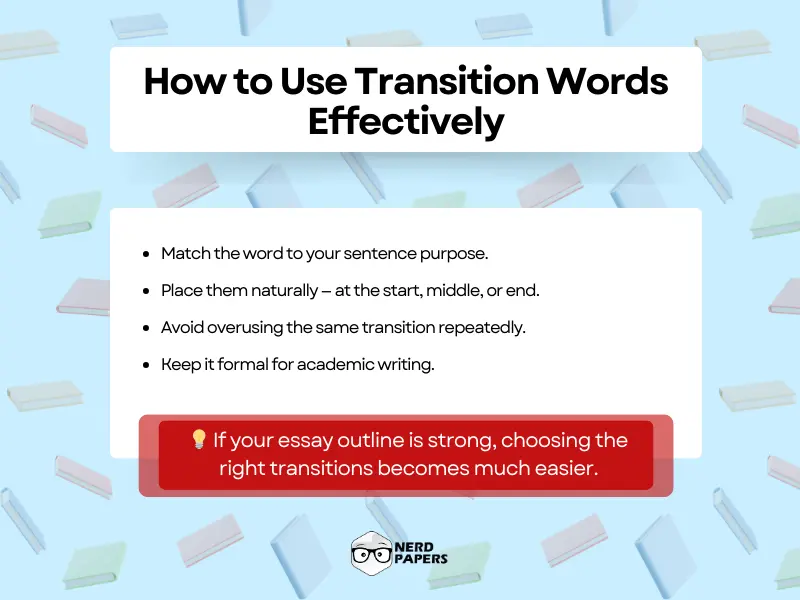
How to Use Transition Words Effectively
Knowing a list of transition words is one thing—using them well is another. Poor placement or overuse can make your essay sound repetitive or forced, while strategic use can make it feel smooth, cohesive, and professional.
1. Match Transitions to Purpose
Every transition word serves a specific role. Use addition transitions (moreover, in addition) when you’re adding evidence, and contrast transitions (however, on the other hand) when showing opposing ideas. The wrong category can confuse your reader and break the logical flow.
2. Vary Placement Within Sentences
Transition words don’t always have to be at the start of a sentence.
- Start: “However, the results were inconsistent.”
- Middle: “The results were inconsistent; however, further testing is needed.”
- End: “The results were inconsistent, however.”
This variation keeps your writing from sounding mechanical and helps transitions feel natural.
3. Avoid Redundancy & Overuse
Using too many connectors in close succession can make your writing clunky. For example:
❌ “However, the study failed. Nevertheless, it still proved useful.”
✔ “However, the study failed, yet it still proved useful.”
Transition Words to Start a Paragraph
A strong paragraph opening tells your reader where you’re headed next and how it connects to the previous idea. The right transition word at the start of a paragraph can signal contrast, continuation, or a new supporting point—making your essay easier to follow.
Purpose of Opening Transitions
When you start a new paragraph, your reader needs a signpost. An effective transition word:
- Connects the new paragraph to the previous one.
- Indicates whether you’re adding information, showing contrast, or moving to a conclusion.
- Maintains the essay’s logical progression.
Strong Examples for New Paragraphs
Addition (to continue an idea)
- Moreover, Furthermore, In addition, Also
Contrast (to present an opposing point)
- However, On the other hand, Conversely, In contrast
Example or Illustration (to clarify a point)
- For example, For instance, To illustrate
Sequence or Order (to move through points)
- Firstly, Next, Then, Finally
Example in Context
Without Transition:
“Social media can be a powerful educational tool. It also poses risks for students’ mental health.”
With Transition:
“Social media can be a powerful educational tool. However, it also poses risks for students’ mental health.”
Transition Words for Conclusions
Your conclusion is the reader’s final impression of your essay. The right transition word signals that your discussion is ending, while still keeping your writing polished and professional.
Purpose of Conclusion Transitions
Conclusion transitions serve three main roles:
- Signal the end of your discussion.
- Summarize key points without repeating them word-for-word.
- Leave a lasting impact that reinforces your argument or message.
Strong Examples for Conclusions
Formal & Academic
- In conclusion, To sum up, Overall, In summary, Finally
For Persuasive or Reflective Essays
- Ultimately, In the end, All things considered, As a result
To Highlight Significance
- Therefore, Thus, Hence, Consequently
Example in Context
Without Transition:
“Technology will continue to shape the way we learn. Educators must adapt to these changes.”
With Transition:
“In conclusion, technology will continue to shape the way we learn, and educators must adapt to these changes.”
Common Mistakes to Avoid
- Using informal phrases like That’s all folks or The end in academic writing.
- Repeating your thesis exactly instead of rephrasing it.
- Overstuffing with multiple conclusion transitions in one sentence.
Common Mistakes with Transition Words
Even though transition words can make your essay smoother and more engaging, using them incorrectly can have the opposite effect. Here are some of the most frequent mistakes students make—and how to avoid them:
1. Overusing Transition Words
- Why it’s a problem: Too many transitions can make your writing feel forced or repetitive. Instead of helping the reader, they can interrupt the natural flow.
- How to fix it: Use transitions strategically—only when you need to guide the reader or clarify a relationship between ideas.
2. Using the Wrong Category
- Why it’s a problem: Choosing a contrast word (however) when you actually need an addition word (moreover) confuses the reader.
- How to fix it: Understand the purpose of each category—addition, contrast, cause-and-effect, sequence, conclusion, and comparison—and match it to your sentence’s intent.
3. Redundancy with Other Signals
- Why it’s a problem: Combining a transition word with another obvious signal can be repetitive. Example: In conclusion, to summarize…
- How to fix it: Pick one strong connector that clearly signals the relationship.
4. Using Informal or Conversational Connectors in Academic Essays
- Why it’s a problem: Phrases like anyway, by the way, or you know can make an essay sound unprofessional.
- How to fix it: Stick to formal connectors suited for academic writing, such as therefore, in addition, or on the other hand.
5. Starting Every Sentence with a Transition Word
- Why it’s a problem: Overly predictable sentence openings can make your essay monotonous.
- How to fix it: Place transitions in different parts of the sentence—sometimes at the beginning, sometimes in the middle.
Tools & Resources
Mastering transition words becomes easier when you have the right resources at your fingertips. Here are some valuable tools to help you choose and use them effectively:
1. Transition Word Lists & Charts
- Comprehensive charts organized by category (addition, contrast, cause-effect, etc.)
- Printable reference sheets to keep next to your writing workspace
- Examples for both formal academic writing and casual contexts
2. Style Guides
- MLA Handbook – for language consistency in humanities essays
- APA Publication Manual – for academic tone in research and psychology papers
- Chicago Manual of Style – for history, publishing, and advanced academic writing
These guides provide formatting rules, citation standards, and examples of proper connector usage.
3. Writing Checklists & Worksheets
- Self-editing checklists to ensure transitions are used correctly and sparingly
- Paragraph planning sheets that help you select the right connector for your purpose
- Worksheets with fill-in-the-blank exercises for mastering specific categories
4. Digital Writing Tools
- Grammar and style checkers that flag overused or misplaced transitions
- AI-powered writing assistants (use with caution — always review suggestions for accuracy)
- Online thesauruses to find synonyms for common connectors and avoid repetition
Conclusion
Mastering the use of transition words for essay writing is one of the simplest yet most powerful ways to improve your academic work. These connectors act like signposts, guiding your reader smoothly through your arguments and ensuring your ideas flow logically from start to finish. By choosing the right transition for each context — whether to add information, contrast ideas, or wrap up a point — you enhance clarity, coherence, and overall readability.
The key is balance: use transitions often enough to create flow, but avoid overloading your writing with unnecessary connectors. With practice, you’ll learn to place them naturally so they support your message rather than distract from it. A well-crafted essay with thoughtful transitions will always leave a stronger impression on your reader.
FAQs About Transition Words for Essays
What are transition words for essays?
Transition words for essays are linking words or phrases that connect ideas, sentences, and paragraphs. They help maintain a logical flow and guide the reader smoothly from one point to the next. Examples include however, therefore, and in addition.
How do transition words improve essay writing?
Transition words improve essay writing by making it easier for readers to follow your argument or narrative. They connect related ideas, signal changes in topic or tone, and prevent your writing from feeling abrupt or disconnected.
Can I start a paragraph with a transition word?
Yes, starting a paragraph with a transition word is common in academic writing. For example, you might begin with on the other hand for a contrasting point or for example to introduce evidence. Just make sure the transition fits the paragraph’s purpose.
What are good transition words for conclusions in essays?
Good conclusion transition words include in conclusion, to sum up, overall, and in summary. These signal to the reader that your essay is wrapping up while reinforcing your main points without repeating them word-for-word.
How many transition words should I use in an essay?
There’s no strict number, but transitions should be used strategically — enough to keep your writing smooth, but not so many that it feels forced or repetitive. A well-structured essay often uses at least one transition word or phrase in each paragraph.