
Writing an essay can feel like stepping into a maze with plenty of possible turns, but no clear direction. One wrong move and your argument can suddenly go off track, your structure can collapse, or you’ll find yourself racing against the clock. It’s no surprise that so many students see essays as one of the toughest parts of their academic journey.
Yet essay writing isn’t just another classroom task; it’s a skill that builds critical thinking, clear communication, and confidence. From shaping strong arguments to organizing ideas in a way that flows, essays train you to express yourself with clarity and purpose. For students who are still figuring out the basics of how to write an essay, building on that foundation with practical strategies can make a massive difference in improving overall writing skills.
The good news? You don’t have to be a “natural writer” to get it right. With the right strategies and consistent practice, anyone can turn messy drafts into polished, compelling essays. This guide will share essay writing tips to help you sharpen your skills, tackle everyday struggles, and make the process less stressful and more enjoyable.
Understanding the Importance of Essay Writing
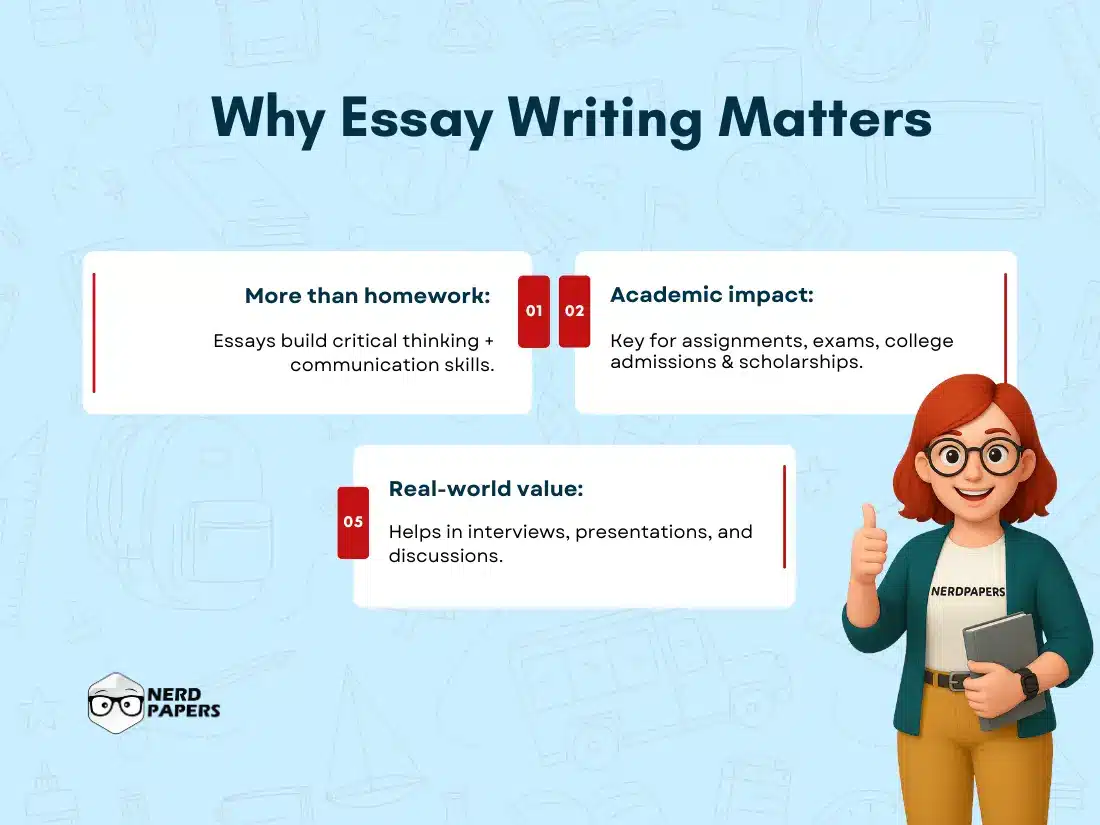
For many students, essay writing can feel like just another assignment piled onto an already busy schedule. But in reality, essays are much more than homework — they’re a skill that can shape both your academic success and your future opportunities.
Think about it: essays appear in almost every stage of education — from class assignments to midterm papers and final exams. They also play a huge role in competitive settings like college admissions and scholarship applications. Admissions committees often look closely at essays to see not just what you know, but how clearly and confidently you can express your ideas. In many cases, a strong essay can make the difference in standing out as a candidate.
Beyond grades and applications, essay writing builds critical thinking and communication skills. When you practice connecting evidence to your arguments and organizing your thoughts logically, you’re preparing for real-life situations too. These same skills help in job interviews, presentations, or even in everyday discussions where clear communication makes a difference.
In short, essays aren’t just obstacles in school — they’re practice for life. The stronger your writing becomes, the more confident you’ll feel in expressing yourself, whether in academics, your career, or personal conversations.
Common Problems in Essay Writing
Even students with plenty of ideas often run into roadblocks when trying to turn those ideas into a well-written essay. Below are some of the most common problems that make essay writing challenging, along with why they happen.
1. Weak or Unclear Thesis Statement
The thesis statement is the foundation of any essay. Without a strong central idea, your essay ends up wandering without direction. Many students either make their thesis too broad (trying to cover too much at once) or too vague (failing to take a clear stance). As a result, the rest of the essay struggles to stay focused and persuasive.
2. Poor Structure and Flow
An essay that jumps from point to point without smooth transitions confuses readers. Common issues include mixing multiple ideas in one paragraph, failing to link arguments logically, or skipping a proper introduction and conclusion. When the structure is weak, even well-researched content loses its effectiveness.
3. Insufficient or Misused Research
Research is the backbone of academic writing, but many students fall into two traps: either relying on too few sources or stuffing essays with quotes without explaining them. Both approaches weaken credibility. An essay that lacks solid evidence feels unconvincing, while one overloaded with unprocessed information feels copied rather than original.
4. Grammar and Vocabulary Issues
Even great ideas can lose their impact if the language isn’t clear. Many students struggle with grammar mistakes, repetitive wording, or limited vocabulary, which makes essays harder to read. On the other hand, some try too hard to “sound academic” by using overly complex or jargon-heavy words. This often makes the essay confusing instead of impressive.
5. Procrastination and Time Management Problems
Leaving essays until the last minute is one of the most common problems students face. Rushed writing often results in weak arguments, careless mistakes, and no time for editing. On the other hand, some students overthink and spend hours perfecting one section, leaving the rest incomplete. Both habits damage the overall quality.
6. Writer’s Block
Few things are more frustrating than staring at a blank page with no idea how to begin. Writer’s block often comes from overthinking the “perfect opening line,” pressure from deadlines, or fear of making mistakes. Instead of starting small and refining later, students sometimes freeze completely, losing valuable writing time.
These problems may look different for each student, but they all lead to the same outcome: essays that don’t fully reflect your abilities. The good news is that every one of these struggles has a solution, and that’s precisely what the next section will cover.
Practical and Effective Essay Writing Tips to Improve Your Writing Skills
Now that we’ve covered the most common problems in essay writing, let’s move toward solutions. Improving your essays doesn’t happen overnight, but by applying the following strategies consistently, you’ll notice a significant difference in clarity, flow, and confidence.
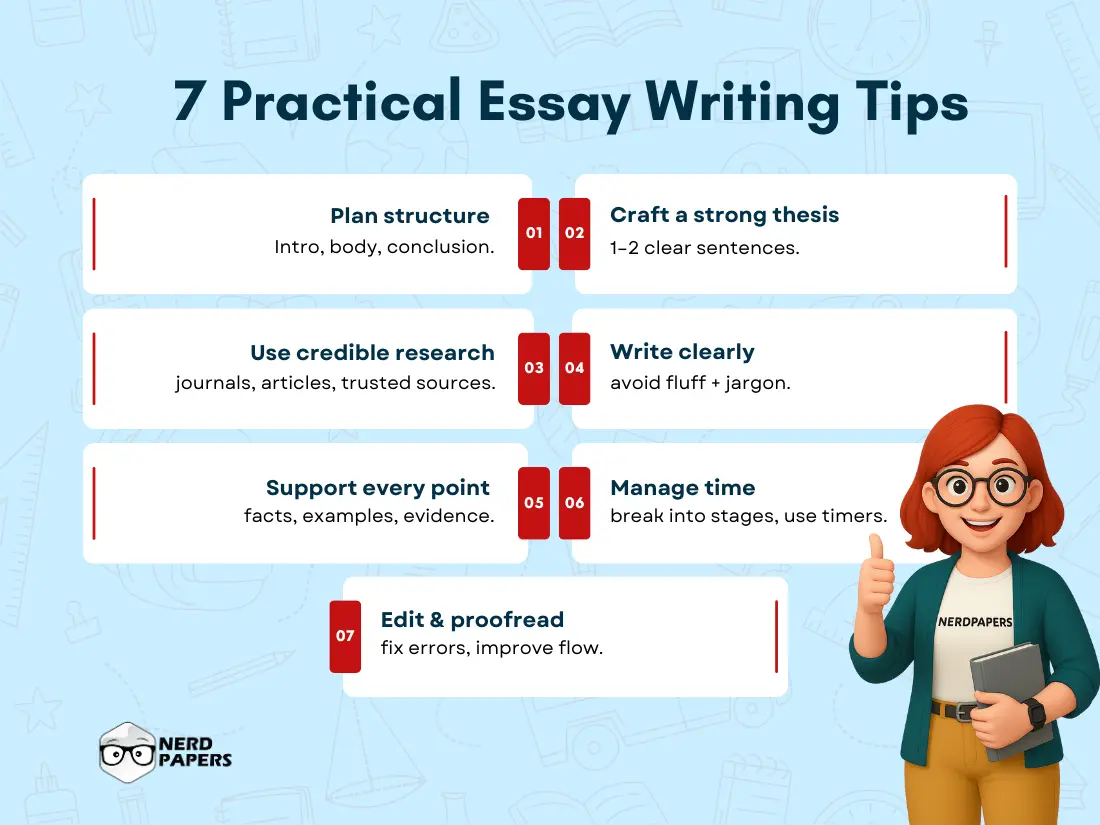
1. Master the Basics of Structure
Every great essay begins with a strong structure. Think of it as a roadmap for both you and your reader. An introduction sets the tone, the body builds your arguments, and the conclusion ties everything together. Without this clear structure, essays can quickly become disorganized and difficult to follow.
Start by crafting a thesis statement that communicates your main point in one or two sentences. This gives your essay direction and ensures every paragraph connects back to your core idea. Use logical transitions between sections so your arguments flow smoothly rather than feeling like isolated points, and choosing the right transitional words can make that flow much easier. By sticking to this framework, you’ll avoid confusion and keep your writing focused.
2. Strengthen Your Research Skills
Scholarly writing is based on research. Excellent papers use reputable sources, such as academic journals, scholarly articles, and credible websites, rather than untrustworthy or low-quality websites. Production of a high-quality essay with the help of credible material enhances the reliability of the author as a writer.
In carrying out research, do not copy and paste long passages of information as you take notes. The summarization of your ideas in your wording makes it easy to insert them comfortably at a later stage. Ultimately, cite your resources. This not only prevents plagiarism, but it also demonstrates your responsibility to deal with academic work.
3. Practice Clear and Concise Writing
One of the most effective essay writing tips is to keep your language clear and direct. Long, complicated sentences or unnecessary “big words” can confuse your reader and weaken your point. Simplicity often works best because it makes your ideas easy to understand.
Avoid adding fluff or filler words that sound nice but don’t add meaning. Instead, focus on accuracy and clarity. A good way to test this is to ask yourself: Does this sentence move my argument forward? If the answer is no, cut it out.
The goal is to strike a balance: keep your writing professional and academic, but also easy to follow. Clear writing not only makes your essay stronger but also shows that you truly understand your topic.
4. Develop Strong Arguments and Evidence
A writing piece without facts is nothing more than opinion. To make your arguments stronger and compelling, you should present them with examples, facts, or references to scholarly sources. Every paragraph needs to start with a statement and then follow this up with evidence.
Every point you make in your essay should be backed up with evidence or examples. Avoid adding claims without support, as they weaken your argument and make your essay less convincing. A combination of personal and research should be used instead. As an example, you can present your idea of a perspective and support it with a quote or statistic. This combination lets your essay be exciting and convincing.
5. Improve Grammar and Vocabulary
Even the smartest and cleverest of ideas end up losing their impact when they are buried under the fluency errors or vocabulary redundancy. A frequent reading of academic texts, like articles in journals or quality essays, can also expose you to good grammar and fancy word choices.
Such easy tasks as memorizing new vocabulary, a couple of words every week, and using them in phrases and sentences should help. However, you should not make your language too complicated; instead, simplicity is best. Lastly, and this should be a routine practice, always run a grammar and spelling check before submitting a document. Tools can assist, but in the long term, practice is the best remedy.
6. Time Management in Essay Writing
The majority of essay-writing struggles have nothing to do with writing; it is a matter of time. It is much easier to manage when broken down into stages. Start with brainstorming + outlining, then come to drafting and leave some time on editing + proofreading.
Use of calendars or timers to determine mini-terms of each stage. This eliminates procrastination and panic-stricken last-minute writing. This may involve 20-30 minutes of solitude a day on an essay, which may be more effective than trying to cram a whole paper the night before. Time seems to be a clever resource to manage, as it can help a person not only get a better essay but also reduce stress.
7. Edit and Proofread Thoroughly
Even the most well-researched essay can lose its impact if it’s riddled with minor errors or unclear phrasing. That’s why the revision stage should never be rushed. Learning how to edit an essay carefully ensures your arguments remain clear and your writing polished, making the difference between a decent draft and a refined final piece.
When revising, look out for common mistakes such as weak transitions, repetitive wording, or grammar slips that can undermine credibility. Tools like Grammarly, Hemingway, and citation managers can help, but nothing replaces a careful re-read with fresh eyes. A strong editing habit not only corrects mistakes but also strengthens your style, allowing your essay to read with clarity and confidence.
Advanced Strategies for Continuous Improvement
Improving your writing is less about sudden breakthroughs and more about consistent, intentional practice. If you’re serious about growth, adopting deliberate strategies to strengthen essay writing can help you progress steadily rather than feeling stuck in the same patterns.
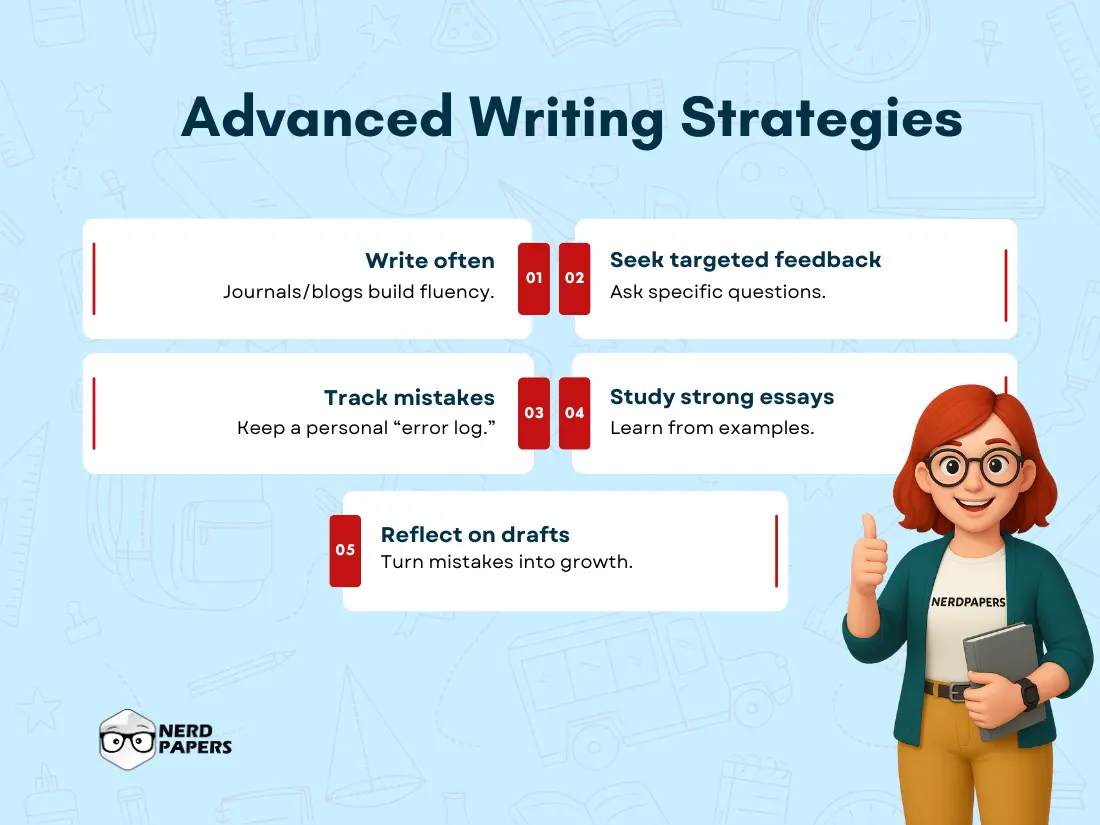
1. Write regularly, even when it’s not for class.
Treat writing like a skill that sharpens with repetition. Journals, blogs, or even quick practice essays are excellent training grounds. For instance, spending 15 minutes each night writing a response to an article not only strengthens critical thinking but also makes drafting essays less intimidating over time.
2. Seek targeted feedback instead of general praise.
One of the most effective steps in how to improve essay writing step by step is asking the right questions when someone reviews your work. Instead of “What do you think?”, try: “Does my thesis feel focused?” or “Where do I lose clarity?” This turns vague advice into actionable insight.
3. Track mistakes to prevent repeat slips.
Create a personal “error log” of issues your teachers point out, like weak transitions, overusing quotes, or grammar slips. Next to each, note the correction and a strong example. Over time, this habit eliminates recurring errors and reinforces long-term academic writing improvement.
4. Learn by studying strong essays.
Choose essays you admire, whether from classmates, published articles, or academic journals, and break them down. How do they build arguments? Where do they introduce evidence? Which transitions make the flow seamless? Mimicking one of these techniques at a time helps you internalize effective strategies.
5. Reflect on every finished essay.
Improvement doesn’t end after submission. Review your instructor’s comments, rewrite one weak paragraph as practice, and jot down two lessons for next time. This reflection transforms mistakes into stepping stones.
When practiced consistently, these small strategies accumulate into lasting improvements, making each essay more transparent, more persuasive, and more confident than the last.
Your Path to Better Essays
Essay writing is not a one-time accomplishment but a skill that can be honed at any time. As in any art, its evolution requires commitment, study, and self-analysis. Considering the strategies presented here, such as planning with clear outlines, learning through the most common mistakes, it is possible to note that strong writing does not use innate talent but rather a set of habits that work, learning through adverse experiences over time. Among the best pieces of advice regarding essay writing improvement is the need to keep the idea of practice in mind. Every draft, no matter how bad, is a step ahead.
Learning to treat assignments as a challenge but not an obstacle, students can slowly yet steadily get better at essay writing and start noticing significant changes in their ability to be organized, precise, and critical with their arguments.
No less significant is writing and editing/revising. The drafting and planning may be where you start, but it is a revisit that can make good essays great. It takes time, input from peers, and the readiness to edit work to produce high-quality papers.
In the end, all the essays you write are drilled to perfection. It takes time to get from where you are and to piece words together to be able to write an argument that not only demonstrates what you know but also what your voice sounds like. But with concerted effort and the best writing tips of students, you can make that leap.
FAQs: Essay Writing Tips
What are the most effective essay writing tips for students?
Start with a clear outline, write a strong thesis statement, use credible research, and revise thoroughly. Breaking the process into steps makes essay writing less stressful.
How can I improve my essay structure?
Follow the basic format: introduction, body paragraphs, and conclusion. Use transition words to guide readers and ensure each paragraph supports your thesis.
What is the best way to strengthen my arguments in essays?
Support each claim with evidence, examples, or scholarly references. Balance personal insight with credible sources for a more persuasive essay.
How can I make my writing clearer and more concise?
Avoid filler words and long, confusing sentences. Each sentence should move your argument forward. Read your essay aloud to spot awkward or unnecessary phrasing.
What are some grammar and vocabulary tips for essays?
Practice using varied sentence structures, expand your vocabulary by reading academic texts, and check grammar with editing tools. Simplicity often works better than overcomplicated wording.
How do I manage time effectively when writing essays?
Break the essay into stages: brainstorming, outlining, drafting, editing, and proofreading. Use a timer or calendar to stay on schedule and avoid last-minute stress.
Why is proofreading important, and how should I do it?
Proofreading ensures your essay is error-free, polished, and easy to read. Take breaks before revising, check grammar and flow, and use tools like Grammarly or Hemingway for support.
Can regular writing practice improve my essay skills?
Yes! Journaling, blogging, or writing short essays regularly helps build confidence, improve fluency, and reduce writer’s block over time.