Ever been told to write a 500 word essay and thought, “That sounds easy!” — until you sat down and didn’t know where to begin? You’re not alone. Many students think short essays are easier, but they actually require more focus and planning because every word counts. But what is a 500 word essay?
A 500 word essay is a short, focused piece of academic writing that requires you to express your ideas clearly and concisely within a tight word limit. Often assigned in high school and college settings, this format is popular for scholarship essays, college applications, and in-class timed responses. Despite its shortness, a 500-word essay demands the same structured approach as longer essays — including a strong thesis, organized paragraphs, and a compelling conclusion.
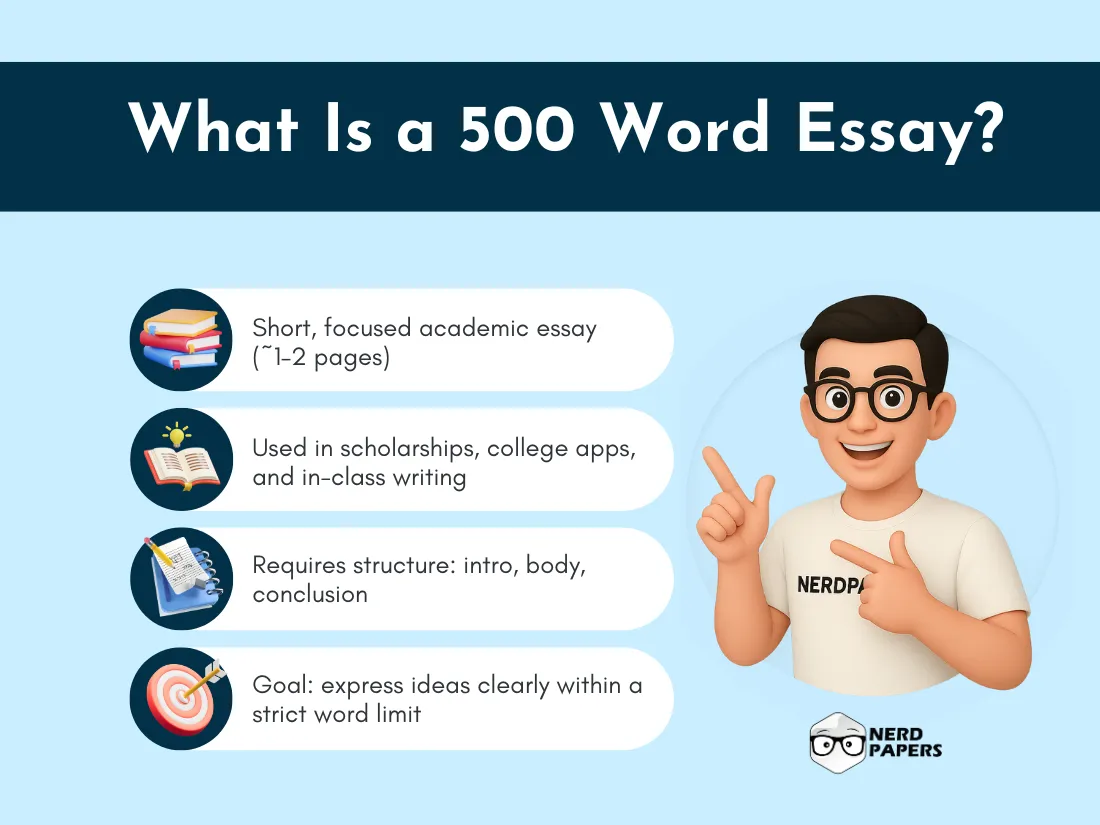
Because you’re working with a limited word count, every sentence must serve a purpose. That means staying on topic, avoiding filler, and using your words strategically to support your argument or message.
Imagine you’re asked to write a 500-word response in your exam. You only have 45 minutes. You don’t have time to ramble — so knowing exactly how to structure your essay makes all the difference. If you’re unsure about introductions, thesis statements, or how to end strong, you’ll want to read our full Essay Structure Guide first.
In this blog, you’ll learn:
- How long a 500 word essay is (in pages and paragraphs)
- The best structure to follow (with word count distribution)
- A step-by-step writing process that saves time
- Proper formatting styles for academic use (MLA, APA, etc.)
- Tips to write clearly and stay within the word limit
- Types of essays that commonly use the 500-word format
- A complete 500 word essay example to guide you
- FAQs and final tips for success
Let’s dive in and break it down.
How Long Is a 500 Word Essay?
A 500 word essay is usually about one full page single-spaced or two pages double-spaced, depending on your font and formatting. It’s not too long, but not super short either — just enough to make a strong point without going off track.
Most 500 word essays are made up of 4 to 6 paragraphs:
- 1 introduction
- 2–4 body paragraphs
- 1 conclusion
Here’s what affects the length on the page:
- Font size and type (e.g., Times New Roman 12pt is standard)
- Spacing (single vs. double)
- Margins (1-inch all around is most common)
Even though the page count might vary a little, the word count is always the same — and that’s what matters. Focus on staying within the 500 word limit while covering your main idea clearly and completely.
Structure of a 500 Word Essay
When you only have 500 words to work with, structure becomes everything. Without it, your ideas can feel rushed or scattered. A well-organized essay helps you stay on topic and make every word count.
Let’s say your professor gives you 45 minutes to write a 500 word essay in class. You start with a clear idea, but you’re unsure how to divide your words — should your introduction be just a few lines? How detailed should each paragraph be? And what if you’re running out of space before reaching your conclusion?
That’s where understanding essay structure helps. Unlike a 1000 Word Essay, where you have more room to expand on multiple points, a 500 word essay forces you to be precise. You’ll need to plan your word allocation carefully and make sure every sentence moves your argument forward.
Recommended Structure (with Word Allocation)
| Section | Purpose | Word Count (Approx.) |
| Introduction | Hook + background + thesis | 50–75 words (10–15%) |
| Body Paragraphs | Main points + evidence + analysis | 350–400 words (70–80%) |
| Conclusion | Summary + final insight | 50–75 words (10–15%) |
Each body paragraph should start with a topic sentence, followed by evidence, explanation, and a transition. Aim to focus on one idea per paragraph to avoid confusion and stay organized.
Tip: Don’t guess your way through the structure. Following a clear framework helps you stay focused and hit the word count without going over.
How to Write a 500 Word Essay (Step-by-Step Process)
Writing a 500 word essay might seem quick, but without a plan, it’s easy to lose focus or go off-topic. Whether you’re writing for a class, a scholarship, or under time pressure, following a clear process will help you stay on track.
You’re taking a timed test and have 45 minutes to write a 500 word response. The clock is ticking. You need to come up with an idea fast, organize your thoughts, and write a strong essay — all while watching the word count. That’s when having a step-by-step writing plan really pays off.
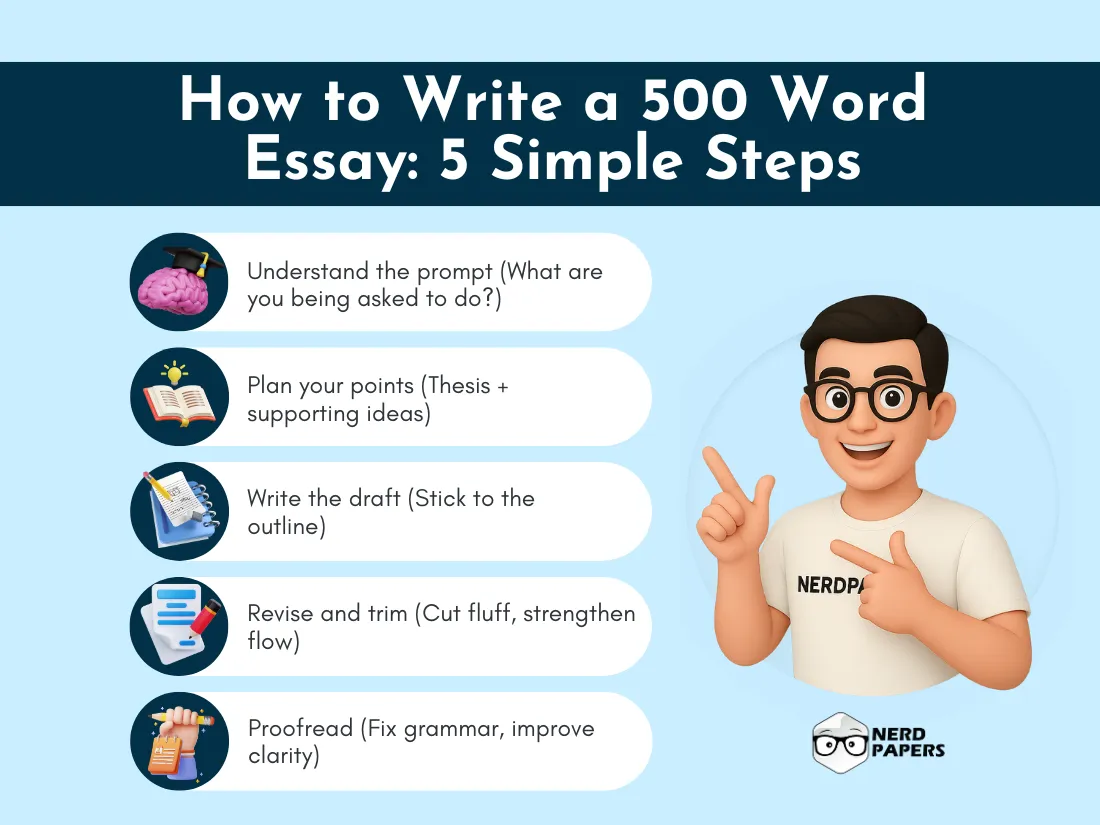
Here’s how to write a great 500 word essay — from start to finish:
Step 1: Understand the Prompt
Make sure you know exactly what the question or task is asking. Look for action words like “explain,” “describe,” or “argue.” Don’t write a narrative if the prompt asks for analysis.
Step 2: Plan Your Ideas
Use a simple outline or mind map. Decide on:
- Your thesis (main idea)
- 2–3 supporting points
- The order in which you’ll present them
Step 3: Write Your Draft
Stick to your outline. Start with a strong introduction and clear thesis, then move through your body paragraphs logically. Use transitions like “first,” “in addition,” or “on the other hand” to connect ideas smoothly.
Step 4: Revise and Cut the Fluff
Check if you’re being clear, direct, and on-topic. A 500 word limit means you must cut any extra words. Avoid phrases like “in order to,” “really,” or “very” — they don’t add value.
Use tools like Hemingway App or Grammarly to spot long or confusing sentences.
Step 5: Proofread for Grammar and Flow
Look for:
- Typos or awkward phrasing
- Repetitive wording
- Missing transitions or vague points
Reading your essay out loud can help you catch issues you might miss on screen.
Formatting Guidelines for a 500 Word Essay
Formatting might seem like a small detail, but it can affect how your essay is graded — especially in college. Most instructors expect you to follow a specific style, like MLA, APA, or Chicago. If you skip formatting rules, even a well-written essay might lose points.
Imagine you’ve written a solid 500 word scholarship essay, but the instructions clearly said to use APA format — and you submitted it in a completely different style. That small mistake could cost you the opportunity.
Here’s how to format your 500 word essay properly:
Standard Formatting Checklist
- Font: Times New Roman or Arial, 12pt
- Spacing: Double-spaced (unless otherwise stated)
- Margins: 1 inch on all sides
- Indentation: First line of each paragraph indented
- Alignment: Left-aligned text
- File types: Word (.doc/.docx), PDF, or Google Docs
Popular Academic Styles
MLA Format
- Common in humanities (e.g., English, History)
- Requires a header with your name, course, and date
- No title page needed
APA Format
- Used in social sciences (e.g., Psychology, Sociology)
- Includes title page and running head
- In-text citations with author + year
Chicago Style
- Used in some history or philosophy papers
- Footnotes and a bibliography are common
- Less frequently used for 500 word essays but still worth knowing
Tip: Always follow the instructions given by your teacher, application committee, or exam rubric. If nothing is specified, MLA or APA is usually a safe bet.
Common Types of 500 Word Essays
A 500 word essay isn’t just a fixed-length writing task — it’s a flexible format used in many academic and personal settings. The key is understanding what type of essay you’re writing, so you can tailor your tone, structure, and content accordingly.
You’re applying for a scholarship that asks for a 500 word essay. Another assignment in class also has a 500 word limit — but this time it’s a narrative. Even though the word count is the same, your writing style and structure will need to adjust.
Here are the most common types of 500 word essays students are asked to write:
Scholarship Essay
- Focus on personal goals, challenges, or community impact
- Often requires a clear story arc and a strong conclusion
- Be honest, reflective, and persuasive
College Application Essay
- Highlights your strengths, personality, or unique experiences
- Stick to one focused story or insight — depth over breadth
Reflective Essay
- Common in nursing, psychology, or general education courses
- Analyze what you learned from a personal or academic experience
- Use the first person, but stay professional and organized
Expository Essay
- Explains a topic logically and clearly
- Ideal for class assignments or timed responses
- Stick to facts, definitions, and structured paragraphs
Persuasive Essay
- Argue for or against an idea in a concise way
- Use evidence, logic, and emotional appeal (sparingly)
- Great for debates or civic writing prompts
Narrative Essay
- Tells a short, true story about a moment in your life
- Use descriptive language and a personal tone
- Stay focused — you only have 500 words
Many of these can be structured using the 5 Paragraph Essay format — intro, 2–3 body paragraphs, and a conclusion — especially helpful for timed writing or templates.
Example of a 500 Word Essay (APA Format)
Topic: Why Leadership Isn’t About Being in Charge
Word Count: 502
Introduction
Leadership is often misunderstood as giving orders or holding a formal position. However, true leadership is less about authority and more about influence, responsibility, and empathy. According to Northouse (2021), leadership is a process whereby an individual influences a group to achieve a common goal. I first realized this when working on a group project in school where no one stepped up to lead. That moment helped me understand that leadership is an action — not a title.
Body Paragraph 1
In high school, I participated in a group assignment focused on environmental sustainability. Our task was to create a local awareness campaign. Initially, everyone hesitated to take initiative. As deadlines approached and team members grew disconnected, I decided to step in. I initiated a meeting, suggested tasks based on strengths, and proposed a shared document to keep track of deadlines. Within days, our team’s communication improved, and we started progressing toward our goal. This experience supported what Goleman (2004) describes as emotionally intelligent leadership — where self-awareness and relationship management play a bigger role than authority. I wasn’t telling people what to do; I was creating space for them to contribute confidently.
Body Paragraph 2
That project changed how I viewed leadership. I used to think effective leaders were naturally bold, outspoken, and directive. But my experience taught me that the best leaders often lead by example, offer support, and adapt to group needs. Kouzes and Posner (2017) argue that credibility and empathy are two of the most important traits of admired leaders — and I saw that firsthand. By listening, supporting, and organizing, I helped the group move forward. This approach has since shaped how I lead in other settings like sports, volunteer projects, and even family situations.
Conclusion
Leadership isn’t about being in charge — it’s about helping others succeed. What I learned from that group project continues to guide my actions. Whether in academics or everyday life, I now believe that leading means influencing with empathy and purpose.
References
- Goleman, D. (2004). What makes a leader?. Harvard Business Review. https://hbr.org/2004/01/what-makes-a-leader
- Kouzes, J. M., & Posner, B. Z. (2017). The leadership challenge: How to make extraordinary things happen in organizations (6th ed.). Wiley.
- Northouse, P. G. (2021). Leadership: Theory and practice (9th ed.). Sage Publications. https://us.sagepub.com/en-us/nam/leadership/book255680
Smart Tips to Write Better in Just 500 Words
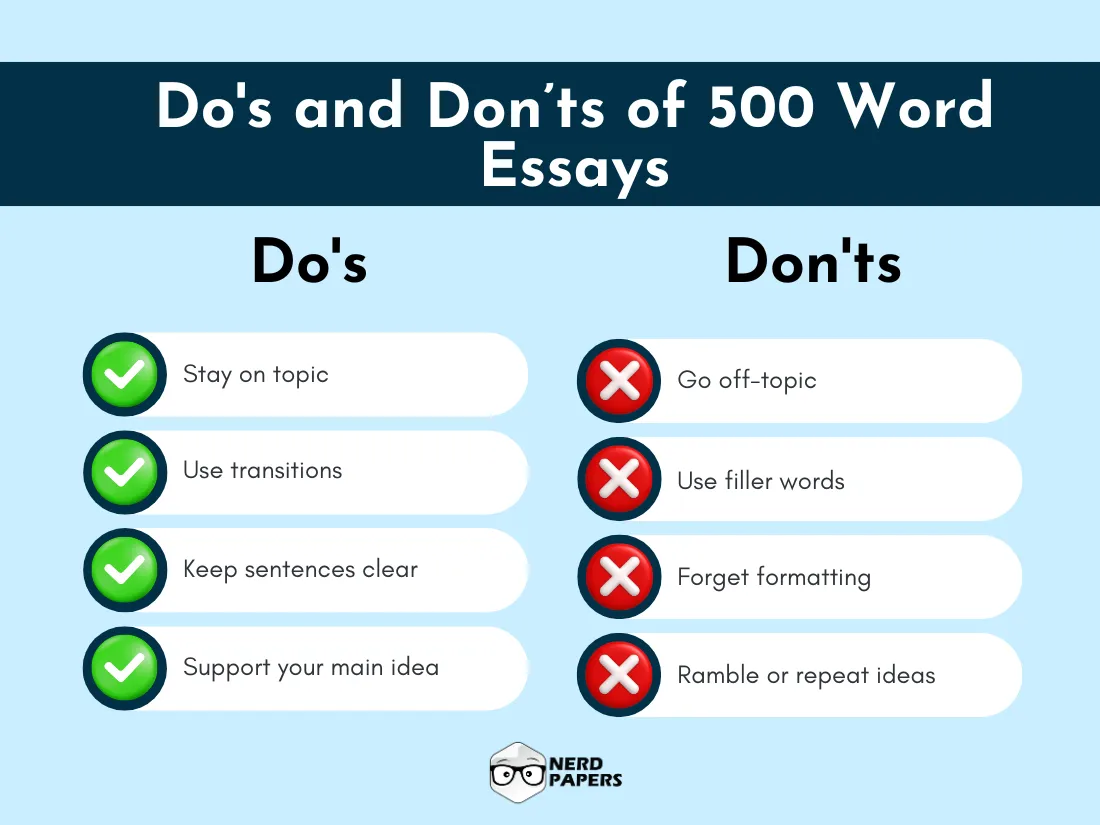
When you’re working with a tight word limit, every sentence matters. A 500 word essay doesn’t give you room to wander or repeat ideas — you have to get straight to the point while keeping your writing clear and strong.
Here are some practical tips to help you make the most of your words:
1. Focus on One Main Idea
Don’t try to cover too much. Stick to one clear argument or story, and support it with 2–3 strong points. Trying to do too much will make your essay feel rushed and confusing.
2. Use Strong Topic Sentences
Each paragraph should start with a sentence that tells the reader what it’s about. This keeps your writing organized and helps readers follow your ideas easily.
3. Cut the Fluff
Avoid unnecessary words like:
- “Very,” “really,” “in order to,” “kind of,” “basically”
- Instead, use direct language: “use” instead of “utilize”, “helped” instead of “was beneficial to”
Tip: If you’re over 500 words, cut redundant phrases — not important points.
4. Use Transitions Wisely
Words like “however,” “in contrast,” “as a result,” and “for example” help your essay flow. Transitions also keep your paragraphs connected and smooth.
5. Read Your Essay Out Loud
This is one of the easiest ways to catch awkward phrasing, repetition, or unclear sentences. If you stumble while reading it, revise that part.
6. Use Editing Tools
After revising your content manually, run your essay through tools like:
- Grammarly – for grammar and spelling
- Hemingway App – for readability and sentence clarity
- WordCounter – to track your word count in real-time
7. Stay Within the Limit
Most instructors or application prompts allow a 10% margin (450–550 words), but it’s safest to aim for around 500 words exactly — especially for scholarship or exam submissions.
Final Thoughts
A 500 word essay may be short, but that doesn’t mean it’s easy. With limited space, you have to plan carefully, stay focused, and make sure every sentence supports your main point. The good news? Learning how to write a clear and well-structured short essay builds the same writing skills you’ll need for longer papers, applications, and even real-world communication.
Here’s a quick recap of what we covered:
- A 500 word essay usually includes 4–6 paragraphs across an intro, body, and conclusion
- Formatting matters — stick to styles like APA or MLA if required
- Stay within the word count by writing with clarity, structure, and purpose
- Focus on one strong message instead of trying to say everything
- Use tools and examples to improve your writing process
FAQs About 500 Word Essays
How many pages is a 500 word essay?
A 500 word essay is about 1 page single-spaced or 2 pages double-spaced, using standard formatting (12pt Times New Roman, 1-inch margins).
How many paragraphs is a 500 word essay?
Most 500 word essays have 4 to 6 paragraphs:
1 introduction
2–4 body paragraphs
1 conclusion
The number depends on how you organize your supporting points.
How long does it take to write a 500 word essay?
It typically takes 1 to 2 hours depending on how well you know the topic. If it’s timed (like in an exam), you might have 30–45 minutes to plan, write, and revise.
Can I go over or under 500 words?
Some flexibility is okay — about ±10% (450–550 words) — unless the prompt says exactly 500 words. Always check the instructions first.
What does a 500 word essay look like?
It looks like a short, focused essay with a clear structure:
A brief intro with a thesis
A few well-developed body paragraphs
A short conclusion
Want a real example? Scroll up to view our full 500 Word Essay example.
Is a 500 word essay hard to write?
It’s not hard — but it can be tricky. The limited word count forces you to choose your words wisely, stay focused, and avoid unnecessary details.
How do I start a 500 word essay?
Start with a hook — a question, quote, or interesting fact — then introduce the topic and end with a clear thesis statement. Keep it short and engaging.
What should I avoid in a 500 word essay?
Avoid:
Repeating the same ideas
Off-topic examples
Long, complex sentences that confuse the reader
Filler phrases like “I believe that” or “in conclusion”
Can I use “I” in a 500 word essay?
Yes — if it’s a personal, reflective, or narrative essay. Avoid first-person in formal expository or persuasive essays unless instructed otherwise.
Should I cite sources in a 500 word essay?
If you’re using facts, quotes, or ideas from others, always cite your sources — even in a short essay. Use the required format (MLA, APA, etc.).
Is the title included in the 500 word count?
Usually, no — the title is not counted. But always check specific instructions from your instructor or application guidelines.