
A 1000 word essay is one of the most common assignments students face in school, college, or university. It might sound intimidating at first, but once you understand how it’s structured and how much you’re expected to write, it becomes much easier to manage.
In this guide, we’ll walk you through everything you need to know about writing a 1000 word essay — from how many pages it takes, how long it takes to write, and what a good structure looks like. You’ll also get practical tips, a sample essay, and answers to common questions like “How many paragraphs should it have?” and “Can I write one in a day?”
Whether you’re writing this essay for a class, scholarship, or entrance exam, this guide will help you write clearly, stay within the word count, and impress your reader with a well-organized piece.
What Is a 1000 Word Essay?
A 1000 word essay is a written piece that contains exactly — or very close to — one thousand words. It’s often assigned in schools, colleges, and universities to help students develop clear thinking, organized writing, and time management skills. Despite the fixed word count, it can cover a wide range of topics and serve different purposes depending on the assignment.
These essays are commonly used for:
- Class assignments
- Timed writing exams
- Scholarship applications
- Entry essays or writing samples
A 1000 word essay can take different forms, depending on the type of writing required:
- Argumentative essay – makes a strong claim and supports it with evidence.
- Expository essay – explains or informs the reader about a topic.
- Descriptive essay – paints a picture using detailed observations.
- Analytical essay – breaks down an idea, text, or situation to study it in depth.
- Narrative essay – tells a personal or fictional story.
Regardless of the essay type, you’re expected to use an academic tone. That means your writing should be formal, focused, and clear — no slang or overly casual phrases.
What makes a 1000 word essay unique isn’t just the word count. It’s the challenge of saying something meaningful within a limited space. That’s why planning, structure, and clarity matter so much — and why we’re breaking all of that down in the next sections.
How Many Pages Is a 1000 Word Essay?
One of the first things students wonder is: “How many pages is a 1000 word essay?” The answer depends mostly on formatting, especially spacing and font size.
General Estimate:
- Single-spaced: About 2 pages
- Double-spaced: About 4 pages (most common for academic essays)
Page Length by Format
| Formatting | Estimated Page Count |
| Times New Roman, 12pt, single-spaced | ≈ 2 pages |
| Times New Roman, 12pt, double-spaced | ≈ 4 pages |
| Arial, 12pt, double-spaced | Slightly less than 4 pages |
| Calibri, 11pt, double-spaced | ≈ 3.5–3.8 pages |
Why the Page Count Can Vary
Several factors affect how long a 1000 word essay looks on paper or screen:
- Font size and style (e.g., Arial is wider than Times New Roman)
- Line spacing (single, 1.5, or double)
- Margins (standard is 1 inch on all sides)
- Formatting style (APA, MLA, Chicago, etc.)
🎓 Real Example:
Let’s say you’re writing a 1000 word psychology paper using APA format. You use Times New Roman, 12-point font, and double-spacing. Your essay will be around 4 full pages — plus a title page and references page, which are usually not included in the word count.
Now imagine submitting a single-spaced personal statement for a scholarship — the same word count would shrink to just under 2 pages.
Word Count Breakdown by Pages (At a Glance)
| Word Count | Single-Spaced | Double-Spaced |
| 250 words | 0.5 pages | 1 page |
| 500 words | 1 page | 2 pages |
| 1000 words | 2 pages | 4 pages |
| 1500 words | 3 pages | 6 pages |
| 2000 words | 4 pages | 8 pages |
Bonus Tip:
Don’t try to change font size or spacing to stretch or shrink your essay. Most instructors use word count over page count and can spot formatting tricks. Stick to the formatting they ask for to avoid losing marks.
How Long Does It Take to Write a 1000 Word Essay?
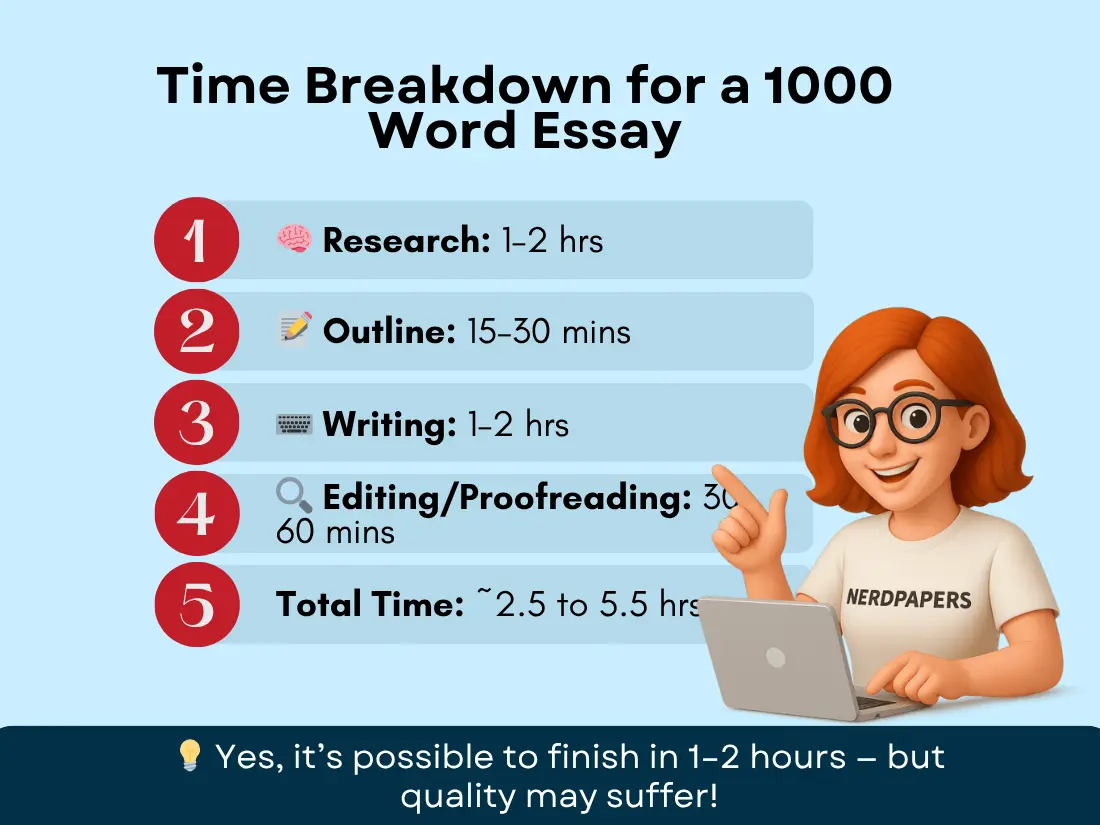
There’s no one-size-fits-all answer to how long it takes to write a 1000 word essay — it depends on your writing speed, how well you understand the topic, and whether research is required. But on average, you can expect to spend anywhere from 2 to 6 hours from start to finish.
Typical Time Breakdown:
| Stage | Time Estimate |
| Research | 1–2 hours |
| Outlining | 15–30 minutes |
| Writing (Draft) | 1–2 hours |
| Editing & Proofing | 30 minutes – 1 hour |
| Total | 2.5 to 5.5 hours |
What Affects the Time It Takes?
- Topic Familiarity: If you know the topic well, writing will be faster.
- Research Needed: Research-heavy essays take longer.
- Typing Speed: A fast typist might finish quicker, but writing thoughtfully still takes time.
- Distractions: Focused writing sessions can cut hours off your total time.
- Essay Type: Argumentative and analytical essays often take longer than descriptive or narrative ones.
Can You Write a 1000 Word Essay in a Day?
Yes — many students do it all the time. If you’re focused and the topic isn’t too complex, you can write and polish a good 1000 word essay in 3 to 5 hours. If you’re in a real rush, it’s even possible to finish in 1 to 2 hours, but the quality may suffer without editing or breaks.
Pro tip: If you only have one day, spend at least 30 minutes planning and another 30 revising — even if you’re on a tight deadline.
Good essays aren’t just about fast typing. The time you spend thinking, planning, and reviewing is just as important. Rushing without a clear outline often leads to weak arguments and messy structure — and that hurts your grade.
Structure of a 1000 Word Essay (With Word Count Breakdown)
No matter the topic or subject, a well-organized structure is what makes a 1000 word essay clear, convincing, and easy to read. A strong structure helps you stay on topic, guide your reader, and avoid going over or under the word count.
Most academic essays—especially those with a 1000-word limit—follow this simple format:
- Introduction
- Body Paragraphs
- Conclusion
Imagine you’re writing a 1000 word essay on climate change for your environmental science class. You have all your research done, but your ideas are all over the place. You start writing, but quickly hit 700 words—and realize you haven’t even added your final point yet. That’s when you realize: it’s not just about what you say, it’s how you organize it.
If you find yourself in this situation, what you really need is a clear essay structure. For a full breakdown with examples, check out our complete Essay Structure Guide.
Standard 1000 Word Essay Structure
1. Introduction (100–150 words)
- Opens the topic and sets the tone
- Provides background or context if needed
- Ends with a thesis statement (your main argument or focus)
Aim for about 10–15% of the total word count.
2. Body Paragraphs (700–800 words)
This is where you develop your argument or explain your main points. Each paragraph should:
- Begin with a topic sentence
- Include evidence (facts, examples, quotes, or research)
- Offer explanation or analysis
- Use transitions for smooth flow
You’ll typically write 2 to 4 body paragraphs, depending on how many key points you’re covering. Each paragraph should be around 150–250 words.
3. Conclusion (100–150 words)
- Restates your thesis in different words
- Summarizes your key ideas
- Ends with a final thought or call to action
Allocate 10–15% of your word count here.
Word Count Breakdown Table
| Section | Words | % of Total Essay |
| Introduction | 100–150 words | 10–15% |
| Body Paragraphs | 700–800 words | 70–80% |
| Conclusion | 100–150 words | 10–15% |
| Total | ≈1000 words | 100% |
Sticking to a clear structure doesn’t just help you write faster—it also makes your argument easier to follow. That’s what instructors look for when grading essays. If your ideas are scattered or paragraphs don’t flow, even strong content can fall flat.
How to Write a 1000 Word Essay (Step-by-Step)
Now that you know how a 1000 word essay is structured, let’s walk through the actual writing process — step by step. Whether you’re writing an argumentative essay or a personal reflection, this plan will help you stay organized, focused, and within the word count.
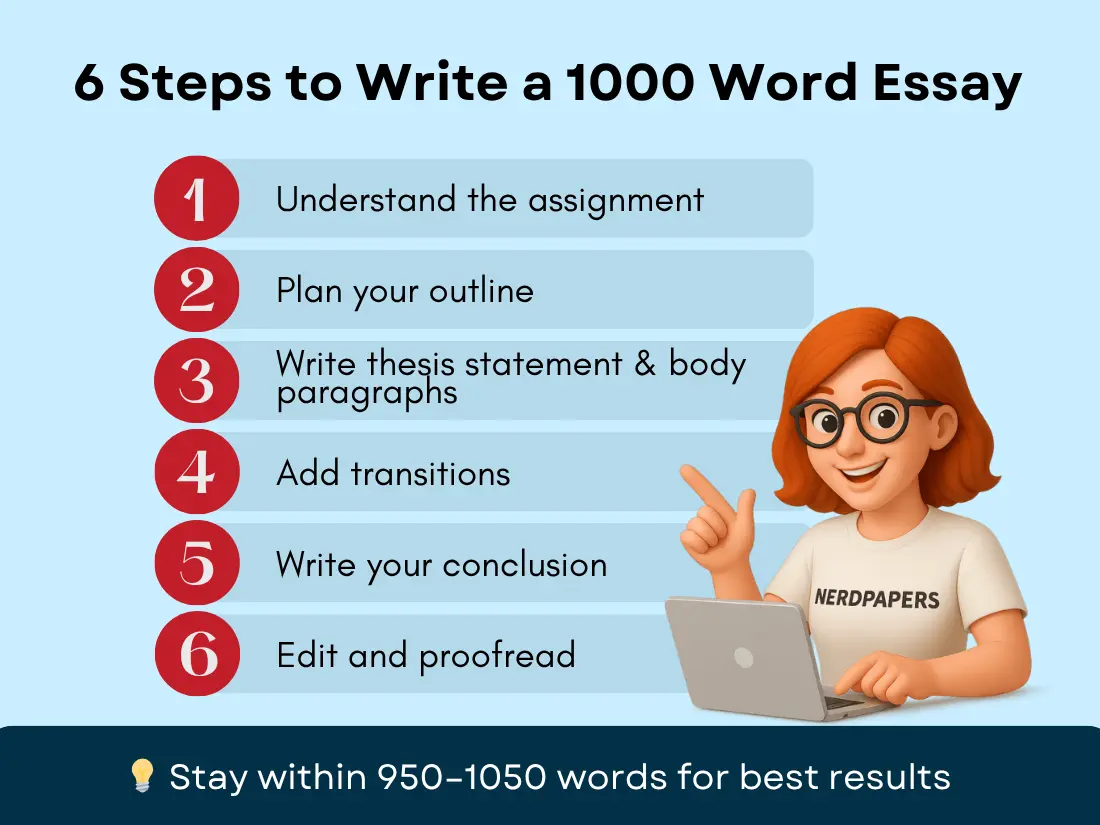
Step 1: Understand the Assignment
Before you start, make sure you fully understand the essay prompt:
- What is the topic?
- What type of essay are you writing? (e.g., argumentative, descriptive, analytical)
- Are there specific formatting or citation requirements?
💡 Clarify anything you’re unsure about before you begin. This avoids rewriting later.
Step 2: Plan Your Essay with a Simple Outline
Create a rough outline before you start writing:
- Decide on your main argument or thesis
- Break it down into 2–4 supporting points (these become your body paragraphs)
- Allocate word count for each section (intro, body, conclusion)
💡 Planning saves time and helps you write a focused, balanced essay.
Step 3: Write a Strong Thesis Statement
Your thesis statement is the main idea of your essay — usually 1–2 sentences at the end of your introduction. It tells the reader what to expect and sets the tone.
Example: “Climate change is no longer a distant threat but a present crisis that demands urgent action from both individuals and governments.”
Step 4: Develop Body Paragraphs with Topic Sentences
Each body paragraph should:
- Start with a topic sentence that introduces the main point
- Provide evidence (facts, data, examples, or quotes)
- Include your own analysis explaining how it supports your thesis
Stay focused — each paragraph should cover one main idea only.
Step 5: Use Transitions to Improve Flow
Use transition words and phrases to connect your ideas smoothly:
- To add a point: furthermore, in addition, also
- To contrast: however, on the other hand, although
- To conclude: therefore, in summary, as a result
These small phrases help your essay feel unified and coherent.
Step 6: Write the Conclusion Last
Your conclusion should:
- Rephrase your thesis in a fresh way
- Summarize the main points (don’t repeat them word-for-word)
- End with a final insight, reflection, or takeaway
Avoid adding brand new ideas here — keep it clean and focused.
Step 7: Edit and Proofread
Set your essay aside for a short break, then come back to:
- Check for clarity, grammar, and structure
- Fix awkward sentences or repeated ideas
- Ensure you’ve hit the word count (within 950–1050 is usually safe)
💡 You can also use tools like Grammarly or Hemingway to catch errors and improve readability.
Example of a 1000 Word Essay
One of the best ways to understand how to write a 1000 word essay is to see an actual example. Below, you’ll find a sample essay that follows the structure we’ve discussed — complete with a clear introduction, strong thesis, focused body paragraphs, and a clean conclusion.
This sample is about a common academic topic and written in a formal tone using simple, clear language — just like you should aim for in your own work.
Sample Essay Topic:
“Should Social Media Platforms Be Regulated to Protect Mental Health?”
🧠 Word Count: Approx. 1000 | Format: MLA | Style: Argumentative
Introduction
In recent years, social media platforms have become central to how people connect, communicate, and consume information. While they offer many benefits, they also raise growing concerns about mental health—especially among teenagers and young adults. This essay argues that social media platforms should be regulated to minimize harmful content, encourage responsible use, and protect vulnerable users from long-term psychological effects.
Body Paragraph 1
One major reason for regulation is the increase in anxiety, depression, and body image issues linked to excessive social media use. A 2020 study by the Pew Research Center found that 59% of teens in the U.S. had experienced some form of cyberbullying or online pressure (Anderson and Jiang). Platforms like Instagram, which focus heavily on appearance, often promote unrealistic beauty standards and popularity-driven content. This leads to low self-esteem and poor mental wellness, particularly in adolescents. Regulation could include warning labels, time limit prompts, or built-in breaks to encourage healthier usage patterns.
Body Paragraph 2
Another concern is the spread of harmful or triggering content. Algorithms are designed to prioritize engagement, not safety—pushing extreme, sensational, or emotionally charged material. According to a report by the Center for Humane Technology, these algorithms often promote content that amplifies anxiety and division (“The Social Dilemma”). Without proper oversight, users are constantly exposed to misinformation, graphic content, or hate speech. Government regulation could require platforms to invest in AI moderation tools and human review teams to ensure timely removal of dangerous posts.
Body Paragraph 3
Some critics argue that regulating social media may threaten freedom of speech. While this concern is valid, it’s important to distinguish between censorship and safeguards. Much like how traffic laws don’t prevent people from driving but ensure safer roads, platform guidelines are meant to reduce digital harm—not silence opinions. Transparent policies and user-first regulations can help maintain a balance between open dialogue and mental health protection.
Conclusion
In conclusion, while social media can be a powerful tool for connection and creativity, its unregulated use comes with significant mental health risks. With thoughtful, balanced regulation—such as limiting harmful content, promoting digital well-being, and offering in-app safeguards—platforms can become safer and healthier spaces. The goal is not to take away freedom but to create digital environments that support long-term emotional well-being for all users, especially young people.
Works Cited
- Anderson, Monica, and Jingjing Jiang. Teens, Social Media & Technology 2020. Pew Research Center, 2020, www.pewresearch.org/internet/2020/04/30/teens-social-media-technology-2020/
- “The Social Dilemma.” Center for Humane Technology, 2021, www.humanetech.com/the-social-dilemma-report
Formatting Tips for a 1000 Word Essay
Formatting may seem like a small detail, but it can seriously affect how your essay is graded. Using the correct format not only keeps your work organized—it also shows that you’re following instructions and treating the assignment seriously.
The most common academic formats for a 1000 word essay are MLA, APA, and Chicago. Each style has its own rules for spacing, font, citations, and headings.
Basic Formatting Checklist (Applies to Most Styles)
- Font: Times New Roman or Arial, 12 pt
- Line spacing: Double-spaced
- Margins: 1 inch on all sides
- Indentation: First line of each paragraph indented (0.5 inch)
- Title Page: Only if your instructor requires it
- Word Count: Aim for 950–1050 words, unless told otherwise
Formatting by Style
MLA (Modern Language Association)
- No title page (unless asked)
- Name, instructor, course, and date at the top-left
- Centered essay title (no bold/underline)
- Page numbers with your last name (e.g., Smith 1)
- In-text citations use author’s last name and page number. Example: (Anderson 42)
APA (American Psychological Association)
- Title page with running head
- Abstract (sometimes optional)
- Headings used for different sections
- In-text citations use author’s last name and year. Example: (Brown, 2023)
Chicago Style
- May use footnotes instead of in-text citations
- Title page required
- Bibliography at the end
- Spacing and margins follow basic academic rules
Why Formatting Matters
Proper formatting:
- Makes your essay easier to read and grade
- Shows attention to detail
- Helps avoid accidental plagiarism through proper citation
💡 Always check your instructor’s requirements before starting. If none are given, MLA is usually a safe default for high school and college-level writing.
Common Mistakes to Avoid in a 1000 Word Essay
Even if your ideas are strong, simple mistakes can hurt your grade or make your essay harder to read. Here are some of the most common issues students face when writing a 1000 word essay — and how to avoid them.
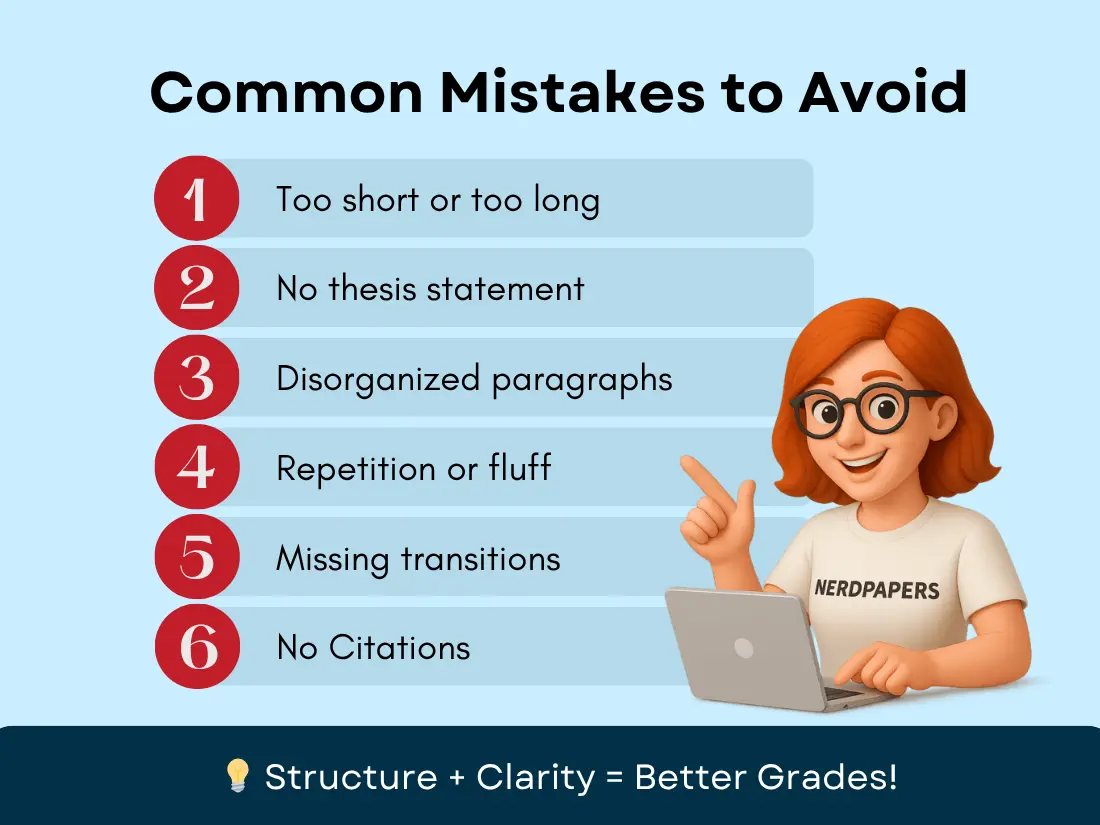
1. Ignoring the Word Count
Many students either overwrite and go well beyond 1000 words, or fall short at 700–800. While small variation is okay, try to stay within 950–1050 words unless your instructor says otherwise.
💡 Tip: Use a word counter tool to track your progress while writing.
2. Weak or Missing Thesis Statement
Your thesis is the main idea of your essay. Without it, your essay lacks direction. A strong thesis should appear at the end of your introduction and clearly state your argument or focus.
💡 Make sure every body paragraph supports your thesis.
3. Lack of Structure
Jumping from idea to idea without clear organization confuses readers and weakens your message.
💡 Use the standard format: intro, body paragraphs, conclusion. Stick to 2–4 body paragraphs with one main idea each.
4. Overuse of Fluff or Repetition
To meet the word count, some students repeat ideas or add unnecessary words. This weakens your writing and wastes space.
💡 Focus on clarity. Every sentence should add value.
5. No Transitions Between Paragraphs
Without transition words, your essay can feel choppy and disconnected.
💡 Use connectors like “In addition,” “However,” or “As a result” to guide the reader smoothly.
6. Forgetting to Cite Sources
If you include quotes, statistics, or research without proper in-text citations, it can be considered plagiarism—even if unintentional.
💡 Always cite your sources using MLA, APA, or the required style.
7. Skipping the Editing Step
Spelling errors, awkward sentences, and grammar issues make your writing look careless.
💡 Always leave time to revise. Use tools like Grammarly or ask a friend to review it.
Best Topics for a 1000 Word Essay
Stuck trying to pick a topic? You’re not alone. Choosing the right subject for a 1000 word essay is half the battle — especially when you only have a limited word count to make your point.
To help you get started, here are some topic ideas across different categories and academic levels.
How to Choose the Right Topic
- Pick something you understand or care about
- Make sure it fits the type of essay (argumentative, descriptive, analytical, etc.)
- Choose a topic you can explain fully within 1000 words
- Avoid overly broad or complex questions that need more space
General Essay Topics (Good for Any Level)
- Should school uniforms be mandatory?
- Is social media helping or hurting communication?
- What makes a person a good leader?
- Should college education be free?
- Is technology making people less creative?
Academic Topics by Subject
Science & Environment
- Should governments invest more in renewable energy?
- Is climate change caused by human activity?
- Pros and cons of genetically modified food
Psychology & Sociology
- How does social media impact self-esteem?
- The role of peer pressure in decision-making
- Effects of childhood trauma on adult behavior
Literature & Arts
- Compare two characters from a classic novel
- What makes a story timeless?
- The role of symbolism in modern poetry
Business & Economics
- Should remote work be the new normal?
- The future of cryptocurrency in the global market
- Is consumerism harming society?
History & Politics
- Was the Cold War truly a “war”?
- How did the civil rights movement reshape America?
- Should voting be mandatory in democratic countries?
Creative & Narrative Topics
- A life lesson I learned the hard way
- The day that changed my perspective forever
- If I could go back in time, I would…
Choose a topic that matches the essay style your instructor assigned. Don’t try to do too much — 1000 words is enough for one clear argument or reflection, not a full debate.
1000 Word Essay vs. 500 Word Essay: Key Differences
If you’ve already written a 500 word essay, you might think a 1000 word essay is just double the effort — but there are a few important differences beyond just length. Knowing how these two assignments compare can help you adjust your writing approach and meet expectations more effectively.
1. Word Count & Depth
- 500 word essay: Usually requires 2–3 main points with brief explanations.
- 1000 word essay: Allows room for deeper analysis, multiple examples, and a more nuanced argument.
💡 With more space, your writing needs to go beyond surface-level points.
2. Structure
- Both follow a basic introduction → body → conclusion format.
- A 500 word essay often has 3–4 paragraphs total.
- A 1000 word essay generally includes 5–6 paragraphs, with each body paragraph more fully developed.
3. Writing & Planning Time
- 500 words: Usually takes 1–2 hours to complete (including editing)
- 1000 words: Often takes 3–6 hours depending on research and revision
🕒 The more words you’re working with, the more time you’ll need to organize and revise your content.
4. Level of Detail
- In a 500 word essay, every sentence has to be tightly focused.
- In a 1000 word essay, you can use:
- More evidence or case studies
- Clear counterarguments
- Broader context or background
Don’t just add more words in a 1000 word essay — add more value. The extra space should help you build stronger arguments, use richer examples, and write with clarity and structure.
Bonus Tools & Resources
Writing a 1000 word essay becomes a lot easier when you have the right tools. Whether you’re planning, writing, or editing, these free and easy-to-use resources can save you time and help improve the quality of your work.
1. Word Count Tools
Track your essay length in real time so you don’t fall short (or go over).
- WordCounter.net
- Charcounter.com
- Google Docs (shows word count automatically under Tools → Word Count)
2. Essay Outline Generators
Start with a solid plan using free outline builders.
- Essay Map (ReadWriteThink)
- EssayBuilder
3. Citation Tools
Generate references in MLA, APA, or Chicago styles in seconds.
- EasyBib
- ZoteroBib
- CiteThisForMe
4. Editing & Proofreading Tools
Catch grammar errors, passive voice, and awkward phrasing.
- Grammarly – for grammar and spelling
- Hemingway Editor – for readability and clarity
- Google Docs (built-in grammar suggestions)
5. Time Management Tools
Stay focused and break your work into manageable writing sessions.
- Pomofocus.io – Pomodoro timer
- Notion – essay planning & task tracking
- Trello – organize tasks and deadlines visually
Great writing comes from both good thinking and good tools. Use these free resources to stay on track, reduce stress, and turn in essays you’re proud of.
Conclusion
Writing a 1000 word essay may seem overwhelming at first, but with the right structure, clear planning, and a bit of focus, it’s a task any student can manage. Whether you’re writing an argumentative paper, a personal narrative, or a research-based assignment, knowing how to balance your word count and organize your thoughts makes all the difference.
Let’s recap what you’ve learned:
- A 1000 word essay is usually around 4 pages double-spaced.
- It follows a simple structure: introduction, body paragraphs, conclusion.
- You can write one in a few hours if you plan your time well.
- Proper formatting and citations matter just as much as content.
- Choosing the right topic and avoiding common mistakes will improve your clarity and grades.
With this guide and a bit of practice, you’ll not only write better 1000 word essays—you’ll become a stronger, more confident academic writer overall.
Bookmark this page and refer back anytime you’re assigned a new essay. And if you’re working on a shorter task, check out our 500 Word Essay Guide for quick help.
FAQs About 1000 Word Essays
How many paragraphs is a 1000 word essay?
A typical 1000 word essay has 4 to 6 paragraphs:
1 for the introduction
2 to 4 for the body
1 for the conclusion
💡 Focus on quality over quantity — each paragraph should develop one main idea.
How long does it take to write a 1000 word essay?
Most students need 2 to 6 hours, including research, drafting, and editing.
You can write a basic version in 1–2 hours, but it may lack polish.
Can I write a 1000 word essay in one day?
Yes! If you plan your time well, you can research, write, and edit a full 1000 word essay in one day.
💡 Tip: Use the structure and time management tips earlier in this guide to stay on track.
Does a 1000 word essay have to be exactly 1000 words?
Not exactly — most instructors accept 950 to 1050 words unless a strict limit is given. Always check your assignment guidelines to be sure.
How long should each section of the essay be?
Introduction: 100–150 words
Body Paragraphs: 700–800 words total
Conclusion: 100–150 words
How many references do I need in a 1000 word essay?
It depends on the subject and essay type. For academic essays, aim for 2 to 4 quality sources. Use proper citation styles (MLA, APA, etc.).
What’s the best format for a 1000 word essay?
Unless told otherwise, use:
Times New Roman or Arial, 12 pt
Double-spaced
1-inch margins
MLA or APA formatting for citations
How do I know if I’ve structured it correctly?
Follow this structure:
Introduction with thesis
2–4 body paragraphs, each with evidence and analysis
Conclusion with a summary and final thought
💡 You can also check out our full Essay Structure Guide for a detailed breakdown.
How can I write a 1000 word essay fast?
To write quickly:
Use a clear outline before starting
Stick to one idea per paragraph
Avoid overthinking the first draft
Don’t edit while you write — revise afterward
💡 If you’re well-prepared, you can finish a solid draft in 2–3 hours.
Can you write a 1000 word essay in an hour?
Yes, but it’s tough — and not recommended for most academic work. If you already know the topic and don’t need much research, a fast typist could draft something in under an hour.
⚠️ Expect lower quality if you rush. Aim for at least 2–3 hours whenever possible.
How many references should a 1000 word essay have?
It depends on the assignment type. For academic essays, aim for 2 to 4 quality sources. A research-heavy essay may need more. Always cite using the correct format (APA, MLA, etc.).
How long should the introduction be in a 1000 word essay?
Keep your introduction around 100 to 150 words. It should briefly:
Introduce the topic
Provide any needed background
End with your thesis statement
How many words should each paragraph be in a 1000 word essay?
Most body paragraphs should be 150 to 250 words long. This allows you to fully explain one point with evidence and analysis. Aim for 2–4 body paragraphs in total.
What’s the ideal word count range for a 1000 word essay?
Unless otherwise stated, stay within 950–1050 words. Slight variation is fine, but avoid going too far over or under to meet academic expectations.