The 5 paragraph essay is one of the most common formats students learn in middle and high school—and for good reason. It’s straightforward, structured, and helps you express your ideas clearly. Whether you’re writing a timed exam response, a persuasive assignment, or a basic analysis, this format provides a reliable framework to follow.
At its core, a 5 paragraph essay includes an introduction, three body paragraphs, and a conclusion—which is why some teachers refer to it as a “3.5 essay.” It’s often called the classic essay format because of its balanced structure and versatility. This format is especially useful when you’re just starting to develop your academic writing skills or when you need to keep your points focused and well-organized.
Many students first encounter this format while learning about the broader structure of an essay—how to build arguments logically, where to place the thesis, and how transitions connect paragraphs. The 5 paragraph essay simplifies all of that into a beginner-friendly blueprint.
In this blog, you’ll learn:
- What the 5 paragraph essay is (and why it works)
- How to structure and outline it step by step
- Real examples and word count tips
- Why it’s sometimes called a 3.5 essay
- Tools to help you write one effectively
Let’s break it down from the top.
What Is a 5 Paragraph Essay?
A 5 paragraph essay is a structured piece of academic writing that consists of five distinct sections: one introduction paragraph, three body paragraphs, and one conclusion paragraph. It’s designed to help writers present a clear argument or idea in a logical and organized way.
This format is commonly taught in schools because it provides a simple blueprint for expressing thoughts, defending a position, or analyzing a topic. Each paragraph has a specific role in supporting the essay’s thesis statement, which is typically introduced at the end of the first paragraph.
The 5 paragraph format is often referred to as the classic essay structure because it builds strong foundational writing skills. Once mastered, it becomes easier to expand into more advanced formats like research essays, analytical papers, or persuasive essays.
Why Is It So Popular?
- Clarity: Each paragraph has a defined purpose, making it easier for readers to follow.
- Simplicity: Perfect for timed writing tasks, standardized tests, and school assignments.
- Foundation: Serves as a stepping stone for writing longer, more complex essays.
In the next section, we’ll explain why the 5 paragraph essay is sometimes called a “3.5 essay”—and what that actually means.
Why Is It Called a 3.5 Essay?
You might hear teachers or textbooks refer to the 5 paragraph essay as a “3.5 essay.” But what does that mean?
The term “3.5” breaks down the essay into its core components:
- The “3” stands for the three body paragraphs, each one supporting a different point related to your thesis.
- The “.5” represents the introduction and conclusion—viewed as half a paragraph each in terms of their role and length compared to the body.
So, the formula looks like this:
½ (Introduction) + 1 (Body Paragraph 1) + 1 (Body Paragraph 2) + 1 (Body Paragraph 3) + ½ (Conclusion) = 3.5
Calling it a 3.5 essay is simply a teaching shortcut to help students remember the structure. It emphasizes that while the body paragraphs carry the bulk of the content, the intro and conclusion are equally essential—they frame the entire argument and bring it to a close.
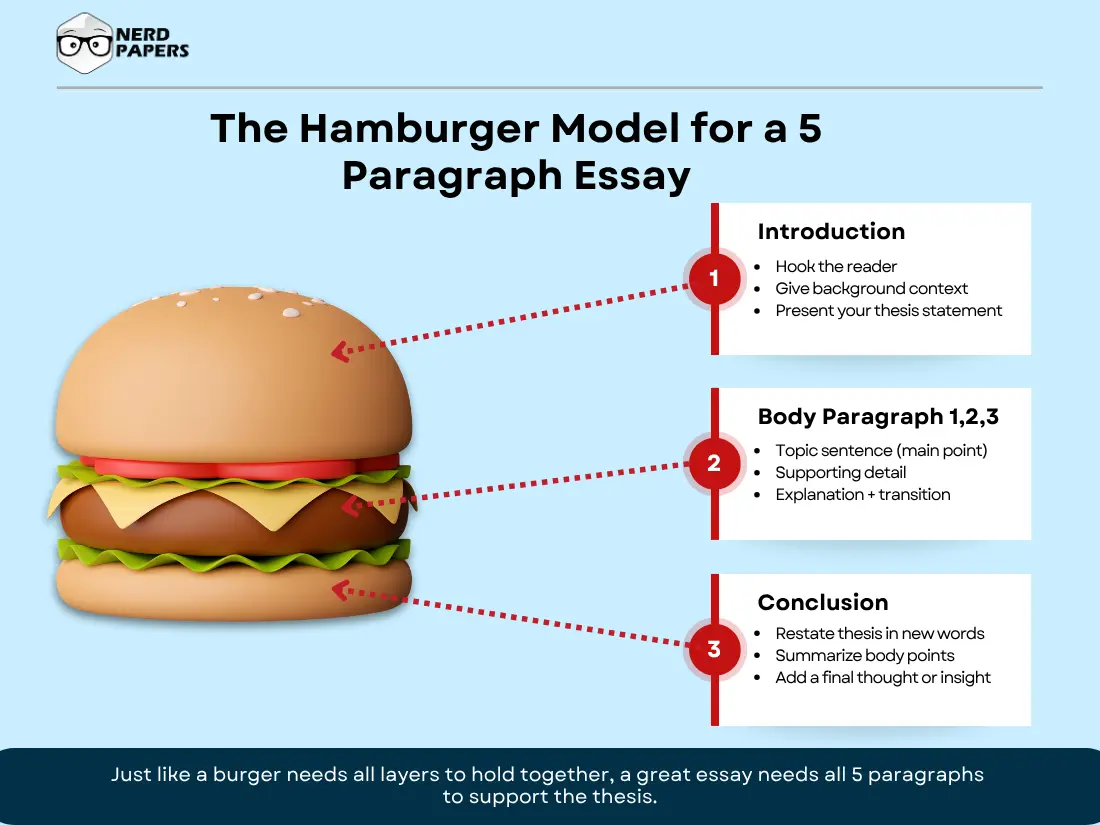
Think of it as a sandwich: the intro and conclusion are the two slices of bread, and the body paragraphs are the filling. Together, they make a complete and satisfying essay.
Up next, we’ll break down the exact structure of a 5 paragraph essay, including word counts and what goes into each part.
Structure of a 5 Paragraph Essay (With Word Count Breakdown)
The 5 paragraph essay format is simple, but each part has a clear purpose. When used correctly, this structure helps your writing stay focused, logical, and easy to follow. Below is a detailed breakdown of each paragraph—what it should include and approximately how long it should be.
Introduction Paragraph (100–150 words)
This is where your essay begins. The introduction should grab the reader’s attention, provide context for the topic, and end with a clear thesis statement.
Key components:
- Hook: A compelling opening sentence to draw in the reader.
- Background Information: A few sentences to introduce the topic.
- Thesis Statement: A clear, one-sentence summary of your main point. It sets up the three body paragraphs that follow.
Tip: The thesis usually comes at the end of the intro and previews the main arguments you’ll cover.
Body Paragraphs (3 paragraphs, 100–200 words each)
Each body paragraph focuses on one specific point that supports your thesis. All three follow a similar structure:
Body Paragraph 1
- Topic Sentence: Introduces the first supporting idea.
- Evidence/Examples: Facts, quotes, or data to back up your point.
- Explanation: Show how the evidence connects to your thesis.
- Transition Sentence: Leads into the next paragraph.
Body Paragraph 2
- Covers the second supporting point.
- Follows the same structure as Body Paragraph 1.
- Transition to Body Paragraph 3.
Body Paragraph 3
- Presents the third and final supporting point.
- Ends with a transition into the conclusion.
Each body paragraph must stay focused on one idea, supported by evidence and clear explanation. If you’re unsure how to develop strong body paragraphs that actually support your thesis, our detailed guide on writing effective essay body paragraphs breaks it down step by step—with examples and writing strategies you can use in any essay.
Conclusion Paragraph (100–150 words)
The conclusion wraps up the entire essay. It restates the thesis, summarizes the main points, and leaves the reader with a final thought.
Key elements:
- Restated Thesis: Use different words to reinforce your main idea.
- Summary of Points: Briefly revisit your three body paragraphs.
- Final Statement: A closing thought, reflection, or call to action.
🛑 Never introduce new information in your conclusion.
This structure gives you a solid starting point—especially for timed essays and school assignments.
Next, let’s look at how to turn this structure into a working plan with a 5 paragraph essay outline.
5 Paragraph Essay Outline Template
Before you start writing, creating an outline can help you stay focused and organized. A 5 paragraph essay outline acts like a roadmap—it lays out your main points so you don’t get lost while writing. It also helps make sure your ideas flow logically from one paragraph to the next.
Here’s a simple outline structure you can follow:
Basic 5 Paragraph Essay Outline
- Introduction
- Hook
- Background/context
- Thesis statement
- Body Paragraph 1
- Topic sentence
- Supporting detail or example
- Explanation
- Transition
- Body Paragraph 2
- Topic sentence
- Supporting detail or example
- Explanation
- Transition
- Body Paragraph 3
- Topic sentence
- Supporting detail or example
- Explanation
- Transition to conclusion
- Conclusion
- Restated thesis (in new words)
- Summary of main points
- Final thought or closing sentence
Visual Tools to Plan Your 5 Paragraph Essay
If you’re a visual learner or just want a more hands-on way to plan your essay, graphic organizers are incredibly helpful. These tools let you visualize how each part of your essay fits together—so you stay organized from start to finish.
Here are some effective tools students use:
- 🍔 Hamburger Chart:
The introduction and conclusion are the buns, while the three body paragraphs are the meat, lettuce, and tomato. It’s a fun way to see how all parts support the central idea. - 🎨 Color-Coded Templates:
These assign colors to different elements—like blue for the thesis, green for topic sentences, and red for evidence—to help you see balance and repetition. - 📄 Printable Outline Sheets:
Especially useful during timed exams, these planners include boxes for each paragraph, evidence slots, and transition reminders. - 💻 Digital Organizers:
Platforms like Google Docs, Canva, and educational tools (like ReadWriteThink) offer drag-and-drop templates to plan essays interactively.
Whether you’re drafting your first essay or just need a reset, combining a written outline with a visual tool can help you write more confidently and clearly.
How to Write a 5 Paragraph Essay (Step by Step)
Once you’ve created your outline, it’s time to start writing. Here’s a simple, step-by-step process to help you write a complete and effective 5 paragraph essay:
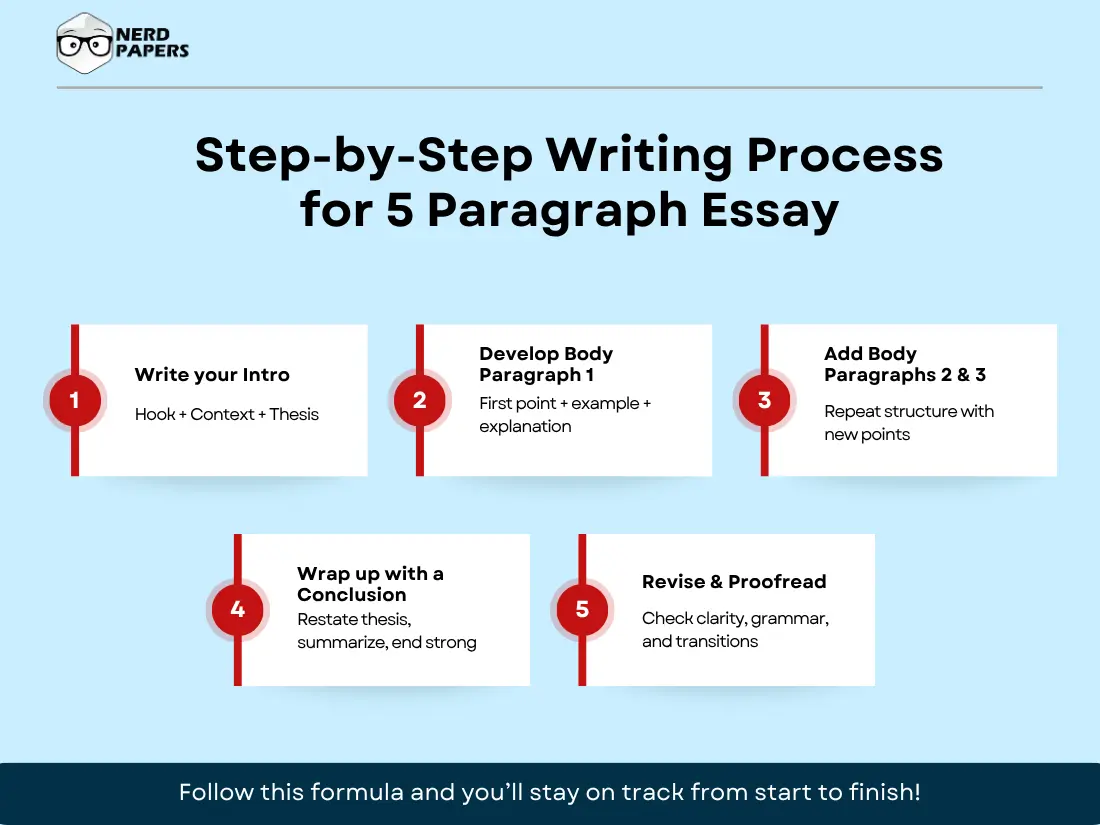
Step 1: Write the Introduction
Start with a hook to grab attention—a question, quote, or surprising fact. Follow it with background information that introduces the topic. End with a clear, one-sentence thesis statement that outlines your three main points.
Example: School uniforms can improve focus, build community, and increase safety in schools.
Step 2: Develop Body Paragraph 1
Begin with a topic sentence that introduces your first point. Add 1–2 pieces of evidence (facts, examples, stats), followed by an explanation showing how the evidence supports your thesis. End with a transition to the next paragraph.
Step 3: Develop Body Paragraphs 2 and 3
Repeat the same structure for your second and third points:
- Start with a topic sentence
- Support it with evidence
- Explain the evidence
- Use transition phrases to connect ideas
Need more help with this part? See our full breakdown on Essay Body Paragraphs.
Step 4: Write the Conclusion
Restate your thesis in new words, summarize your three points, and end with a final thought, reflection, or call to action. Avoid introducing new arguments here.
Step 5: Revise and Proofread
Before submitting, read your essay out loud and check for:
- Clarity and flow between paragraphs
- Grammar and punctuation errors
- Consistent structure and formatting
- Whether your thesis is fully supported
Following these five steps ensures your 5 paragraph essay is not only well-organized but also compelling and easy to follow. Combine this process with your outline and you’re set for success!
5 Paragraph Essay Example (With Annotations)
Now that you understand the structure, let’s look at a real 5 paragraph essay example—with annotations to highlight how each part functions. This sample demonstrates how to build a clear argument using the classic essay format.
Essay Topic: Should schools require students to wear uniforms?
Introduction
School uniforms have long been a topic of debate among students, parents, and educators.
(Hook – introduces the topic in a way that grabs attention.)
While some believe uniforms suppress individuality, others argue they promote equality and reduce distractions.
(Background information – briefly introduces both sides of the argument.)
A school uniform policy can improve student focus, foster a sense of community, and create a safer learning environment.
(Thesis statement – clearly outlines the three points that will be developed in the body paragraphs.)
Body Paragraph 1 – Improves Focus
Uniforms eliminate the pressure to dress a certain way, helping students concentrate on academics rather than fashion.
(Topic sentence – introduces the first supporting point.)
Without the distraction of comparing clothes, students are more likely to stay engaged in class.
(Explanation – clarifies why the point matters.)
For example, a study from the National Association of Secondary School Principals found that schools with uniform policies reported higher student attentiveness.
(Evidence – includes data to support the argument.)
Body Paragraph 2 – Builds Community
Wearing the same outfit builds a sense of belonging and unity among students.
(Topic sentence – introduces the second supporting idea.)
It shifts the focus from appearance to shared identity, reducing cliques based on clothing or brand labels.
(Explanation – shows how uniforms impact social dynamics.)
This sense of equality can lead to improved cooperation and peer relationships within the school.
(Extension – deepens the impact of the point.)
Body Paragraph 3 – Enhances Safety
Uniforms make it easier to identify intruders on campus, which increases school safety.
(Topic sentence – introduces the third point.)
They also reduce bullying tied to clothing choices. When everyone wears the same outfit, there’s less room for judgment or exclusion based on economic status or style.
(Explanation + supporting reasoning – connects to emotional and safety concerns.)
Conclusion
Although some argue that uniforms restrict self-expression, the benefits outweigh the drawbacks.
(Restated thesis – acknowledges the counterpoint while reaffirming stance.)
Uniform policies support academic focus, strengthen school community, and enhance overall safety.
(Summary of main points – one sentence recap.)
For these reasons, schools should strongly consider adopting uniform requirements.
(Final thought – a clear, persuasive call to action.)
5 Paragraph Essay Word Count, Length & Page Estimate
One of the most common questions students ask is:
“How long should a 5 paragraph essay be?”
The answer depends on your grade level, assignment requirements, and writing goals—but there are some general guidelines you can follow.
Typical Word Count
A standard 5 paragraph essay is usually between 500 and 800 words. Here’s how that typically breaks down:
| Paragraph | Word Count Range |
| Introduction | 100–150 words |
| Body Paragraph 1 | 100–200 words |
| Body Paragraph 2 | 100–200 words |
| Body Paragraph 3 | 100–200 words |
| Conclusion | 100–150 words |
| Total | 500–800 words |
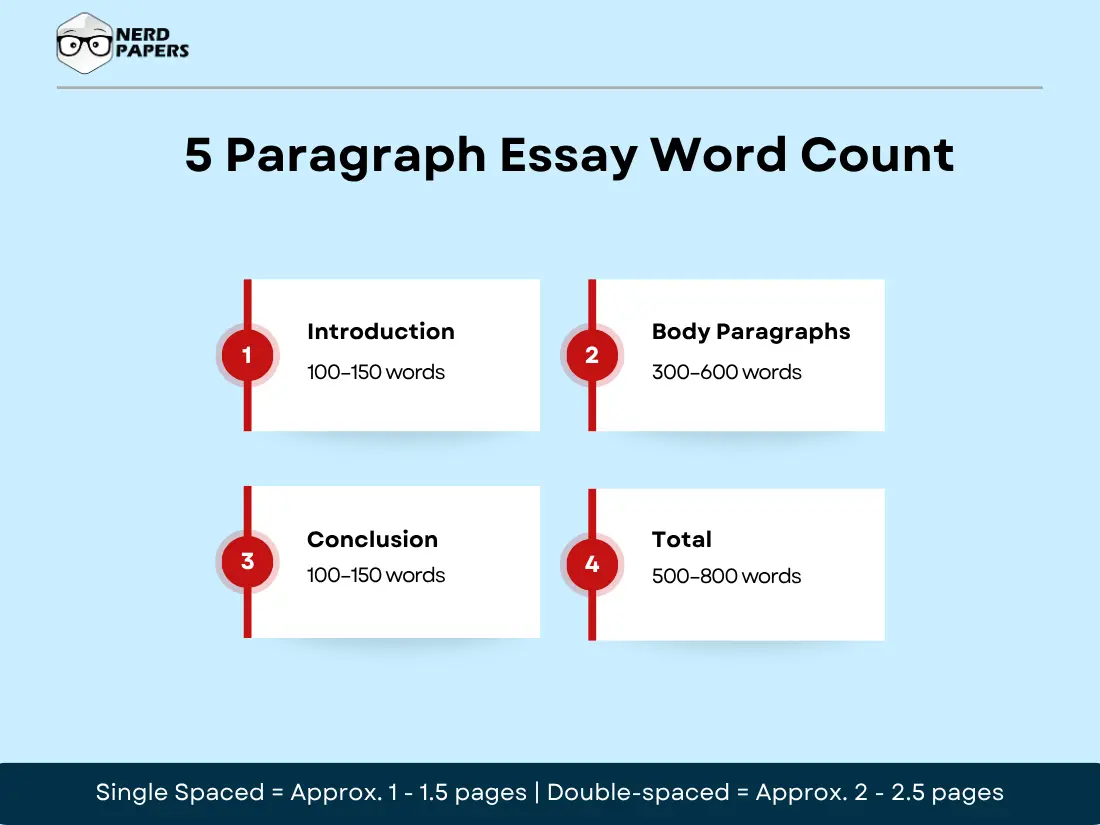
For example, a 500 word essay is often structured using this same format—but with more concise paragraphs.
How Many Pages Is a 5 Paragraph Essay?
- Single-spaced: Approximately 1 to 1.5 pages
- Double-spaced: Around 2 to 2.5 pages
- Font: Times New Roman or Arial, 12pt
- Margins: 1 inch on all sides
How Long Does It Take to Write One?
- Beginner writers: 90–120 minutes
- Intermediate/High school students: 45–60 minutes
- With planning & outline done: 30–45 minutes
Of course, this depends on your topic, research, and how comfortable you are with the format. Using a solid outline can cut your writing time in half.
When and Why to Use the 5 Paragraph Essay Format
The 5 paragraph essay format isn’t just a classroom exercise—it’s a versatile writing structure that works across subjects and grade levels. While it may seem basic, there are strong reasons why this format remains popular among students, teachers, and test graders.
When Should You Use It?
The 5 paragraph structure is ideal for:
- Timed essays (e.g., standardized tests like SAT, ACT, or TOEFL)
- Classroom assignments where a short, focused response is needed
- Introductory writing practice for middle school and high school students
- Basic persuasive, expository, or narrative essays
- Scholarship applications with short word limits
It’s also great for when:
- You need to explain three supporting points clearly
- You’re learning how to write with a strong thesis and structure
- You want to organize your thoughts quickly and effectively
💡 Why Is It So Useful?
Here’s what makes the 5 paragraph essay so effective—especially for students:
| Benefit | Why It Matters |
| Clarity & Simplicity | Each paragraph has a clear purpose, making writing and reading easier. |
| Easy to Learn & Replicate | Once mastered, you can apply the format to almost any topic. |
| Helps Build Structure Skills | Teaches how to introduce, support, and conclude ideas in an organized way. |
| Encourages Focused Thinking | Forces you to limit ideas to your thesis and stay on topic. |
| Widely Recognized by Teachers | It’s a format many rubrics are built around—so it helps you meet expectations. |
Is It Perfect for Every Situation?
Not always.
The 5 paragraph format works well for short essays, but for advanced academic writing, it can feel limiting. College-level essays, research papers, and analytical essays often require:
- More than three supporting points
- Complex argument structures
- Subsections within paragraphs or expanded introductions
Still, mastering the 5 paragraph essay gives you the foundation needed to tackle more advanced formats with confidence.
Conclusion
The 5 paragraph essay remains one of the most effective formats for building strong writing skills—especially for students just starting out. Its clear structure—introduction, three body paragraphs, and a conclusion—helps you organize your thoughts, support your thesis, and stay focused from start to finish.
While it may not be ideal for every type of writing, mastering this classic essay format gives you the foundation to handle more advanced assignments with confidence. Whether you’re preparing for a test, writing a class essay, or tackling a short academic piece, the 5 paragraph structure keeps things simple and effective.
Now that you understand how the 5 paragraph essay works—from outline to execution—you’re ready to write one like a pro.
FAQs About the 5 Paragraph Essay
To wrap things up, here are answers to some of the most common questions students ask about the 5 paragraph essay format—from thesis placement to word count and usage in higher education.
Where is the thesis stated in a 5 paragraph essay?
The thesis statement is usually placed at the end of the introduction paragraph. It clearly states your main point and previews the three supporting ideas you’ll cover in the body paragraphs.
How many words is a typical 5 paragraph essay?
Most 5 paragraph essays fall between 500 and 800 words. Each paragraph usually contains 100–200 words, depending on the assignment or grade level.
How many sentences should each paragraph have?
Each paragraph typically contains 5 to 7 sentences. That adds up to about 25 to 35 total sentences across the essay.
Can I use the 5 paragraph essay format in college?
Sometimes, yes—especially for short assignments, in-class essays, or exams. But many college-level essays require a more flexible structure with additional body paragraphs and deeper analysis.
What are the parts of a 5 paragraph essay again?
Introduction: Hook, background, thesis
Body Paragraph 1: First supporting point
Body Paragraph 2: Second supporting point
Body Paragraph 3: Third supporting point
Conclusion: Restated thesis, summary, final thought
Why do some people dislike the 5 paragraph essay?
Critics say it can feel too rigid or formulaic—especially for complex topics. However, it’s still a useful starting point for learning how to organize and express ideas clearly.
Can I add more than 3 body paragraphs?
Absolutely—especially if your topic has more than three strong points. The 5 paragraph format is just a foundation, not a limit.