

Writing a strong essay body paragraph is essential to making your argument clear, logical, and convincing. It’s where you present your main points, support them with evidence, and explain how they connect to your thesis. But a body paragraph doesn’t stand alone — it plays a key role in your essay’s overall structure, working alongside the introduction and conclusion to build a complete, cohesive argument.
If you’re not fully confident in how the body fits into the bigger essay framework, take a moment to explore the Essay Structure guide. It breaks down the full layout of an essay — from intro to conclusion — so you’ll see exactly where the body paragraph belongs and how to organize your ideas from the ground up.
Whether you’re writing a school assignment, a timed exam, or a college-level essay, understanding how to structure your body paragraphs can take your writing to the next level.
In this guide, we’ll walk you through everything you need to know about crafting effective body paragraphs. You’ll learn how to start a body paragraph, what to include in each part, and how to keep your ideas flowing smoothly from one point to the next. We’ll also show you common mistakes to avoid, real examples to follow, and writing tips to help you stay organized and focused.
What Is a Body Paragraph in an Essay?
An essay body paragraph is where the real work of your essay happens. It’s the section where you develop your main ideas, present supporting evidence, and explain how everything connects to your thesis. Each body paragraph focuses on a single point and follows a clear structure to keep your writing organized and easy to follow.
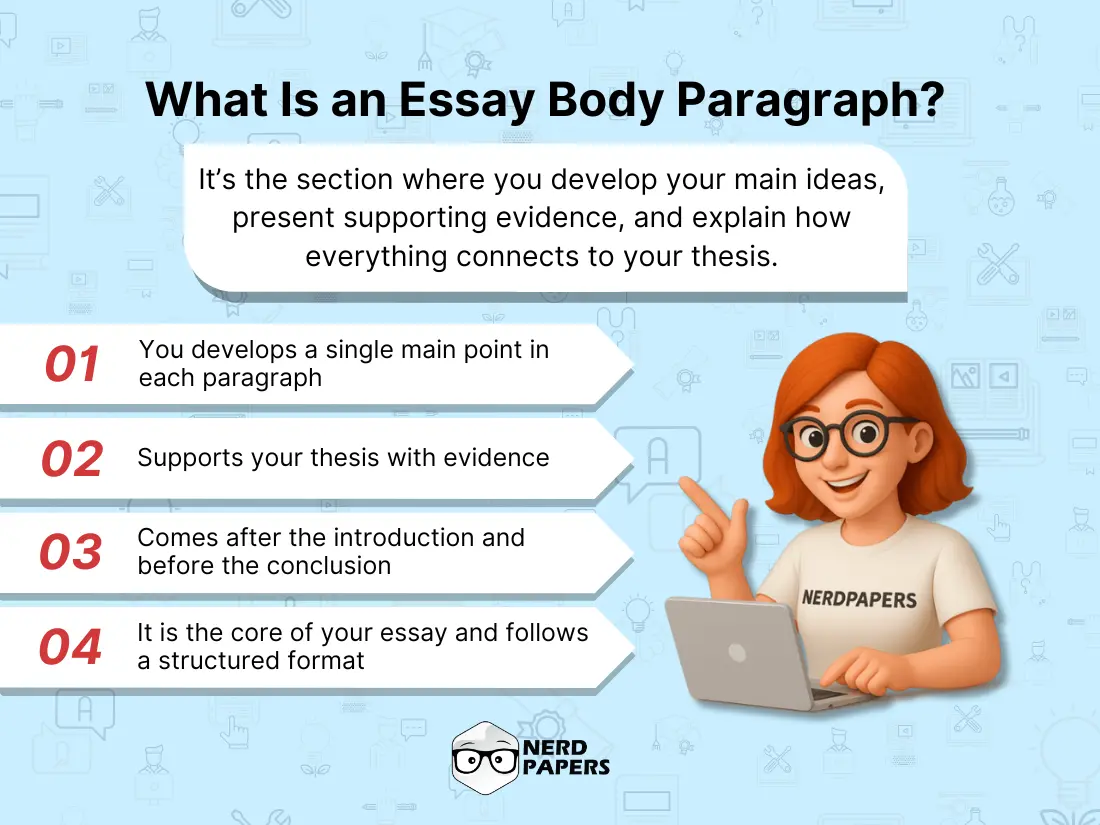
In a typical academic essay, body paragraphs sit between the essay introduction and the essay conclusion. While the introduction introduces the topic and the thesis, and the conclusion wraps everything up, the body paragraphs are where you explain, argue, or analyze—depending on the type of essay you’re writing.
No matter the format—whether it’s a short response, or a 5-paragraph essay, body paragraphs play a critical role in helping your reader understand and engage with your ideas.
How Many Body Paragraphs Should an Essay Have?
The number of essay body paragraphs you need depends on the length, purpose, and type of your essay. There’s no one-size-fits-all rule, but there are common patterns based on academic standards and word count.
Typical Guidelines:
- Short essays (100–300 words): Usually 1–2 body paragraphs
- Standard essays (500 words): Often 2–3 body paragraphs
- 5-paragraph essays: Always have exactly 3 body paragraphs
- Longer essays (1000+ words): 3 or more body paragraphs, depending on complexity
Each body paragraph should focus on a single main point that supports your thesis. If you’re unsure how many to include, a good rule of thumb is: one paragraph per main idea.
💡 Instead of aiming for a specific number, focus on fully developing each idea. If a paragraph feels too crowded, split it. If it feels too short, expand with examples or explanations.
Essay Body Paragraph Structure (P-I-E / T-E-E-L / S-E-E / P.E.E.L.)
A well-written essay body paragraph isn’t just a block of text—it follows a clear internal structure. Whether you’re writing an argumentative, expository, or analytical essay, most strong paragraphs follow a repeatable pattern that helps your ideas stay focused and coherent.
Popular Paragraph Structures in Academic Writing:
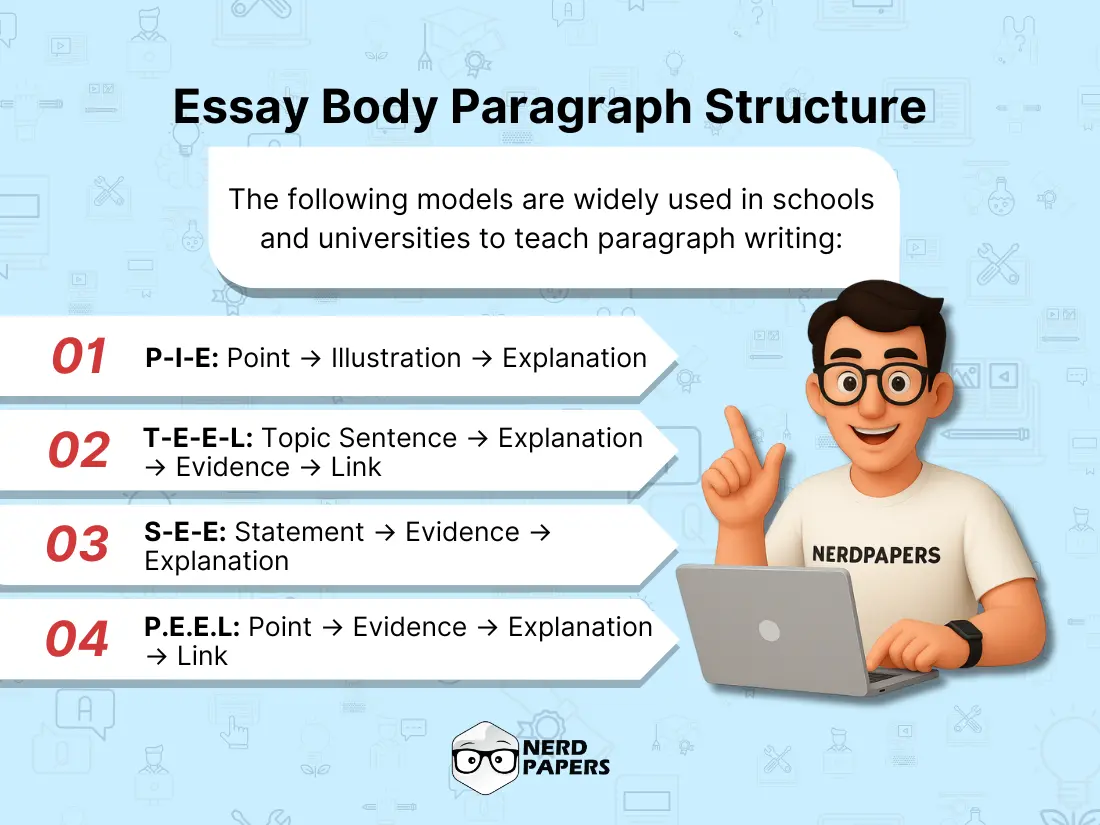
These models are widely used in schools and universities to teach paragraph writing:
- P-I-E: Point → Illustration → Explanation
- T-E-E-L: Topic Sentence → Explanation → Evidence → Link
- S-E-E: Statement → Evidence → Explanation
- P.E.E.L: Point → Evidence → Explanation → Link
Why Structure Matters:
Using a consistent structure helps:
- Ensure your ideas flow logically
- Keep each paragraph focused on a single point
- Support your thesis with clear, layered reasoning
Later in this guide, we’ll break down each part of the paragraph using real examples so you can see how these structures look in action.
5 Key Components of a Strong Essay Body Paragraph
A well-developed essay body paragraph includes more than just sentences grouped together—it follows a purposeful structure that helps your reader follow your logic. Each part of the paragraph plays a role in supporting your thesis and keeping your writing organized.
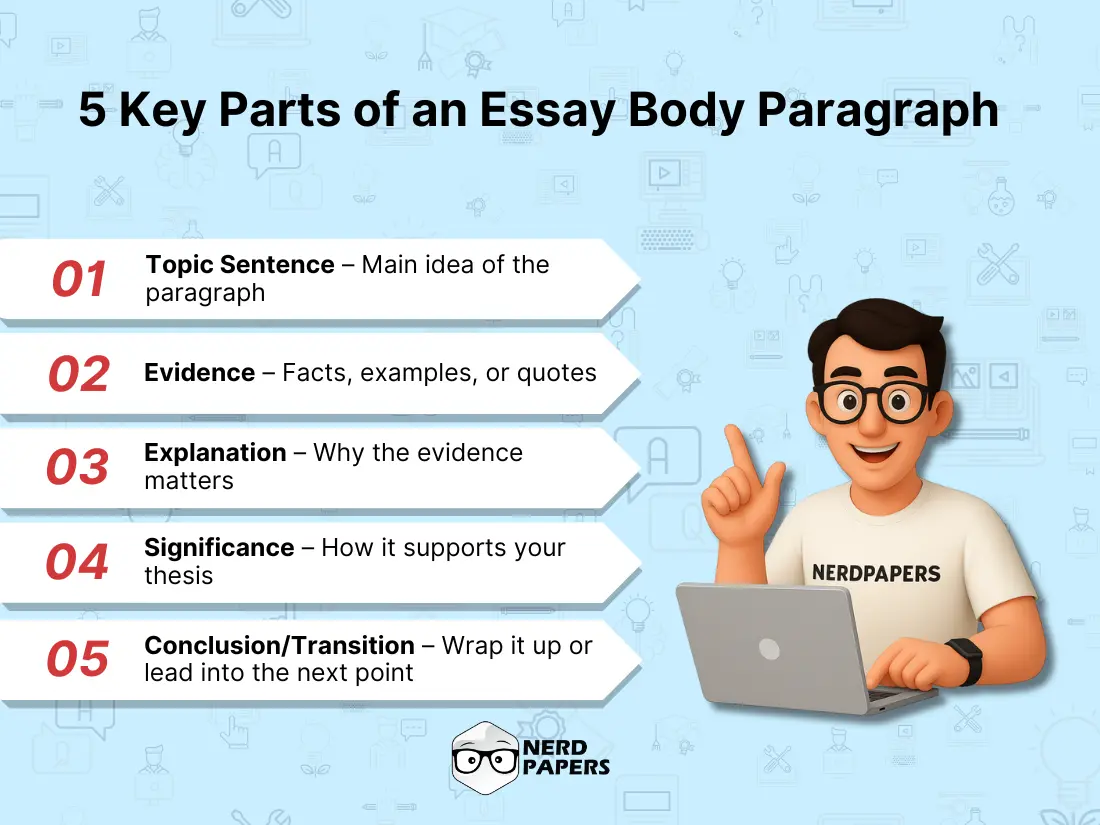
Let’s break down the 5 essential components found in most academic essay body paragraphs:
1. Topic Sentence
The topic sentence introduces the main idea of the paragraph. It tells the reader what the paragraph is about and should clearly connect back to your thesis.
Attributes:
- Usually the first sentence
- Contains a clear topic + controlling idea
- Sets the stage for supporting details
Example:
One reason school uniforms improve student focus is by reducing social pressure.
2. Supporting Details / Evidence
This is where you back up your claim with facts, examples, statistics, quotes, or data. Your evidence must directly support the point you introduced in the topic sentence.
Attributes:
- Use credible, relevant sources
- Avoid unrelated or shallow examples
Example:
A 2022 study by the University of Chicago found that students in uniformed schools were 15% more focused in class.
3. Explanation / Analysis
This is often where students go wrong—don’t just drop facts. You must explain the evidence and show how it supports your main point.
Attributes:
- Clarifies how your evidence connects to your thesis
- Shows your critical thinking
Example:
This suggests that uniforms can reduce distractions caused by peer comparison, allowing students to concentrate better.
4. Significance / Interpretation
Go a step further and show why it matters. How does this point contribute to your overall argument or essay purpose?
Attributes:
- Reflects deeper meaning or consequence
- Bridges between paragraph point and essay’s main goal
Example:
By minimizing social stress, uniforms help foster a more equal and productive learning environment.
5. Concluding or Transition Sentence
End your paragraph with a sentence that wraps up the idea and/or transitions smoothly into the next paragraph.
Attributes:
- Sums up the paragraph’s purpose
- Leads into your next main idea (when relevant)
Example:
For these reasons, school uniforms can significantly improve students’ ability to stay focused and engaged.
How to Write a Body Paragraph (Step-by-Step)
Writing a clear and focused essay body paragraph takes more than just listing facts or opinions. Each paragraph should build upon your thesis, develop one key idea, and guide the reader through your reasoning with structure and clarity.
Here’s a step-by-step process you can follow to write a strong body paragraph every time:
Step 1: Start with a Clear Topic Sentence
Begin with a sentence that introduces the main point of the paragraph and connects it to your thesis.
Example:
Access to nutritious school lunches significantly improves student performance.
Step 2: Add Credible Supporting Evidence
Back up your point with facts, examples, statistics, or expert quotes.
Example:
According to the CDC, students who eat a healthy lunch score up to 18% higher on standardized tests.
Step 3: Explain the Evidence (Analysis)
Don’t assume the reader will make the connection—spell it out. Show how your evidence supports the topic sentence.
Example:
This data shows that when students receive the proper nutrition, their brain function and focus improve, leading to better academic outcomes.
Step 4: Add Significance (Optional but Powerful)
Explain why this point matters in the broader context of your essay.
Example:
This highlights how school policies that promote health can directly influence educational success.
Step 5: End with a Transition or Summary Sentence
Wrap up the idea and prepare the reader for the next paragraph.
Example:
Improved academic performance is just one of the many benefits linked to better school lunch programs.
💡 Your topic sentence should align with your Essay Introduction, and your concluding sentence should prepare the reader for what’s to come—ultimately leading toward your Essay Conclusion.
Examples of Essay Body Paragraphs (Good vs. Weak)
One of the best ways to learn how to write a strong essay body paragraph is by comparing examples. Below are two versions of the same paragraph topic — one well-written and one weak — followed by clear explanations so you understand exactly what works and what doesn’t.
💪Strong Body Paragraph Example
Topic: Should schools start later in the morning?
One major reason schools should start later is to improve students’ mental and physical health. According to the American Academy of Pediatrics, teenagers need 8–10 hours of sleep, yet most high schools begin before 8 a.m., leading to widespread sleep deprivation. This lack of sleep is linked to higher rates of anxiety, depression, and poor academic performance. When students start school later and get enough rest, they’re more focused, emotionally balanced, and better able to succeed in class. For this reason, delaying school start times can significantly boost students’ overall well-being.
Why This Works:
- Topic Sentence: States a focused claim that ties back to the thesis introduced in the essay introduction
- Evidence: Credible statistic strengthens the point
- Explanation: Clearly interprets the data instead of just presenting it
- Significance: Reinforces the paragraph’s importance in the larger argument
- Conclusion/Transition: Wraps the idea and prepares for the next point
👎 Weak Body Paragraph Example
Kids don’t get enough sleep. Lots of students are tired during school, and it’s hard to focus when you’re tired. Schools start early, and that’s not good. People say school should start later so kids can sleep more. Not everyone agrees, but it’s a good idea.
What’s Wrong Here:
- No connection to the main thesis from the introduction, making the paragraph feel isolated
- Lacks supporting evidence — if you’re unsure how to include facts, review our section on paragraph structure
- No analysis or transitions, which makes it harder to lead into the essay conclusion
Student Takeaway: What Makes a Good Essay Body Paragraph?
| ✅ Must Include | ❌ Avoid |
| A clear topic sentence | Starting vaguely or off-topic |
| Strong supporting evidence or examples | Personal opinions without support |
| Explanation that links to your thesis | Just listing facts or repeating ideas |
| Significance or connection to bigger point | Rambling or unrelated details |
| A closing or transition sentence | Ending without a conclusion |
Common Mistakes to Avoid in Essay Body Paragraphs
Even with a good structure in mind, many students fall into traps that weaken their essay body paragraphs. Whether it’s vague ideas, poor transitions, or lack of analysis, these issues can make your writing unclear or disconnected from your main argument.
Let’s break down the most common mistakes — and how to fix them:
1. Weak or Missing Topic Sentence
Without a clear topic sentence, readers won’t know what the paragraph is about. This creates confusion and breaks the flow of your essay.
Instead:
Start with a focused topic sentence that directly supports your thesis. It should act like a mini headline for the paragraph.
2. Listing Facts Without Explanation
Just stating facts or examples isn’t enough. If you don’t explain why they matter, your paragraph feels like a data dump.
Instead:
Follow up each piece of evidence with an explanation that connects it back to your point.
💡 Remember: A strong essay body paragraph structure includes both evidence and analysis.
3. Going Off-Topic
Including unrelated information or jumping to a new point mid-paragraph weakens clarity and focus.
Instead:
Stick to one main idea per body paragraph. If you have a new idea, start a new paragraph.
4. No Transitions or Flow
Abrupt shifts between sentences or paragraphs make your essay hard to read.
Instead:
Use transition words or phrases to guide your reader from one idea to the next. This helps maintain logical flow and prepares for the essay conclusion.
5. Not Explaining the Significance of Your Point
Many students forget to explain why their point matters within the larger context of the essay.
Instead:
Always include a sentence that shows the impact of your argument or insight.
✅ Quick Fix Checklist for Better Body Paragraphs
- Clear topic sentence
- Relevant, credible evidence
- Strong explanation
- Smooth transitions
- Clear connection to thesis
🧠 Want to practice? Try rewriting the weak example from earlier using this checklist. Then compare it to the strong one to see what improved.
Body Paragraph Starters & Transition Words
A strong essay body paragraph doesn’t just rely on structure—it also needs flow. The way you begin each paragraph and connect ideas plays a big role in how smooth and persuasive your writing feels.
Whether you’re starting your first body paragraph or transitioning between multiple points, having a variety of sentence starters and linking words helps your essay read naturally and logically.
Body Paragraph Starters: First, Second & Third Paragraphs
These are useful when writing multi-paragraph essays like a 5-paragraph essay, where each paragraph supports a different point.
| Paragraph | Starters You Can Use |
| 1st | “One key reason…”, “The first way…”, “To begin with…” |
| 2nd | “Another important point…”, “Additionally…”, “The second reason…” |
| 3rd | “Finally…”, “A third factor…”, “Lastly…” |
Transition Words for Sentence Flow Within Paragraphs
Use these linking words and phrases to connect sentences, add evidence, or introduce analysis.
| Purpose | Examples |
| To Add | also, in addition, furthermore, moreover |
| To Explain | this shows, in other words, that means |
| To Give Example | for example, for instance, such as |
| To Compare | similarly, likewise |
| To Contrast | however, on the other hand, although |
| To Conclude | in summary, therefore, as a result |
A well-structured essay body paragraph uses these transitions to guide the reader through your point without confusion or abrupt shifts.
Example with Transitions in Action:
One key reason schools should start later is the impact on student focus. For example, a study from Harvard shows that students who get 8+ hours of sleep score higher on exams. This suggests that rest directly affects learning. Furthermore, better focus can improve classroom behavior and participation.
How Long Should an Essay Body Paragraph Be?
A common question students ask is: “How long should a body paragraph be in an essay?” The answer depends on the length and complexity of your essay—but there are general guidelines that can help you stay on track.
Typical Length Guidelines:
- Short essays (100–300 words): 1 well-developed body paragraph (4–6 sentences)
- Standard essays (500 words): 2–3 body paragraphs, each around 100–150 words
- Longer essays (1000+ words): 3–5+ paragraphs, often 150–200 words each
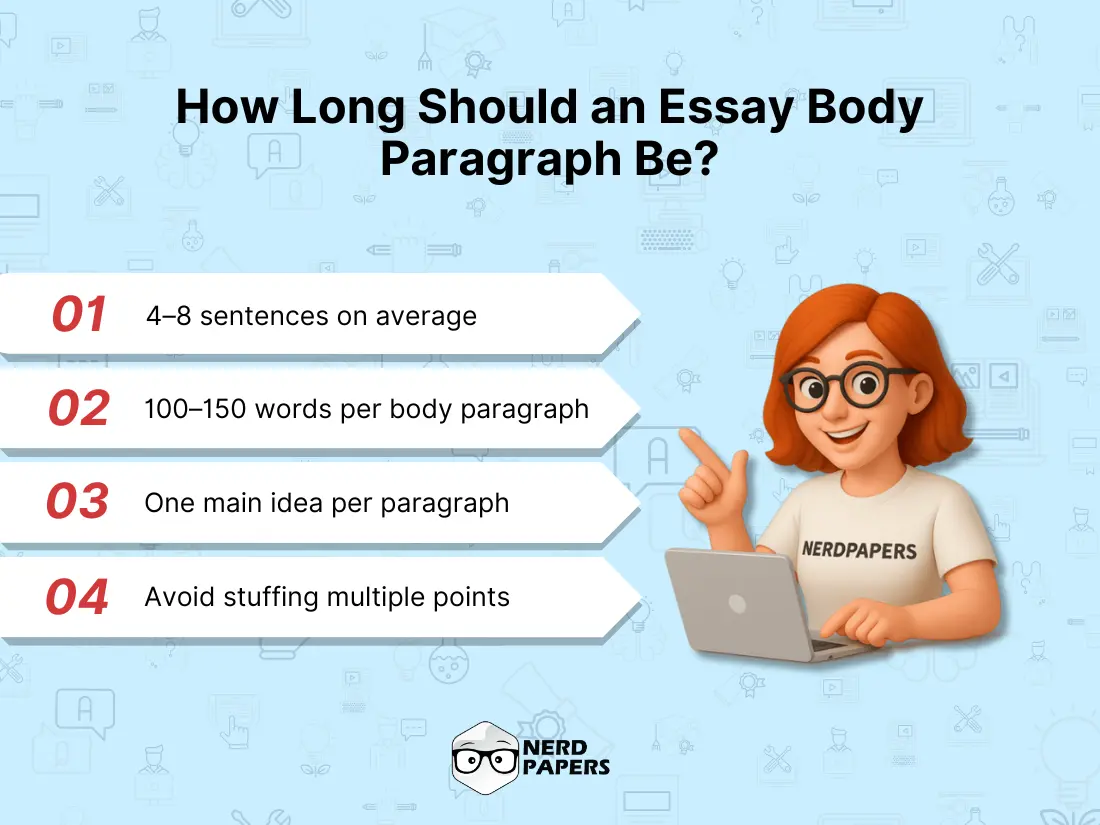
Each essay body paragraph should be long enough to:
- Introduce a clear main point (topic sentence)
- Provide evidence or examples
- Explain how the evidence supports the argument
- Conclude or transition to the next point
Example Length Breakdown (500-word Essay):
- Introduction: ~75 words
- 3 Body Paragraphs: ~125 words each
- Conclusion: ~50–75 words
Avoid These Length Mistakes:
- Too short (1–2 sentences): Lacks development
- Too long (300+ words): May contain multiple points and lose focus
- Aim for clarity, not word count—make sure each paragraph fully supports one idea
📚 Quality matters more than quantity. Focus on developing one idea per essay body paragraph with just enough detail to make it clear and persuasive.
How Body Paragraphs Support Your Thesis
Every essay body paragraph plays a key role in reinforcing your thesis. While your introduction states your main argument, it’s the body that builds your case—one paragraph at a time.
Think of your thesis as a promise. Each body paragraph helps fulfill that promise by exploring a specific point, backing it with evidence, and explaining why it matters.
How the Body Connects to the Thesis:
- Topic Sentence: Ties directly to a part of your thesis statement
- Evidence & Explanation: Expands on the “why” and “how” of your argument
- Significance: Shows how this point matters within your broader claim
If your paragraph doesn’t clearly support the thesis you introduced in your essay introduction, it may be off-topic or need revision.
Example:
Thesis Statement (from intro):
“School uniforms improve academic focus, reduce peer pressure, and promote equality.”
Matching Body Paragraph Topic Sentence:
“Uniforms reduce peer pressure by removing the distraction of clothing-based competition.”
This paragraph would then use evidence, explanation, and significance to prove that point—directly supporting part of the thesis.
Why This Link Matters:
Strong essays maintain unity between introduction, body, and conclusion. When your body paragraphs drift from your thesis, your argument weakens and your essay loses focus.
Essay Body Paragraph Formats for Different Essay Types
Not all essays are created the same — and that means your essay body paragraphs may look slightly different depending on the type of essay you’re writing. While the basic structure (topic sentence, evidence, explanation, conclusion) remains consistent, the purpose and style of each paragraph will vary.
Here’s how body paragraphs function in common academic essay types:
Argumentative Essay
Purpose: To persuade the reader of your position.
What to include:
- Clear claim (topic sentence)
- Strong supporting evidence (facts, studies, expert opinions)
- Rebuttals to counterarguments (if applicable)
- Explanation of why your point is valid or stronger
Example:
“One reason schools should ban junk food is its negative impact on student concentration. A study from the WHO found that high sugar intake leads to energy crashes and reduced focus. This shows that regulating cafeteria food supports better learning.”
Expository Essay
Purpose: To explain or inform the reader about a topic.
What to include:
- Neutral, factual tone
- Clear explanation of a concept or process
- Examples or statistics (if relevant)
Example:
“Photosynthesis is the process by which plants convert sunlight into energy. It takes place in the chloroplasts and involves carbon dioxide, water, and light. This process is crucial for producing oxygen and sustaining life on Earth.”
Analytical Essay
Purpose: To analyze a text, idea, event, or issue.
What to include:
- Topic sentence focused on a specific aspect of the analysis
- Quote or reference from the source
- Interpretation and critical commentary
- Connection back to thesis or overall theme
Example:
“In Shakespeare’s Macbeth, the dagger scene symbolizes Macbeth’s growing descent into madness. The imagined weapon shows his mental conflict and foreshadows his irreversible choices.”
Opinion Essay
Purpose: To express and justify personal opinions with reasoning and evidence.
What to include:
- Clearly stated opinion
- Supporting reasons and examples
- A persuasive tone balanced with logic
Example:
“I believe all students should learn a second language. It not only opens up job opportunities but also helps develop cognitive skills. Studies show bilingual individuals often perform better on problem-solving tasks.”
Conclusion
Writing a strong essay body paragraph isn’t just about plugging in facts or stretching your word count—it’s about communicating your ideas clearly, logically, and persuasively. Each paragraph should serve a purpose: support your thesis, explain your reasoning, and keep the reader engaged.
Let’s recap what makes a body paragraph effective:
- A clear and focused topic sentence
- Relevant and credible evidence
- Thoughtful explanation or analysis
- Meaningful significance
- A smooth transition or concluding sentence
Whether you’re writing a 5-paragraph essay, a 500-word assignment, or a longer research paper, following a consistent structure ensures that your essay is both readable and convincing.
Don’t Let Your Essay Fizzle Out—End Strong.
Learn how to write a memorable and meaningful Essay Conclusion that reinforces your argument and leaves a lasting impression on your reader.
With practice, you’ll be able to write clear, confident essay body paragraphs that support your ideas and impress your readers.
FAQs About Essay Body Paragraphs
What is a body paragraph in an essay
A body paragraph is the part of your essay that explains and supports one main idea. It comes after your introduction and before your conclusion, and it should connect directly to your thesis.
How do you start an essay body paragraph?
Begin with a topic sentence that introduces the main point of the paragraph. This sentence should be specific and clearly connected to your thesis.
How many sentences should be in a body paragraph?
Most essay body paragraphs are 4–8 sentences long. Each should include a topic sentence, evidence, explanation, and a concluding or transition sentence.
What should be included in a body paragraph?
A strong body paragraph includes:
A topic sentence
Supporting details or evidence
Explanation or analysis
A sentence showing significance
A concluding or transition sentence
How many body paragraphs should an essay have?
It depends on the essay’s length and purpose. A typical 5-paragraph essay has 3 body paragraphs, but longer essays may include 4 or more.
How do I connect body paragraphs to my thesis?
Each topic sentence should support part of your thesis, and the evidence should explain why your point matters. Review your Essay Introduction to ensure alignment.
Can I include more than one idea in a body paragraph?
It’s best to focus on one main idea per paragraph. If you have another point, start a new body paragraph to avoid confusion.
How do I end a body paragraph?
Use a concluding sentence that wraps up the point or adds a transition to the next paragraph. This helps maintain flow throughout your essay.