
Staring at an empty screen, while being aware of an upcoming deadline, can have you wondering if time itself is trying to trick you. The cursor blinks on the screen, but no proper words come up in your mind. This is not due to a lack of desire to get on with the job, but rather your mind’s refusal to cooperate. This annoying deadlock in productivity is what most students are familiar with as writer’s block. In academic essay writing, it’s much more common than you might think.
It’s not typically a matter of “having no ideas.” When writing an essay, the problem often lies in knowing where to start, how to organize your thoughts, or how to proceed after you’ve begun writing. Knowing the essay-writing process can eliminate most of the resistance that causes writer’s block. This makes the rest of the writing process more relaxed and less frustrating.
Here, we are going to talk about the causes of writer’s block in essay writing and present practical, tried-and-tested tips in overcoming it so that you can go from the first word to the finish essay without wasted efforts.
Understanding Writer’s Block in Academic Essays
Many students often ask what Writer’s Block is in Academic Writing. Writer’s block in academic essays is more than just “feeling stuck”; it’s a mental barrier that stops the flow of ideas and prevents words from forming on the page. Unlike creative writing blocks, academic blocks often stem from pressure to meet strict requirements, adhere to formal structures, and present clear arguments. This combination of rules and expectations can make starting and continuing the essay feel overwhelming.
Now, the next question arises: How does writer’s block affect essay writing? When writer’s block hits, productivity slows to a crawl. Students often spend hours rearranging the same sentence instead of making real progress, which leads to last-minute rushes and compromised quality. Over time, this stress builds up, making future assignments feel even more intimidating. The result is a cycle where the common causes of writer’s block in academic writing, like perfectionism, lack of clarity, or time pressure, keep feeding the problem until it becomes a persistent struggle.
Writer’s block is rarely an isolated issue. It often overlaps with everyday challenges in writing an essay, such as poor time management, difficulty structuring ideas, and uncertainty about research. These struggles not only slow down the writing process but can also drain motivation and confidence. For example, a student who can’t decide how to organize his points may delay starting entirely, which often leads to a lack of ideas. Understanding these connected issues is the first step toward preventing them and toward breaking free from writer’s block before it derails your progress.
Leading Causes of Writer’s Block in Essay Writing
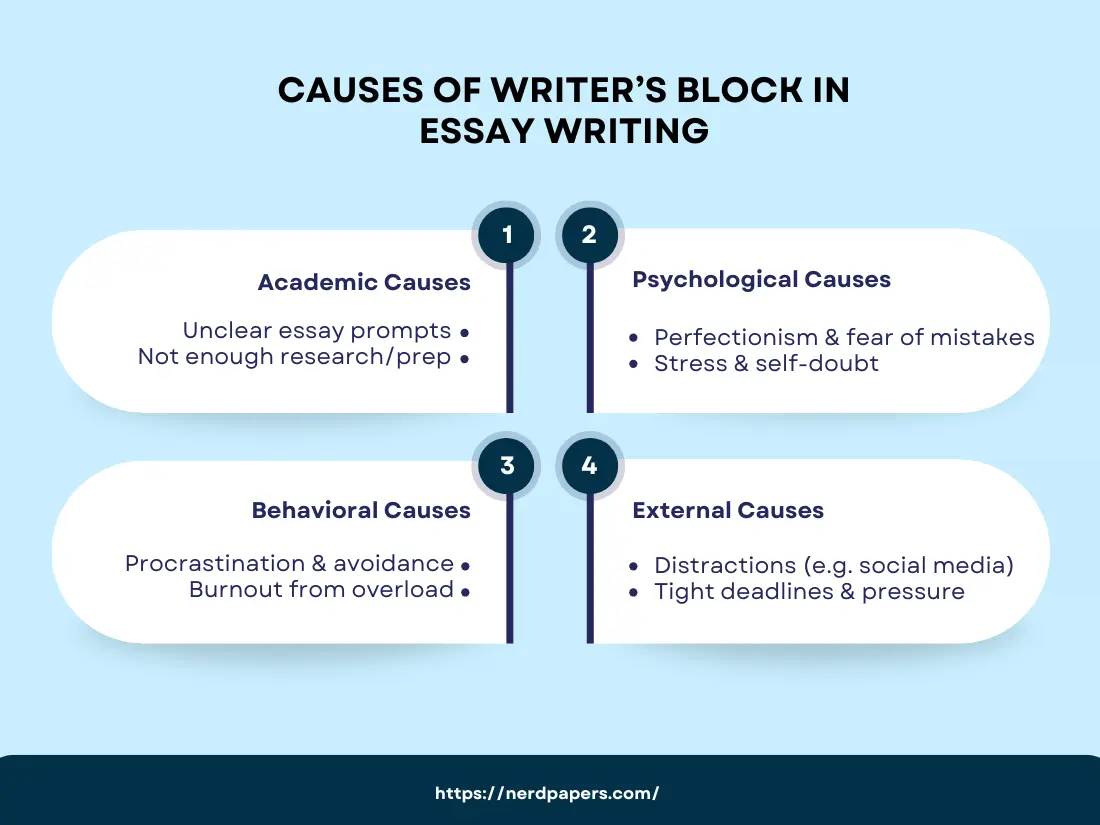
There is rarely just one trigger for writer’s block. It affects the majority of pupils because of a combination of environmental, academic, and mental factors. Understanding the causes of writer’s block in essay writing not only helps overcome the existing block but also prevents it from occurring again in future tasks.
1. Lack of Clarity on the Essay Topic
When the essay prompt is vague, overly broad, or poorly understood, the writing process becomes a battle. Instead of writing down their thoughts, students can spend hours attempting to “figure out” the proper viewpoint. Students spend hours attempting to “get” the right way to proceed rather than writing. If you don’t know how much to write, your essay will be unfocused even if it has a fascinating topic.
2. Perfectionism and Fear of Mistakes
Writing becomes a never-ending cycle of rewriting the same line over and over again to achieve the “perfect” language, driven by perfectionism. The fear that those ideas won’t live up to expectations is what’s producing this mental block, not a lack of ideas.
3. Insufficient Research or Preparation
Starting without enough relevant information leads to stalled progress mid-paragraph. Without facts, examples, or references, students hesitate to commit ideas to the page.
4. External Distractions and Time Pressure
Interference in the form of noise, social media, or constant diversion disrupts concentration, and it is virtually impossible to maintain a thought stream. Tight deadlines increase the block by raising stress levels, which intensifies this effect.
Emotional and Psychological Factors
1. Stress and Self-Doubt
The most common cause of writer’s block among students is the overwhelming pressure to meet high expectations. Such pressure is often the product of a dire fear of failing to meet expectations, either academically or creatively.
- A student might question every sentence, wondering if it is “smart” enough.
- This over-consciousness can extend to overthinking about sentence structure, which can halt the work in its entirety.
- Even such students with good writing abilities can be frozen by the fear of having to get it right on the first try.
Students facing high academic stress often see reduced motivation and performance, with evidence showing this pressure can even raise the risk of dropping out.
2. Procrastination and Avoidance
If writing is stressful, most students will automatically resort to procrastination, checking social media, rearranging a desk, or “researching” for far too long.
- Although this avoidance offers temporary respite, it leads to a more serious issue: “panic writing” before deadlines, which results in hurried, below-average work.
- Not often a sign of laziness, procrastination is a coping strategy for the onset of anxiety.
- Unfortunately, it spirals out of control: putting off the task makes you more stressed, which makes it harder to start.
3. Mental Fatigue and Burnout
Students juggling multiple essays, projects, and exams can experience creativity drain, where their ability to generate fresh ideas sharply declines.
- Multiple back-to-back assignments can leave little room for mental recovery, making it hard to focus even on simple writing tasks.
- Sleep deprivation, prevalent during examination periods, affects concentration, memory recall, and the ability to solve problems immediately, all of which are needed for writing.
- Eventually, burnout can make writing a dreaded task, rather than a beloved gift or craft, and more solidly anchor the block.
Breaking the Block: Proven Strategies to Start Writing
When writer’s block hits, the blank page can feel like an immovable wall. But the truth is, this wall is often built from a mix of overthinking, perfectionism, and mental fatigue, and the right strategies can break it down piece by piece. Below are practical, tested methods that help students stop staring at the cursor and start putting words on paper.
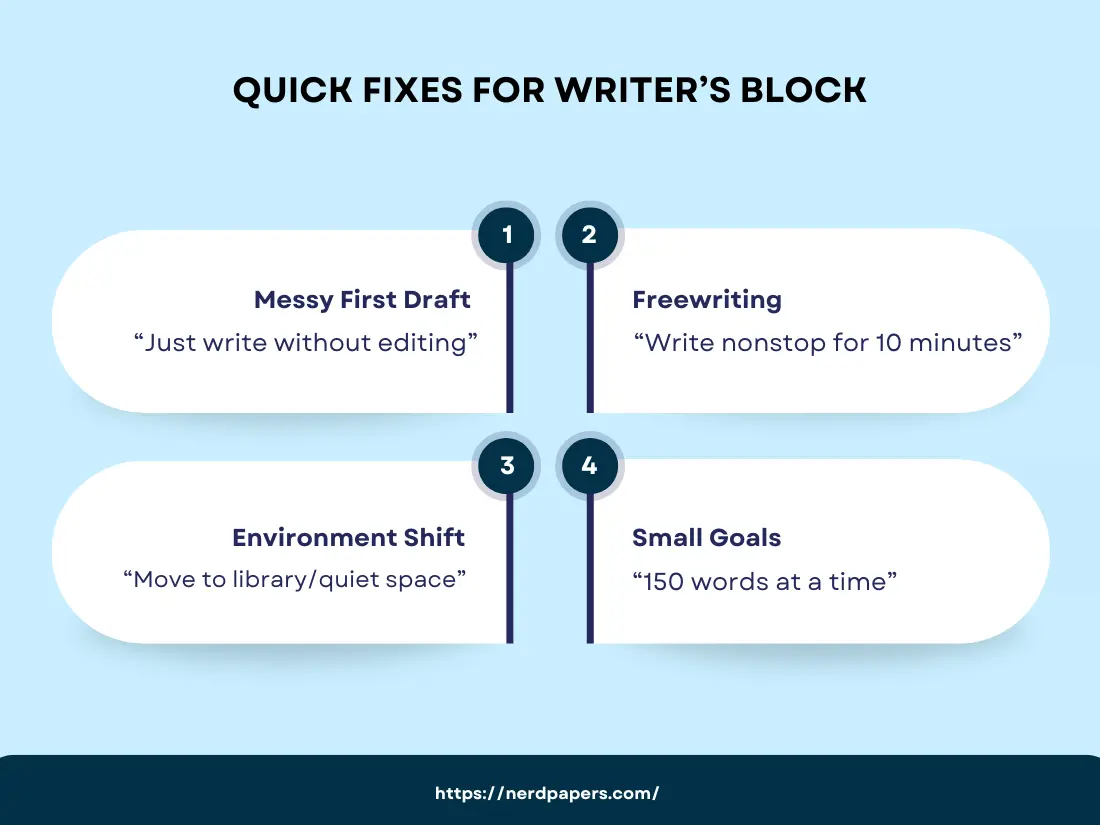
1. Use the “Messy First Draft” Method
Perfectionism is one of the most significant contributors to writer’s block. Students often pressure themselves to write their first draft as if it were the final version, which leads to endless hesitation over word choice or sentence structure. The “messy first draft” approach eliminates that pressure by allowing you to write without editing as you go. You permit yourself to produce something unpolished; the only goal is to get your ideas down in any form. Later, once the core ideas are on the page, you can refine, reorganise, and improve them without losing momentum.
2. Set Small, Achievable Writing Goals
Facing a significant assignment all at once can feel overwhelming, which often leads to procrastination. Instead of trying to write an entire essay in one sitting, break the task into smaller, manageable segments. For example, commit to writing just 150–200 words in one session or aim to complete only the introduction before taking a break. These mini-goals provide a sense of progress and help bypass the mental resistance that comes with tackling a big project all at once.
3. Try Freewriting to Unlock Ideas
Anxiety-free freewriting is a practice in which you set a timer for 5–10 minutes and write continuously on your topic without regard for grammar, spelling, or organization. Although the practice usually generates amazing connections and fresh ideas for your writing, your work could look disorganized or messy. It also silences the inner critic that stops ideas from flowing. This workout can be used as a warm-up to help you start any writing job.
4. Change Your Environment for a Mental Reset
A permanent workplace can subtly generate psychological challenges. Switching to a coffee shop, library, or even another room can help you feel better if you’ve been sitting in the same spot for hours or days. This change of scenery can free up distractions related to a specific location, spark creativity, and transform writing from labor into a pleasurable pastime.
5. Use Writing Prompts or Outlines to Jumpstart the Process
Sometimes writer’s block is due to not having an idea where to start. In that case, external writing suggestions or written outlines can be a good starting point. Even simple suggestions regarding your topic can get you past the initial obstacle of a blank page. Once you have a couple of sentences on paper, your ideas come more freely, and you can ride the wave of that early momentum.
6. Manage Stress and Energy Levels Before Writing
Stress, fatigue, and mental disorganization have a direct influence on your ability to focus. Preparing ahead of time with a little relaxation routine, such as a brief stroll, some stretches, or some deep breathing, will help quiet your mind. Similarly, eating, having a good glass of water, and getting enough sleep will help you work faster. Because writing is both physical and mental, your energy levels are more of a worry than most students realize.
Long-Term Habits to Prevent Writer’s Block
Maintain a Consistent Writing Schedule
Treat writing like any other regular commitment rather than something you do only when inspiration strikes. Setting a fixed time each day, whether it’s 30 minutes in the morning or an hour before bed, helps train your brain to enter “writing mode” more easily. Over time, this routine reduces resistance and makes writing feel like a natural part of your day.
Read Widely and Regularly
Exposure to different writing styles, topics, and perspectives can keep your creativity sharp. Reading beyond your preferred genre, such as essays, short stories, news articles, and even poetry, introduces you to new ways of expressing ideas. This variety not only expands your vocabulary but also inspires fresh approaches to your work.
Keep a “Idea Bank” or Creative Journal
Inspiration rarely arrives on demand, so having a dedicated place to capture sudden ideas is invaluable. Whether it’s a physical notebook or a notes app, jot down interesting phrases, potential topics, or thoughts that strike you during the day. When you sit down to write, you’ll have a ready-made pool of ideas to draw from instead of starting from scratch.
Set Realistic and Manageable Goals
Overly ambitious targets can be overwhelming and lead to procrastination. Instead, break larger writing projects into smaller, achievable tasks like completing an outline today, drafting one section tomorrow, and revising later in the week. This step-by-step approach keeps you moving forward without the pressure of perfection.
Prioritize Self-Care and Mental Well-Being
Writing is a mentally demanding activity, and a tired mind rarely produces excellent work. Adequate sleep, balanced meals, regular exercise, and breaks away from screens help keep your brain sharp. Stress management techniques such as mindfulness or breathing exercises also protect your creativity from being drained by burnout.
Create a Dedicated Writing Environment
Your surroundings influence your focus more than you might think. A clean, organized, and comfortable writing space signals to your brain that it’s time to concentrate. Minimize distractions by silencing unnecessary notifications, closing unrelated tabs, and keeping only the tools you need on your desk. Over time, your brain will associate that space with productivity.
Reflect and Adjust Your Writing Process
Every writer’s workflow evolves. Take note of when you write best, what environments help you focus, and which strategies keep you motivated. Regular self-assessment ensures you’re not stuck in unproductive patterns and allows you to refine your approach for long-term success.
Common Mistakes to Avoid When Facing Writer’s Block
Many students unknowingly make choices that intensify their writer’s block instead of reducing it. While these habits may seem harmless or even productive at first, they often create a cycle of mental exhaustion, stress, and frustration. By recognising these mistakes early, students can save themselves hours of wasted time and unnecessary anxiety.
1. Waiting for “Perfect Inspiration”
One of the most damaging habits is believing you must feel inspired before you start writing. Waiting for the perfect moment often means you don’t start at all, or you start too late. Inspiration is unpredictable; if you tie your productivity to it, your deadlines will suffer.
2. Over-Editing While Writing
Another common mistake is editing every sentence as soon as it’s typed. This perfectionist habit disrupts the writing flow, keeping students stuck in the first paragraph for hours.
3. Comparing Your Work to Others
Reading a classmate’s polished draft can be motivating, but for many, it sparks insecurity instead. Constantly comparing your progress to others can create self-doubt, which slows you down even further.
4. Avoiding the Work Entirely
When writer’s block hits, some students switch to “productive procrastination”, cleaning their room, reorganising notes, or checking social media, telling themselves they’ll “start in just a few minutes.” In reality, hours pass with no progress.
5. Pushing Through Exhaustion Without Rest
Students sometimes believe that working nonstop will “force” the words out. In truth, mental fatigue only worsens writer’s block, making it harder to think clearly.
6. Ignoring the Underlying Cause
Many students treat writer’s block as a random event, not realizing it’s often a symptom of deeper issues such as stress, unclear instructions, or lack of research. Ignoring these root causes means the block will keep returning.
Final Thoughts: Turning Writer’s Block into Writing Momentum
The beginning of fixing writer’s block is finding its underlying reasons when working on essays. Knowing if your block results from perfectionism, trouble concentrating, or mental fatigue helps you to choose treatments that are not just successful but also practical enough to fit your work style. The methods we have examined, task decomposition and segmenting the process of creating long-term writing habits into little phases, offer you tools you may customize to your taste. Writing is a process rather than a burst of inspiration. Work towards gradual progress, rather than aiming for ideal first drafts. Every sentence you write brings you nearer to the finishing point. Patience and persistence will carry you further than sitting around for the “perfect” moment to write, for no matter how small, progress is still progress.
FAQs About Writer’s Block in Essay Writing
What causes writer’s block in essay writing?
Writer’s block in academic essays is usually caused by perfectionism, unclear essay prompts, stress, poor time management, or lack of research. These issues create mental roadblocks that stop ideas from flowing naturally.
How can I overcome writer’s block in academic writing?
Start with small goals, use freewriting, and separate drafting from editing. Changing your environment, creating an outline, or using writing prompts can also help you break through the block.
Can procrastination cause writer’s block?
Yes. Procrastination is both a symptom and a cause of writer’s block. Delaying writing increases stress, which makes it harder to start, leading to a cycle of avoidance and rushed work.
What are quick strategies to beat writer’s block before an exam?
Use the “two-minute rule” (write for two minutes to get started), freewrite to spark ideas, or outline your main points quickly. Short bursts of focused effort often reduce anxiety and build momentum.
Can writer’s block be prevented?
Yes. Building long-term habits like keeping a consistent writing schedule, managing stress, and preparing clear outlines before drafting significantly lowers the chances of experiencing writer’s block.