
Why does essay writing feel effortless for some students but like a constant struggle for others? The truth is, writing an essay requires more than just ideas — it’s a mix of critical thinking, research, organization, and clear expression. When even one of these skills feels shaky, students run into the most common challenges in essay writing: misunderstanding the assignment, weak structure, time pressure, grammar mistakes, or lack of confidence.
The good news? These challenges are not permanent roadblocks. With the right strategies, you can overcome them and make essay writing less stressful and more rewarding. In this guide, we’ll explore the biggest problems students face when writing essays and break down practical solutions to help you:
- Understand essay requirements clearly
- Organize and structure your ideas
- Manage time effectively
- Improve grammar and vocabulary
- Strengthen research, editing, and proofreading skills
When students begin writing an essay, many of them face challenges along the way. By the end of this blog, you’ll not only recognize the obstacles that may be holding you back but also discover clear strategies to overcome them and write essays with confidence.
Why Students Find Essay Writing Challenging
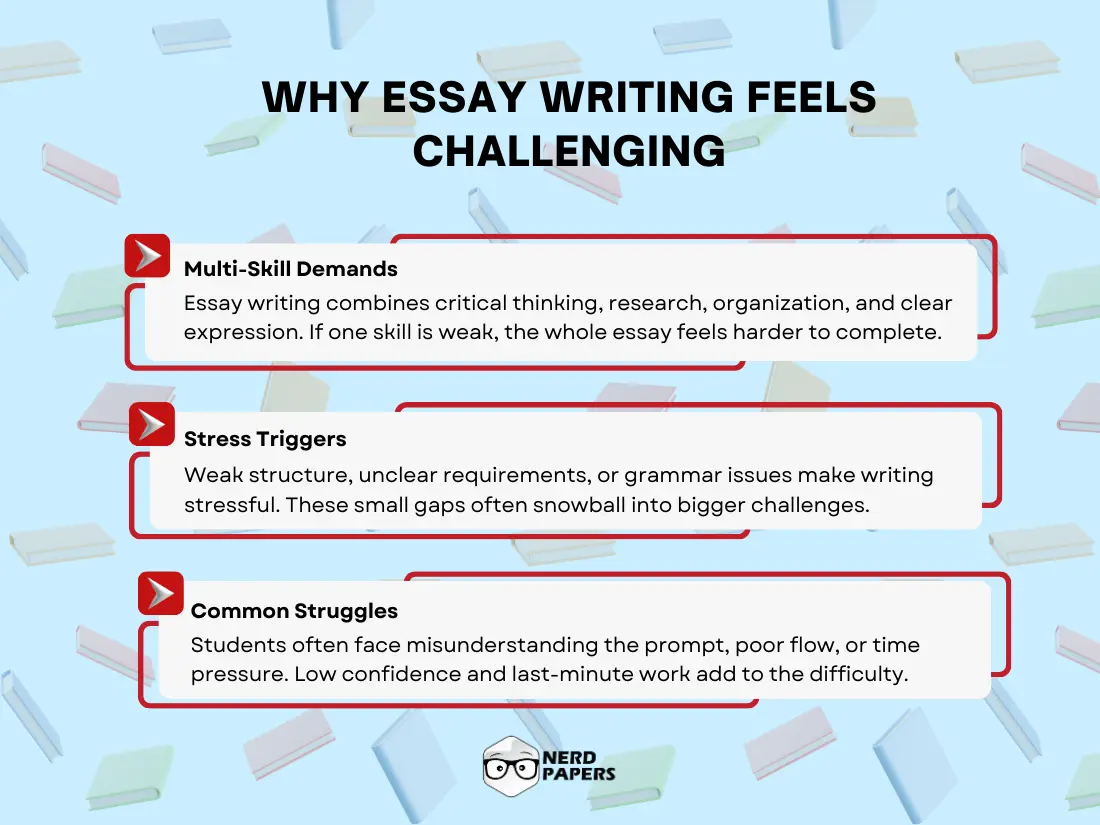
An essay is not just about writing; it is about planning, critical analysis, and effective use of communication skills. Any student who wants to enjoy the process ultimately gains and becomes a better person every time he or she composes an essay. To most learners, issues encountered in the process of writing an essay can be attributed to the existence of both academic, personal, and psychological challenges. Such problems usually have an impact on the readability, organization, and quality of the finished product.
Lack of proper understanding of the requirements of an assignment is one of the most common problems when it comes to essay writing. The lack of knowledge will result in poorly focused essays that fail to answer the main question or stay within the intended scope. In other instances, students may struggle to formulate and structure their ideas, leading to disjointed arguments or duplicated content.
Another issue that is of immense importance to the problem of writing an essay is time management. Last-minute-related procrastination causes frustration in completing the assignment due to tight deadlines, and as a consequence, it does not produce quality research, drafts, and proofreading. Such problems not only lower the essay’s quality but also increase stress, thereby making it more complex than necessary.
When students realize the root cause of these difficulties early, they will start implementing measures that will help the course of action become more productive, systematic, and controllable – issues we are going to address in the upcoming sections.
Common Problems in Essay Writing
Essay writing involves multiple skills, and students often face a variety of challenges that affect their ability to produce quality work. Understanding these common problems can help you identify areas to improve and develop strategies to write more effectively.
Lack of Writing Skills
Another reason many students struggle to write extensive essays is that they have difficulty organizing their thoughts effectively. The excessive use of filler words or the use of clichés may undermine the message of your writing and reduce the effectiveness of your arguments. One must learn how to be a good writer to present their ideas and keep the audience interested accurately.
Understanding Essay Requirements
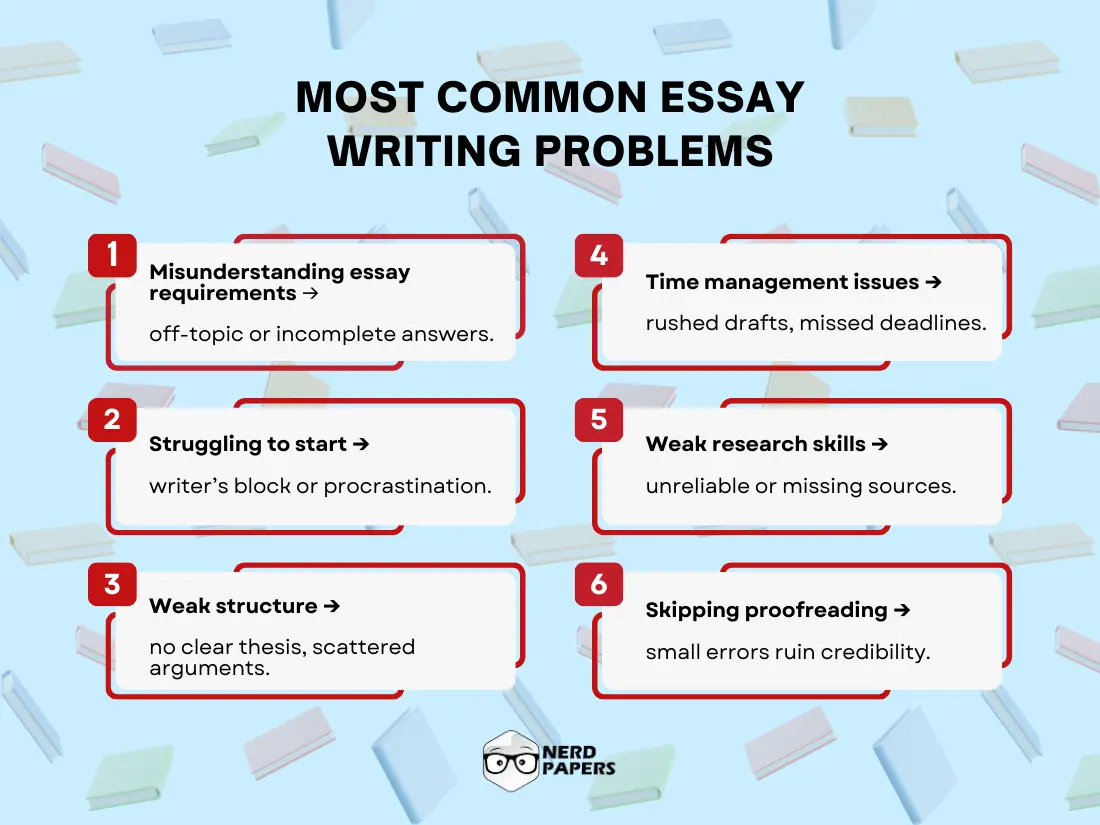
Failing to comprehend essay requirements thoroughly is one of the most common reasons students lose marks. This may occur in two respects:
Misinterpretation of prompts– Most students do not methodically break down the essay question, hence jumping to writing. To illustrate how this works, a prompt that seeks a critical analysis is not the same as a prompt that seeks a summary. There is a tendency to misinterpret the purpose, which sometimes leads to the contents failing to meet the instructor’s expectations.
Disregarding instructions on formatting style – Every institution or instructor might have their instructions regarding font style, sources, word count, and/or organization. Ignoring these minor details may result in unnecessary penalties, even if the content is otherwise suitable for the essay.
By spending time on analyzing the prompt and reading through the formatting instructions, you will keep your essay up to date, neat, and in line with the grading rubric.
Poor Grammar and Vocabulary
Repetitive grammatical errors will weaken your frame as an author, given that the stale language will fail to attract readers.
The use of vocabulary can be done such that the sentences become monotonous or challenging to understand. This could be done by acquiring the grammar regulations and expanding your vocabulary so that the essay is read easily. You would be in a position to alter the style and tone of writing to accommodate the issue.
Difficulty Starting an Essay
Many students struggle to begin writing, especially when faced with a blank page. This hesitation often comes from writer’s block in academic writing, which can make even the first sentence feel impossible. Procrastination worsens the problem, as delaying the start of an essay leaves less time for research, drafting, and editing, increasing stress in the process.
Structuring an Essay
An essay that is adequately organized will have a decent thesis along with coherent paragraphs. Without a compelling thesis, the focus of your essay can be lost, and any lack of organization in how the points in your paragraphs jump around can make the argument hard to follow. The most important thing that will help you to get your reader through your thoughts is to learn how to organize an essay. The selection of writing styles and adherence to proven rules help students develop a strong thesis, craft consistent paragraphs, and establish a precise flow throughout the essay, including the introduction and conclusion.
Time Management in Essay Writing
The failure to meet deadlines or poorly planned essays may be caused by procrastination. Over-recycling of a part may result in an underdevelopment of other areas. Time management is an essential part of essay writing that requires setting proper objectives and allocating time to each part of the process.
Lack of Research Skills
Not using reliable sources or citing the sources incorrectly may interfere with the credibility of your essay. Acquisition of good research expertise involves being able to locate trustworthy information sources and being able to apply citations, which are essential for the integrity of academic writing.
Editing and Proofreading Challenges
Even the most well-researched essay can fall short if it’s riddled with mistakes. Many students face editing and proofreading challenges that can undermine their hard work:
- Skipping the revision stage – Writing the final sentence and immediately submitting the paper is tempting, especially when deadlines are tight. However, without revisiting your work, you might miss inconsistencies in argument flow, unclear phrasing, or missing citations.
- Not spotting small but impactful errors – Typos, misplaced commas, or incorrect word usage might seem minor, but they can alter the meaning of a sentence and leave a poor impression on the reader.
A structured review process, ideally with breaks in between writing and editing, helps catch both major and minor issues, making your essay polished and professional.
How to Overcome Essay Writing Difficulties
Understanding the challenges students face is only the first step; applying effective strategies can transform essay writing from a daunting task into a manageable process. Below are practical ways to address everyday struggles and improve your skills.
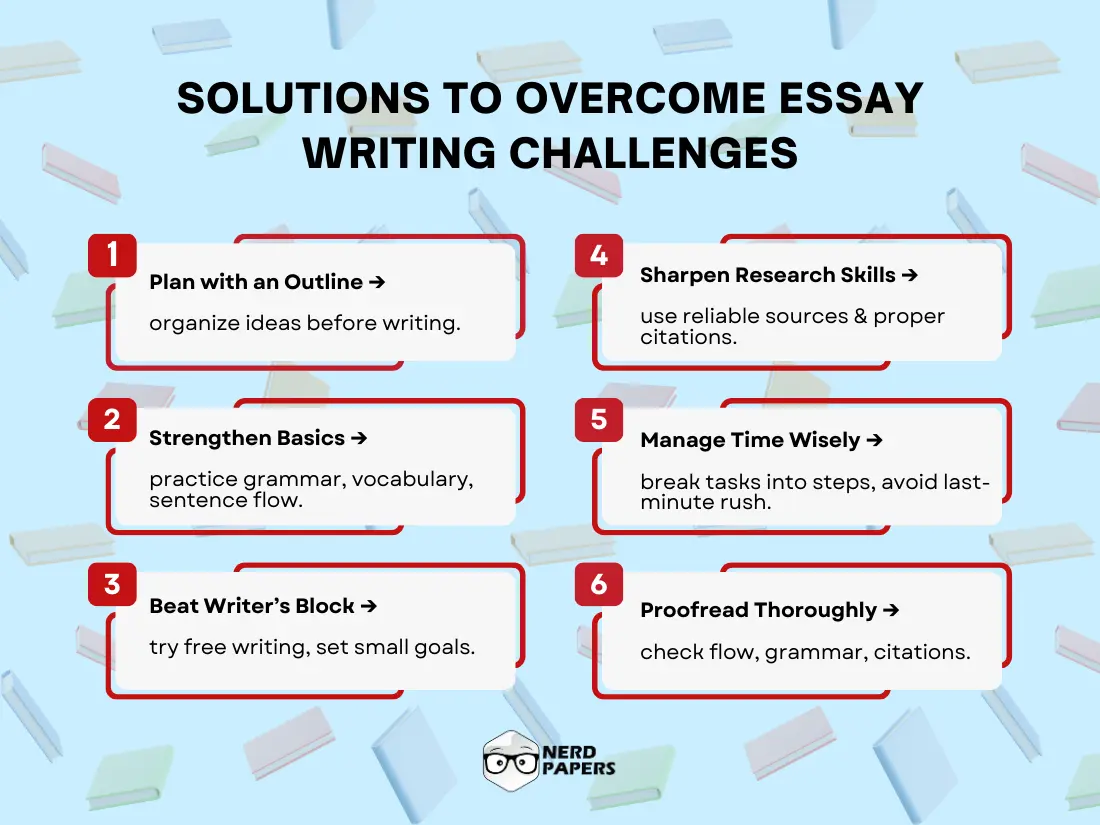
Develop a Clear Plan and Outline
With your essay, break it up into small, bite-sized pieces to lose any sense of overwhelm and keep on track with writing. Developing a frame that resembles the prompt provided with an assignment makes it more evident that every segment has a point and role. The strategy is particularly beneficial to learners who are puzzled about how to beat the challenges of writing essays by planning out their ideas beforehand.
Build Strong Writing Fundamentals
To have good grammar, a varied vocabulary, and extensive sentence work is an excellent way to write an essay. The most frequent causes that make students lose points are repetition of words or errors. To perfect these basics, reading and writing exercises should be carried out regularly, and any areas where an individual struggles, such as grammar or vocabulary, should be addressed. Such abilities can be acquired over time through reading, writing, and paying attention to exercises in daily life. These are some skills that must be reinforced to produce more precise and more convincing writing.
Overcome Writer’s Block
One of the impediments that may halt essay writing progress is writer’s block. Free writing, switching environments, or short writing objectives are some of the strategies that can be employed to jog the writer back into a writing rampage. It helps to be more creative and lessen anxiety. Understanding these techniques allows students to break through mental blocks and begin writing more confidently.
Improve Your Grammar and Vocabulary
Strong grammar and a rich vocabulary make your writing more straightforward, more persuasive, and more engaging. Here’s how to sharpen both:
- Use reading and writing exercises – Regularly reading high-quality articles, essays, and books exposes you to correct grammar usage and varied vocabulary. Pair this with daily writing practice, such as journaling or drafting short essays, to reinforce what you’ve learned.
- Leverage tools like Grammarly and Hemingway – Grammarly helps identify grammatical errors and suggests corrections, while Hemingway highlights overly complex sentences and passive voice. Using these tools consistently can speed up your improvement.
Over time, you’ll find that well-structured sentences and precise word choice will come naturally, making your essays stand out academically and stylistically.
Manage Time Effectively
Meeting deadlines on time, both during research and the writing stage, is what is called time management when it comes to essay writing. With focused effort and the help of a clock or calendar, saving time is not an issue. This will help you complete all tasks within the allotted time, allowing you to prepare your essays in advance without the last-minute rush.
Enhance Research Skills
Strong arguments are supported by reliable research. Developing the skill to recognize and correctly cite reliable sources is a new way to validate your arguments and uphold scholarly honesty. Improving these skills will lower issues when writing an essay on plagiarism or misinformation.
Edit and Proofread Thoroughly
The other important activity often neglected by students is editing. Most grammatical errors, incorrect phrasing, and lack of coherence can be attributed to inadequate proofreading. You can identify areas of struggle you would overlook if you read it aloud or have it read aloud to you.
Mistakes to Avoid in Essay Writing
When writing essays, even seasoned students might develop undesirable writing habits. Understanding the typical errors made when writing essays will help you create more impactful, unique, and focused work. Key dangers to avoid are as follows:
Over-generalizing arguments
The credibility of your article is weakened by generalizations devoid of supporting details. Instead of just stating, “Social media is bad for everyone,” help your claim with examples from studies and thoughtful viewpoints.
Plagiarism and over-reliance on quotes
Originality can be compromised by using too many direct quotes or by copying someone else’s work. To incorporate references while keeping your voice consistent, use paraphrasing and in-text citations.
Writing without an outline
Jumping straight into writing without a plan often leads to disorganized ideas and repetitive content. An outline helps structure your introduction, body, and conclusion logically, preventing common problems with writing essays.
Avoiding these mistakes ensures your essay is not only well-written but also credible and academically sound.
Final thoughts
The process of essay writing may seem complicated, yet the majority of barriers, starting with insufficient clarity and including structural problems, can be addressed through the proper attitude. Coming to know the most common errors in essay writing, which include over-generalizing arguments, overusing quotes, or foregoing the outline, you put yourself in a better position to write a more persuasive paper.
You have to remember that an effective essay is composed of preparation, critical analysis, and structure. Think of writing as something you can learn even as you get older, as opposed to a task. Perseverance and planning become the products of all write-ups, as every composition always proffers an improved one than the last one.
It is never an overstatement to practice, keep opening up to constructive criticism, and take any chance you find to practice your voice. The more you practice, the more comfortable and skilled you will become, and in due time, not so far in the future, writing quality essays will become second nature.
Frequently Asked Questions (FAQs)
What are the most common challenges in essay writing?
Some of the biggest challenges students face include misunderstanding essay requirements, weak structure, time management issues, poor grammar or vocabulary, lack of research skills, and skipping proper editing and proofreading.
Why do students struggle to understand essay requirements?
Many students misinterpret prompts or ignore formatting instructions. For example, a prompt asking for analysis might be treated like a summary, or specific guidelines on sources and word count may be overlooked — leading to lost marks.
How does poor grammar and vocabulary affect essay writing?
Weak grammar can make your ideas unclear, while limited vocabulary may cause repetition or confusion. Strong grammar and varied word choice help make essays more persuasive, clear, and engaging.
Why is time management important in essay writing?
Without proper planning, students often procrastinate and end up rushing essays. Poor time management reduces the quality of research, drafting, and proofreading — making the essay less polished and more stressful to complete.
How can I overcome writer’s block when starting an essay?
Writer’s block is common. Techniques like free writing, breaking tasks into smaller steps, or outlining ideas first can help. Creating a clear essay outline also makes it easier to get started and stay focused.
What role does research play in essay writing?
Good essays rely on credible sources. Poor research or incorrect citations can weaken arguments and reduce academic integrity. Strong research skills ensure your essay is both persuasive and trustworthy.
Why is structuring an essay such a challenge for students?
Without an outline, essays can lack flow or jump between points. A strong structure — with a clear thesis, organized body paragraphs, and a solid conclusion — keeps your ideas connected and easier for readers to follow.
How can editing and proofreading improve my essay?
Editing helps refine arguments and improve clarity, while proofreading catches grammar mistakes, typos, and missing citations. Skipping this step often leaves essays unpolished and less credible.
What are common mistakes to avoid in essay writing?
Typical mistakes include over-generalizing arguments, relying too much on quotes, writing without an outline, using filler words, and failing to check grammar or flow. Avoiding these can make your essay stronger and more focused.
How can students overcome the challenges of essay writing?
The best way is to break tasks into steps: analyze the prompt, create an outline, manage time effectively, build strong writing fundamentals, practice research, and leave enough time for editing. With practice, essays become less stressful and more rewarding.