
It’s not always easy to tell the difference between an argumentative and a persuasive essay. Don’t worry if you’re having trouble with either style for your next task. In this blog, you will understand everything you need to know about persuasive vs argumentative essays.
First, we will talk about the main points of argumentative and persuasive writing. Then, we discuss the best ways to start writing. You will also find a persuasive vs argumentative venn diagram to explore the key similarities and difference of persuasive vs argumentative essay writing. Whatever you’re writing, you should know your target audience. Keep reading this article to learn more about persuasive vs argumentative essay writing.
Argumentative vs Persuasive Essay Writing: Main Goals
In both argumentative and persuasive writing, you have to say what you think about a subject. But each time, you’ll use it in a different way. It should be clear to you what the goals are by looking at the words “argumentative” and “persuasive.” Let’s take a look.
In an argumentative essay, you only need to say what you think. But the people who read your information should also feel like they can trust it. Moreover, they don’t need to agree with you about this subject. The reader only has to agree with you that your point of view is interesting.
But the goal of a persuasive essay is to get people to agree with you. You want the reader to agree with your point of view as well as understand the facts.
For more information on the differences between the types of essays, you can look at persuasive essay examples. But remember that the more controversial your topic is, the less likely it is that the viewer will agree with you.
Tips on How to Begin Argumentative Writing vs Persuasive Writing
Most of the time, both types of writing are about the same thing. Before you even think about how to start a persuasive essay, pick a subject that interests you. The next step will be different for argumentative and persuasive writing.
It’s essential that you have all the information you need to make strong points and give good examples when you’re writing an arguing piece. This is why it’s so important to learn a lot about the field you’ve chosen. When you have all the facts, it’s easy to choose which side to back. You should never push a paper to agree with your point of view if you don’t have enough proof.
You get to pick a good persuasive essay topic and decide which side to support when you write a persuasive essay. The beginning is a little easier to understand.
Argumentative Essay vs Persuasive Essay: Writing Strategies
The dispute of argumentative vs persuasive writing gets interesting now. Following a generic persuasive essay outline is never sufficient while writing for college. You need to be aware of the subtle differences between these two writing styles if you want to earn that better grade.
Most of the reasons are both recent and significant and form the basis of most argumentative essays. The initial investigation begins here. Having the appropriate evidence and data from credible sources is crucial for an essay’s validity. When that happens, they’ll be able to see things from your perspective.
The use of supporting evidence is essential in persuasive essays, just like argumentative writing. Your work will be more convincing if it strikes an emotional chord with the reader. In addition, presenting opposing viewpoints is unnecessary. Having the reader agree with you is your goal.
Persuasive vs Argumentative Essay: Perspective & Topics
Opinion writing always starts with a view, claim, or stance. But because this is opinion writing, the subjects are debatable—people have different thoughts on what is right, fair, or best. And the guidelines say that the main difference between persuasive vs argumentative essay writing is whether or not different points of view are included.
| Persuasive | Argumentative |
| The author only talks about one side of a controversial subject. Even if the opposing view is mentioned, the piece is still seen as convincing because it doesn’t back up its claims with proof. | The author shows more than one side of a problem. This means that the writer not only says there is an alternative point of view but also adds several lines and paragraphs defending it. |
| To see persuasive writing clearly, picture a scale that isn’t balanced. | This can be shown visually as a scale that is more evenly balanced. |
Structure of Persuasive vs Argumentative Essay
A what-and-why format is used in all types of arguments, such as opinions, reviews, recommendations, persuasive letters, speeches, debates, arguments, and so on. The writer says what he thinks (usually his claim or view) at the beginning, and then he gives reasons for his thoughts in the body. The body of the paper is what makes the distinction between persuasive vs argumentative writing.
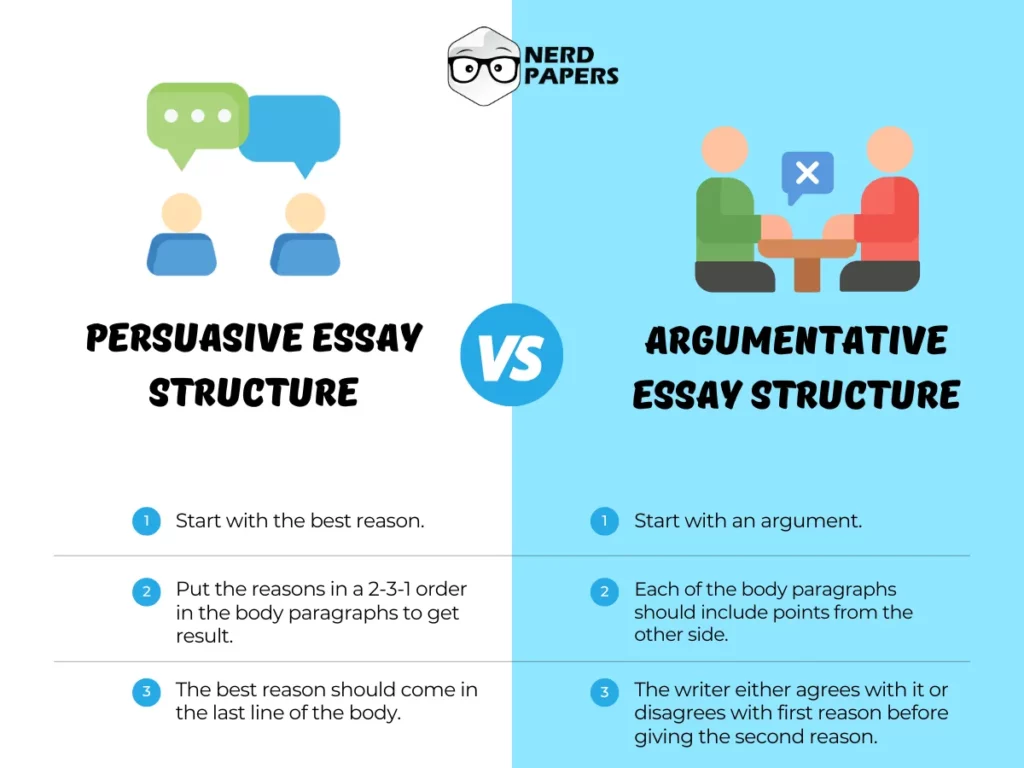
Persuasive Essay
According to traditional instruction, you should start with the best reason. In the end, though, this means that the reasons will become less strong.
It would be stronger to leave the reader wondering what the best reason is. Put the reasons in a 2-3-1 order to get this result.
Before you do anything else, you should rank the reasons and choose the best one. Which one do you think will connect with the crowd the most? That reason should come in the last line of the body.
Then, pick the least strong of the three reasons. The second-best reason should come first, and the best reason should be hidden in the middle.
Students can start with a good reason and save their best for last with this organization. Putting “the clincher” at the end of the last body line makes a strong transition to the conclusion.
Argumentative Essay
In this more complex type, there are also three or more reasons given in the body. However, adding the statement to an argumentative piece is harder than adding it to a persuasive piece.
Each of the body paragraphs should include points from the other side. After naming and going into more detail about one reason, the writer moves on to explain the other side’s point of view (e.g., But, On the other hand, etc.). The writer then either agrees with it or disagrees with it before giving the second reason. This “They Say/I Say” organization mixes the good and bad points of both points of view.
(HINT: Color code the two places to show this.)
Even though this is a more complex structure, it might be better to start by just developing the counterclaim in its own paragraph. Put this extra knowledge about the other side after the weakest reason but before the strongest one. This would change the structure to 2-3-CC-1.
While the structure of these essays differs, their similarities and differences can be summarized effectively through a visual representation. Let’s explore this comparison with an argumentative vs persuasive Venn diagram.
Visualizing the Differences – Persuasive vs Argumentative Venn Diagram
In academic writing, the main goal of both persuasive and argumentative essays is to convince their reader. But, they differ in their approach, tone, and writing process.
A Venn diagram is a visual tool that helps explain the differences while highlighting their commonalities and properties. Students who understand this comparison will be able to choose the best essay style for their audience and goal.
Learning about the commonalities and differences is very important because selecting the incorrect essay type can result in a misaligned essay outline, weakened arguments, and a loss of grades.
When trying to understand persuasive writing vs argumentative writing, it helps to compare them using a persuasive vs argumentative Venn diagram. Both styles aim to convince the reader of something, but they do it in slightly different ways. In persuasive writing, the focus is more on appealing to emotions and personal beliefs, while argumentative writing relies on facts, evidence, and logic to support its points.
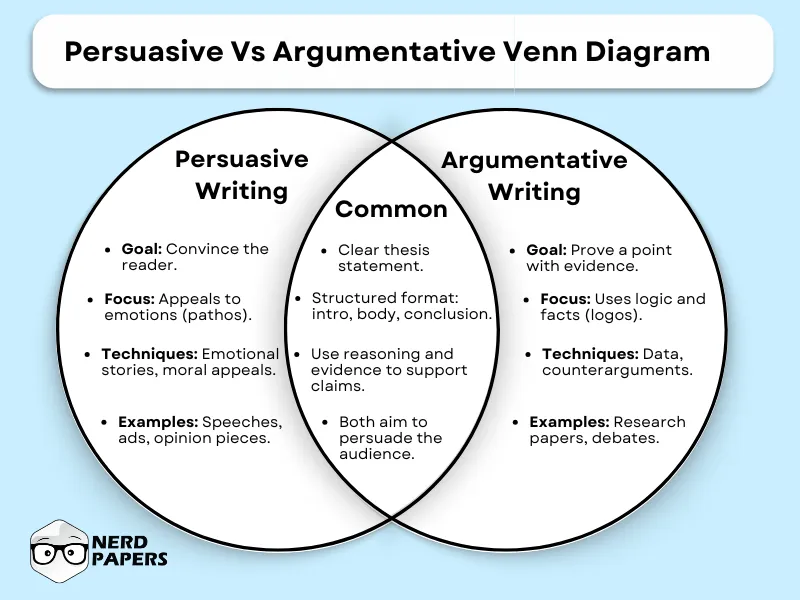
A difference between persuasive vs argumentative essay writing can be shown using the Venn diagram. It shows that persuasive writing tries to get the reader to agree with a point of view. In contrast, argumentative writing is more about presenting both sides of an issue before supporting one.
At the same time, similarities between persuasive vs argumentative essays can be highlighted using Venn diagrams. This highlights that both styles need clear reasoning and strong arguments. Comparing them visually through an argumentative vs persuasive Venn diagram can make it easier to see how they overlap and where they differ.
Pro Tip: Whether its persuasive or argumentative essay, always consider the context of your assignment or the expectations of your instructor.
Persuasive Essay vs Argumentative Writing: Point of View & Audience
A writer makes his writing that fits the audience or person he wants to read it. The level of seriousness of the writing is affected by the audience or readers.
If a writer uses first-person words like “I,” “me,” or “my,” it means that he or she knows the reader already. In this way, the writer and his view may become more personal. Third-person pronouns, on the other hand, keep the reader and writer apart, making the conversation official and between strangers.
Persuasive
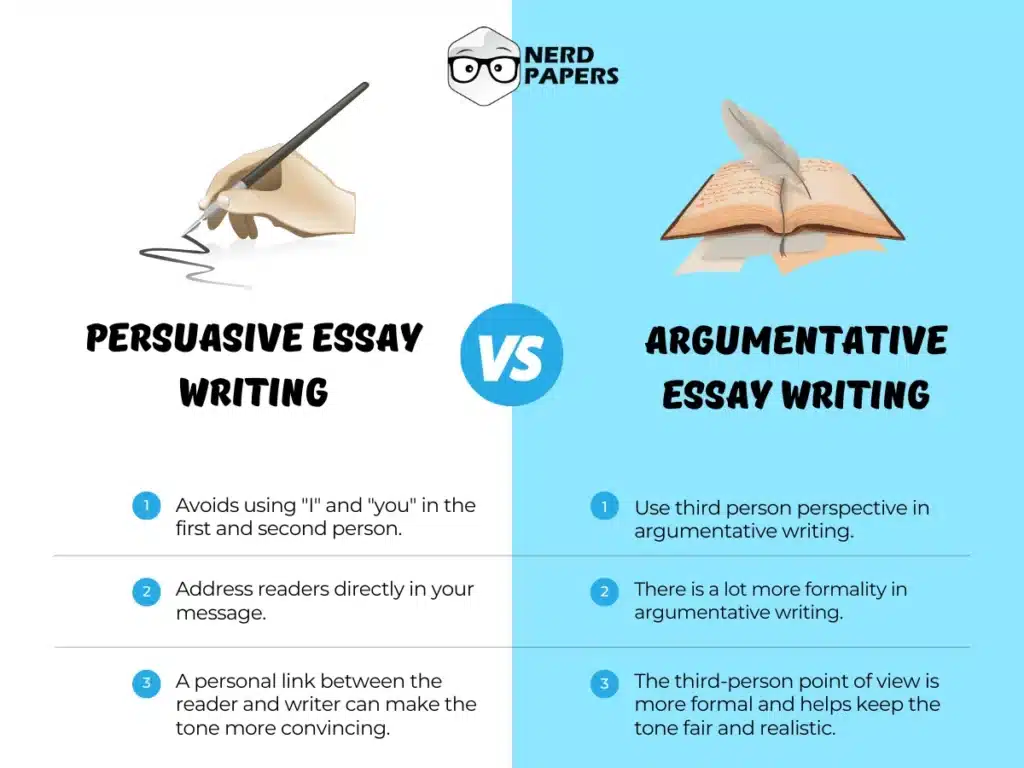
Persuasive writing avoids using “I” and “you” in the first and second person most of the time. But there are times when effective writing doesn’t follow this rule.
If you want to persuade a particular person or group, be sure to address them directly in your message. This could mean addressing the audience by name in the introduction or greeting and/or talking directly to the reader by saying “you” from time to time. Taking into account this personal link between reader and writer can actually make the tone more convincing.
Because of this, it’s not always wrong to use first- and second-person names in persuasive writing.
Argumentative
There is a lot more formality in argumentative writing. The writer and the reader don’t know each other. Because of this, third-person names are always used when writing it.
That being said, the author is giving his view, but he changes “I” to “supporters” and “opponents” to “you.” This choice of words is very important when writing about a problem that is controversial or up for debate and is already emotional for the writer.
The third-person point of view is more formal and helps keep the tone fair and realistic. At the same time, it puts the focus on the subject and not on how the writer or reader feels.
Persuasive Essay vs Argumentative Essay: Tone & Attitude
Teach your children not only what information to include in each body paragraph but also how to say it in a persuasive way rather than argumentative.
Persuasive
Voice is an essential part of persuasion, but writers also think about which emotional strategies will work best with their readers. For example, he might use an angry tone for one reason and a sympathetic tone for another. His last reason should make the reader feel driven and inspired.
Tip #1: Strong emotional arguments can help with persuasion, but a long list of passionate and passionate pleas is NOT enough to back up an opinion that doesn’t have proof (e.g., evidence, facts, data, and quotes).
Tip #2: It’s easy to get angry when you only talk about one side. But don’t say hurtful things about the other side, like “You’re stupid if you think…”
Argumentative
The lack of voice is not the problem with argumentative writing. Instead, the tone isn’t as emotional as the one-sided persuasive one.
By adding the counterclaim, the writer tries to show that he knows about the problem and is not biased in any way. This is meant to speak to the sceptical reader and change his mind in the end. Because of this, the writer keeps an objective tone by using his logical arguments supported by proof. The writer persuades the reader not with his or her feelings but with facts.
This part of argumentative writing is generally taught with more emphasis on ethos, pathos, and logos at the secondary level.
There are some differences between persuasive and argumentative writing, but there are also some similarities, like how the point is made and why it makes sense.
Position and Research
When writing an argument with more than one point of view or a persuasive piece with only one point of view, the writer always starts by studying the subject. He gets information from all sides. After looking into the problem and the evidence for each side, it aligns with the strongest position, the one that has the most evidence. After this, his claim or topic line comes next.
Reasons and Proof
The writer makes a list of facts from texts to help them figure out which side of an argument or persuasive piece is the best. All of these parts of the text could be used as proof by the writer, but none of them are the student’s own reasons.
In an argumentative or persuasive paper, the student needs to give reasons for why they believe what they do. All the information he got from the text came from other writers or sources. None of them come from his own thoughts.
So, a student has to put together a bunch of text details that are connected and come up with a category that they all fit into. That category or idea is a reason. After that, the grouping of textual information is used as proof.
The examples given by the college and career-ready standards show that persuasive writing vs argumentative writing is different in a number of ways. Because of this, it makes sense that, at the basic level, giving a one-sided argument is the norm. This is the basis for a future argument that will happen in middle school and high school. If a student can’t get the reader to see things from one point of view, it will be hard for him to do so when he has to show two.
Frequently Asked Questions (FAQs)
Q1: Is an argumentative essay the same as a persuasive essay?
Ans. Both are not exactly the same, but there are some similarities like research, position, evidence, etc.
Q2: What is the difference between argumentative and persuasive?
Ans. In an argumentative essay, we support our point of view with scientific research and facts. However, in a persuasive essay, we use emotions alongside facts to convince the reader. In an argumentative essay, the goal is not necessarily to persuade the audience but rather to demonstrate that our viewpoint is correct based on evidence.
Q3: How do you know if an essay is persuasive or argumentative?
Ans. Opinions are the foundation of persuasive writing. Argumentative writing is based on facts. Your students could be asked to write an argumentative paper that doesn’t need much or any study.
Q4: What is the difference between informative, persuasive and argumentative essays?
Ans. Informative writing is meant to teach, and the goal of persuasive writing is to persuade, while argumentative writing aims to persuade while also giving and arguing against counterarguments.
Q5: What is considered an argumentative essay?
Ans. The argumentative essay is a type of writing that asks students to research a subject, find, create, and assess evidence, and provide a clear position on the subject.
Q6: What is an example of a persuasive argument?
Ans. For instance, “The average worker cannot live on the hourly minimum wage”. The statement is likely true, but strong reasons should make a case for the positive. In other words, the thesis statement should talk about how the minimum wage of a dollar an hour is too low or not enough.