

Starting an argumentative essay can feel challenging, especially when you’re unsure how to begin. If you’re wondering how to start an argumentative essay, the key is to open with a hook, give brief background information, and present a clear thesis that outlines your stance. Writing a good introduction is an important part of you complete argumentative essay writing process. A strong introduction sets the tone for your entire essay and helps the reader understand what you’re arguing and why.
In this guide, you’ll learn exactly how to write an engaging introduction for an argumentative essay. We will also discuss the best ways to grab attention, provide context, and build a focused thesis statement. You’ll also find the examples, templates, and common mistakes to avoid so you can start confidently.
What Is an Argumentative Essay Introduction?
An argumentative essay introduction is the first paragraph of your essay where you grab the reader’s attention, explain the topic briefly, and present your main argument. It follows a simple structure: hook → background information → thesis statement, and sets up the direction of your entire essay.
The introduction helps the reader understand what issue you’re discussing, why it matters, and what stance you’re taking. A strong beginning makes your argument clearer, more persuasive, and easier to follow. Whether you’re writing a classroom assignment or a college-level essay, starting with a well-structured introduction is the key to building a solid argumentative foundation. But creating an outline for an argumentative essay is the first steps which begins before you start the argumentative essay. An outline guide your essay and make sure you do not got distracted by the other information.
The 3 Essential Parts of an Argumentative Essay Introduction
A strong argumentative essay introduction includes three key parts: a hook, background information, and a clear thesis statement. Together, these elements help you grab attention, explain the topic, and show the reader exactly what you’ll be arguing.
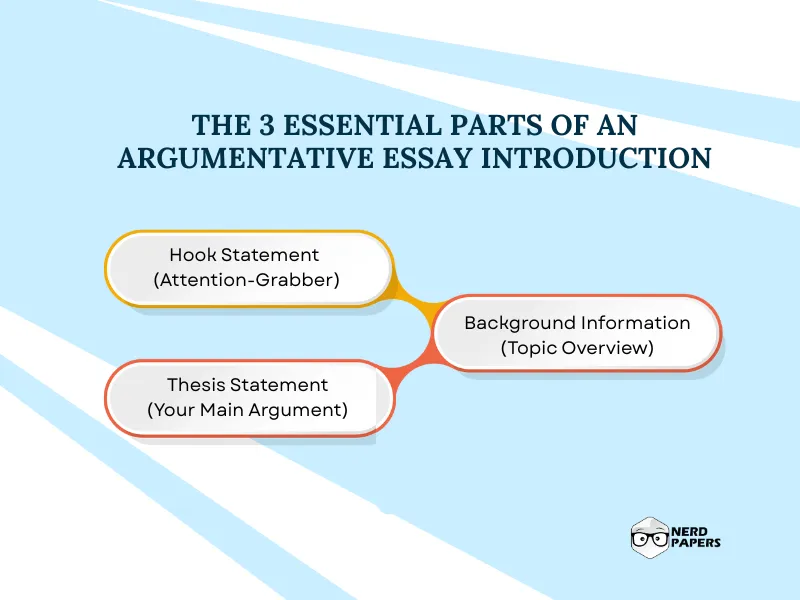
Hook Statement (Attention-Grabber)
The hook is the first 1–2 sentences of your introduction. Its purpose is to get your reader interested enough to keep reading. A good hook should be relevant to your topic and engaging without sounding dramatic or exaggerated.
Common hook types include:
- Statistic or fact: Start with a surprising or credible data point
- Question: Ask something that makes the reader think
- Quote: Use a meaningful line from a reputable source
- Anecdote: Share a short, relevant story or scenario
A strong hook sets the tone and opens the door to your argument.
Background Information (Topic Overview)
After your hook, add 2–3 sentences of background information to help the reader understand the issue. Background context should be short, factual, and directly connected to your argument.
Use this space to:
- Explain key terms or definitions
- Introduce the broader topic
- Mention why the issue matters
- Prepare the reader for your thesis
Avoid giving evidence or making claims here—that belongs in your body paragraphs. Your goal is to set up the topic clearly.
Thesis Statement (Your Main Argument)
Your thesis statement is the most important sentence in your introduction. It presents your stance on the issue and outlines the main argument you will defend in the essay. A strong thesis is:
- Clear: Easy for the reader to understand
- Debatable: Takes a real position, not a fact
- Specific: Shows exactly what you’ll discuss
- Focused: Avoids broad or vague claims
Place your thesis at the end of the introduction to create a smooth transition into your body paragraphs.
How to Start an Argumentative Essay: Step-by-Step Process
Starting an argumentative essay becomes much easier when you follow a clear, organized process. These steps guide you from understanding the assignment to crafting a strong introduction that includes a hook, background information, and a focused thesis. Whether you’re working on a rough draft or a polished final version, this method helps you build a solid foundation for your argument.
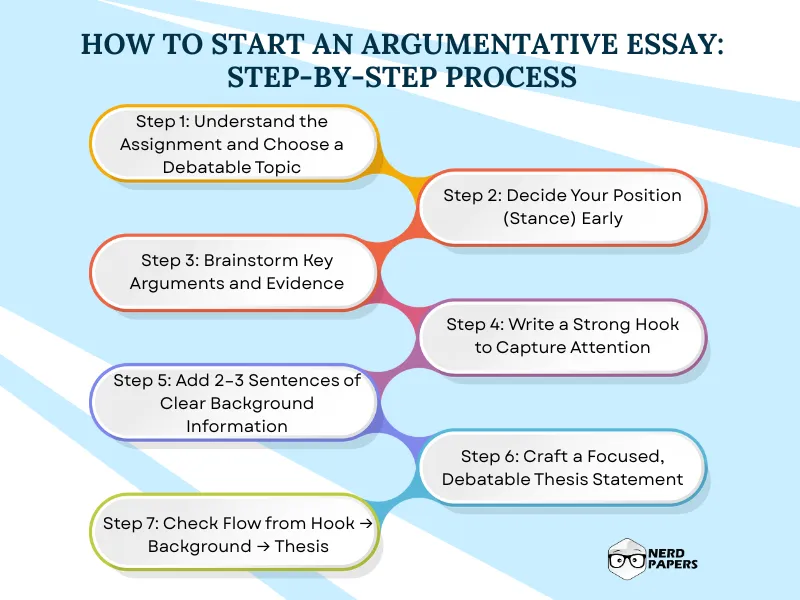
Step 1: Understand the Assignment and Choose a Debatable Topic
Before writing your introduction, make sure you fully understand the prompt. Identify what the question is asking, what issue you need to address, and whether you must argue for or against something.
Choose a topic that is debatable, meaning reasonable people can disagree. A strong argumentative essay always begins with a focused issue that has two or more sides.
Step 2: Decide Your Position (Stance) Early
Your introduction, and especially your thesis, depends on knowing your stance. Decide which side of the argument you support based on logic, evidence, or research.
Knowing your position early helps you write a clearer and more confident thesis.
Step 3: Brainstorm Key Arguments and Evidence
Before writing the introduction, think about the main reasons you support your stance and the evidence you might use. This planning helps you shape a thesis that is specific and defensible.
You do not need to include evidence in your introduction, but you should know the direction your argument will take.
Step 4: Write a Strong Hook to Capture Attention
Start your introduction with a hook that grabs the reader’s interest. Choose a type that fits your topic, statistic, question, quote, or short anecdote.
A good hook prepares the reader for your argument and sets the tone for your essay.
Step 5: Add 2–3 Sentences of Clear Background Information
Give the reader enough context to understand the issue.
Keep it brief and relevant by including:
- What the issue is about
- Why it’s important
- Any key terms or concepts they need to understand
Avoid turning this into a body paragraph. Save your arguments and evidence for later.
Step 6: Craft a Focused, Debatable Thesis Statement
End your introduction with a thesis that clearly states your stance.
A strong thesis:
- Takes a clear position
- Mentions the main argument or direction
- Sets up the structure of the essay
This one sentence guides your entire essay and shows the reader what to expect.
Step 7: Check the Flow from Hook → Background → Thesis
Read your introduction as a whole to make sure it flows logically.
Ask yourself:
- Does the hook connect to the topic?
- Does the background lead into the thesis?
- Is the thesis clear and specific?
A smooth, logical flow makes your introduction stronger and easier to understand.
How to Write a Strong Hook for an Argumentative Essay (With Examples)
A strong hook is the first step to starting an argumentative essay that captures attention and sets the right tone. The hook should be relevant to your topic, connected to your argument, and engaging enough to make the reader want to continue. The best hooks are clear, purposeful, and directly lead into your background information.
Below are four effective hook types you can use, along with examples you can easily adapt for your own topic.
1. Start With a Surprising Statistic or Fact
Using a credible statistic instantly adds authority and makes the reader curious.
When to use it:
- When your topic involves research, social issues, education, or public policies.
- When data can highlight the importance of your argument.
“Over 70% of high school students report feeling overwhelmed by academic stress, yet schools rarely offer mental health support.”
2. Ask a Thought-Provoking Question
A question encourages readers to think critically and engage with the topic.
When to use it:
- When your issue invites reflection or debate.
- When your goal is to challenge assumptions.
“If social media influences our opinions every day, how much control do we really have over our own beliefs?”
3. Use a Meaningful Quote
A strong, relevant quote can set the tone and connect your argument to a broader idea.
When to use it:
- When a well-known figure or expert supports your topic.
- When writing about ethics, society, or historical issues.
As George Orwell warned, ‘Freedom is the right to tell people what they do not want to hear.’
4. Share a Short, Relevant Anecdote
A brief story or scenario makes your topic relatable and personal.
When to use it:
- When writing about real-world issues, education, technology, or personal rights.
- When you want to build emotional connection.
Last year, a local school banned cell phones during class—and within weeks, student engagement increased dramatically.
How to Choose the Right Hook
- Match it to your topic (don’t force a quote or story).
- Keep it brief (1–2 sentences max).
- Make sure it leads naturally into your background information.
- Avoid overly dramatic or vague statements that weaken your credibility.
A well-crafted hook draws readers in and prepares them for the argument you are about to make.
How to Write Background Information in an Argumentative Essay
Background information is the part of your introduction that helps the reader understand the issue you are discussing. It comes directly after the hook and should give just enough context to explain the topic, its relevance, and any key terms or concepts needed to follow your argument.
The goal is to prepare the reader not overwhelm them. Background information should be brief, clear, and directly connected to your thesis.
What to Include in Background Information
Your background section should cover the essentials:
1. Topic Overview
Give a short explanation of what the issue is about. Example: “School uniforms have been debated for decades in both public and private institutions.”
2. Key Terms or Definitions (If Needed)
Define any important words or concepts that will appear in your argument. Example: “A ‘dress code’ refers to guidelines that limit clothing choices but do not require a specific uniform.”
3. Why the Issue Matters
Explain the relevance or significance of the topic. Example: “As schools try to balance safety, equality, and self-expression, the uniform debate has become increasingly important.”
What NOT to Include in Background Information
Avoid turning this into a mini body paragraph. Do not include:
- Evidence
- Examples
- Statistics (unless part of your hook)
- Separate arguments
- Counterarguments
- Emotional or biased language
All of these belong in the body, not the introduction.
How Long Should the Background Section Be?
Typically, 2–3 sentences is enough. It should bridge the gap between your hook and your thesis without adding unnecessary detail.
Background Information Example
Here’s a short sample you can model:
School uniforms have sparked debate for years, with educators and parents disagreeing about whether they promote equality or restrict individuality. As schools continue to search for ways to create safe and inclusive environments, the question of mandatory uniforms has become more relevant. Understanding both sides of this issue helps highlight why the uniform policy debate remains so important.
This example sets up the topic clearly and leads naturally into a thesis statement.
How to Write a Thesis Statement for an Argumentative Essay Introduction
The thesis statement is the most important sentence in your argumentative essay introduction. It presents your stance on the issue, outlines the main argument, and tells the reader exactly what to expect from the rest of your essay. A strong thesis is clear, specific, and debatable, meaning someone could reasonably disagree with it.
Your thesis should appear at the end of your introduction, right after the hook and background information. This placement creates a smooth transition into your body paragraphs.
What Makes a Strong Argumentative Thesis Statement?
A strong thesis has four qualities:
1. Clear Position (Stance)
It tells the reader exactly which side of the issue you support.
Weak: “School uniforms are an important topic today.”
Strong: “Schools should require uniforms to promote equality and reduce distractions.”
2. Debatable Claim
It must present an argument someone could challenge.
Weak: “Exercise is healthy for people.” (Not debatable)
Strong: “Schools should mandate daily physical education because it improves academic performance and mental health.”
3. Specific + Focused
Avoid vague or broad statements.
Weak: “Technology affects education.”
Strong: “Schools should limit smartphone use during class because it reduces focus and harms academic performance.”
4. Predictive Structure (Optional but Helpful)
It hints at the main points the essay will cover. Example: “Schools should adopt later start times because it improves student focus, reduces absenteeism, and supports healthier sleep patterns.”
Simple Formula for Writing a Thesis Statement
Use this easy structure:
👉 [Your stance] + because + [main reason 1], [main reason 2], and [main reason 3].
College athletes should receive financial compensation because they generate significant revenue, face demanding schedules, and risk serious injuries.
Examples of Strong Thesis Statements
Here are several you can model:
- Public schools should implement mandatory financial literacy programs because they prepare students for real-life responsibilities and reduce long-term financial mistakes.
- Social media platforms should enforce stricter age verification because younger audiences are vulnerable to harmful content, cyberbullying, and online manipulation.
- Online learning should remain an option for students because it provides flexibility, supports different learning styles, and increases access to education.
Each thesis takes a clear stance, is debatable, and sets the direction for the essay.
Full Examples: Sample Argumentative Essay Introductions
Here are three complete introduction examples showing how a strong hook, clear background information, and a focused thesis work together. You can use these as models when writing your own argumentative essay introduction.
Example 1: Statistic Hook
Hook: “Nearly 60% of teenagers report feeling pressure to present a perfect image online.”
Background: “With social media shaping everything from friendships to self-esteem, concerns about its effects on mental health have grown quickly. Many argue that platforms are not doing enough to protect young users.”
Thesis: “Social media companies should implement stricter content monitoring and mental health safeguards because teenagers are highly vulnerable to online pressure, misinformation, and emotional manipulation.”
Example 2: Question Hook
Hook: “If students learn math, science, and history in school, shouldn’t they also learn how to manage their own money?”
Background: “Financial literacy is often overlooked in traditional curriculum, leaving many young adults unprepared for real-life financial responsibilities. As debt and financial mistakes rise among young people, the issue has become more urgent.”
Thesis: “High schools should require financial literacy classes because they help students understand budgeting, reduce long-term debt, and build strong decision-making skills.”
Example 3: Anecdote Hook
Hook: “When Emma started her first year of college, she was shocked by how expensive textbooks, supplies, and basic living costs were.”
Background: “With tuition rising every year, more students are struggling to afford the essentials they need to succeed academically. Many must choose between working long hours and keeping up with school.”
Thesis: “Colleges should expand financial support programs because rising education costs create barriers to success, increase student stress, and limit equal opportunities.”
Common Mistakes When Starting an Argumentative Essay (and How to Fix Them)
Many students lose marks in the first paragraph of their argumentative essay because they start with the wrong tone, unnecessary details, or unclear ideas. Avoiding these mistakes will help you write a strong, focused introduction that sets up your argument effectively.
Here are the most common errors, and how to fix them.
1. Starting With a Dictionary Definition
Mistake: Opening with lines like “According to the dictionary, bullying means…” feels generic and unoriginal.
Fix: Use a hook that adds real value, such as a statistic, question, quote, or short anecdote.
2. Adding Too Much Background Information
Mistake: Some students turn their introduction into a mini essay with history, examples, or evidence.
Fix: Limit background to 2–3 sentences. Save detailed explanations and evidence for your body paragraphs.
3. Writing a Vague or Weak Thesis Statement
Mistake: A thesis like “School uniforms are important” is too broad and doesn’t show your stance.
Fix: Make your thesis clear, specific, and debatable. Example: “Schools should require uniforms to promote equality and reduce classroom distractions.”
4. Being Too Emotional or Biased
Mistake: Using dramatic language (“This is the worst thing ever!”) weakens your credibility.
Fix: Keep a formal, academic tone. Use logical reasoning instead of emotional appeal.
5. Jumping Straight Into Arguments or Evidence
Mistake: Including examples, statistics, or supporting points in the introduction confuses the structure.
Fix: Stick to the formula: hook → background → thesis. Arguments belong in the body paragraphs.
6. Writing Long, Unfocused Sentences
Mistake: Students often write wordy introductions that are hard to follow.
Fix: Keep sentences clear and concise. Each line should move the introduction forward.
7. Not Connecting the Hook to the Thesis
Mistake: A strong hook is useless if it doesn’t relate to your argument.
Fix: Choose a hook that naturally leads into your topic, then follow it with background information that builds toward your thesis.
Avoiding these mistakes will help you start your argumentative essay confidently and create an introduction that is clear, effective, and academically strong.
How to Start an Argumentative Essay: Quick Checklist for Students
Use this checklist to make sure your introduction is strong, clear, and ready for your reader. If you can check off each item, your argumentative essay intro is on the right track.
✔ Hook
- My introduction starts with a relevant, attention-grabbing hook.
- The hook matches my topic (statistic, question, quote, or anecdote).
- It is only 1–2 sentences long.
✔ Background Information
- I added 2–3 sentences of brief, clear background context.
- I explained what the issue is and why it matters.
- I avoided adding evidence, examples, or arguments here.
✔ Thesis Statement
- My thesis clearly states my stance on the topic.
- It is specific, debatable, and easy to understand.
- It appears at the end of the introduction.
- It gives the reader a clear direction for what comes next.
✔ Structure & Flow
- My introduction follows the formula: hook → background → thesis.
- Each sentence flows logically into the next.
- I avoided long, confusing sentences and emotional language.
✔ Relevance & Focus
- Everything in my introduction connects to the main argument.
- I did not include extra explanations, evidence, or unrelated details.
- My introduction prepares the reader for the body paragraphs.
This checklist helps you write an introduction that is strong, structured, and ready for an academic audience.
Conclusion
Starting an argumentative essay becomes much easier once you understand the simple structure behind a strong introduction. By opening with a clear hook, providing brief background context, and ending with a focused thesis statement, you set clear expectations for your reader from the very beginning.
That clarity doesn’t just help the body paragraphs, it also makes writing a strong conclusion easier. When your introduction clearly defines your argument, your conclusion can return to that same idea, reinforce your position, and leave the reader with a clear final takeaway.
If you want to understand how to close your argument effectively and bring your essay full circle, explore our guide on writing a strong argumentative essay conclusion.
Frequently Asked Questions
What is the best way to start an argumentative essay?
The best way to start an argumentative essay is with a strong hook, such as a statistic, question, quote, or short anecdote, followed by brief background information and a clear, debatable thesis statement.
How long should the introduction of an argumentative essay be?
An introduction is typically 10–15% of the total essay length. For a 1,000-word essay, your intro should be around 100–150 words.
Do I need a hook in an argumentative essay introduction?
Yes. A hook grabs the reader’s attention and sets the tone for your argument. It helps your introduction feel engaging and purposeful.
What should I include in the introduction of an argumentative essay?
Include three key parts:
Hook – grabs attention
Background information – explains the topic
Thesis statement – presents your stance
Should the thesis be at the beginning or end of the argumentative essay introduction?
Place the thesis at the end of your introduction. This creates a smooth transition into your body paragraphs and clearly signals your main argument.
Can I start an argumentative essay with a question?
Yes, using a thought-provoking question is an effective hook, as long as it connects to your topic and leads naturally into your background information.
Should I include evidence in the introduction?
No. Save evidence and examples for your body paragraphs. The introduction should only provide context and your main argument.
What mistakes should I avoid when starting an argumentative essay?
Avoid dictionary definitions, emotional language, vague claims, long introductions, and adding evidence too early. Stick to the formula: hook → background → thesis.