

At some point in college, nearly every student faces the classic argumentative essay assignment. It usually comes with a familiar challenge like choosing a position, organizing your thoughts, finding credible research, and then presenting everything in a way that actually makes sense. And while the task may feel intimidating at first, learning how to write an argumentative essay is one of the most valuable academic skills you’ll use beyond the classroom.
Argumentative writing isn’t about arguing for the sake of winning. It’s about forming a clear, well-supported claim and communicating it logically and respectfully. Strong arguments are based on logic, evidence, and structure rather than just subjective judgments or feelings. It makes no difference if you’re talking about social media usage, climate change, or educational policies.
Of course, some students prefer extra guidance, especially when deadlines stack up or the topic feels overwhelming. Getting help with argumentative essay writing online from our experienced Nerdwriters can provide clarity, direction, and breathing room.
For now, though, let’s break down the process step by step so you can approach your next argumentative essay with confidence, clarity, and a solid plan.
What Is an Argumentative Essay?
An argumentative essay is a structured piece of academic writing where you take a clear position on an issue and support it with credible evidence. The objective is to provide a rational, fact-based argument that a reasonable reader could accept rather than depending on subjective opinions or sentimental claims. In simpler terms, you are arguing and supporting a claim.
Argumentative essays and persuasive essays frequently get mixed up by students. Despite this, these two categories of essays differ partially. The goal of persuasive writing is to persuade readers, sometimes by appealing to their emotions. On the other hand, an argumentative essay places more emphasis on factual support, critical thinking, and fair analysis. It acknowledges multiple viewpoints, evaluates them, and then demonstrates why one perspective is stronger.
These assignments appear in high school, college, and even professional settings because they reflect real-world communication, from policy discussions to workplace proposals. When written effectively, an argumentative essay demonstrates your comprehension of the subject. It also shows your ability to assess the evidence, how you present a convincing case.
Why Argumentative Essays Matter in School (and Real Life)
The purpose of assigning argumentative essays is not merely to complete a syllabus. They assist students in acquiring transferable skills such as clear communication, logical conclusion building, and source evaluation. Research projects, presentations, workplace reports, and daily decision-making all require these skills.
Argumentative writing is valued in academic settings because it shows critical thinking. Rather than restating facts, you are analyzing them, challenging theories, and developing a well-reasoned opinion. That skill becomes especially important in college-level discussions, debates, and research-based courses.
Beyond the classroom, knowing how to construct a well-supported argument can influence proposals at work, advocate for community issues, or simply navigate conversations where opinions differ. In addition to writing the essay, listening, evaluating the facts, and politely responding are all crucial.
The Basic Structure (Nothing Complicated)
Most argumentative essays follow a structure designed to guide readers through your reasoning. The structure is usually the same: an introduction, multiple body paragraphs, a counterargument, and a conclusion. However, formats may differ depending on the instructor or discipline. This structure guarantees that your evidence makes sense and aids in the clear presentation of your position.
The introduction sets the stage by providing context and presenting your thesis. It is the central claim your essay will defend. The body paragraphs then develop that claim. Every body paragraph focuses on a particular idea that is backed up by analysis, examples, or research. Strong argumentative essays also include a counterargument to acknowledge different points of view. This shows that you have thought about alternative viewpoints before pointing out your stance. Lastly, the conclusion connects everything by restating the argument and highlighting its significance.
Think of structure as the framework that holds your ideas together. Once it’s in place, the writing process becomes far more manageable, and your readers can follow your thinking without confusion.
Approaches to Write an Argumentative Essay
Every argumentative essay employs a different approach. Depending on your topic, audience, and assignment requirements, you can better organize your reasoning by using different argumentative strategies. Toulmin, Classical, and Rogerian are the three most widely used methods.
Toulmin Method
The Toulmin approach is often used for analytical, research-heavy topics. Toulmin method breaks an argument into clear components: claim, evidence, and reasoning. It demonstrates how your ideas are logically supported by the facts. When a subject is complicated, multidimensional, or likely to provoke discussion, this approach is effective.
Classical Approach
The Classical model has its roots in ancient rhetoric. This aaproach has a simple format: introduce the topic, make your case, provide evidence to back it up, address the other side, and conclude. This format works well for a lot of college essays due to the fact that it is clear, structured, and straightforward for readers to understand.
Rogerian Approach
The Rogerian technique aims to find common ground. Instead of immediately taking a strong stance, the author recognizes the other position, demonstrates understanding, and then presents an alternate viewpoint. This approach is particularly effective for sensitive or emotionally charged subjects.
Understanding these approaches doesn’t mean you must choose one every time. Often, students blend elements from each, depending on the assignment and writing style. What matters most is clarity, logical support, and respect for differing viewpoints.
Steps on How to Write an Argumentative Essay
Writing an argumentative essay becomes far less overwhelming when you approach it in manageable stages. Each step builds on the previous one, helping you form a focused, well-supported argument rather than a collection of disconnected ideas.
Step 1 : Understand the Assignment
Before writing anything, review the instructions carefully. Analyze the submission requirements, including the needed length, formatting style, and quantity of sources. Lack of understanding of the prompt is one of the most common reasons for students to lose points.
Step 2: Choose a Debatable, Focused Topic
Select an issue with multiple reasonable viewpoints. Strong argumentative essays work best when the topic requires a detiled analysis and is not widely recognized.
Step 3: Conduct Credible Research
Check out reputable websites, books, and academic journals for proof. Take notes, record your sources, and search for patterns or persistent findings. Your essay’s strength will depend on the quality of the content you use.
Step 4: Develop a Clear Thesis Statement
One precise sentence should sum up your thesis. It directs the entire essay, so make sure it’s debatable, targeted, and backed up by the data you’ve gathered.
Step 5: Write the Introduction
Provide brief context, introduce the issue, and lead into your thesis. The goal is to prepare readers—not overwhelm them with details that belong later in the essay.
Step 6: Build Well-Supported Body Paragraphs
Each paragraph should center on one aspect of your thesis. Start with a topic statement, give evidence, talk about its importance, and then smoothly move on to the next point.
Step 7: Address a Counterargument
Demonstrating awareness of the opposing perspective adds credibility. Once you have acknowledged the other point of view, use reasoning or evidence to show that your position is still stronger.
Step 8: Write a Purposeful Conclusion
Reinforce your thesis, highlight key points, and leave readers with a final insight. A conclusion shouldn’t introduce new evidence. It should clarify why your argument matters.
Step 9: Revise, Proofread, and Cite Sources
Examine your essay’s language, flow, clarity, formatting, and citation accuracy. Reading aloud or pausing briefly before editing can help you identify issues that you previously missed.
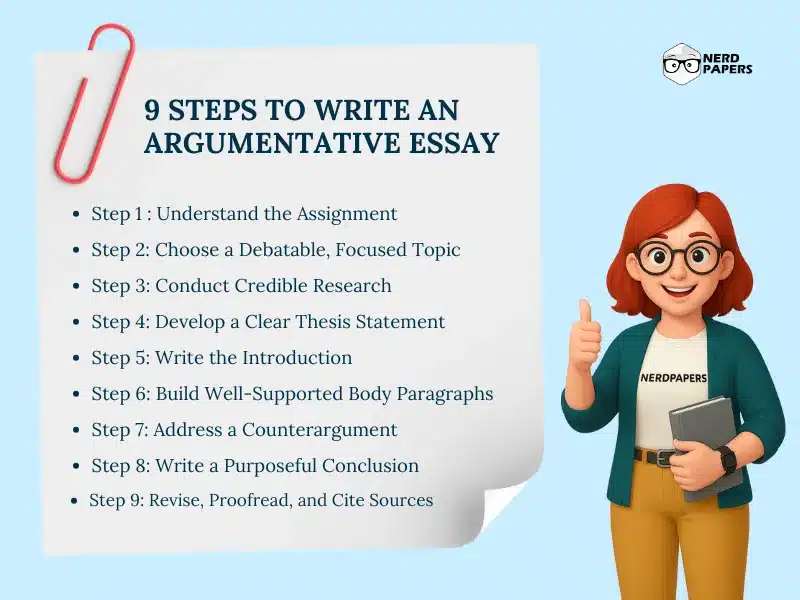
Following these steps doesn’t guarantee the perfect paper, but it does create a solid foundation for writing an argumentative essay that is organized, thoughtful, and academically sound.
Common Mistakes Students Make (And How to Avoide Them)
Even strong writers can lose clarity or credibility in an argumentative essay if they’re not careful. Being aware of common pitfalls makes it easier to avoid them—and produce a more impactful argument.
1. Relying on Opinions Instead of Evidence
Personal beliefs alone aren’t enough. Academic arguments need verified facts, research studies, statistics, or expert insights to be persuasive.
2. Choosing a Topic That’s Too Broad
Issues like “technology” or “education” are difficult to explore meaningfully in a single essay. Narrowing the focus leads to a stronger, more organized argument.
3. Ignoring the Opposing Perspective
A well-rounded essay acknowledges counterarguments. Addressing them respectfully shows you’ve considered the full conversation, not just one side.
4. Overloading Paragraphs With Information
Body paragraphs should focus on one clear idea at a time. Too many points at once can confuse readers and weaken your thesis support.
5. Using Emotional or Aggressive Language
Argumentative writing is logical, not confrontational. A calm, evidence-based tone is far more convincing than dramatic statements.
6. Forgetting to Cite Sources Properly
Incorrect or missing citations can affect credibility and academic integrity. Always follow the required format and credit your sources.
7. Revising Only for Grammar, Not Content
Editing should also include checking organization, transitions, clarity, and whether the argument actually answers the prompt.
Recognizing these mistakes early makes the writing process smoother and helps you submit a polished, well-developed essay.
Final Formatting, Clarity & Proofreading Tips
Once the writing is complete, refining the presentation of your argumentative essay is just as important as developing the argument itself. Strong ideas can lose impact if formatting or clarity distracts the reader.
Follow the Required Citation Style
Whether your instructor requests APA, MLA, or Chicago, apply the formatting consistently for title page, in-text citations, reference list, spacing, and headings. Proper documentation strengthens credibility and prevents plagiarism concerns.
Check for Flow and Transitions
Read your essay from start to finish to ensure that each paragraph flows naturally into the next. You can help the reader follow your argument by using clear subject sentences and transitional phrases.
Prioritize Clarity Over Complexity
Long, complicated sentences don’t automatically make writing stronger. If a sentence feels difficult to read aloud, simplify it. Academic writing should be precise, not overwhelming.
Verify Evidence Accuracy
Double-check statistics, quotations, and paraphrased information against original sources. Accuracy reinforces the reliability of your argument.
Read the Essay Out Loud
Hearing your writing can reveal awkward phrasing, grammatical errors, and gaps in logic that may be missed during silent reading.
Perform a Final Grammar and Spell Check
Tools like Grammarly can be helpful, but don’t rely solely on them. Pair digital proofreading with manual review for the best results.

A well-formatted, carefully reviewed essay demonstrates attention to detail—something instructors notice and appreciate.
Conclusion
Learning how to write an argumentative essay becomes much more manageable once you understand the purpose behind it presenting a clear position supported by logical reasoning and credible evidence. With careful research, a focused thesis, and organized paragraphs, you can guide readers through your perspective thoughtfully and confidently.
Like any academic skill, strong argumentative writing develops over time. The more you practice analyzing sources, addressing counterarguments, and refining your structure, the easier it becomes to express complex ideas clearly.
And if you ever feel stuck, pressed for time, or unsure whether your argument is fully developed, seeking guidance from experienced academic writers—such as the team at Nerdpapers—can provide clarity, feedback, and dependable support when you need it most.
Frequently Asked Questions
Do argumentative essays always require research?
Yes. Even if the topic feels familiar, strong argumentative essays rely on credible sources—statistics, studies, expert opinions—not just personal viewpoints.
How long should an argumentative essay be?
It depends on the assignment. High school essays may be 3–5 paragraphs, while college-level papers often range from 1,000 to 2,500 words. Always follow your instructor’s guidelines.
Can I use first-person (“I”) in an argumentative essay?
Some instructors allow it, others prefer third person. Check the rubric or ask for clarification. When in doubt, keep the focus on evidence rather than personal experience.
Do I have to include a counterargument?
Yes—most academic argumentative essays expect one. Addressing the opposing perspective strengthens your credibility and shows balanced reasoning.
What makes a strong thesis statement?
A clear, specific, arguable claim supported by evidence. It should tell readers exactly what position you’re taking and what your essay will prove.
Can emotional appeals be used in an argumentative essay?
Occasionally, but sparingly. Logical reasoning and factual evidence should be the foundation of your argument.
How many sources should I use when writing my argumentative essay?
Assignments vary, but most college essays require at least three to five credible sources. Quality matters more than quantity.
What if I’m struggling to organize my ideas during argumentative essay writing?
Create a simple outline, focus on one point per paragraph, and revise after drafting. If needed, academic writing support—like Nerdpapers—can help you structure and refine your essay.