

Writing a strong argumentative essay conclusion is just as important as crafting a clear thesis or presenting solid evidence. The conclusion of your argumentative essay is where you bring your ideas together, restate your position, and show the reader why your argument truly matters.
In an argumentative essay, the conclusion does more than “end the paper.” It reminds the reader of your main claim, reinforces the logic behind it, and leaves them with a final, confident takeaway. A well-written conclusion helps your entire argumentative essay feel complete, purposeful, and persuasive.
In this guide, you’ll learn exactly how to write a clear and effective argumentative essay conclusion, including structure, steps, templates, sentence starters, and real examples. And if you want to see how the conclusion fits into the bigger picture of planning and shaping your argument, our full guide on how to write an argumentative essay walks through the entire writing process from start to finish.
What Is an Argumentative Essay Conclusion? (Quick Definition)
An argumentative essay conclusion is the final paragraph of your essay. This paragraph restates your thesis, summarizes your main claims, and shows why your argument matters. Its purpose is to reinforce your position, tie your ideas together, and leave the reader with a clear, confident understanding of your overall point.
Purpose of a Conclusion in an Argumentative Essay
The conclusion of an argumentative essay does more than summarize your writing. It strengthens your position and shows the reader why your argument matters. A strong conclusion helps your argumentative essay feel complete, logical, and persuasive. Here are the key purposes it serves:
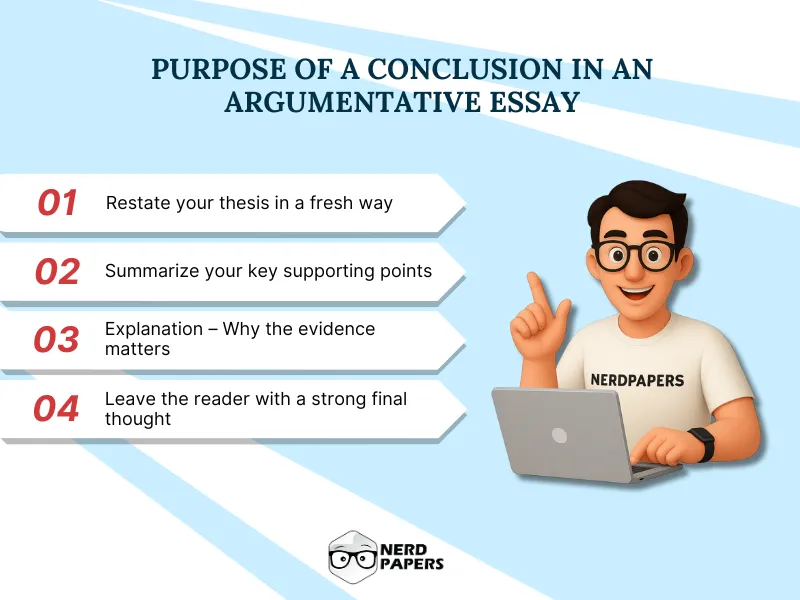
1. Restate your thesis in a fresh way
The conclusion revisits your main claim without repeating it word-for-word. This reminds the reader of your central argument while showing how your reasoning has developed.
2. Summarize your key supporting points
Briefly highlight the main evidence and reasoning you used. This helps reinforce the strength of your argument and ties the body paragraphs together.
3. Explain the significance of your argument
A good conclusion answers the question, “So what?” It shows why your claim matters, how it impacts the issue, or why the reader should care.
4. Leave the reader with a strong final thought
Your closing statement can offer a concluding insight, a broader implication, or a call for further thinking. It should feel confident and purposeful.
How to Write a Conclusion for an Argumentative Essay (Step-by-Step Process)
A strong argumentative essay conclusion follows a clear structure. These steps help you wrap up your argument with clarity and confidence while reinforcing the strength of your position.
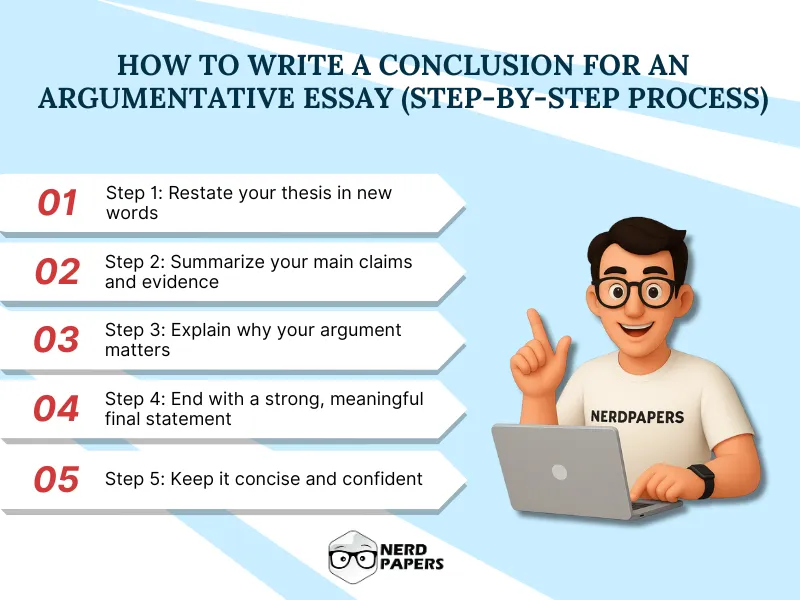
Step 1: Restate your thesis in new words
Start by rephrasing your main argument without repeating the original thesis exactly. This reminds the reader of your claim in a fresh, more developed way.
Original thesis: “School uniforms limit students’ self-expression.”
Restated: “Mandatory uniforms restrict students’ ability to express their individuality.”
Step 2: Summarize your main claims and evidence
Briefly recap the key points you argued. This should feel like a quick highlight reel but not a full repetition of your body paragraphs.
The financial burden on families, the lack of impact on academic performance, and the restriction of identity all show why uniforms are not an effective solution.
Step 3: Explain why your argument matters
Answer the “So what?” of your essay. Show the broader impact, real-world importance, or implications of your claim.
When students can express themselves freely, they build confidence and develop stronger social identities.
Step 4: End with a strong, meaningful final statement
Your last sentence should leave the reader with a clear takeaway. It can be an insight, a prediction, or a thoughtful reflection. However, it must be connected to your argument.
Schools should prioritize policies that support individuality rather than restrict it.
Step 5: Keep it concise and confident
Your conclusion shouldn’t introduce new evidence or become overly long. Aim for clarity, confidence, and cohesion in just a few focused sentences.
Argumentative Essay Conclusion Structure (Simple Template)
A strong argumentative essay conclusion follows a predictable, easy-to-follow structure. This format helps you restate your main claim, reinforce your reasoning, and end with a meaningful final thought.
Basic Structure
- Restate your thesis in new words
- Summarize your key arguments
- Explain the importance of your position
- End with a strong concluding insight
This structure works for high school, college, and advanced academic writing.
Sample Template (Ready to Use)
- Thesis Restatement: Rewrite your thesis using different wording to remind the reader of your main argument.
- Summary of Key Points: Briefly restate the most important claims and the evidence that supports them.
- Significance: Explain why the argument matters or what the reader should understand from your position.
- Final Insight: End with a confident, thoughtful final statement that reinforces your claim.
Fill-in-the-Blank Template
Restated Thesis: Ultimately, the evidence shows that __________ because __________.
Supporting Points Summary: Throughout the essay, it becomes clear that __________, __________, and __________ support this position.
Significance: This issue matters because __________.
Final Insight: For these reasons, __________ remains the most reasonable and impactful conclusion.
How to Start a Conclusion Paragraph for an Argumentative Essay
The start of your conclusion sets the tone for the entire final paragraph. Instead of repeating your thesis right away, begin with a strong, smooth transition that signals to the reader that you are wrapping up your argument with confidence.
Strong Ways to Start a Conclusion Paragraph
Use transition phrases that sound natural while clearly shifting toward the end of your essay.
Effective starters include:
- “Ultimately,”
- “Overall,”
- “The evidence clearly shows that…”
- “Taking everything into account…”
- “Given these points…”
- “When considering all the arguments…”
- “These findings make it clear that…”
- “As shown throughout this essay…”
These phrases smoothly prepare the reader for your final argument without sounding repetitive.
How to Write a Strong Opening Sentence of the Conclusion
A good opening sentence of a conclusion should:
- Transition into your final thoughts
- Reconnect with your thesis
- Set up your restated claim
- Maintain a confident and academic tone
Overall, the evidence demonstrates that renewable energy is the most practical long-term solution for reducing global emissions.
What NOT to Start your Argumentative Essay Conclusion With
Avoid weak or overly common phrases that feel mechanical or outdated:
- “In conclusion,”
- “To sum up,”
- “In summary,”
- “As stated above,”
- “As mentioned earlier,”
While not grammatically wrong, these phrases often feel too generic for academic writing.
What Should Be Included in the Conclusion of an Argumentative Essay?
A strong argumentative essay conclusion contains four essential elements. Together, these pieces help reinforce your position and bring your ideas together in a clear, meaningful way.
1. A Restated Thesis (in new words): Your conclusion should begin by revisiting your main claim without repeating your original thesis word-for-word. This shows how your argument has developed throughout the essay.
2. A Summary of Your Key Arguments: Briefly highlight the main points and evidence you used to support your claim. This recap reminds the reader of the strength and logic behind your argument.
3. The Significance of Your Argument: Explain why your position matters. This may include broader implications, real-world importance, or what the reader should understand after considering your points.
4. A Clear and Confident Final Insight: End with a strong, purposeful closing statement. This might be a final reflection, a broader conclusion about the issue, or a thought-provoking idea that reinforces your stance.
Each of these components plays a specific role in tying your argument together and helping the reader walk away with a clear understanding of your perspective.
What NOT to Include in an Argumentative Essay Conclusion
A strong conclusion reinforces your argument — it doesn’t introduce new ideas or distract the reader. To keep your ending clear, persuasive, and academically appropriate, avoid the following common mistakes.
1. New Evidence or New Arguments: Your conclusion is not the place to bring in fresh statistics, examples, or claims. Introducing new information confuses the reader and weakens the final impact of your essay.
2. Repeating Your Thesis or Points Word-for-Word: Restating your thesis is important, but copying sentences directly from the introduction of your argumentative essay or body makes your conclusion feel repetitive. Use new wording to show growth in your argument.
3. Emotional or Dramatic Statements: Avoid overly emotional appeals, exaggerated claims, or dramatic conclusions. Argumentative essays rely on logic and evidence, not emotion.
4. Unrelated Thoughts or Off-Topic Ideas: Do not include personal stories, random opinions, or unrelated facts. Everything in your conclusion should directly support your main claim.
5. Weak or Uncertain Language: Phrases like “I think,” “maybe,” or “it could be argued” weaken your argument. Your conclusion should sound confident and clear.
6. Apologies or Self-Doubt: Avoid statements like “This might not cover everything” or “I’m not an expert.” These undermine the strength of your argument and your essay.
7. Overly Long Explanations: A conclusion should be concise. Long explanations, repeated evidence, or unnecessary details disrupt the flow and reduce the reader’s impact.
Argumentative Essay Conclusion Examples
Seeing real examples is one of the easiest ways to understand how a strong argumentative essay conclusion works. Below are short, medium, and full-length examples you can use as models for your own writing. Each one follows the standard structure: restated thesis → summary of points → significance → final insight.
A. Short Conclusion Examples (2–3 Sentences)
Overall, the evidence shows that school uniforms limit students’ individuality and place unnecessary financial pressure on families. Because they do not improve academic performance or behavior, mandatory uniforms are not an effective policy. Schools should instead support environments that encourage self-expression.
Taken together, the research makes it clear that social media has a measurable impact on teen mental health. While it can offer community, the risks connected to comparison, anxiety, and pressure are significant. Teens need stronger digital literacy education to navigate these challenges.
The facts demonstrate that renewable energy is the most practical path toward reducing global emissions. Fossil fuels are simply not sustainable for long-term use. Prioritizing clean energy ensures a healthier, more stable future.
B. Full Paragraph Examples
Ultimately, the argument for integrating technology into classrooms is supported by its ability to personalize learning, increase student engagement, and prepare learners for a digital future. These advantages show that technology is not a distraction but a powerful tool for academic growth. Schools that adopt balanced, well-designed tech programs will create stronger and more adaptable learners.
The evidence clearly demonstrates that banning single-use plastics is a necessary step toward reducing pollution. From harming marine ecosystems to contributing to overflowing landfills, these materials create long-lasting damage. By transitioning to reusable alternatives and enforcing stricter waste policies, communities can protect the environment and move toward a more sustainable future.
C. Weak vs. Strong Conclusion Comparison
Weak Conclusion
In conclusion, pollution is bad, and we should try to fix it. Everyone should care more about the environment. That’s why pollution should stop.
Why It’s Weak:
- Too vague
- No thesis restatement
- No evidence summary
- Overly emotional
- No meaningful final insight
Strong Conclusion
Overall, the evidence shows that reducing pollution requires coordinated action in waste management, energy use, and public policy. These measures not only protect natural ecosystems but also support long-term public health. Addressing pollution today ensures a safer and more sustainable world for future generations.
Conclusion Paragraph Starters & Transition Words
The right transition words can make your argumentative essay conclusion smoother, clearer, and more powerful. These starters help signal to the reader that you’re wrapping up your ideas, without sounding repetitive or overly formal.
Below are categorized lists you can use in any conclusion.
A. Strong & Academic Conclusion Starters
- “Overall,”
- “Ultimately,”
- “Clearly,”
- “Taking everything into account,”
- “Given these points,”
- “As the evidence shows,”
- “In light of the presented arguments,”
- “When considering the key findings,”
- “The research demonstrates that…”
These starters help you reaffirm your thesis with confidence.
B. Cause-and-Effect Conclusion Starters
Ideal when your essay shows how one idea leads to another.
- “As a result,”
- “Therefore,”
- “Because of this,”
- “For this reason,”
- “Consequently,”
- “This evidence confirms that…”
C. Future-Focused Conclusion Starters
Best when your argument connects to long-term impact or future outcomes.
- “Moving forward,”
- “In the future,”
- “If these trends continue,”
- “Looking ahead,”
- “This will continue to shape…”
D. Insight or Reflection-Based Starters
Useful when your conclusion highlights importance or significance.
- “This issue highlights the need for…”
- “These points illustrate why…”
- “This analysis makes it clear that…”
- “The broader implication is…”
What to Avoid
While phrases like “In conclusion” and “To summarize” are common. They can feel repetitive or outdated in academic writing. It’s better to use more natural academic transitions that guide the reader smoothly into your final argument.
Argumentative Essay Conclusion Outline (Full Blueprint)
A strong argumentative essay conclusion follows a predictable structure. This outline helps you restate your argument, reinforce your reasoning, and end with a confident final thought . It helps you cover all the points without repeating your introduction or adding new information.
A. Simple 4-Part Conclusion Outline
- Restated Thesis
- Rewrite your main claim using fresh wording.
- Summary of Key Points
- Briefly recap the main arguments or evidence.
- Significance of the Argument
- Explain why the argument matters or what it shows.
- Final Insight
- End with a strong, clear, meaningful closing statement.
This basic outline works for any argumentative essay, from high school to college level.
B. Expanded Conclusion Outline (Detailed Blueprint)
1. Transition + Restated Thesis
- Begin with a smooth transition word.
- Rephrase your thesis to reflect the development of your argument.
Ultimately, the evidence makes it clear that…
2. Recap of Main Arguments
Summarize the strongest points from your body paragraphs:
- Claim 1 + brief reasoning
- Claim 2 + brief reasoning
- Claim 3 + brief reasoning
This should feel like a high-level summary, not a repeat of each paragraph.
3. Explain the Importance (The “So What?”)
Show why the issue matters by highlighting:
- Real-world impact
- Broader implications
- Why your conclusion makes sense
- What readers should take away
This is where your essay gains depth and relevance.
4. Final Concluding Insight
End with a strong, confident sentence that reinforces your argument:
- Final reflection
- Insight or broader takeaway
- Future impact or next steps
- Meaningful closing idea
Avoid emotional appeals or new arguments. Keep it logical and concise.
Conclusion Templates for Argumentative Essays
Using a template can make writing a strong conclusion much easier. Below are several templates you can use depending on the tone, assignment type, or academic level of your argumentative essay.
A. Basic Argumentative Essay Conclusion Template (Beginner-Friendly)
Restated Thesis: Ultimately, the evidence shows that [restate your thesis].
Summary of Key Points: Throughout the essay, the arguments about [point 1], [point 2], and [point 3] support this position.
Significance: This issue matters because [explain why your argument is important].
Final Insight: For these reasons, [strong final takeaway].
B. Academic / College-Level Conclusion Template
Restated Thesis: When considering the evidence as a whole, it becomes clear that [restate thesis in advanced language].
Summary: The claims related to [point 1], supported by [evidence type], along with [point 2] and [point 3], demonstrate the strength of this argument.
Significance: These findings highlight the broader implications of [topic] on [context or real-world impact].
Final Insight: Such conclusions show why [final insight] remains essential moving forward.
C. Persuasive / Impact-Driven Conclusion Template
Restated Thesis: The arguments presented clearly demonstrate that [restate your claim].
Summary: From the analysis of [point 1] to the evidence supporting [point 2] and [point 3], the reasoning consistently supports this position.
Significance: This issue affects [group, society, community], making it vital to understand its impact.
Final Insight: Only by addressing [core issue] can we move toward [desired outcome or solution].
D. Counterargument-Focused Conclusion Template
Restated Thesis: Although some argue that [counterclaim], the evidence strongly shows that [restate your thesis].
Summary: The reasoning behind [point 1], along with the rebuttal to [counterargument], and the support for [point 2/3], reinforces this conclusion.
Significance: Understanding both perspectives highlights why [your argument] provides the most balanced and logical perspective.
Final Insight: Addressing this issue thoughtfully will lead to [broader impact or lesson].
E. High School–Friendly Conclusion Template
Restated Thesis: In the end, all the evidence points to the idea that [restate thesis simply].
Summary: The examples about [point 1], the explanation of [point 2], and the reasons behind [point 3] all support this claim.
Significance: This matters because [simple significance].
Final Insight: Overall, the argument shows that [final point].
Common Mistakes to Avoid When Writing the Conclusion
Even a well-written essay can feel incomplete if the conclusion is unclear, repetitive, or unfocused. Avoiding the following mistakes will help your conclusion feel stronger, more persuasive, and academically polished.
1. Introducing New Evidence or New Arguments
A conclusion should wrap up your ideas not add new statistics, examples, or claims. New information confuses the reader and breaks the flow of your argument.
2. Repeating the Thesis or Points Word-for-Word
Restating your thesis is important, but copying the same sentence from your introduction makes your conclusion feel weak. Instead, rephrase your thesis to show growth in your thinking.
3. Adding Emotional or Dramatic Statements
Avoid using emotional pleas, exaggerations, or dramatic language. Argumentative essays rely on logic and evidence, not emotion.
4. Ending Abruptly Without a Final Insight
A conclusion shouldn’t stop suddenly. Always include one clear, confident closing idea that reinforces the meaning of your argument.
5. Going Off Topic or Including Personal Opinions
Do not add random thoughts, unrelated comments, or personal stories. Every sentence should support your main claim.
6. Making the Conclusion Too Long
A conclusion should be clear and concise. Overexplaining or repeating every point from the body can make the ending feel heavy and unfocused.
7. Using Weak, Uncertain Language
Phrases like “I think,” “maybe,” or “it might be true” weaken the impact of your argument. Your conclusion should sound confident and final.
8. Ignoring the Essay’s Broader Significance
A strong conclusion explains why the argument matters. Skipping this step makes your essay feel less meaningful and complete.
Tips for Writing a Strong Conclusion for an Argumentative Essay
A well-written conclusion strengthens your entire essay. These tips will help you end your argument clearly, confidently, and with purpose.
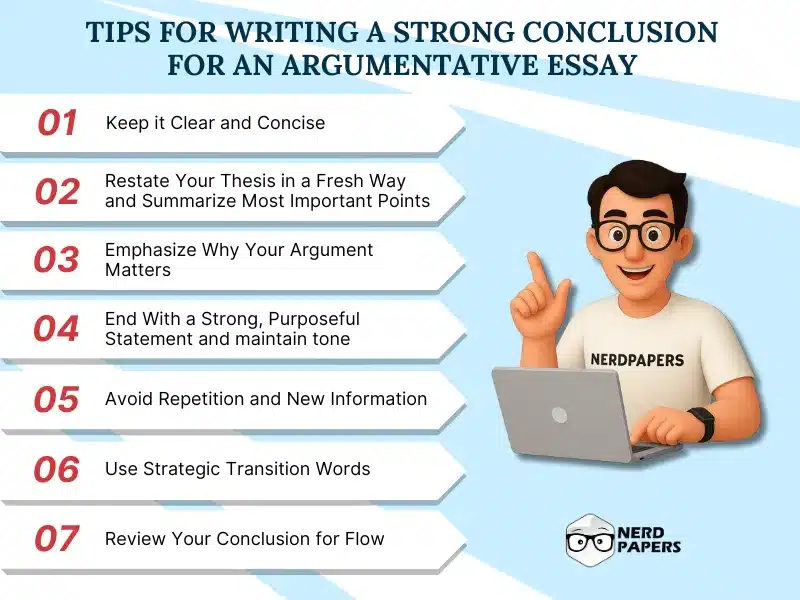
1. Keep it Clear and Concise
A strong conclusion is focused and to the point. Avoid long explanations or unnecessary details. Aim for a short, powerful paragraph that reinforces your argument.
2. Restate Your Thesis in a Fresh Way
Don’t copy your thesis from the introduction. Reword it to show how your ideas developed and what your essay ultimately proved.
3. Summarize Only the Most Important Points
A conclusion is not a second body paragraph. Highlight only the key arguments that directly support your claim.
4. Emphasize Why Your Argument Matters
Show the broader significance of your position. A great conclusion answers: “So what?” “Why should the reader care?”
5. End With a Strong, Purposeful Statement
Your final sentence should feel confident and complete. Avoid weak endings like questions, emotional pleas, or vague predictions.
6. Maintain a Logical, Academic Tone
Use clear, assertive language. Stay consistent with the tone of the essay—professional, direct, and focused on evidence.
7. Avoid Repetition and New Information
Don’t restate your arguments word-for-word or add new evidence. Keep the conclusion clean and unified.
8. Use Strategic Transition Words
Start with natural academic transitions such as “Overall,” “Ultimately,” or “Given these points” to smoothly guide the reader into your final thoughts.
9. Review Your Conclusion for Flow
After writing, read your conclusion aloud to ensure it sounds smooth, logical, and complete. A strong conclusion should leave the reader with clarity, not questions.
Conclusion
Writing a strong argumentative essay conclusion is all about clarity, confidence, and purpose. You can give your essay a substantial and thorough conclusion by rephrasing your thesis, summarizing your important ideas, and highlighting the value of your argument. Your conclusion becomes the section of the essay that ties everything together. It gives the reader a clear grasp of your argument if it has the proper structure, transitions, and concluding insight.
Frequently Asked Questions
What is a conclusion in an argumentative essay?
A conclusion in an argumentative essay is the final paragraph that restates your thesis, summarizes your main arguments, and shows the significance of your claim. Its purpose is to strengthen your position and leave the reader with a clear, confident final thought.
How do you write a conclusion for an argumentative essay?
To write a strong conclusion, rewrite your thesis in fresh words, briefly summarize your main claims, explain why your argument matters, and end with a strong closing insight. Keep it concise, logical, and focused on reinforcing your position—not introducing new ideas.
What should be included in an argumentative essay conclusion?
A complete conclusion includes a restated thesis statement, a summary of your key arguments, a brief explanation of your argument’s significance, and a strong final sentence. These elements make your conclusion clear, persuasive, and academically solid.
What should you avoid in an argumentative essay conclusion?
Avoid introducing new evidence, repeating your body paragraphs, using emotional appeals, adding unrelated information, or ending abruptly. Your conclusion should clarify your main point, not complicate it.
How long should an argumentative essay conclusion be?
Most argumentative essay conclusions are 3–5 sentences long. A college-level conclusion may be one full paragraph. The length depends on the complexity of the essay—but it should always be clear, concise, and focused.
How do you start a conclusion paragraph for an argumentative essay?
Start your conclusion with a strong transition such as “Ultimately,” “Overall,” or “The evidence shows that…” Then restate your thesis using different wording and lead into your final insights. Avoid overused phrases like “In conclusion.”
What is a good final sentence for an argumentative essay?
A good final sentence reinforces your position without repeating it. It can highlight the broader significance of your argument, offer a final insight, or leave the reader with a thought-provoking idea. It should feel confident, direct, and logically connected to the essay.
Does an argumentative essay need a conclusion?
Yes. An argumentative essay must include a conclusion because it ties your argument together, clarifies the purpose of your claims, and shows the reader what they should take away. Without a conclusion, the argument feels incomplete and less persuasive.