

What is an academic essay — and why does it matter so much in college?
If you’ve ever found yourself staring at an assignment prompt, wondering where to even begin, you’re not alone. Academic essays are one of the most common and important types of writing you’ll encounter in higher education. Whether you’re analyzing a novel, building a case in a psychology paper, or responding to a research question in sociology, this form of writing helps you organize your thoughts, defend your ideas, and meet academic expectations.
Unlike general essays, academic essays follow a more formal structure. They rely on evidence-based arguments, a clear thesis, proper citation formats, and a logical flow from start to finish. They’re not just about what you think — they’re about how well you can support your thinking.
In this guide, we’ll walk you through:
- What exactly defines an academic essay
- Why it’s used in university-level writing
- Its structure, tone, and formal components
- Key writing techniques like thesis development, transitions, and rebuttals
- How academic essays are evaluated in real classrooms
By the end, you’ll have a clear understanding of how academic essays are structured, what makes them effective, and how to meet the expectations of academic writing.
Just starting out? You might want to check out our What Is an Essay? guide first — it covers the basics before we dive into the academic version.
Definition and Purpose of an Academic Essay
What Is an Academic Essay?
An academic essay is a formal piece of writing used in higher education to explore, analyze, or argue a specific idea or question. It is structured, thesis-driven, and supported by credible sources, written to meet the standards of scholarly communication.
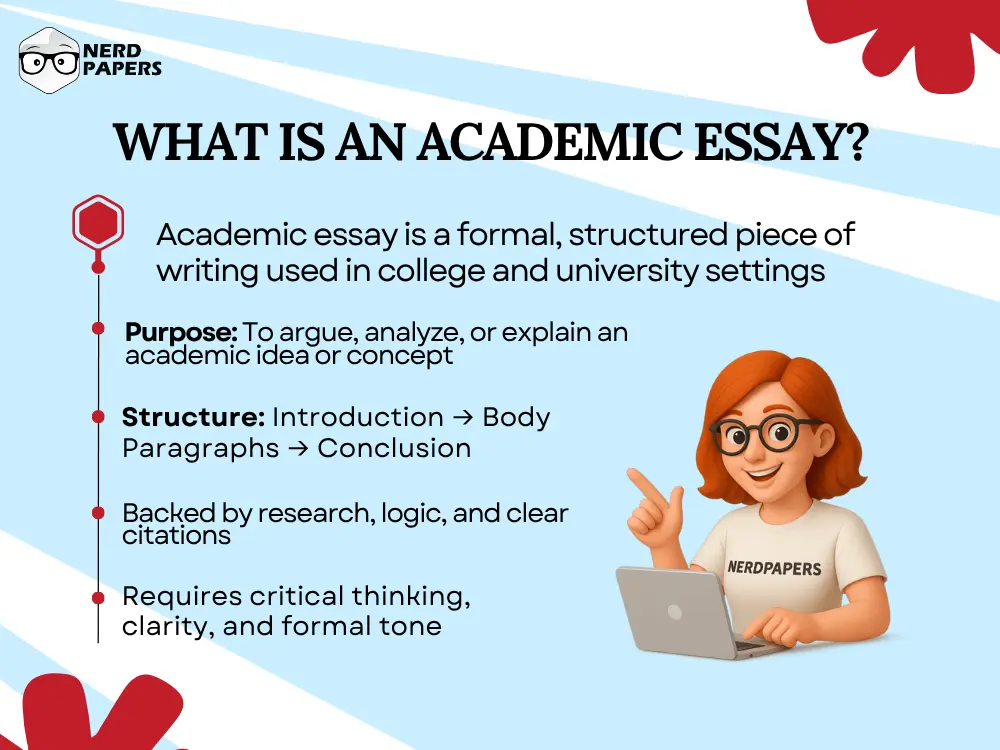
Unlike general essays that might appear in blogs or magazines, academic essays serve a specific audience: professors, peers, and scholars within a particular field. They follow strict conventions in tone (formal and objective), format (APA, MLA, Chicago, etc.), and structure (introduction, body, and conclusion).
Academic essays are not about personal opinions or storytelling — they are about building logical arguments, backed by research and presented with clarity. You’ll find them in everything from literature classes to engineering courses, each adapted to suit the discipline’s expectations.
What Is the Purpose of an Academic Essay?
The primary purpose of an academic essay is to develop and communicate a reasoned argument or analysis on a specific topic. It pushes students to:
- Think critically and independently
- Engage with scholarly sources
- Present ideas in a logical and structured format
- Demonstrate understanding of course content
- Contribute to academic dialogue in their field
There are several key functions of academic essays, depending on the type and context:
- To analyze – Break down ideas or texts to understand how they work (e.g., literary analysis, lab reports)
- To argue – Defend a position using logic and research (e.g., argumentative essays)
- To explain – Clarify a process, idea, or theory (e.g., expository essays)
- To reflect – Examine personal experience in the context of academic learning (e.g., reflective essays)
Academic essays are more than assignments — they’re tools for learning, communication, and scholarly growth.
A psychology student writing a research-based essay on memory retention isn’t just summarizing — they are analyzing theories, comparing sources, and forming a well-supported conclusion that reflects their academic understanding.
Key Characteristics of Academic Essays
Academic essays aren’t just about answering questions — they’re about how you present those answers. What sets them apart from other forms of writing is a combination of structure, tone, evidence, and intent. Whether you’re writing for a humanities course or a science class, the following traits are consistent across all academic essays.
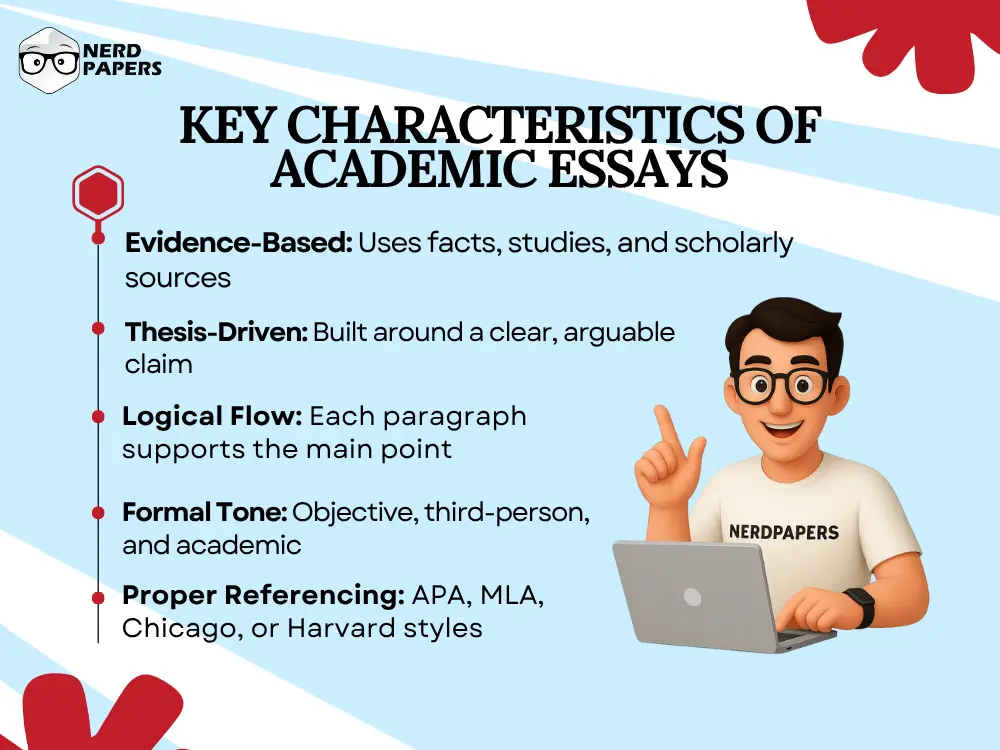
1. Formal and Objective Tone
Academic writing maintains a professional tone — it avoids slang, contractions, and overly casual language. Instead of personal anecdotes, it emphasizes logic, clarity, and neutrality.
Instead of writing “I think climate change is bad,” an academic version would say:
“Current data indicates that climate change poses measurable risks to environmental and economic systems.”
2. Evidence-Based Arguments
Every claim in an academic essay must be supported by credible sources, including peer-reviewed journals, books, and reputable academic websites. Opinions are valid only when backed by evidence.
“As noted by Thompson (2021), academic motivation in first-year university students is directly tied to instructor feedback.”
3. Clear Structure and Logical Flow
Academic essays typically follow a three-part format: introduction, body paragraphs, and conclusion. Each section has a specific role in guiding the reader through the argument.
4. Thesis-Driven
At the heart of every academic essay is a thesis statement — a concise summary of the main argument or claim. Every paragraph should relate back to this central idea.
5. Use of Citations and Referencing
Academic integrity is a core value. Every source that is used, whether paraphrased or quoted, must be properly cited. Most institutions require adherence to a citation style such as APA, MLA, Chicago, or Harvard for both in-text citation and in a final bibliography or reference list. This ensures academic integrity and traceability.
These elements distinguish academic essays from casual writing or opinion pieces. Mastering them is essential not just for grades — but for participating in academic discourse with clarity and credibility.
Structure & Format of an Academic Essay
Academic essays follow a predictable, standardized format that allows readers — particularly instructors and scholars — to identify your thesis, supporting arguments, and sources easily. Mastering this structure is crucial for both clarity and academic credibility.
Standard Essay Structure
A well-organized academic essay includes the following components:
1. Introduction
- Begins with a hook to capture attention
- Provides background/context to frame the discussion
- Ends with a thesis statement – a clear, concise claim or argument that the rest of the essay will support
“While social media platforms promote connectivity, they also contribute to widespread digital burnout — a growing concern in modern psychology.”
2. Body Paragraphs
- Each paragraph starts with a topic sentence that connects back to the thesis
- Includes evidence, examples, or quotes from credible sources
- Contains analysis that explains how the evidence supports the argument
- Uses transitions to maintain logical flow between ideas
“A 2022 study by the American Psychological Association found a 30% increase in reported digital fatigue among college students due to screen overexposure (APA, 2022).”
3. Conclusion
- Restates the thesis in light of the arguments presented
- Summarizes the key points
- Ends with a final insight, call-to-action, or implication
Formatting Styles
Academic essays must adhere to a specific formatting style, depending on the institution or discipline. Common formats include:
- APA (American Psychological Association) – used in psychology, education, and sciences
- MLA (Modern Language Association) – used in humanities and literature
- Chicago – common in history and publishing
- Harvard – used in many UK and international universities
Each format has rules for:
- In-text citations
- Title pages
- Reference or Works Cited lists
- Page formatting (margins, spacing, font)
(Smith, 2023, p. 45)
Smith, John. The Rise of Digital Burnout. Penguin, 2023.
Types of Academic Essays
Academic essays aren’t all the same — and they’re not just about writing well. Each type serves a distinct purpose and follows specific structural expectations in scholarly settings. Below is a structured breakdown of the main academic essay types, their subtypes, and how they differ based on purpose, tone, and academic context.
1. Argumentative / Persuasive Essays
Main Goal: To convince the reader of a position using reasoning, logic, and supporting evidence.
These essays take a clear stance on an issue and defend it through argumentation.
Common Subtypes:
- Argumentative Essay – Presents a clear thesis and defends it with logic and research.
- Persuasive Essay – Similar to argumentative but allows for more emotional appeal.
- Opinion Essay – Expresses the author’s viewpoint supported with justification.
- Synthesis Essay – Combines information from multiple sources to form a coherent argument.
- Deductive Essay – Applies general principles to reach a specific conclusion.
2. Expository Essays
Main Goal: To explain, inform, or describe a topic logically and clearly — without persuasion.
These are informational and fact-based, requiring clarity and organization.
Common Subtypes:
- Expository Essay – General informative writing without argument.
- Analytical Essay – Breaks a subject into parts to explore meaning or function.
- Compare and Contrast Essay – Highlights similarities and differences between two topics.
- Cause and Effect Essay – Examines reasons and consequences.
- Process Essay – Describes how something is done or works.
- Definition Essay – Explains the meaning or concept of a term or idea.
- Classification Essay – Groups items or concepts into categories.
- Evaluation Essay – Assesses the value or quality of something.
- Exemplification Essay – Uses examples to support a general idea.
3. Narrative Essays
Main Goal: To tell a story, often based on personal experience or reflection.
While more commonly used in personal statements or application writing, some academic settings allow narrative techniques in reflective assignments.
Common Subtypes:
- Narrative Essay – Tells a story from a specific viewpoint.
- Personal Essay – Describes personal insights or life experiences.
- Reflective Essay – Analyzes a personal event and what was learned.
- Response Essay – Offers a personal reaction to a text or issue.
4. Descriptive Essays
Main Goal: To describe a person, object, setting, or event using vivid sensory detail.
These are less common in strictly academic contexts but may appear in creative writing courses.
Subtype:
- Descriptive Essay
5. Critical / Analytical Essays
Main Goal: To interpret, critique, or evaluate a text, idea, or issue — often using academic sources.
These are frequently assigned in literature, philosophy, media studies, and history.
Common Subtypes:
- Critical Analysis Essay – Examines strengths, weaknesses, or impact of a work.
- Analytical Essay – Focuses on dissecting a concept or theme (can also be expository depending on purpose).
6. Application / Professional Essays
Main Goal: To present oneself effectively for academic, professional, or competitive opportunities.
Although these blend narrative, persuasive, and descriptive elements, they’re unique in their function.
Common Subtypes:
- College Admission Essay
- Scholarship Essay
- MBA Essay
- Nursing School Essay
- Extended Essay (IB Program – often argumentative or analytical in nature)
Key Elements & Academic Writing Techniques
Strong academic essays share more than just a formal tone and a clear thesis — they rely on precise techniques that guide readers through structured reasoning. The elements below help shape your arguments, support your claims, and build clarity from start to finish.
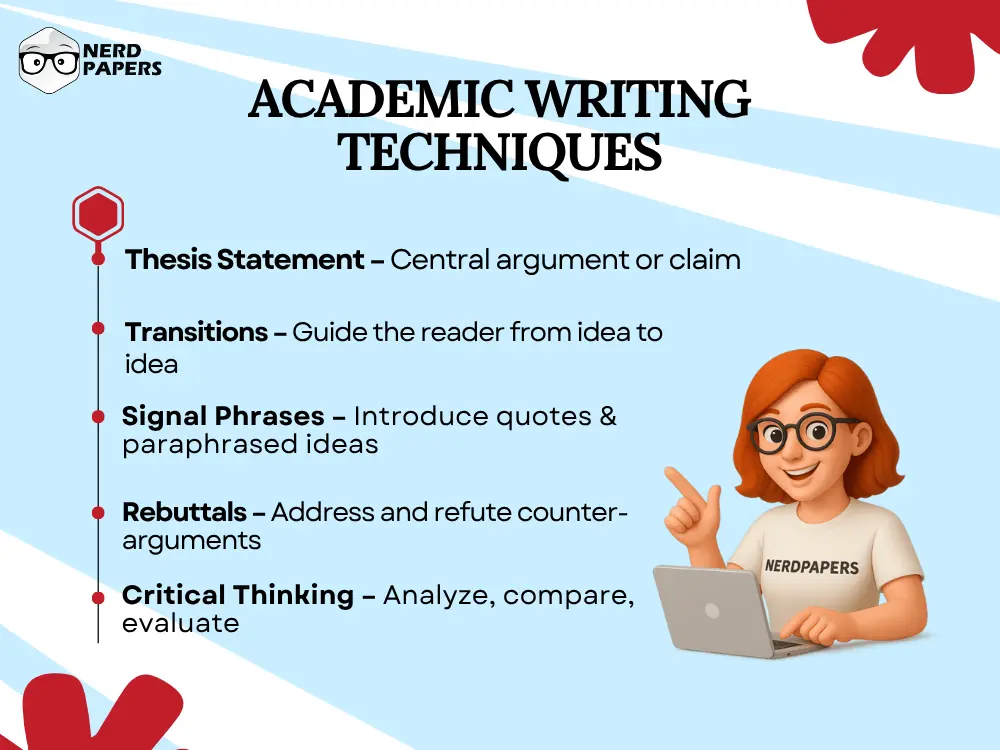
Thesis Statement
A thesis statement is the central idea that defines your entire essay. It appears in the introduction and sets the direction for your arguments, analysis, or discussion.
Good thesis statements are:
- Specific and focused
- Debatable (not just a fact)
- Aligned with the essay’s structure and scope
“While online education offers flexibility, it often lacks the depth of peer engagement required for critical thinking in humanities.”
Transitions
Transitions are words, phrases, or sentences that connect ideas smoothly between paragraphs and sections.
Moreover, However, As a result, In contrast, Therefore, For example
Signal Phrases
A signal phrase introduces a quotation, paraphrase, or summary from a source — helping to attribute it properly.
A. According to Dr. Johnson…
B. The study conducted by Smith (2023) states…
C. As noted in the journal article…
These phrases also demonstrate academic integrity and source transparency.
Rebuttals
A rebuttal addresses and refutes opposing viewpoints. It shows critical awareness and strengthens your position.
Some scholars argue that standard testing improves accountability, but this view overlooks its limitations in assessing creativity and long-term learning outcomes.
Academic Tone and Formal Language
Academic writing avoids slang, contractions, vague generalizations, or overly emotional language. Instead, it embraces clarity, formality, and objectivity.
✅ Use:
- Third-person point of view
- Precise vocabulary
- Clear, concise sentences
- Subject-specific terminology
🚫 Avoid:
- “I think,” “in my opinion,” “you can see that…”
- Colloquialisms: “a lot of,” “kind of,” “really big deal”
Research, Evidence & Citations in Academic Essays
In academic writing, strong ideas mean little without strong support. That’s why evidence-based argumentation lies at the heart of any academic essay. From citing peer-reviewed studies to properly referencing a textbook, how you use research determines your essay’s credibility and academic integrity.
Why Research Matters in Academic Essays
Academic essays require verifiable support, not just personal opinion. Whether you’re defending a claim in an argumentative essay or explaining a concept in an expository one, high-quality sources give your work legitimacy and show you’ve engaged with the scholarly conversation.
The primary functions of research in an essay are:
- Strengthens your argument with facts and logic
- Shows depth of understanding through source diversity
- Demonstrates academic integrity by avoiding plagiarism
- Engages with existing scholarly work and perspectives
Types of Sources to Include
Not all sources carry equal weight in academic essays. Prioritize peer-reviewed journals, academic books, credible government or institutional websites, and reputable databases like JSTOR or Google Scholar.
| Source Type | Use Case Examples | Reliable? |
| Peer-reviewed journal | Research for a psychology paper | ✅ Best |
| Academic Book | Theory support or historical analysis | ✅ Strong |
| Government website | Citing data (e.g., U.S. Census Bureau) | ✅ Strong |
| Blog post | Informal opinion or anecdote | ⚠️ Use rarely |
| Wikipedia | For background only; not for citations | ❌ Not academic |
According to a study by Mitchell et al. (2021), students who used at least three scholarly sources per essay scored 23% higher on average than those who relied solely on internet search results.
→ (Source: Journal of Academic Writing, APA Style)
How to Integrate Evidence
In academic writing, evidence must be smoothly integrated into your own argument — not dumped in as filler. The three most common ways to include evidence are:
- Direct Quotations – Word-for-word use of a source
Example: “Academic integrity is the cornerstone of scholarly communication” (Smith, 2022, p. 14). - Paraphrasing – Restating the idea in your own words
Example: Smith (2022) argues that academic integrity underpins all responsible writing practices. - Summarizing – Condensing a broader idea or argument
Example: Multiple scholars highlight integrity and source reliability as foundational to academic writing (Jones, 2020; Smith, 2022).
Academic Citation Styles
Depending on your discipline, your essay will follow a specific formatting style. These formats govern in-text citations, bibliographies, and even headings and margins.
| Style | Common In | Key Feature |
| APA | Psychology, Education, Sciences | Author-date format, page #s |
| MLA | Literature, Humanities | Author-page format |
| Chicago | History, Philosophy | Footnotes and bibliography |
| Harvard | Social Sciences, Business | Author-date, similar to APA |
Academic Integrity & Plagiarism
Using sources improperly — or failing to cite them — is plagiarism, which can result in severe academic consequences. Always:
- Cite every quote, information or idea that is not your own
- Use plagiarism checkers (like Turnitin or Grammarly Premium)
- Keep track of your research with tools like Zotero or Mendeley
Evaluation Criteria in Academic Essays
Understanding how academic essays are evaluated is essential for improving your writing and meeting academic expectations. Universities and instructors use structured rubrics to assess essays based on multiple dimensions, not just grammar or word count.
A rubric is a scoring guide used by educators to evaluate an essay based on predefined criteria. It typically includes categories like thesis clarity, argument development, organization, use of sources, and grammar or style, each with point ranges or performance levels (e.g., Excellent, Good, Fair, Poor).
Whether you’re writing a persuasive essay or a research-based one, your work is typically assessed using five core criteria: clarity, structure, depth of analysis, evidence, and proper referencing.
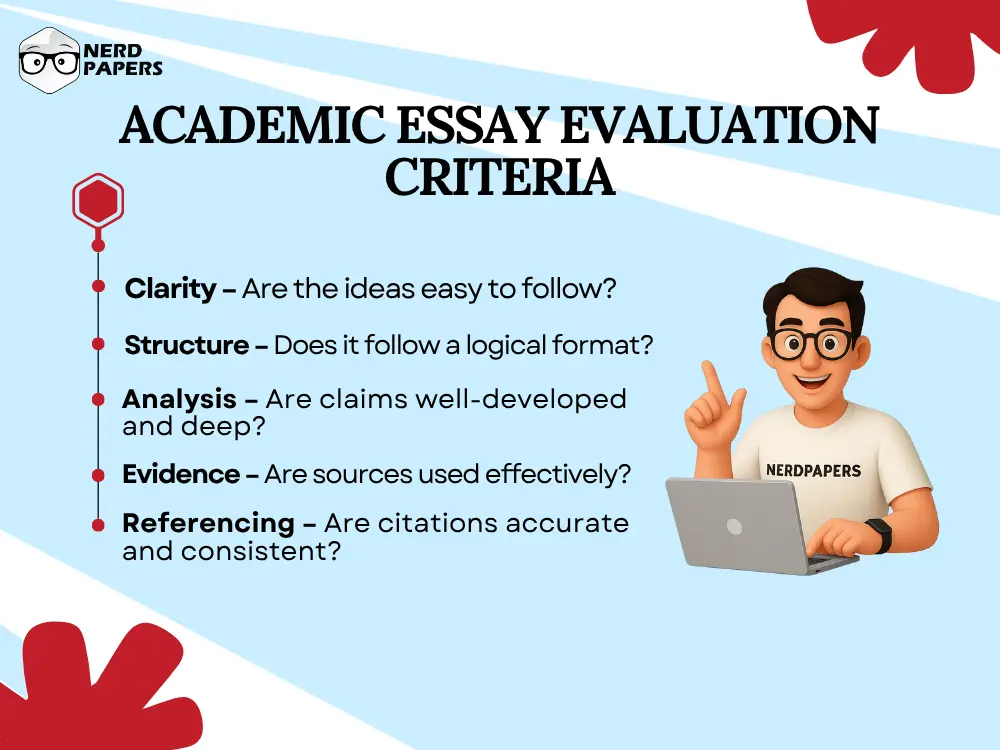
1. Clarity of Argument
The core idea of your essay — usually presented through the thesis statement — should be clear, specific, and easy to follow. Each paragraph should support this central argument in a focused way.
What evaluators look for:
- A strong, concise thesis statement
- Clear topic sentences in each paragraph
- Logical progression of ideas
“Good thesis, but the argument becomes unclear in the middle section — consider strengthening transitions.”
2. Organization & Structure
Academic essays must follow a logical structure, usually Introduction → Body → Conclusion. Each section should serve a purpose and guide the reader through your reasoning without confusion.
What evaluators look for:
- Introduction with background and thesis
- Body paragraphs that each focus on one idea
- Conclusion that ties everything together
- Effective use of transitions
3. Depth of Analysis & Critical Thinking
Surface-level summaries won’t cut it. A high-scoring academic essay engages with ideas critically — questioning assumptions, exploring implications, and evaluating evidence.
What evaluators look for:
- Original analysis, not just description
- Thoughtful engagement with opposing viewpoints
- Synthesis of ideas from multiple sources
Demonstrating expertise and insight through deep, independent analysis builds trust and academic authority.
4. Quality & Use of Evidence
Evidence isn’t just an add-on — it’s the backbone of an academic argument. From statistics to scholarly quotes, every claim you make should be grounded in reliable sources.
What evaluators look for:
- Use of peer-reviewed or credible sources
- Proper integration (quotation, paraphrasing, signal phrases)
- Relevance and accuracy of information
“Citing a blog post for a scientific claim weakens your argument — use a peer-reviewed source instead.”
5. Referencing & Academic Integrity
Incorrect or missing citations can reduce your credibility — and in some cases, result in academic penalties. Proper referencing reflects academic integrity and acknowledges the contributions of original authors.
What evaluators look for:
- Correct formatting (APA, MLA, Chicago, etc.)
- A complete bibliography/reference list
- No signs of plagiarism or source misattribution
How Grading Rubrics Work
Most universities use grading rubrics that break down scores into weighted categories — each representing one of the above criteria. Here’s a simplified example of a common rubric structure:
| Criterion | Weight |
| Argument & Clarity | 25% |
| Organization & Structure | 20% |
| Depth of Analysis | 25% |
| Use of Evidence | 20% |
| Referencing & Format | 10% |
Academic Writing Expectations
Academic essays aren’t just about presenting ideas — they must also meet a standard of writing expected in higher education. These expectations reflect the values of scholarly communication: objectivity, clarity, credibility, and structure.
Whether you’re submitting a first-year college paper or a senior thesis, meeting academic writing norms helps establish credibility with instructors and peers alike.
1. Formal Tone and Objective Language
Academic writing avoids casual phrasing, contractions, slang, and overly emotional language. Instead, it favors a neutral, formal tone that presents arguments logically and professionally.
✅ Use:
- Third-person point of view (e.g., “This paper argues…”)
- Precise vocabulary
- Clear, evidence-based statements
🚫 Avoid:
- First-person statements unless allowed (e.g., “I believe…”)
- Colloquialisms and filler phrases
- Vague generalizations
2. Clarity and Conciseness
Academic writing values clarity over complexity. Long, wordy sentences with unclear structure are not a sign of intelligence — they often confuse your reader.
What instructors expect:
- Direct, concise arguments
- Minimal repetition or redundancy
- Active voice where possible (e.g., “Researchers found…” vs. “It was found by researchers…”)
Instead of: “It can be seen that this phenomenon is quite interesting in many different ways.”
Write: “This phenomenon raises several compelling questions.”
3. Alignment with Assignment Guidelines
Every academic essay should follow the specific requirements of the assignment — including word count, formatting, citation style, and topic scope.
Always double-check:
- Word/page limits
- Font size, margins, and spacing
- Formatting style (APA, MLA, Chicago, etc.)
- Submission platform requirements
4. Academic Audience and Purpose
When writing an academic essay, you’re addressing an audience of instructors, peers, or researchers. This means your content must be:
- Well-structured and research-backed
- Objective and logically organized
- Aligned with disciplinary norms (e.g., scientific, literary, social science)
Think of it like this: You’re not just writing to “complete a task” — you’re entering a scholarly conversation where evidence and reasoning matter more than opinion.
Meeting academic writing expectations isn’t about being overly rigid — it’s about respecting the integrity of scholarly work. Once mastered, these conventions not only boost your grades but also sharpen your communication skills for life beyond the classroom.
Conclusion
Academic essays aren’t just routine assignments — they’re a core part of how ideas are developed, tested, and communicated in higher education. From analyzing complex theories to arguing a position with evidence, academic essays train students to think critically, structure arguments, and engage in scholarly dialogue.
In this guide, we explored:
- What defines an academic essay and how it differs from casual or personal writing
- The key components and structure that make academic essays clear and persuasive
- Various types of academic essays, from analytical to argumentative
- Essential writing techniques like thesis statements, transitions, signal phrases, and rebuttals
- Research and citation standards that ensure academic integrity
- How essays are evaluated, including common grading criteria and expectations
- Formal tone, clarity, and academic discipline as key features of credible academic writing
Whether you’re a college freshman writing your first argumentative essay or a senior crafting a critical analysis, understanding the mechanics of academic writing sets the foundation for success in any discipline.
Frequently Asked Questions (FAQ)
What is an academic essay?
An academic essay is a formal piece of writing used in higher education to explore, argue, or analyze a topic. It presents a clear thesis, supports it with evidence, and follows a structured format that includes an introduction, body paragraphs, and a conclusion.
What is the purpose of writing an academic essay?
The main purpose is to develop and communicate critical thinking, argumentation, and original insights. Academic essays help students build logical reasoning and demonstrate understanding of a subject within a scholarly context.
What is the structure of an academic essay?
Academic essays typically follow a standard format:
Introduction: Presents the topic and thesis
Body Paragraphs: Each discusses a key point supported by evidence
Conclusion: Summarizes the argument and reinforces the thesis
What is the function of a signal phrase in an academic essay?
A signal phrase introduces a quotation, summary, or paraphrase from a source. It tells the reader who is speaking and gives proper attribution — a key element in academic integrity.
What is the purpose of a thesis statement in an academic essay?
The thesis statement expresses the main argument or claim. It serves as the foundation for the essay’s structure and guides the development of every supporting point.
What type of language is most effective in academic essays?
Academic essays use formal, objective, and precise language. Writers avoid slang, contractions, and overly casual phrases, focusing instead on clarity and professionalism.
What is the purpose of transitions in an academic essay?
Transitions connect ideas between paragraphs and within arguments. They improve flow, clarify relationships between points, and help readers follow the logical structure of the essay.
What is an academic reference in an essay?
An academic reference cites a reliable source (e.g., journal article, book, or scholarly website) to support a claim. Proper referencing builds credibility and avoids plagiarism.
What is the format of an academic essay?
Academic essays follow specific citation styles — such as APA, MLA, or Chicago — and have clear formatting rules including title pages, margins, font size, and reference lists.
How is an academic essay different from a regular essay?
Unlike personal or casual essays, academic essays emphasize critical thinking, structured arguments, formal tone, and use of credible sources. They’re written for an academic audience and graded on scholarly criteria.