

A research paper is a written document where you present your findings on a specific topic. It is often based on original research or thorough analysis of existing information. Research papers are a cornerstone of academic work, helping students, academics, and professionals communicate their insights effectively.
Understanding the types of research papers is essential for anyone involved in academic writing. Different research papers serve different purposes, from explaining a concept to debating a controversial topic. Choosing the right type can make your research paper more impactful and easier to understand for your audience.
In this blog, we’ll explore the most common types of research papers. For each type, we’ll discuss its purpose, structure, and practical examples. By the end, you’ll have a clear idea of which type of research paper is suitable for your topic or field of study. If you need assistance with your research paper, you can always ask for research paper help from our expert Nerd writers.
What Constitutes a Research Paper?
A research paper is a detailed academic document that presents original research findings, analysis, or interpretations on a particular subject. It serves as a medium for researchers to communicate their discoveries to the academic community and contributes to the overall knowledge base of a given field.
The typical structure of a research paper includes the following key components:
- Abstract: A concise summary of the research, typically 150-250 words, highlighting the key objectives, methods, results, and conclusions.
- Introduction: This section introduces the topic, presents the research question, and states the purpose of the study. It often includes background information and sets the context for the research.
- Methodology: Describes the methods used to collect and analyze data, outlining the procedures, tools, and techniques that were applied.
- Results: This section presents the data or findings from the research, often in the form of tables, charts, or figures.
- Discussion: The analysis of the results, explaining their significance, implications, and how they relate to existing research.
- Conclusion: A summary of the findings, suggesting possible future research directions or actions.
- References: A list of the sources cited throughout the paper, formatted according to a specific citation style, such as APA, MLA, or Chicago.
Key Characteristics of Research Papers
Research papers are characterized by their structured format, academic tone, and rigorous adherence to a specific citation style, ensuring consistency and credibility. These papers are academic documents that present a detailed analysis, interpretation, or argument based on research findings. Here are the key characteristics of research papers:
1. Structured Format
- Organized Sections: A research paper follows a clearly defined structure, including the Introduction, Methodology, Results, Discussion, and Conclusion. These sections ensure the paper is logically organized and easy to follow.
- Standardized Formatting: Research papers often adhere to specific style guides (APA, MLA, Chicago) that dictate formatting for citations, headings, and references.
2. Thesis-Driven
- Central Argument: A research paper has a central thesis statement that presents the main argument or purpose of the paper. The entire document is structured to support or analyze this thesis.
- Clear Focus: The research paper maintains a focused discussion around the thesis, avoiding tangential information or unnecessary details.
3. Evidence-Based
- Data and Sources: Research papers are grounded in credible evidence obtained through experiments, surveys, case studies, literature reviews, or other research methods. Sources are cited throughout to support claims.
- Reliable Sources: The research paper relies on peer-reviewed journals, books, academic articles, and other authoritative materials to back up its findings.
4. Originality
- New Contributions: A research paper presents original ideas, interpretations, or solutions. It contributes to the existing body of knowledge by adding new insights, interpretations, or data.
- Plagiarism-Free: To maintain academic integrity, research papers must be free from plagiarism, with proper citations for all referenced material.
5. Objective and Analytical
- Neutral Tone: The tone of a research paper is formal, objective, and impartial. It avoids personal bias or emotional language, focusing instead on presenting facts and logical arguments.
- Critical Analysis: Research papers engage in critical thinking and provide in-depth analysis of the subject matter, evaluating various perspectives and drawing conclusions based on evidence.
6. Methodological Rigor
- Clear Methodology: In empirical research papers, the methodology section outlines the research design, data collection methods, tools used, and analysis techniques. This ensures transparency and allows others to replicate the study.
- Reproducibility: The research design is often described in such a way that the study can be replicated by other researchers, ensuring the validity of the findings.
7. Clarity and Precision
- Clear Language: Research papers use clear and concise language to communicate complex ideas effectively. They avoid vague or ambiguous terms and aim for precision in presenting research findings.
- Logical Flow: The paper is organized so that readers can easily follow the argument or analysis. Ideas build upon each other in a logical sequence.
8. Peer-Reviewed
- Quality Control: Many research papers undergo a peer review process before being published in academic journals. This ensures that the research meets high standards of quality, reliability, and significance.
- Credibility: Peer-reviewed papers are considered more credible because they have been evaluated by experts in the field for accuracy and scholarly rigor.
9. Citation and Referencing
- Proper Citation: Research papers include citations throughout the text to give credit to the original authors of the sources used. Citation styles (e.g., APA, MLA, Chicago) specify the format for referencing.
- Reference List: At the end of the paper, a comprehensive reference list or bibliography is provided, listing all the sources referenced throughout the paper.
10. Conclusion and Implications
- Summary of Findings: The conclusion briefly summarizes the findings and restates the thesis in light of the evidence presented.
- Implications and Future Research: It often suggests the implications of the findings for the field, practical applications, or future research areas that could build on the current work.
These characteristics ensure that research papers are rigorous, credible, and effective in contributing to the scholarly community.
Major Types of Research Papers
1. Analytical Research Paper
Definition and Purpose: An analytical research paper focuses on evaluating and interpreting information, often aiming to present an analysis of a specific topic. The goal is not just to summarize or describe but to break down complex ideas or data into manageable pieces, offering insight into their meaning or impact. Analytical papers ask “how” or “why” certain things happen, often relying on evidence from various sources to build a comprehensive analysis.
Structure: The structure of an analytical research paper generally includes the following:
- Abstract: A brief summary of the key points.
- Thesis Statement: The main argument or analysis presented in the paper.
- Analysis: The body of the paper where evidence is examined and interpreted.
- Conclusion: Summarizes the findings of the analysis and their broader implications.
Example Topics:
- Economic trends and their impact on small businesses.
- A literary analysis of the themes in a classic novel.
- An analysis of social movements and their societal effects.
2. Argumentative Research Paper
Definition and Purpose: An argumentative research paper aims to take a clear stance on a particular issue and support that position with evidence, reasoning, and logical argumentation. It is often used to persuade readers of a particular point of view, relying heavily on facts, data, and expert opinions. The key to writing a successful argumentative paper is to anticipate and address counterarguments while bolstering one’s position with solid evidence.
Structure: The typical structure includes:
- Thesis Statement: A clear declaration of the paper’s stance.
- Supporting Arguments: Each section presents evidence to support the thesis.
- Counterarguments: Acknowledging opposing views and providing rebuttals.
- Conclusion: Summing up the argument and reinforcing the thesis.
Example Topics:
- The effectiveness of renewable energy laws.
- Debating the ethics of gene editing.
- The impact of minimum wage laws on the economy.
3. Experimental Research Paper
Definition and Purpose: Experimental research papers are based on the scientific method, where researchers conduct controlled experiments to test hypotheses. These papers document the experiment, its methodology, the data collected, and the results, with the goal of proving or disproving a theory. This type of research is common in the natural and social sciences, where controlled environments allow researchers to manipulate variables and observe outcomes.
Key Components:
- Hypothesis: The proposed explanation or prediction.
- Methodology: The detailed process of how the experiment is conducted.
- Data: The results of the experiment.
- Analysis: Interpretation of the data to draw conclusions.
Example Topics:
- Clinical trials for new medications.
- Experiments on consumer behavior in marketing.
- Engineering innovations in sustainable materials.
4. Cause and Effect Research Paper
Definition and Purpose: A cause and effect research paper examines the relationship between two or more events or phenomena to determine how one may have caused the other. This type of research paper is useful for understanding the impact of a specific factor or event on a given outcome. It typically outlines the causes first, followed by the effects, and analyzes the nature of their connection.
Structure:
- Introduction: Briefly presents the cause and effect being analyzed.
- Cause: A detailed examination of the factors contributing to the event.
- Effect: Analysis of the consequences or outcomes.
- Conclusion: Summary and insights on the cause and effect relationship.
Example Topics:
- The impact of social media on mental health.
- Effects of climate change on biodiversity.
- Causes and consequences of political instability in a region.
5. Survey Research Paper
Definition and Purpose: A survey research paper is based on data collected through surveys or questionnaires. This type of research paper involves designing surveys, gathering responses, and analyzing the results to draw conclusions. It is often used in social sciences, market research, and other fields where large sample sizes and quantitative data are necessary.
Steps:
- Survey Design: Crafting the questionnaire and choosing the sample population.
- Data Collection: Administering the survey and gathering responses.
- Data Analysis: Analyzing the responses to identify patterns or trends.
Example Topics:
- Consumer behavior in online shopping.
- Employee job satisfaction surveys.
- Public opinion on social or political issues.
6. Case Study Research Paper
Definition and Scope: A case study research paper involves an in-depth analysis of a particular instance, such as a company, event, or individual. It aims to provide a comprehensive understanding of a real-world problem or situation, exploring it from multiple angles and presenting possible solutions or implications. Case studies are common in business, medical, and legal research.
Key Elements:
- Problem Identification: Clearly defining the issue or challenge.
- Analysis: Investigating the factors contributing to the problem.
- Solutions/Implications: Offering potential solutions or discussing the implications of the case.
Example Topics:
- A corporate case study on managing a crisis.
- Case studies in medical ethics or patient care.
- Analysis of historical events and their impact on society.
7. Comparative Research Paper
Definition and Purpose: A comparative research paper involves comparing and contrasting two or more subjects to highlight their similarities and differences. This type of research is used to draw conclusions or make informed recommendations based on the comparison of specific elements.
Structure:
- Criteria Definition: Defining the elements being compared.
- Comparison: Analyzing each element according to the defined criteria.
- Conclusion: Summarizing the findings of the comparison.
Example Topics:
- Comparing education systems in different countries.
- A comparison of market trends in two industries.
- Contrasting the political systems of two nations.
8. Review Research Paper
Definition and Purpose: A review research paper summarizes and critiques existing literature on a particular topic. Instead of presenting new research, review papers consolidate existing research findings to provide an overview of the current state of knowledge in a specific field. They are often written when a significant body of literature has been published on a subject.
Components:
- Introduction: Overview of the topic and purpose of the review.
- Literature Summary: A summary of key findings from existing research.
- Critique: Evaluation of the strengths and weaknesses of the studies reviewed.
- Conclusion: Insights based on the reviewed literature and future directions.
Example Topics:
- A review of recent advancements in renewable energy technology.
- Literature review on mental health interventions.
- Review of developments in artificial intelligence.
9. Exploratory Research Paper
Definition and Purpose: Exploratory research papers are used to investigate new, uncharted topics or questions. These papers are often preliminary, gathering information to identify trends, patterns, or directions for future study. The primary goal is to explore the topic without necessarily providing definitive answers, allowing the researcher to outline areas for further investigation.
Structure:
- Problem Introduction: Presenting the unknown aspects of the topic.
- Exploration: Investigating various facets of the issue.
- Future Directions: Suggesting areas for further research.
Example Topics:
- Investigating AI’s potential applications in healthcare.
- Exploring new technologies in renewable energy.
- Analyzing trends in digital marketing.
10. Interpretative Research Paper
Definition and Purpose: An interpretative research paper focuses on interpreting a specific set of data, events, or phenomena, offering an explanation or understanding of its meaning. These papers analyze the subject matter through a particular lens or theoretical framework, providing insights into its significance or implications.
Structure:
- Data Presentation: Presenting the data or events that are being interpreted.
- Interpretation: Offering an analysis or explanation of the meaning behind the data.
- Conclusion: Summarizing the interpretation and its broader implications.
Example Topics:
- Interpreting historical documents in the context of political change.
- Analyzing art through a psychological perspective.
- Interpretation of literary texts using various critical theories.
Choosing the Right Type of Research Paper
Choosing the right type of research paper is essential for ensuring that your work is both effective and academically appropriate. Depending on your topic, research question, and goals, selecting the correct paper format will help structure your work in a way that communicates your findings clearly and persuasively. Here are the factors to consider when making your choice:
Factors to Consider
1. Audience: Understanding your target audience is crucial in determining the type of research paper. Is your audience academic (professors, researchers) or general (public, industry professionals)? Academic audiences typically prefer papers that focus on objective analysis, evidence, and scholarly discourse. For a more general audience, you might choose an argumentative or exploratory paper that is more accessible and focused on clear communication.
2. Purpose: The purpose of your research paper guides your choice of format. Are you trying to inform, persuade, or analyze? For instance:
- If you are informing, a review or exploratory paper would be ideal to synthesize existing knowledge or explore new ideas.
- If you are persuading, an argumentative paper would allow you to present and defend a position.
- If your goal is to evaluate and interpret data, an analytical research paper will help you present your findings in a structured and logical manner.
3. Research Question: The type of research question you have often dictates the type of paper. If your research question is exploratory or asks about unknown variables, you would likely choose an exploratory research paper. If your question involves determining cause and effect, a cause and effect paper would be more suitable.
4. Discipline: Different academic fields may have preferred research paper formats. For example, in the social sciences, survey and case study papers are common, while the sciences often require experimental or analytical research papers. Understanding your discipline’s expectations can help you pick the right paper type.
Common Challenges and Mistakes in Writing Research Papers
Writing research papers can be a daunting task, especially when faced with a wide array of paper types and complex requirements. However, being aware of common challenges and mistakes can help you avoid them and streamline your writing process.
Common Challenges
1. Choosing the Wrong Type for the Topic One of the most common mistakes is selecting the wrong type of research paper for your topic. Each paper type has a specific purpose, and deviating from the right format can confuse readers and weaken your argument. For instance, writing an analytical paper when your topic calls for an argumentative one can cause misalignment between your research question and your paper’s structure.
2. Misunderstanding the Required Structure Every research paper follows a distinct structure (e.g., introduction, methodology, results). Misunderstanding these requirements can lead to incomplete or disorganized papers. Not adhering to these guidelines can impact the clarity and flow of your work.
3. Inadequate Research or Use of Unreliable Sources Effective research is the backbone of any good paper. Relying on unreliable sources or failing to conduct thorough research can severely compromise the quality of your paper. Avoid basing your argument on weak or unverified data.
How to Avoid Mistakes
- Thoroughly Understand the Requirements: Always read your assignment or research guidelines carefully to ensure you understand the expectations.
- Use Credible Sources: Make sure you use reputable sources and properly cite them.
- Seek Feedback and Revise: Don’t hesitate to seek feedback from peers, professors, or writing centers and make revisions to improve your paper.
Conclusion
In conclusion, understanding the different types of research papers is crucial for academic and professional success. Each type of research paper serves a unique purpose and follows a specific structure, whether you are analyzing data, building an argument, or conducting an experiment. By knowing which type of research paper to choose for your topic, you can present your findings in a more organized, effective, and engaging way.
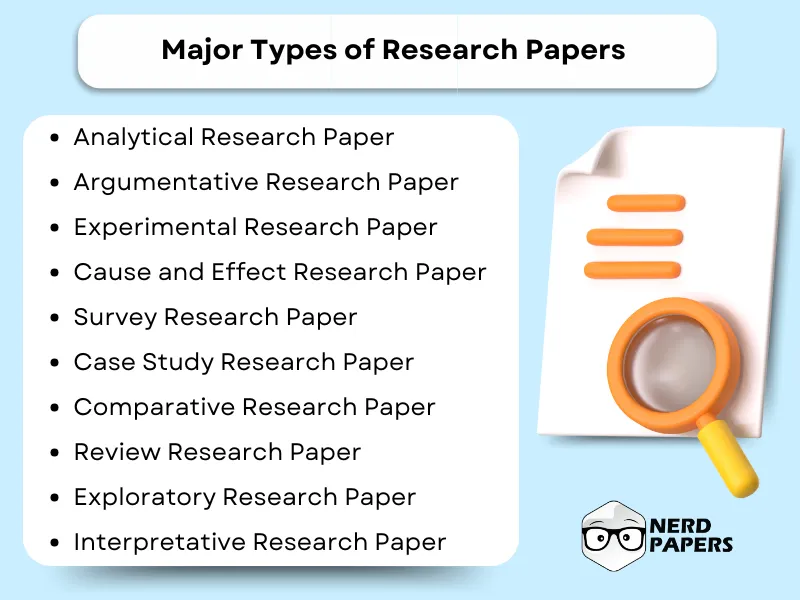
As we’ve explored, the major types of research papers include analytical, argumentative, experimental, cause and effect, survey, case study, comparative, review, exploratory, and interpretative. Each one requires a different approach, from the evaluation of evidence in analytical papers to the exploration of new ideas in exploratory research. The key to success lies in choosing the right format for your research question, discipline, and audience.
Selecting the appropriate research paper type not only ensures that your work aligns with academic standards but also helps you communicate your ideas more clearly. A well-chosen format allows for better organization and a more persuasive presentation of your research findings. Understanding the structure and purpose of various research papers will undoubtedly enhance your academic writing and elevate your ability to communicate complex ideas effectively.