

A thesis statement is one line that tells what your paper or essay is about and why it is important. It’s often near the end of your opening.
If you’re writing a different kind of essay, your thesis will look a little different. But the main idea you want to get across should always be clear in the thesis statement. Your whole writing should be built around this one idea.
In this guide, you will learn what is a thesis statement, thesis statement template, types of thesis statement, and examples.
What is a Thesis Statement?
A thesis statement tells what your essay is about and what it says. In other words, it tells the reader what the essay will argue and why. These are the best thesis statements:
Contentious: You shouldn’t just say something that everyone already knows as your argument. You should make a claim in your thesis statement that needs more proof or analysis to back it up.
Concise: Don’t use more words than you need to in a thesis statement; keep it short and sweet. One or two lines should make your point clear and to the point.
Coherent: Your thesis statement must be backed up by and explain everything in the rest of your work.
Why is a Thesis Statement Important?
You should have a thesis statement in your article or letter of continued interest. Why is that? In an essay or letter that keeps people interested, a thesis statement tells them what the essay or letter is about and how to get around it. Like a nail in your paper, it holds everything together. It’s not enough to just restate the topic in your thesis; it should also have something to do with the question or statement you’re answering. This is your chance to
- Talk about the main idea of your writing first.
- Show the reader the way your case will go so they can follow it.
- Make your point clear and full of specifics.
- Help you organize your writing well.
The thesis statement should be the main point of your essay. You make every other point to support it. A strong thesis statement also helps you organize your thoughts and pick out the most important things to write about in your essay.
Types of Thesis Statements
There are different ways to write a thesis statement based on the goal of the essay. Here are some popular types of thesis statements:
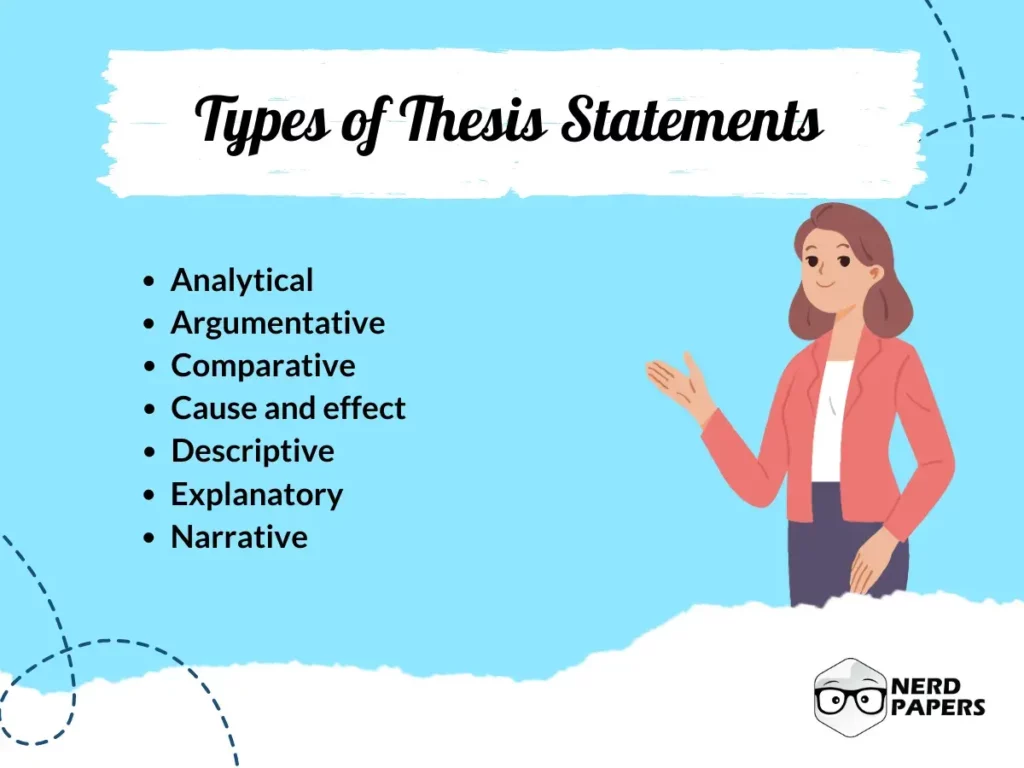
Analytical
Breaks a subject down into its parts and rates them.
Example
“By looking at symbols and how characters change over time, Shakespeare’s ‘Hamlet’ explores the theme of society’s moral decline.”
Argumentative
Takes a stand on a difficult issue and gives reasons or proof to back it up.
Example
“To protect public safety and cut down on mass shootings, the government should pass stricter gun control laws.”
Comparative
Compare two or more things to show how they are alike or different.
Example
“Both cats and dogs are great pets, but dogs need more care and attention because they are more active and need to run around.”
Cause and effect
Finds the link between what you do and what happens.
Example
“Young adults feel lonely and isolated because they don’t spend as much time with their friends in person because so many of them have smartphones.”
Descriptive
This gives an outline or brief explanation of a subject.
Example
“The intricate craftsmanship and religious symbolism of the Middle Ages are shown in the Gothic architecture of Notre Dame Cathedral in Paris.”
Explanatory
Gives an explanation of what a subject means.
Example
It is said that the Industrial Revolution changed economies, social systems, and everyday life in a big way.
Narrative
Tells a story or a list of events that happened.
Example
“My journey to overcome hardship and pursue higher education is proof of the strength of the human spirit.”
Tips for Writing a Good Thesis Statement
People often mix up the thesis statement with the topic sentence, which starts a paragraph. Both of these sentences introduce the key idea that will be discussed later. Use these tips to make sure that your thesis statement states what your whole paper is about.
- Make sure your thesis statement is clear and to the point, and that it makes your main point very clearly.
- For a focused and targeted case, talk about a certain part of the topic.
- To make a clear point, write your thesis as a clear statement instead of a question.
- Don’t go into too much detail; just get to the point of your case.
- Give an outline of the important ideas or arguments that you will be talking about in your paper.
- Make it clear what you think about the subject, whether you agree with, disagree with, or are trying to understand an idea.
- Keep your thesis’s tone formal and objective, and don’t use any emotional words.
- Keep in mind that your thesis may change as you do more research and analysis and gain new ideas.
- Review and change your thesis statement often to make sure it fits with how the rest of your paper is developing.
Now you know the type of thesis statements, let’s learn how to write a good thesis statement.
How to Write a Thesis Statement?
After going through the basic tips on how to write a good thesis statement, let us now move on to a step-by-step guide for making one. If you want to pay someone to write your essay from scratch, you can get our help with just one click.
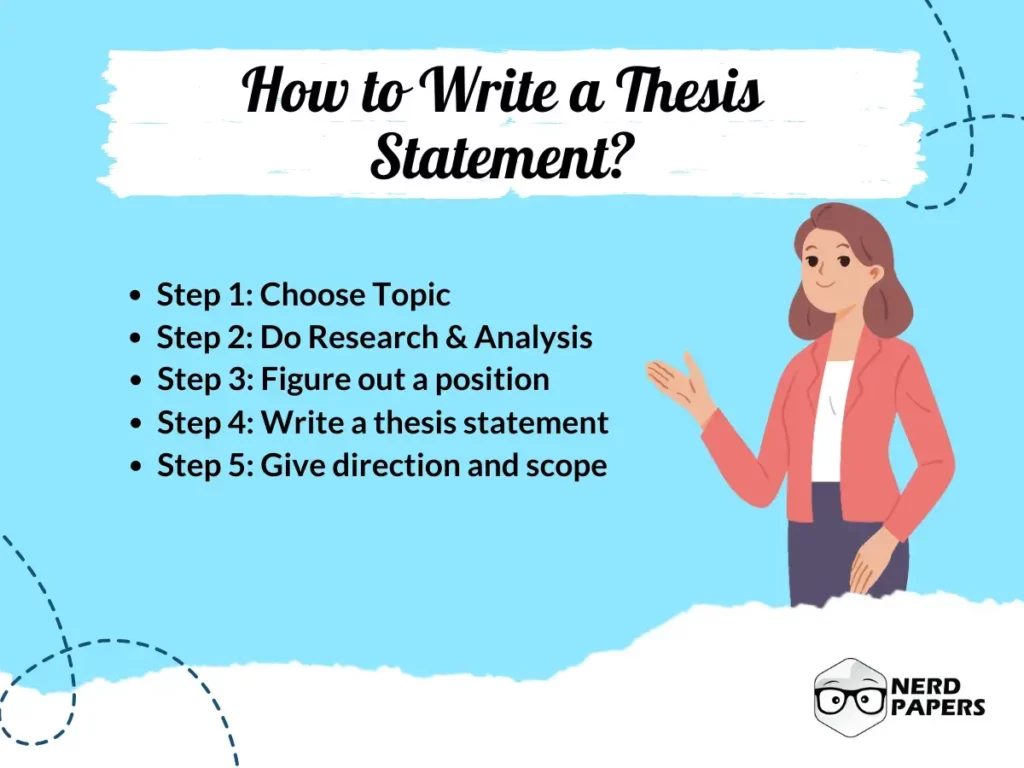
Step 1: Choose Topic
It is very important to pick a topic for your thesis statement that you are truly interested in. This will help you stay motivated as you do your study and write. Think about how broad or small your topic is. It should be just right. Think about it:
- What aspects of my field of study really interest me?
- Can the topic be covered in a thesis? If not, is it too broad or too narrow?
- What does my topic add to the debates or information that already exists in my field?
- Are there any new information or trends that I can look into that are linked to this topic?
Step 2: Do Research & Analysis
While you’re gathering information, think about how credible, reliable, and relevant each source is to your theory. Find patterns, links, and holes in the current research that you can fill with your own ideas. Think about these things:
- What are the most important ideas, theories, or opinions about my subject?
- Are there different points of view or holes in the research that I need to fill?
- What studies, or literature have already been done that I can use to back up my thesis?
- How can I evaluate and seriously think about the sources I find to make sure they are relevant and reliable?
- Do you know of any methods or ways I can use to learn more about my topic and get new insights?
Step 3: Figure out a position
After you identify the topic and complete your research, the next step is to make a clear argument that you are going to defend in your paper. For instance if you choose a topic on healthcare policy, you have to identify the argument relevant to the effectiveness of a specific healthcare reform initiative backed up by the proof from your research.
Or, in a literary analysis thesis, you could say what you think about how to understand a book’s themes or characters and use evidence from the text to back up your point of view. You might want to think about the following in each case:
- What evidence supports my viewpoint from my research?
- Should my thesis statement address counterarguments?
- How does my perspective contribute to my field’s discussion or understanding?
- Does my thesis statement express my opinion in a few phrases while providing room for debate?
Step 4: Write a thesis statement
The next step is to craft a debatable and compelling thesis statement. You should avoid unclear and lengthy statements because they don’t provide any clear direction or information to reader.
Here are some thesis statement examples:
Non-Debatable Statements:
- The Earth is round.
- Water boils at 100 degrees Celsius at sea level.
- Gravity exists.
- The human heart is located on the left side of the chest.
- All living things need water to survive.
Debatable Statements:
- The death penalty is an effective deterrent to crime.
- Social media has a negative impact on mental health.
- Artificial intelligence poses a serious threat to humanity.
- Universal basic income is the solution to poverty.
- Genetically modified organisms are safe for human consumption.
Step 5: Give direction and scope
After coming up with a thesis statement that can be argued, it’s important to make it clear what your thesis is about and where it’s going. This step tells your readers what to expect and helps you know what to look for and write.
If your thesis statement is about how technology changes education, you could say that your study will be mostly about how teaching apps are used in elementary schools.
For a thesis on mental health stigma, you could say that your study will look at how mental illness is portrayed in the media and how that affects how people think about it.
If your thesis statement talks about how well a certain marketing strategy works, you could say that your analysis will focus on how it is used in a certain business.
Good Thesis Statement Examples
Let’s have a look at good thesis statement examples:
Literature
- Subject: The Great Gatsby by F. Scott Fitzgerald
- Thesis Statement: In The Great Gatsby, F. Scott Fitzgerald criticizes the emptiness of the American Dream in the 1920s despite its glamorous portrayal.
History
- Subject: The French Revolution
- Thesis Statement: The French Revolution was driven primarily by economic inequality and resentment toward the monarchy, although Enlightenment ideas also played a role.
Science
- Subject: The impact of social media on adolescent brain development
- Thesis Statement: Excessive social media use among adolescents can harm cognitive function, emotional regulation, and self-esteem due to increased social comparison and dependency on dopamine.
Psychology
- Subject: The effectiveness of mindfulness meditation for reducing stress
- Thesis Statement: Regular mindfulness meditation reduces stress by encouraging awareness of the present moment and acceptance of thoughts and feelings without judgment.
Art History
- Subject: Guernica by Pablo Picasso
- Thesis Statement: Pablo Picasso’s Guernica, with its fragmented forms and distorted images, is a powerful condemnation of the civilian suffering during the Spanish Civil War.
Sociology
- Subject: The impact of social media on political polarization
- Thesis Statement: Social media algorithms that create echo chambers and confirm biases contribute significantly to political polarization by reducing exposure to diverse viewpoints and fostering hostility toward opposing opinions.
Final Thoughts
Your thesis statement isn’t just a sentence—it’s the heart of your writing. It keeps your work on track and grabs the reader’s attention. The better you can express your ideas in your thesis, the more memorable your writing will be.
A strong thesis statement is crucial. It can make your work stand out and reach its full potential.
Frequently Asked Questions (FAQs)
Q1: How long should a thesis statement be?
Ans. There is no set length for a thesis statement. A good thesis statement usually has between 20 and 50 words. One paragraph is another length that works for a thesis statement. Anything longer than that is most likely too long.
Q2: How many sentences are in a thesis statement?
Ans. A thesis statement must be one line long, no matter how many words it has. Being clear in your writing is more important than following these rules.