If we’re being honest, writing about your own life sounds like the easiest assignment ever until you actually sit down to do it. A personal narrative essay asks you to tell a real story from your life, but in a way that feels meaningful, organized, and honestly kind of vulnerable. And that’s where most of us freeze up a little.
The good thing? Once you understand what teachers are actually looking for, personal narratives start to feel way more natural. They almost feel like you’re just walking someone through a moment that really stuck with you. In this guide, I’ll break down everything you need to know, from what a personal narrative essay even is to how to structure it, how to start it, and what a solid example looks like. I’ll even share some real student-style samples so you can see how all the pieces fit together.
And if you are a beginner who is just starting, then you should learn the narrative essay writing process first because the personal narrative essay is a type of narrative essay. By the end of this blog, you’ll understand how to pick the right moment to write about, how to build a strong hook, how to shape your story, and how to wrap it up with a reflection that feels real, not forced. Let’s get into it.
What Is a Personal Narrative Essay?
A lot of people hear the term personal narrative essay and immediately overthink it. But honestly, it’s just a polished version of a story you’d tell someone about something that actually happened to you. The goal is simple: take a real experience, reflect on it, and explain why it mattered.
A personal narrative essay is written in the first-person point of view (“I”) and focuses on a meaningful personal experience. It can be something that taught you a lesson, changed your perspective, or stuck with you for some reason. It doesn’t have to be dramatic or life-changing. Sometimes the smallest moments end up being the most relatable.
So if you’ve ever wondered “what is a personal narrative essay?” or “what’s a personal narrative essay supposed to look like?”, think of it as a story with a purpose. There’s a clear beginning, middle, and end, but there’s also emotion, reflection, and a message that readers can connect with.
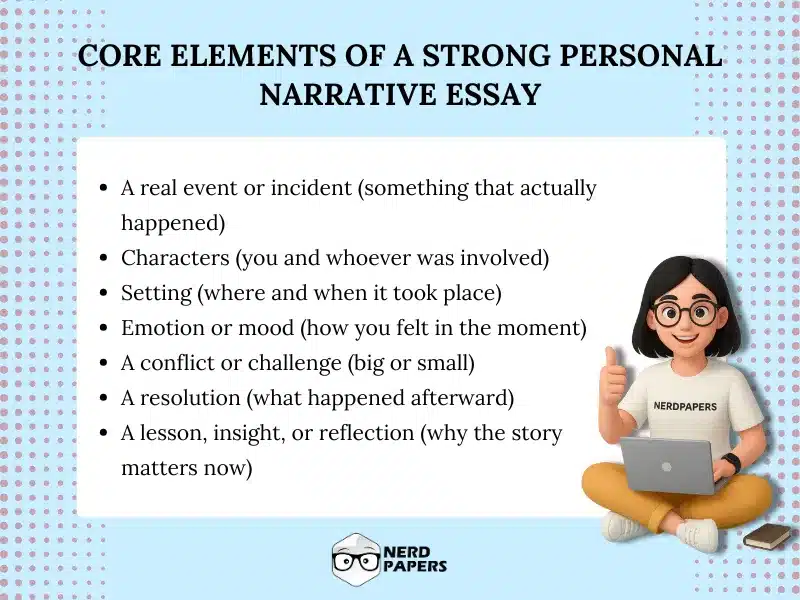
Core elements of a strong personal narrative essay include:
- A real event or incident (something that actually happened)
- Characters (you and whoever was involved)
- Setting (where and when it took place)
- Emotion or mood (how you felt in the moment)
- A conflict or challenge (big or small)
- A resolution (what happened afterward)
- A lesson, insight, or reflection (why the story matters now)
This combination is what turns a simple memory into a powerful narrative. And because every student has different experiences, a personal narrative essay can take a lot of different forms, funny, serious, emotional, awkward, or even embarrassing.
By the time you finish this guide, you’ll understand the full personal narrative essay definition and how to tell your own story in a way that feels real, structured, and meaningful.
Structure of a Personal Narrative Essay
Even though a personal narrative feels like a casual story, the structure of a personal narrative essay actually matters a lot. Without some kind of shape, the writing starts to feel like rambling. Think of the structure as a simple roadmap that helps your story make sense to someone who wasn’t there.
A typical personal narrative essay structure follows this basic flow:
1. Introduction (the opening scene)
This is where you set things up. You introduce:
- the setting (time + place)
- the main characters involved
- the general mood or emotion surrounding the moment
It usually includes some kind of hook and a small “hint” of the message or direction the story will eventually reveal. You don’t need a formal thesis like an argumentative essay, but a light “this moment mattered because…” idea helps give the intro purpose. That’s the foundation of your personal narrative essay format.
2. Body Paragraphs (the actual experience)
This is where the story unfolds in chronological order or a clear sequence.
It normally includes:
- the incident or event
- the conflict, challenge, or tension
- the emotional ups and downs
- dialogue or descriptive details that bring the moment to life
This is the heart of a personal narrative essay. It is the part where readers feel like they’re right there with you. You can include sensory details, internal thoughts, reactions, and anything else that makes the experience feel alive.
3. Conclusion (the reflection)
A personal narrative isn’t just “here’s what happened.” It also answers the bigger question:
Why does this moment still matter to me today?
The conclusion usually includes:
- the lesson learned
- the personal insight
- how the event changed your perspective or taught you something
- the emotional “after” compared to the “before”
This is the part that transforms your story from a basic memory into an actual essay with meaning.
Quick Personal Narrative Essay Outline (Student-Friendly)
Here’s a simple outline you can follow if you ever feel stuck:
- Hook
- Setting
- Characters
- Light “thesis” or main idea
- Event begins
- Conflict rises
- Key moment or climax
- Emotional details + reflection-in-the-moment
- What you realized
- How you changed
- Why the experience matters now
This structure works for high school assignments, college applications, scholarship essays, and pretty much any narrative writing you’ll ever do. Once you learn the pattern, writing a clear and meaningful narrative starts to feel a lot easier.
How to Start a Personal Narrative Essay
Starting a personal narrative essay is honestly the part that stresses people out the most. You know the story you want to tell, but getting those first few lines down can feel awkward. The goal of your personal narrative essay introduction is to pull readers into your world right away. It’s kind of like opening a door and saying, “Okay, here’s where everything started.”
A strong beginning usually has three things:
- A hook (something that grabs attention)
- A clear sense of the setting
- A hint about why this moment matters
That’s really it. You don’t need to over-explain anything. Think of it like choosing the perfect starting point in a movie. You want the reader to feel curious, not confused.
How to Start a Personal Narrative Essay (In Simple Terms)
Here are a few easy approaches that work almost every time:
- Drop readers right into the moment.
- Start with a feeling you had.
- Use a short piece of dialogue.
- Describe the setting in a vivid or unusual way.
- Begin with the problem or conflict.
Any of these can work to start off a personal narrative essay. They’re all asking for the same thing: a beginning that feels alive.
Personal Narrative Essay Hook With Examples
Hooks are honestly the secret sauce of a strong intro. Here are a few types of hooks you can use, along with student-style examples that don’t feel forced:
1. Dialogue Hook
“You’re going to be fine,” my dad whispered, even though I could tell he wasn’t sure either.
2. Action Hook
I sprinted across the parking lot, praying the bus door wouldn’t close before I got there.
3. Vivid Description Hook
The gym smelled like rubber floors, sweat, and the kind of nerves you only feel before a championship game.
4. Emotional Hook
I didn’t expect one text message to change how I saw myself, but it did.
5. Mystery Hook
I should’ve known something was wrong when everyone suddenly went quiet.
These examples show how a personal narrative essay hook instantly sets the mood and draws readers into the story. The right hook makes your introduction smoother, more engaging, and honestly just more fun to write.
Personal Narrative Essay Thesis Statement With Examples
Even though personal narratives don’t need a super formal thesis, it still helps to give readers an idea of what your story is really about. Think of it as a “soft thesis”, a sentence that hints at the lesson or point of your story.
Here are a few natural, student-friendly examples:
- That was the day I realized how important it is to speak up for myself.
- Losing that game taught me more about teamwork than winning ever could.
- Moving schools halfway through the year changed the way I see friendships.
- Working my first job showed me what responsibility actually feels like.
- I didn’t know it then, but that afternoon shaped who I am today.
A simple line like this can help you guide the rest of your narrative without making it sound like a strict argumentative thesis.
How to Write a Personal Narrative Essay Step by Step
Once you understand the structure, actually writing a personal narrative essay becomes way easier. Most students overthink the process, but it’s really just storytelling with a bit of reflection added in. If you’ve ever explained a wild moment to a friend, you already know the basics of writing a personal narrative essay; this is just the more polished version.
Below is a simple breakdown of how to write a personal narrative essay step by step, whether you’re in high school, college, or writing for a scholarship.
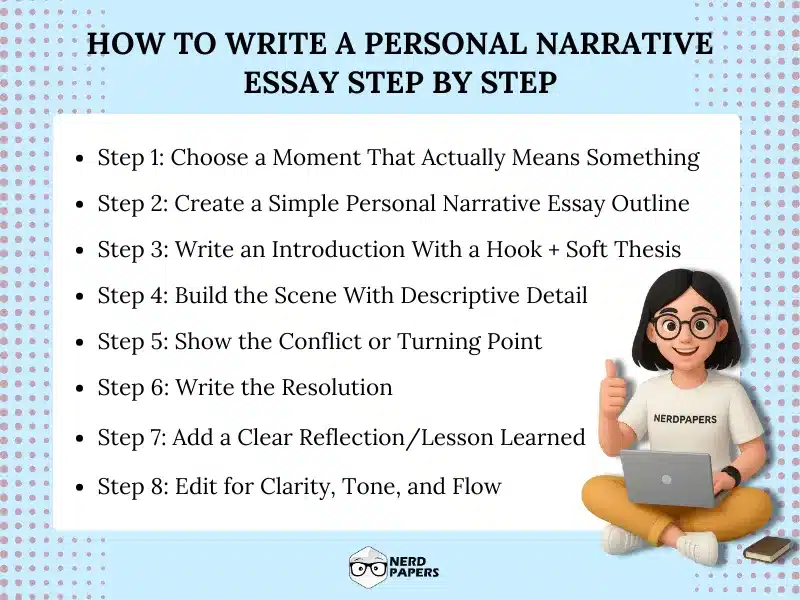
Step 1: Choose a Moment That Actually Means Something
A personal narrative isn’t a diary entry; it’s a story with a point. Pick an experience that taught you a lesson or changed your perspective. If you are having trouble recalling a specific memory, browsing through a list of narrative essay topics can help spark an idea that resonates with your own life. Remember, even small moments like a weird conversation or a tough choice can lead to a powerful essay.
Big dramatic events are cool, but even small moments work. These momoents can be a bad practice, a weird conversation, a tough choice, or a random day that hit differently.
Step 2: Create a Simple Personal Narrative Essay Outline
This doesn’t need to be fancy. Your outline can be as short as:
- Beginning: Where was I? Who was there? How did I feel?
- Middle: What happened? What went wrong? What changed?
- End: What did I realize? Why does it matter now?
This helps you organize the personal experience, characters, setting, conflict, and resolution before you start writing.
Step 3: Write an Introduction With a Hook + Soft Thesis
Use one of the hook styles from the previous section, like dialogue, action, or emotion. Then add a small hint of why the moment matters. This doesn’t need to be a formal thesis, just a guiding idea.
“That afternoon taught me what honesty actually looks like.”
This gives your story purpose from the start.
Step 4: Build the Scene With Descriptive Detail
A strong narrative feels like the reader is right there with you.
Use:
- sensory details (what you saw, heard, smelled)
- emotion (fear, excitement, embarrassment, frustration)
- pacing (slow down the important moments)
- small pieces of dialogue
This is where entities like setting, time, characters, and mood become important.
Step 5: Show the Conflict or Turning Point
Every good personal narrative has a moment where something shifts.
It might be:
- a mistake
- a challenge
- an argument
- a realization
- an unexpected event
This is the “middle” of a personal narrative essay, the part where tension builds before things get resolved.
Step 6: Write the Resolution
This is where the event settles. Maybe the problem gets fixed, or maybe you just learn something from it. Either way, the resolution ties the experience together.
Think:
- How did this situation end?
- What changed afterward?
- How did I feel once it was over?
Step 7: Add a Clear Reflection or Lesson Learned
This is the heart of a personal narrative. Without it, your essay is just a story.
A reflection could be:
- something you realized about yourself
- a new perspective
- a lesson
- a truth you didn’t understand before
This is where the insight, moral, or takeaway shows up naturally.
Step 8: Edit for Clarity, Tone, and Flow
Before turning it in, check:
- Does the story flow logically?
- Are there unnecessary details?
- Is the tone consistent?
- Does the reflection feel real, not forced?
- Have you used first-person (“I”) throughout?
- Does the essay feel like you?
This final step is what makes your writing clear, personal, and meaningful.
When you follow these steps to write a personal narrative essay, your story becomes more than just a memory. It becomes something readers can understand, connect with, and maybe even relate to.
How to End a Personal Narrative Essay
Ending a personal narrative essay is one of those things teachers never really explain well. They just say “add a reflection” and expect it to magically happen. But honestly, a strong ending is just you looking back at the moment and explaining why it stuck with you.
A great personal narrative essay conclusion answers two simple questions:
- What did this experience teach me?
- How did it change the way I think, feel, or act?
That’s it. You don’t need some dramatic “moral.” Just be real about what you learned or how the situation shaped you. Even small realizations count.
Steps to End a Personal Narrative Essay
Here are a few natural ways to wrap things up without sounding cheesy or forced:
1. Reflect on the Lesson
Talk about the insight you gained.
Looking back, that moment taught me that speaking up, even when it’s uncomfortable, matters more than staying quiet.
2. Compare the “Before” and “After”
Show how the experience changed you.
Before that day, I never questioned myself. Afterward, I understood why confidence starts with honesty.
3. Zoom Out to the Bigger Picture
Connect your story to real life.
It was a small incident, but it made me realize how fast things can shift when you actually trust yourself.
4. End With a Final Thought or Emotion
This works when the story doesn’t need a lesson.
Even now, the memory pops up sometimes, and it still makes me smile.
5. Tie Back to Your Hook
If your story started with a scene, you can return to it.
The gym doesn’t feel as intimidating anymore, but every time I walk past that court, I remember exactly how that day felt.
Personal Narrative Essay Conclusion Examples (Short + Natural)
Here are a few student-style ending lines you can model:
- I didn’t realize it then, but that experience shaped a part of who I am today.
- Looking back, I’m grateful it happened because it pushed me to grow.
- It wasn’t a perfect moment, but it was the one that changed me the most.
- Even now, I can still hear the echo of that lesson when I need it the most.
- That day didn’t solve everything—but it gave me the clarity to move forward.
A strong ending doesn’t need to be dramatic. It just needs to feel true.
Personal Narrative Essay Examples
Sometimes the easiest way to understand a personal narrative essay is just to read one. Seeing how another student handled the setting, the characters, the conflict, and the reflection makes the whole structure feel way less intimidating.
Below are three original personal narrative essay examples: one for high school, one for college, and one shorter example you can use as a quick reference. Each one shows how a real moment can turn into a meaningful story.
High School Personal Narrative Essay Example
(Approx. 150–170 words)
I still remember the exact squeak of my sneakers on the gym floor the afternoon I messed up the final serve of our volleyball game. We’d practiced that rotation all week, and I kept telling myself I was ready. But as soon as the ball sailed out of bounds, way out, I felt every pair of eyes in the room land on me.
My teammates tried to be nice about it, but I could tell everyone was disappointed. Honestly, I was disappointed in myself. I kept replaying the moment in my head, wondering how something so simple could fall apart so fast.
But the weird thing is, that mistake ended up helping me more than any win we had that season. After the game, our coach pulled me aside and told me that owning your mistakes is part of becoming a leader. It wasn’t the speech I expected, but it was exactly what I needed. Looking back, that serve taught me more about confidence and teamwork than any perfect hit ever could.
College Personal Narrative Essay Example
(Approx. 180–220 words)
During my first semester of college, I took a part-time job at a campus café mostly because I needed the money. I wasn’t expecting it to teach me anything deep. But on my third week, I messed up about six drink orders in a row during the lunch rush. People were frustrated, the line was practically wrapping around the counter, and I felt my chest tightening with every new customer.
I wanted to walk into the back room and hide, but my manager came over, took one look at me, and said, “Take a breath. You’re fine. Just slow down.” It sounded almost too simple, but somehow it helped. I stopped rushing, focused on one order at a time, and slowly the chaos settled.
That day taught me more about dealing with pressure than any lecture I’d sat through. I realized I didn’t need to be perfect at everything right away. I just needed to stay calm, stay kind, and keep trying. It’s funny, making coffee wasn’t supposed to change my life, but that afternoon shifted the way I handle stress in almost every part of my life now.
Short Personal Narrative Essay Example (120–150 Words)
The morning of my driver’s test, my hands were shaking so badly I could barely unlock the car. My instructor barely spoke the entire time, which only made me more nervous. Halfway through, I accidentally rolled a little too far past a stop sign. I thought I’d failed instantly.
But instead of giving up, I took a deep breath and finished the test as carefully as I could. When we parked, he looked at me, paused, and said, “You’re not perfect, but you’re safe. You passed.”
It wasn’t the confident victory I imagined, but it taught me something important: sometimes doing your best even when you’re terrified is enough.
Personal Narrative Essay Topics
Choosing a topic is honestly half the battle. A lot of students think they need some dramatic, life-changing event to write a good personal narrative essay, but that’s not true at all. Some of the best stories come from small, everyday moments that taught you something real.
Below are personal narrative essay topics that work for high school, college, and beginner writers. If a topic makes you remember a strong emotion, embarrassment, excitement, fear, or pride, it’s probably a good one.
Personal Narrative Essay Ideas for Beginners
- A time you felt proud of yourself
- Your most embarrassing moment (that you can laugh about now)
- The first day you tried something completely new
- A moment when someone surprised you with kindness
- A challenge you didn’t expect to overcome
- A time you had to make a tough choice
- When you realized you misunderstood someone
- The moment you bonded with a friend or teammate
- A small mistake that taught you a big lesson
- A time you faced a fear
High School-Friendly Personal Narrative Essay Topics
- A memorable sports game or performance
- A conversation that changed how you saw things
- Learning to stand up for yourself
- A time you disappointed someone and how you fixed it
- A family tradition that means a lot to you
- A childhood memory that still sticks with you
- The moment you realized you were growing up
College Personal Narrative Essay Topic Ideas
- Your first job or internship experience
- Moving away from home
- A class or professor that changed your perspective
- Your earliest struggle adjusting to college
- A moment when you questioned your identity
- A time you failed and had to rebuild your confidence
- A meaningful friendship in your adult life
Emotional or Reflective Narrative Ideas
- A moment that made you rethink your priorities
- A time you felt truly alone—but grew from it
- When you realized someone believed in you more than you believed in yourself
- A mistake you’re glad you made because it taught you something
- A difficult goodbye that changed you
These personal narrative essay topics and ideas work because they give you room to describe the setting, the emotion, the conflict, and the lesson. These are all the core elements of a strong narrative.
Tips to Improve Your Personal Narrative Writing
Even if you already have your story picked out, the way you tell it makes all the difference. A strong personal narrative essay isn’t just a list of events. It’s a mix of clear storytelling, honest emotion, and a reflection that feels real. Below are some simple, student-friendly tips for writing a personal narrative essay that actually connects with readers.
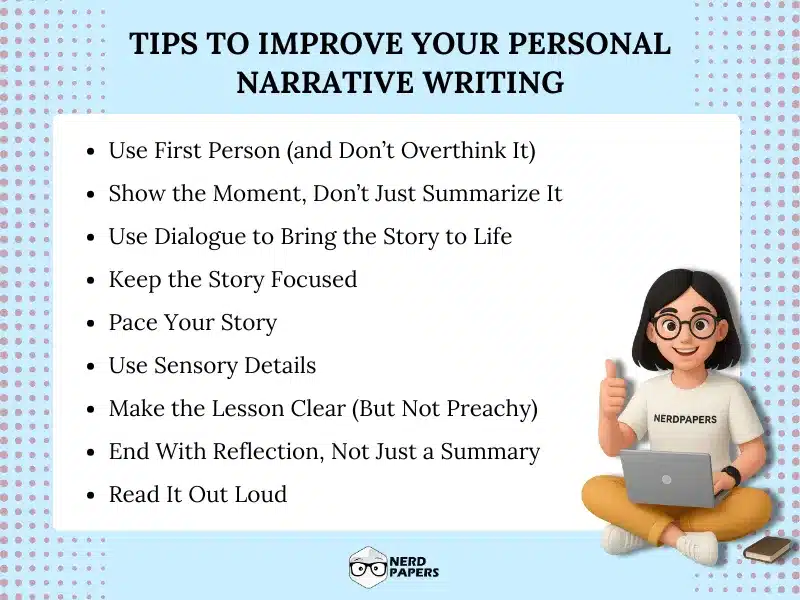
1. Use First Person (and Don’t Overthink It)
Personal narratives are supposed to sound like you. Use “I,” show what you were thinking, and let your natural voice come through. If it feels stiff or overly formal, loosen it up.
2. Show the Moment, Don’t Just Summarize It
Instead of writing:
“I was nervous before the presentation,”
try something like:
“My hands were shaking so badly I almost dropped the note cards.”
Specific details make the story feel real.
3. Use Dialogue to Bring the Story to Life
A small line of dialogue can completely change the energy of a scene. It also helps readers hear the characters the way you remember them.
4. Keep the Story Focused
A personal narrative essay works best when it centers on one main event or experience. If you try to include too much, the message gets cloudy.
5. Pace Your Story
Slow down during important moments and speed up through less important ones. This creates a natural rhythm and makes key moments stand out.
6. Use Sensory Details
Think about what you saw, heard, smelled, or felt. Even one or two sensory moments can make the writing more vivid.
7. Make the Lesson Clear (But Not Preachy)
Every good narrative has some kind of insight. Keep it honest and simple. You’re not giving a TED Talk—you’re just showing what you learned.
8. End With Reflection, Not Just a Summary
Instead of restating everything, show how the experience changed you. This is what makes a good personal narrative essay feel complete.
9. Read It Out Loud
If your story sounds awkward when spoken, it’ll feel awkward on the page. Reading it out loud helps you catch weird phrasing and improve the flow.
These tips for writing a personal narrative essay keep your story emotional, organized, and engaging. When you mix clear storytelling with real reflection, your writing becomes something readers can genuinely connect with.
Personal Narrative Essay Checklist
Before you hit “submit,” it helps to run through a quick checklist to make sure your personal narrative essay has all the key parts. Think of this like a final walk-through to catch anything missing or confusing. A strong narrative is clear, emotional, and reflective—and this list covers all of that.
- Hook: Does your opening sentence grab attention or set the scene?
- Introduction: Did you introduce the setting, the characters, and the overall mood of the moment?
- Clear Focus: Is your essay centered on one main event or experience?
- First-Person Voice: Did you stick with “I” throughout the story?
- Sensory Details: Did you describe what you saw, heard, felt, or thought during the moment?
- Conflict or Tension: Is there a challenge, problem, or turning point in your story?
- Dialogue (Optional but Helpful): Did you include any small pieces of dialogue to bring the moment to life?
- Emotional Arc: Can readers tell how you felt during different parts of the experience?
- Reflection / Lesson Learned: Does your conclusion explain why the moment mattered or what you learned?
- Smooth Flow: Does the story move naturally from beginning → middle → end?
- Final Read-Through: Did you read the essay out loud to catch awkward sentences or missing details?
Using this checklist makes your writing cleaner, clearer, and more meaningful—basically everything your teacher is hoping for.
Conclusion
Writing a personal narrative essay might feel overwhelming at first, but once you break it down, it’s really just a story about a moment that mattered to you. The structure helps keep things clear, the hook pulls readers in, and the reflection at the end gives the whole thing purpose. And honestly, the more you practice telling your own stories, the easier it becomes to recognize which moments shaped you and why.
By now, you know how to start your essay with a strong hook, how to build your scenes, how to show your emotions without overdoing it, and how to end your narrative in a way that feels complete. You’ve also seen real examples, topic ideas, and a checklist you can use anytime you’re stuck.
FAQs
What’s the purpose of a personal narrative essay?
A personal narrative essay lets you share a real experience in a meaningful way. It shows what you went through, how it felt, and what you learned from it. Teachers assign it to help you practice storytelling and reflection.
How long should a personal narrative essay be?
Most personal narrative essays are between 500–1,000 words, but teachers sometimes ask for shorter ones (like 250 words) or longer ones (750+). The length really depends on your assignment.
What point of view should I use?
Personal narratives are almost always written in first-person (“I”) because you’re telling your own story. It’s your experience, so it should sound like your voice.
What’s the best way to start a personal narrative essay?
Start with a hook, a line of dialogue, a moment of emotion, or a vivid detail. The goal is to make readers feel like they just stepped into the moment with you.
Do personal narrative essays need a thesis statement?
Not a formal one. But a “soft thesis” (a line hinting at the lesson or message) helps give your story direction. Something like, “That day taught me what trust really looks like.”
Can I use dialogue in a personal narrative essay?
Absolutely. Dialogue can bring your characters to life and make the moment feel real. Even one sentence of dialogue can change the tone of a scene.
What mistakes should I avoid while writing my personal narrative essay?
Try not to jump around too much, summarize everything, or end without reflection. The biggest mistake is telling a story with no clear purpose or takeaway.
How do I end a personal narrative essay effectively?
A strong ending focuses on the reflection—what you realized or how the experience changed you. It shouldn’t just repeat what already happened; it should show growth or insight.