Imagine you’ve just finished reading a well-argued essay. The points were clear, the evidence was solid—yet the final paragraph feels rushed or vague. It’s like watching a movie that cuts to black before the ending. Frustrating, right?
That’s what happens when a strong conclusion is missing. The conclusion isn’t just a formality—it’s your final chance to wrap things up, reinforce your main idea, and leave your reader with a sense of closure.
If you’ve ever wondered how to write a conclusion for an essay that feels complete and impactful, you’re in the right place. In this guide, we’ll walk you through each step, show you real examples, and highlight common mistakes to avoid—so your essay ends just as strong as it begins.
If you’re not sure how the conclusion fits into the bigger picture of an essay, start by reviewing the full essay structure to see how each part—introduction, body, and conclusion—works together to build a clear, organized argument.
What Is an Essay Conclusion?
An essay conclusion is the final paragraph that brings your entire essay to a close. It’s where you restate your main argument, summarize your key points, and give the reader a final impression that ties everything together.
But a conclusion isn’t just about repeating what you’ve already said. A well-written conclusion shows how your ideas connect, explains why they matter, and provides a sense of completeness. It helps your reader walk away with clarity, not confusion.
Think of it as the answer to the question:
👉 “Now that I’ve read this, so what?”
In most essays, a conclusion includes:
- A restated thesis in new words
- A brief summary or synthesis of the main ideas
- A final thought, reflection, or call to action (depending on the essay type)
Whether you’re writing a school assignment, a college application essay, or an analysis paper, the conclusion is your last chance to make your point clear and memorable.
💡 Remember: Don’t introduce new information or arguments here—focus on wrapping up what you’ve already written.
Why Is the Conclusion Important?
A strong conclusion does more than just end your essay—it helps your ideas stick.
Think of the conclusion as your last word. It’s the final moment to remind your reader what you’ve said, why it matters, and how everything fits together. Without a clear ending, even a well-written essay can feel unfinished or confusing.
Here’s why the conclusion matters:
- It provides closure: Your reader needs a sense of completion. A strong ending signals that your argument is complete and the discussion is wrapped up.
- It reinforces your message: Restating your thesis and summarizing your main points helps strengthen your argument in the reader’s mind.
- It leaves a lasting impression: Whether it’s a powerful quote, a thought-provoking idea, or a call to action, your last sentence is often what the reader remembers most.
- It answers the “So what?” question: A good conclusion reminds the reader why your essay matters in a bigger context.
A weak or rushed conclusion can undo the impact of everything that came before it. But a strong conclusion can leave your reader thinking—even after they’ve finished reading.
Key Components of a Strong Essay Conclusion
Every strong essay conclusion follows a simple but powerful structure. While the wording and tone may change depending on your topic or essay type, the key elements usually stay the same.
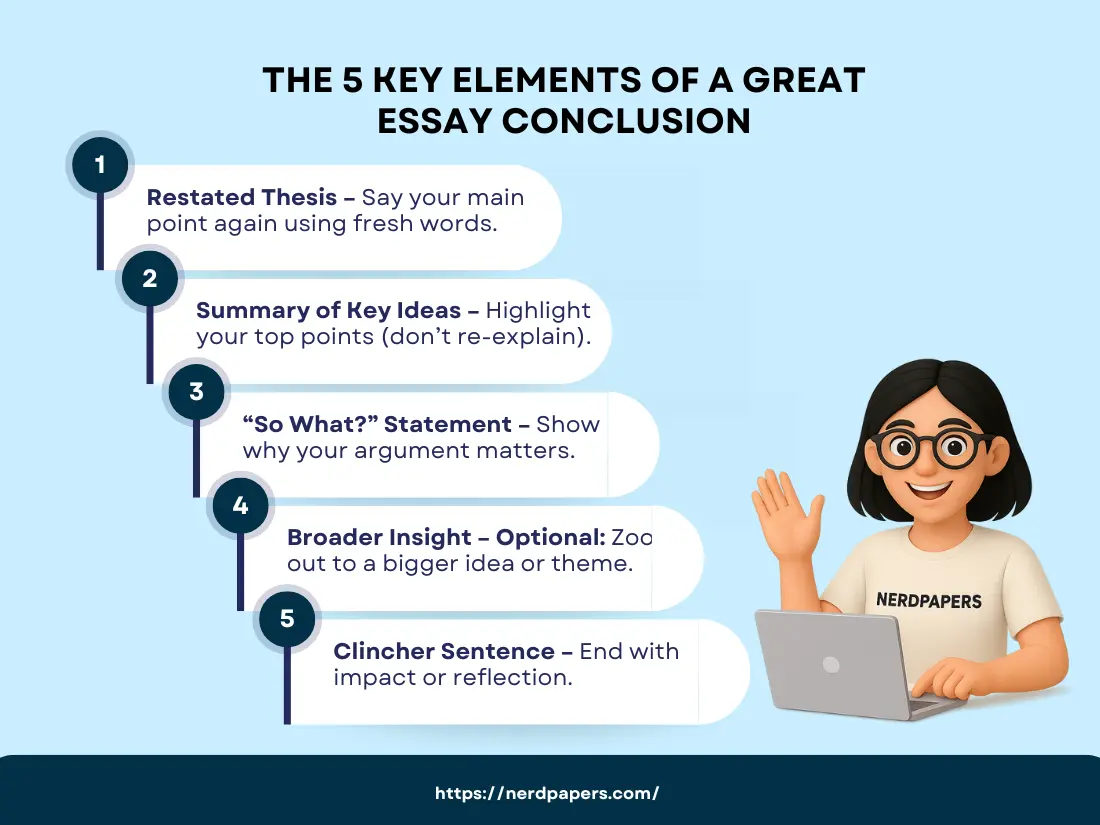
Here are the main parts to include in your conclusion:
Restated Thesis
Briefly remind the reader of your main argument—but don’t just copy-paste your original thesis. Reword it in a fresh, meaningful way that fits the flow of your final paragraph.
Example:
Original: “Social media negatively impacts teen mental health.”
Restated: “Overall, social media can harm young people’s mental well-being when used without balance or boundaries.”
Summary or Synthesis of Key Points
Quickly highlight your most important points. This helps tie everything together. You can mention 2–3 of your strongest arguments or insights without re-explaining them.
💡 Avoid listing points like a checklist—aim for a smooth summary that connects ideas.
“So What?” Statement
Answer the question: Why does this all matter? This part explains the larger purpose or real-world significance of your essay.
💡 Think about: What should the reader take away from this? What’s the bigger picture?
Broader Perspective (Optional)
Zoom out. Connect your topic to a larger theme, issue, or implication. This works well in reflective, analytical, or informational essays.
Example: “As technology continues to shape our world, understanding its impact on mental health will remain more important than ever.”
Clincher or Closing Phrase
End with a sentence that feels final. This could be a powerful statement, a rhetorical question, a short reflection, or even a callback to your essay’s introduction or hook.
💡 Make sure it feels intentional—not rushed or generic.
Call to Action (For persuasive essays only)
If your goal is to persuade, leave your reader with a specific next step or challenge.
Example: “It’s time for schools, parents, and platforms to take teen mental health seriously and promote healthier online habits.”
Each of these elements plays a role in crafting a clear, impactful ending. You don’t need to include every one every time—but the best conclusions usually contain at least three or four.
Step-by-Step – How to Write a Conclusion Paragraph for an Essay
Now that you know the key parts of a conclusion, let’s break down exactly how to write one—from the first sentence to the last.
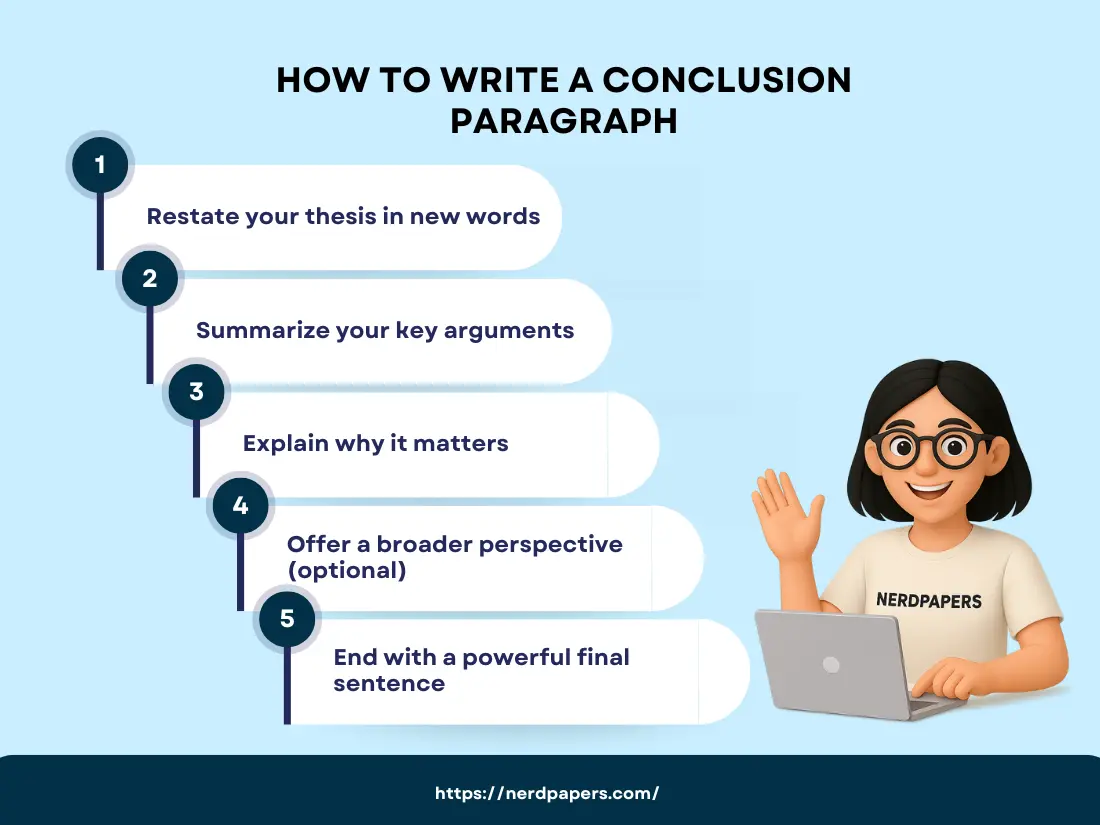
Follow these five simple steps to create a conclusion that’s clear, structured, and effective:
Step 1: Restate Your Thesis (in Different Words)
Start your conclusion by reminding the reader of your main point—but use fresh wording. This reinforces your message without sounding repetitive.
💡 Tip: Don’t copy-paste your thesis. Instead, rephrase it to reflect the insights you’ve shared throughout the essay.
Step 2: Summarize Your Key Points
Briefly go over your main arguments or ideas. Pick 2–3 of the strongest points from your essay body and tie them together in a few short sentences.
💡 Avoid re-explaining—focus on connecting ideas clearly and concisely.
Step 3: Answer “So What?”
Help the reader understand why your argument matters. This is your chance to show real-world relevance, emotional impact, or long-term importance.
💡 Think about what the reader should take away from your essay.
Step 4: Offer a Final Thought or Broader Insight
Depending on your topic, you can zoom out and leave the reader with a larger reflection, a big-picture idea, or a connection to current issues or the future.
💡 Optional but powerful—especially in analytical or narrative essays.
Step 5: End with a Strong Closing Sentence
Finish with a sentence that sounds final and confident. This could be a bold statement, a call to action (for persuasive essays), or a thought that sticks with the reader.
Avoid weak endings like “That’s why…” or “In conclusion…”
Instead, try:
“Only by understanding the risks can we build a healthier digital future.”
💡 Pro Tip: Before finalizing your essay, re-read your introduction. A strong conclusion often mirrors the intro—bringing your ideas full circle.
How to Start a Conclusion in an Essay
Starting your conclusion the right way sets the tone for a strong finish. But many students make the mistake of using dull, overused phrases that weaken the impact of their final paragraph.
❌ What Not to Use:
Avoid cliché or mechanical phrases like:
- “In conclusion,”
- “To sum up,”
- “In summary,”
- “As I have shown,”
These can make your writing feel basic or repetitive—especially in academic settings where stronger transitions are expected.
✅ Better Ways to Start a Conclusion
Instead of robotic phrases, use natural transitions that help your ideas flow. Here are some alternatives to begin your final paragraph with more purpose and clarity:
- “Taken together, the evidence suggests that…”
- “Ultimately, this discussion highlights…”
- “These points clearly demonstrate that…”
- “Looking at the bigger picture, we can see that…”
- “All things considered, it’s clear that…”
- “Reflecting on the arguments above, it’s evident that…”
These openers still signal closure—but in a more thoughtful and reader-friendly way.
💡 Tip: Your conclusion should feel like a natural next step—not a sudden shift. Let it flow from the last body paragraph with a soft transition, not a hard stop.
Conclusion Styles Across Essay Types (General Overview)
While the basic structure of a conclusion stays the same—thesis restatement, summary, and final thought—the tone and purpose can vary depending on the type of essay you’re writing. Each essay type has its own rhythm and goal.
Here’s a general idea of how different essay types influence the way you end your paper:
Informative or Expository Essays
Focus on clarity and understanding. Your conclusion should summarize the main points and leave the reader with a key takeaway or broader understanding of the topic.
Example: “Understanding climate change is the first step toward creating long-term solutions for a healthier planet.”
Narrative or Personal Essays
These conclusions often reflect on personal growth, lessons learned, or emotional impact. Aim for a reflective, memorable final line that ties back to the story.
Example: “Though the journey was difficult, it taught me the value of resilience and self-belief.”
Persuasive or Argumentative Essays
These endings usually restate the position strongly and often include a call to action or a powerful closing statement to inspire change or agreement.
Example: “It’s time to act—not just talk—if we want to create real change in how we support mental health in schools.”
Example of a Strong Essay Conclusion
Seeing how all the pieces fit together can make the writing process much easier. Below is an example of a clear, structured essay conclusion—followed by a short breakdown of what makes it effective.
Sample Essay Topic:
Should schools start later in the day to improve student well-being?
Example Conclusion Paragraph:
Starting school later in the day is more than a matter of convenience—it’s a practical way to support student health, focus, and academic performance. Studies show that teens need more sleep to function at their best, yet early school start times often work against their natural sleep cycles. Delaying the start of the school day could reduce stress, improve mental health, and lead to better learning outcomes. If we truly want students to thrive, adjusting school schedules to match their biological needs is a step worth taking.
Why This Works:
| Component | Explanation |
| Restated Thesis | “Starting school later… is a practical way to support student health…” |
| Summary of Key Points | Mentions sleep, stress, and learning outcomes |
| So What? Statement | “If we truly want students to thrive…” → real-world relevance |
| Clincher Sentence | A confident, persuasive closing: “…a step worth taking.” |
💡 Notice how the paragraph doesn’t repeat ideas word-for-word. Instead, it connects the dots in a smooth, final message that reinforces the essay’s argument.
Common Mistakes to Avoid in Essay Conclusions
Even strong essays can lose their impact if the conclusion falls short. Here are some of the most common mistakes students make—and how to fix them.
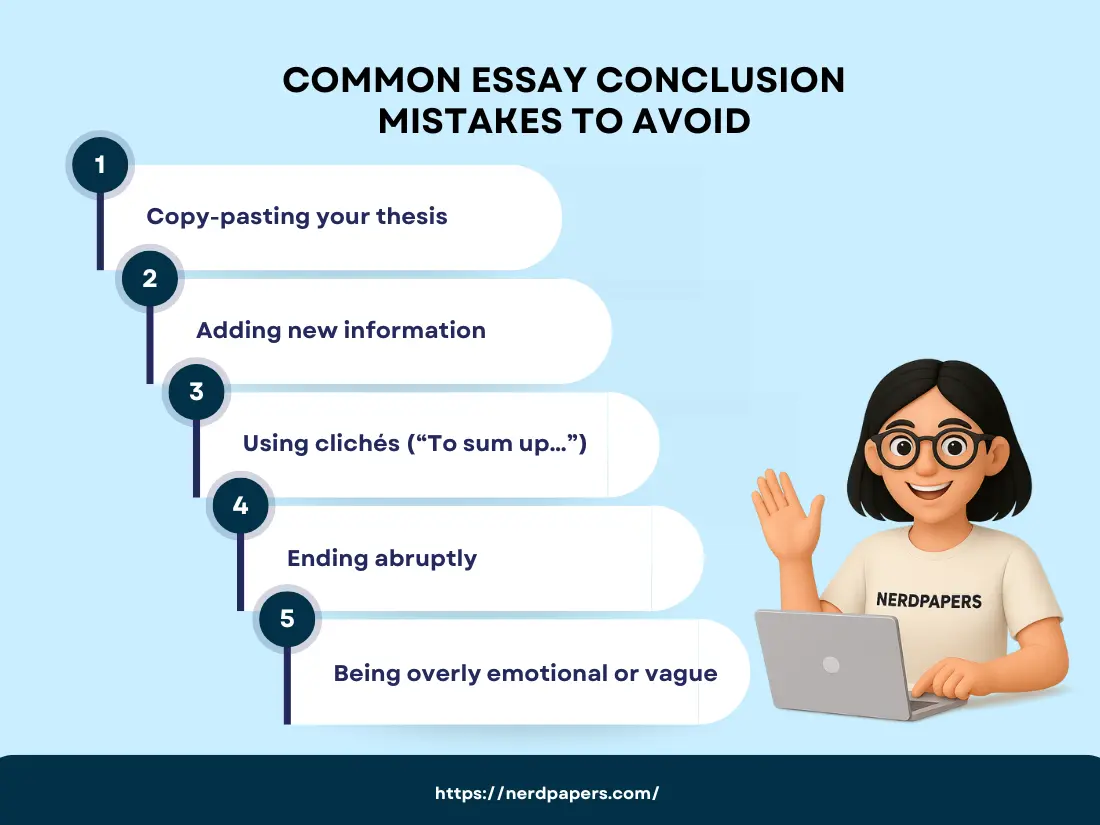
1. Repeating the Thesis Word-for-Word
Why it’s a problem: Copying your original thesis makes your conclusion sound lazy or robotic.
What to do instead: Rephrase your thesis using different words to show deeper understanding.
2. Listing Points Like a Summary Sheet
Why it’s a problem: A checklist-style summary feels mechanical and disconnected.
What to do instead: Synthesize your ideas—connect your key points into a smooth, final message.
3. Introducing New Information
Why it’s a problem: The conclusion is not the place for new evidence or arguments. This confuses the reader.
What to do instead: Stick to what you’ve already covered. Focus on wrapping up, not adding more.
4. Ending Abruptly
Why it’s a problem: A rushed or one-sentence ending feels incomplete.
What to do instead: Take time to reflect, reinforce your argument, and close with intention.
5. Using Generic or Cliché Phrases
Why it’s a problem: Phrases like “In conclusion” or “As you can see” sound overused and unoriginal.
What to do instead: Use natural transitions or confident statements that flow from the body of your essay.
6. Getting Too Emotional or Off-Topic
Why it’s a problem: Overly dramatic or personal endings can distract from your main point.
What to do instead: Stay focused. Keep your tone consistent and your conclusion aligned with the rest of the essay.
Avoiding these common mistakes can take your conclusion from “meh” to memorable.
Essay Conclusion Writing Checklist
Before you hit submit, use this quick checklist to make sure your essay conclusion is clear, complete, and impactful.
Ask yourself:
Structure & Content
- Have I restated my thesis in fresh, original wording?
- Did I summarize or connect my key points clearly?
- Did I explain why my argument matters (the “So what?”)?
- Does my conclusion reflect the overall purpose of the essay?
Avoiding Mistakes
- I didn’t introduce any new information or arguments.
- I avoided copy-pasting or repeating phrases from earlier sections.
- I didn’t use generic transitions like “In conclusion.”
Impact & Final Impression
- Does my last sentence feel strong, memorable, or thoughtful?
- Does the paragraph give the reader a sense of closure?
- Would I feel satisfied reading this as the final paragraph?
💡 Tip: Reading your introduction and conclusion side by side can help you check for alignment and flow.
Final Thoughts – End with Confidence
Writing a strong conclusion doesn’t have to be complicated—it just takes a little strategy and intention.
Your conclusion is the final step in guiding your reader through your ideas. Done well, it brings your message full circle and leaves a lasting impression that ties your essay together.
If you’ve ever felt unsure about how to wrap things up, remember this: clarity, structure, and a sense of purpose are all you need to finish strong.
With a little practice, you’ll not only know how to write a conclusion for an essay—you’ll be able to write one that stands out.
FAQs – Essay Conclusion Writing
How do you write a conclusion for an essay?
Start by restating your thesis in new words, then summarize your key points, explain why they matter, and finish with a strong final sentence. Avoid introducing new information.
What are the 3 parts of an essay conclusion?
Restated thesis
Summary or synthesis of main points
Final thought, reflection, or call to action
Can I add new information in the conclusion?
No. A conclusion is for wrapping up your existing points—not for adding new arguments or evidence.
How do I end an essay with impact?
Use a clincher sentence that leaves a lasting impression. You can end with a reflective insight, a rhetorical question, or a call to action—depending on your essay type.
What’s the difference between a summary and a conclusion?
A summary briefly restates key points. A conclusion goes further by wrapping up the argument and showing its broader significance.
How long should a conclusion paragraph be?
Usually 4–6 sentences. Long enough to be meaningful, but short enough to stay focused.
Should I use phrases like “In conclusion”?
It’s better to avoid overused phrases like “In conclusion” or “To summarize.” Use more natural transitions like “Overall,” or “Taken together…”
How do you end an essay effectively?
To end an essay effectively, restate your thesis using new words, briefly summarize your main points, and include a strong closing sentence that leaves a lasting impression. Avoid new information and cliché phrases.
What’s a strong way to end an essay?
A strong ending might include a powerful final thought, a reflective insight, or a call to action—depending on the essay type. Make sure it connects to your thesis and gives the reader closure.
What’s the last sentence of an essay supposed to do?
The last sentence should wrap up your message, reinforce your main point, and leave the reader thinking. It’s often called a clincher and should feel final and impactful.
Can you ask a question to end an essay?
Yes—especially in reflective or narrative essays. Ending with a rhetorical question can leave the reader thinking, but make sure it ties back to your main argument or message.
How do you end the conclusion of an essay?
End the conclusion with a sentence that feels complete and confident. Avoid weak transitions like “That’s why…” Instead, use phrases like “This shows that…” or “Ultimately, this reveals…”
Is it okay to use quotes at the end of an essay?
Yes, but only if the quote reinforces your main point and adds meaning. Avoid using a quote as a substitute for your own final thought—your voice should be the last one the reader hears.