You stare at a blank screen, the cursor blinking like it’s judging you. The deadline is looming, but you’re stuck on the very first sentence. Sound familiar? You’re not alone—over 70% of students say the introduction is the hardest part of writing an essay, especially when it comes to crafting a strong hook for essay writing.
That opening line—the hook—is your chance to grab your reader’s attention and pull them into your argument, story, or analysis. Whether you’re writing a high school assignment or a college-level paper, a powerful essay hook can set the tone for everything that follows.
In this guide, you’ll learn what a hook in an essay is, why it matters, and how to write one that’s engaging, relevant, and easy to connect to your topic. We’ll break down the different types of hooks, give you examples, and show you how to avoid common mistakes.
Of course, a great hook is only the beginning. To see how it fits into the full structure, check out our complete guide on how to write an essay introduction, where we walk you through every part of the opening paragraph.
What Is a Hook in an Essay?
A hook in an essay is the first sentence (or two) of your introduction that’s designed to grab the reader’s attention. It acts as a bridge between the reader and your topic, making them curious enough to keep reading.
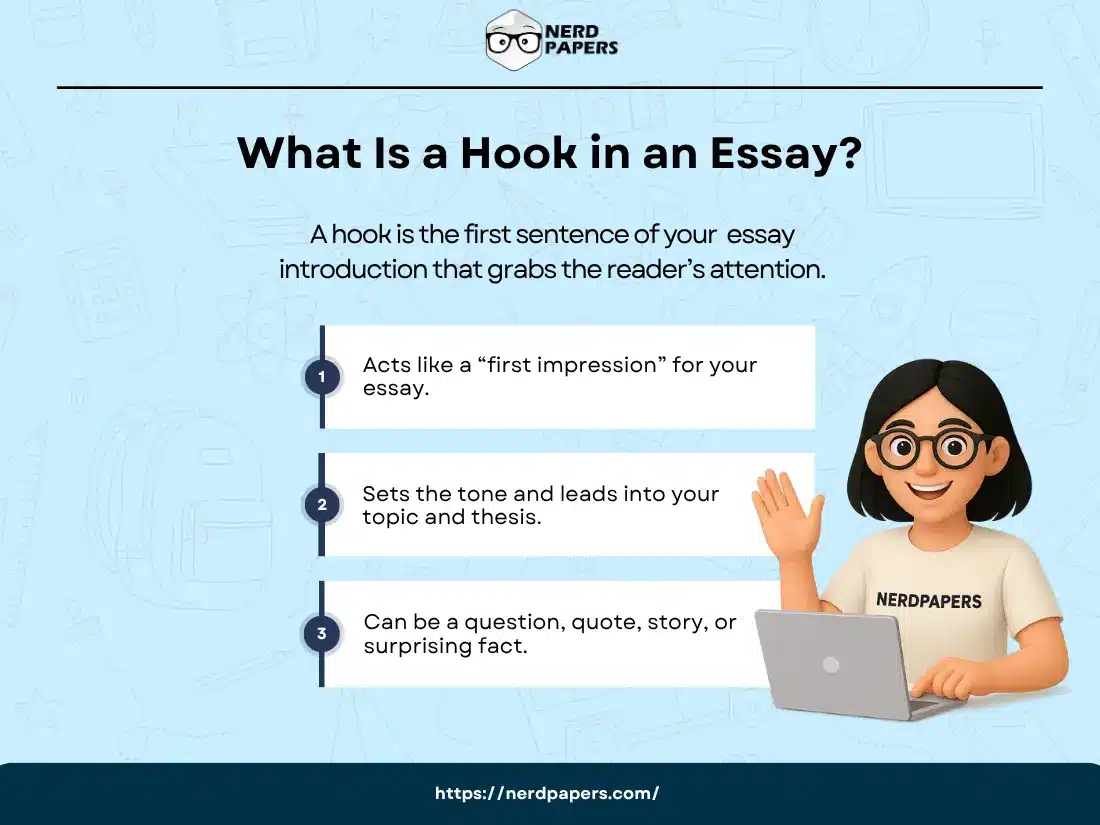
Think of it as your essay’s first impression—it sets the tone and encourages engagement right from the start.
In simpler terms, a hook can:
- Ask a thought-provoking question
- Share an interesting fact or statistic
- Offer a compelling quote
- Tell a brief personal story
- Make a bold or surprising statement
No matter the type, the goal is the same: to make your audience want to read more.
Why Is the Hook Important in Essay Writing?
A strong hook isn’t just a fancy way to start your essay—it’s a functional part of academic writing that helps you make a strong first impression.
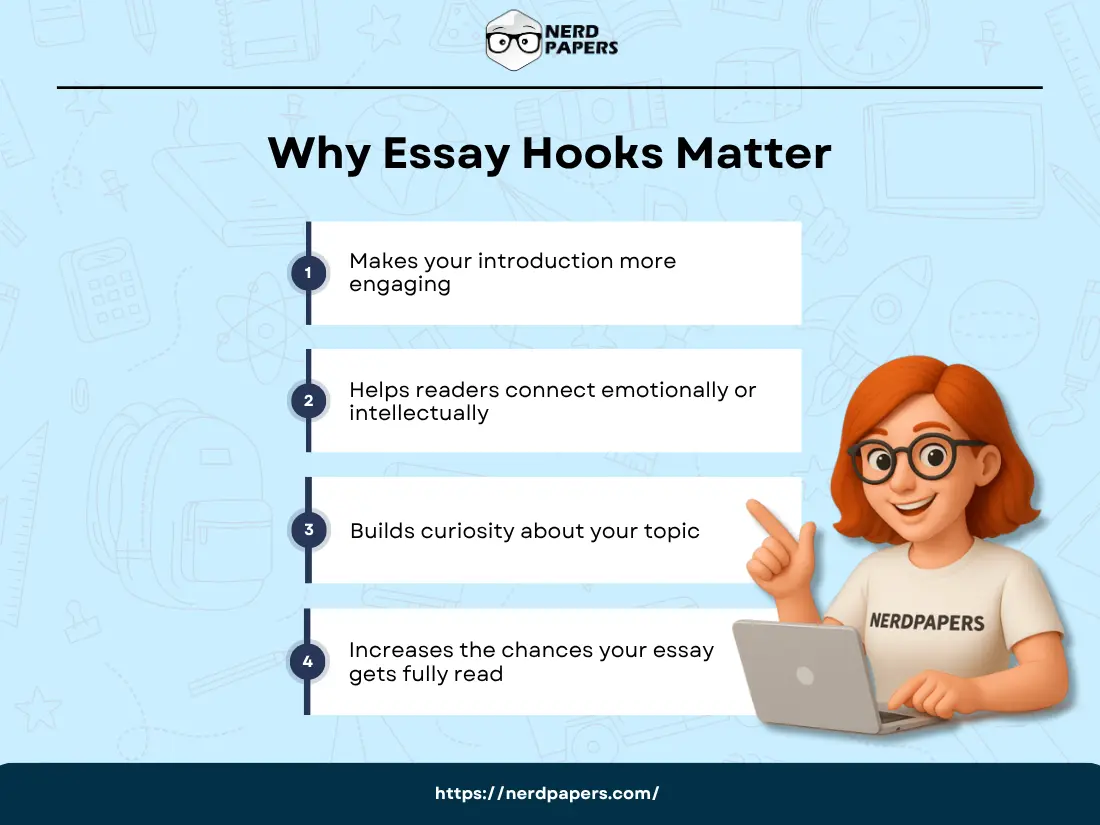
📚 Here’s why the hook matters:
- Grabs attention: Your hook pulls the reader in from the very first line, especially important in academic settings where professors review dozens of essays.
- Sets the tone: Whether you’re being serious, persuasive, or reflective, your hook gives readers a sense of your writing voice and style.
- Establishes relevance: A well-crafted hook makes your topic feel timely, relatable, or important right away.
- Encourages reader engagement: In both formal writing and timed exams, a compelling hook increases the chance that your essay is read carefully, not skimmed.
- Leads into your argument: Your hook builds a smooth transition into your background information and thesis statement.
In academic essays especially, a good hook helps meet your reader’s expectations—and shows you’re in control of your writing.
Types of Hooks for Essays (With Examples)
There’s no single perfect way to begin an essay—but using the right type of hook for essay writing can help you grab attention and set the tone from the first sentence. The best hook depends on your audience, topic, and essay purpose.
Below are 10 effective types of hooks, complete with explanations and examples to help you choose the right one for your next assignment.
1. Question Hook
What it is: A question hook opens your essay with a thought-provoking question. It invites your reader to think and instantly engages them.
Best used when: You want to challenge assumptions or encourage curiosity. Great for persuasive or reflective essays.
Example:
👉 “What if your daily habits could predict your future success?”
This makes the reader stop and think—and want to find out more.
2. Quotation Hook
What it is: This hook uses a quote from a famous person, author, or expert that directly relates to your topic. It adds credibility or emotion to your opening.
Best used when: You want to support your topic with wisdom or authority. Works well in literary analysis, argument, or reflective essays.
Example:
👉 “As Maya Angelou once said, ‘There is no greater agony than bearing an untold story inside you.’”
It connects emotion and meaning right from the start.
3. Statistic or Fact Hook
What it is: This hook gives a surprising, powerful, or shocking statistic or fact. It immediately creates interest and shows relevance.
Best used when: You want to impress the reader with real-world data. Perfect for expository, argumentative, or research-based essays.
Example:
👉 “Over 80% of teenagers check their phones before getting out of bed.”
This makes readers think about how that fact connects to the essay’s topic.
4. Anecdotal Hook (Personal Story)
What it is: An anecdotal hook starts with a brief personal story that connects emotionally or relates directly to your topic.
Best used when: You want to create a human connection, especially in personal, reflective, or narrative essays.
Example:
👉 “At age nine, I sold lemonade to raise money for a local shelter—and learned more than I expected.”
It draws the reader in with emotion and real-life experience.
5. Definition Hook
What it is: This hook defines a term, concept, or idea in a surprising or insightful way. It’s especially useful if your essay centers around a commonly misunderstood term.
Best used when: Your essay discusses abstract or complex concepts—common in academic or analytical writing.
Example:
👉 “Resilience isn’t about avoiding failure—it’s about bouncing back stronger.”
This redefinition adds clarity and depth to the topic.
6. Bold Declaration Hook
What it is: A strong, confident, or controversial statement that grabs attention immediately. This hook makes the reader curious or even disagree—both are effective.
Best used when: You want to take a clear stance. Excellent for argumentative, persuasive, or opinion essays.
Example:
👉 “Grades are a broken system that fail to measure real learning.”
This makes a strong point and prepares readers for a bold argument.
7. Common Misconception Hook
What it is: This hook challenges a belief many people hold. By correcting a common myth, you immediately engage and surprise your reader.
Best used when: Your essay aims to change the reader’s perspective or debunk widely accepted ideas.
Example:
👉 “Many believe introverts dislike people—but that couldn’t be further from the truth.”
It sets up the essay to clarify the truth.
8. Simile or Metaphor Hook
What it is: This hook uses a comparison to make your topic more vivid or relatable. It can be emotional, funny, or descriptive.
Best used when: You want to create a memorable image in the reader’s mind. Effective in narrative, descriptive, or reflective essays.
Example:
👉 “Writing an essay is like assembling IKEA furniture—confusing at first, but satisfying in the end.”
It adds humor and a visual connection.
9. Catchy Phrase or Pop Culture Hook
What it is: A hook that uses modern slang, humor, or a pop culture reference to sound relatable and fresh. It works well with younger audiences and informal essays.
Best used when: You’re writing with a conversational tone or trying to appeal to students or younger readers.
Example:
👉 “It’s giving… academic excellence.”
Short, modern, and catchy—it makes readers curious and entertained.
10. Thesis Preview Hook
What it is: A subtle version of your thesis used as a hook. It teases your central idea while still being engaging.
Best used when: You want to dive into your main point without a dramatic opening. Ideal for exam responses or when time is tight.
Example:
👉 “This essay will show why climate change isn’t tomorrow’s problem—it’s today’s emergency.”
This prepares the reader and blends smoothly into the full introduction.
💡 Pro Tip: You don’t have to master every type. Focus on choosing the hook that feels natural, matches your essay’s purpose, and makes your reader want to keep going.
How to Write a Hook for an Essay – (Step-by-Step Process)
Writing a good hook for an essay doesn’t have to be complicated. The goal is to create an opening that captures attention and sets the stage for your topic.
Follow these steps to craft a hook that works for any type of essay:
1. Know Your Audience and Purpose
Think about who will read your essay (teacher, exam grader, classmates) and what you want them to feel or understand.
- Writing a formal argument? A bold statement or statistic may work.
- Telling a personal story? Start with an anecdote or vivid imagery.
2. Choose the Right Hook Type
Pick a hook that aligns with your essay type and topic. Refer to the Types of Hooks section above for ideas like:
- Rhetorical question for curiosity
- Statistic for shock
- Anecdote for emotion
- Quotation for authority
3. Keep It Brief but Meaningful
Most hooks are 1–2 sentences max. Don’t overexplain—let the hook do its job: draw the reader in.
4. Connect to the Topic
Your hook should clearly relate to your essay’s subject. Avoid random facts or stories that don’t tie back to your main idea.
5. Lead into Your Thesis Smoothly
Your hook shouldn’t float alone. Use a transitional sentence after the hook to guide your reader into the background info and thesis.
Common Mistakes to Avoid with Essay Hooks
Even the best essay ideas can fall flat if your hook misses the mark. To make sure your hook is actually effective—not distracting or confusing—avoid these common pitfalls:
1. Using a Hook That Doesn’t Relate to the Essay Topic
Mistake: Starting with a fun fact, story, or joke that has nothing to do with your thesis.
Why it’s a problem: It confuses readers and feels disjointed when you shift into your actual topic.
Instead:
Choose a hook that flows naturally into your background info and thesis.
Example Fix: If your essay is about the effects of social media, don’t start with a story about your dog—start with a stat about screen time instead.
2. Making the Hook Too Long or Complex
Mistake: Writing a full paragraph or a complicated story before getting to the point.
Why it’s a problem: You’ll lose your reader’s attention before they even know what your essay is about.
Instead:
Keep your hook short and sharp—ideally 1 to 2 sentences.
Example Fix: Replace a long anecdote with a quick moment that still illustrates your point.
3. Using Overused or Cliché Hooks
Mistake: Starting with “Since the beginning of time…” or “Webster’s Dictionary defines…”
Why it’s a problem: These are tired openers that teachers see all the time—they sound generic and unoriginal.
Instead:
Be creative. Use a fresh stat, surprising fact, or personal insight that feels authentic.
Example Fix: Replace “Since the dawn of civilization…” with a surprising, current stat or opinion.
4. Starting with a Quote Without Context
Mistake: Throwing in a famous quote with no explanation or connection to your topic.
Why it’s a problem: It feels random or forced if you don’t explain why the quote matters.
Instead:
Choose a quote that directly supports your argument and connect it to your thesis.
Example Fix: After the quote, add a sentence explaining how it relates to your topic.
5. Skipping the Significance
Mistake: Including a hook that sounds nice but doesn’t show why it matters.
Why it’s a problem: The reader may not understand the importance of your point—or why they should care.
Instead:
Always follow up your hook with a sentence that shows how it relates to your topic or argument.
Example Fix: After a statistic about climate change, add: “This shows how urgently we need to act—starting with awareness.”
🎓 Final Tip: A good hook is relevant, clear, and purposeful. It leads your reader smoothly into the rest of your introduction—don’t let it become a distraction.
Tools & Aids to Create Essay Hooks
Crafting the perfect hook for essay writing doesn’t always come naturally—and that’s okay. Whether you’re stuck staring at a blank screen or just need a little inspiration, there are tools and strategies to help you get started.
Below are some of the best aids—both digital and mental—that can help spark your creativity:
1. Online Hook Generators & Writing Tools
These tools can give you fresh ideas, suggest phrases, or even help with sentence structure.
- Grammarly – Helps refine your hook for clarity, tone, and engagement.
- Hemingway Editor – Ensures your hook is punchy and easy to read.
- AI Tools – Use writing assistant tools to generate creative opening lines but don’t fully rely on them. Use them to get ideas.
🧠 Pro Tip: Don’t copy-paste results. Use them as a starting point and rewrite in your own voice.
2. Brainstorming with a Purpose
Before using a tool, ask yourself:
- “What emotion do I want to create—shock, curiosity, empathy?”
- “What’s the most interesting fact, story, or idea about my topic?”
- “If I were the reader, what would grab my attention?”
Jot down answers and turn them into hook drafts. Sometimes, the best hook comes from your own thoughts—not a generator.
3. Look at Strong Examples
Read the introductions of high-scoring essays or your favorite blog articles. Pay close attention to:
- What type of hook they use (question, anecdote, quote)
- How they lead from the hook into their thesis
- Whether the tone matches the essay’s topic and audience
✍️ Try This: Rewrite those hooks in your own words, then apply the same pattern to your own topic.
4. Use Google & News Headlines for Inspiration
Headlines are built to grab attention—just like hooks. Search your topic and skim:
- Google’s “People also ask” section
- Trending news headlines
- Reddit and Quora questions on your topic
These can spark great question hooks, bold statements, or even common misconceptions to challenge.
5. Practice Writing 3 Different Hook Types
Don’t try to get it perfect on the first try. Instead:
- Write a question hook
- Then try a fact/statistic hook
- Then write a personal anecdote
Compare the three and choose the one that fits your topic and tone best. The more you practice, the easier hook writing becomes.
Quick Essay Hook Examples to Inspire Your Opening Line
Already know the types of essay hooks but still stuck writing your first line?
Use this section as a cheat sheet when you need quick ideas. These realistic hook examples are easy to adapt for any essay topic—and perfect for sparking inspiration fast.
| Hook Type | Example | Best For |
| Question Hook | “What if your phone addiction is silently changing your brain?” | Persuasive, Analytical |
| Quotation Hook | “Education is the most powerful weapon which you can use to change the world.” – Nelson Mandela | Reflective, Social Issues |
| Statistic or Fact Hook | “One in three teens reports feeling anxious almost every day.” | Research, Argumentative |
| Anecdotal Hook | “When I was 12, I failed a math test and learned more than any lesson could teach me.” | Personal, Narrative, Reflective |
| Definition Hook | “Success isn’t measured by money, but by the impact you leave on others.” | Analytical, Expository |
| Bold Declaration Hook | “Homework is doing more harm than good in modern education.” | Argumentative, Opinion-Based |
| Common Misconception Hook | “Many people believe that sleep is optional—but it’s as vital as food or water.” | Informative, Persuasive |
| Simile or Metaphor Hook | “Writing an essay is like planting a seed—you need the right tools and patience to grow it.” | Descriptive, Creative, Reflective |
| Catchy Phrase/Pop Culture | “TikTok isn’t just a distraction—it’s reshaping how we learn.” | Youth-Centered, Technology Topics |
| Thesis Preview Hook | “This essay will explain why financial literacy should be a mandatory high school subject.” | Timed Exams, Academic Argument |
Summing Up: Why Your Essay Hook Matters
Writing a great hook for an essay isn’t just a stylistic trick—it’s a skill that can dramatically improve how your writing is received. A strong hook creates interest, sets the tone, and invites the reader into your argument or story. Whether you’re writing a persuasive piece, a narrative, or an academic paper, choosing the right hook helps your introduction shine and sets the foundation for the entire essay.
By understanding the different types of essay hooks—from personal anecdotes to bold claims—you can pick the one that best fits your topic and audience. Then, using the step-by-step tips, tools, and examples in this guide, you’ll be able to write hooks that not only grab attention but also connect seamlessly to your thesis.
FAQ – Answering Common Hook Questions
What is a hook in an essay?
A hook is the opening sentence (or two) of your essay that’s designed to grab the reader’s attention. It can be a question, fact, quote, or short story that sets the tone for what’s to come. A strong hook also smoothly leads into your introduction and thesis.
How long should an essay hook be?
Ideally, an essay hook is just 1 to 2 sentences long. It should be short, clear, and attention-grabbing. If it takes too long to get to the point, readers may lose interest before they reach your thesis.
Which type of hook works best for academic essays?
It depends on the essay’s tone and topic. For academic essays:
Use a statistic, quotation, or definition hook for a formal tone.
Avoid overly casual or humorous hooks like pop culture references.
Make sure the hook connects logically to your thesis and argument.
Can I start an essay with a question?
Absolutely. Question hooks are a great way to make readers think and engage them early. Just be sure it’s relevant and not too broad. Follow it up with background info and a clear thesis to guide your reader forward.
Should I always use a hook when writing an essay?
Yes—especially for essays in school, exams, or college applications. A hook helps:
Draw in your reader
Set a strong tone
Improve overall flow of your introduction
In rare cases, like scientific abstracts, a direct start might be acceptable—but for most essays, a hook adds real value.
How do I choose the right type of essay hook?
Ask yourself:
What emotion or reaction do I want to trigger? (Curiosity, surprise, empathy?)
Who is my audience—teacher, peer, general reader?
What’s the tone of my essay—formal, reflective, personal?
Then choose a hook type (question, anecdote, fact, etc.) that matches your goal and writing style.
Can my hook be the thesis statement?
No—the hook and thesis are different.
The hook grabs attention.
The thesis explains your main argument or focus.
But they should connect smoothly. A good essay introduction moves from hook → background → thesis in one natural flow.
Is a hook the same as a lead-in?
Not exactly. A hook is designed to grab attention in the very first sentence, while a lead-in provides background or context after the hook and before the thesis. The hook is flashy and engaging; the lead-in is logical and informative.
Can I write the hook after finishing the essay?
Yes! In fact, many writers find it easier to write the hook last—after they’ve finished their body paragraphs and conclusion. That way, the hook can directly reflect the tone and message of the full essay.
What are some examples of bad essay hooks?
Here are a few types to avoid:
Overused clichés like “Since the beginning of time…”
Dictionary definitions (e.g., “Webster defines success as…”)
Generic questions like “Have you ever wondered?”
Jokes that don’t land or feel off-topic
Can I use humor in my essay hook?
Yes—if it fits the tone of your essay and is used skillfully. Humor can make your writing memorable, but it’s risky in formal essays. When in doubt, test it on someone else to see if it hits the right note.
How does the hook relate to the rest of the essay?
Your hook should:
Grab attention
Introduce the topic indirectly
Set the tone
Lead naturally into your background info and thesis
Think of it like the opening scene of a movie—it sets the mood and direction without giving away everything at once.
Do different essay types need different hook styles?
Yes. Here’s a quick match-up:
Argumentative: Bold statement, statistic, question
Narrative: Anecdote, simile/metaphor, quote
Expository: Definition, fact, thesis preview
Persuasive: Bold claim, question, shocking fact
Analytical: Quotation, statistic, rhetorical question