

Imagine trying to assemble a puzzle without knowing the picture on the box. That’s what writing an analytical essay without an outline feels like. An analytical essay outline acts as the blueprint, helping organize your thesis, evidence, and analysis into a logical order. It not only makes writing smoother but also ensures that every argument clearly supports your main point.
This guide explains how to write an analytical essay outline, step by step, highlights common pitfalls, shares strategies to strengthen your structure, and provides a practical example. To see how a structured outline translates into a complete essay, a guide on writing an analytical essay shows how each section of an outline develops into coherent, fully fleshed-out paragraphs.
Understanding the Analytical Essay Outline
An outline of an analytical essay is a guide that helps you to arrange your ideas and evidence before you begin writing. Think of it like a roadmap: it illustrates how your introduction, the body paragraphs and your conclusion will be arranged and that each point will support your thesis and will work towards a logical argument. Unlike a complete essay draft, an outline does not have complete sentences and transitions; instead, it reveals key topics, examples and logic among them.
An outline is the process that a writer undertakes in understanding their thoughts to prevent them from wandering and attaining a proper balance in focus between analysis and evidence. Drawing bright directions and making the actual essay could be much easier and less frightening for students or others who want a systematic, well-laid, logical essay outline. It calls for a position logically, stating all assertions with relevant facts to support them.
By understanding the framework and its operation, one can better prepare one’s mind for writing and focus on in-depth analysis rather than organizing.
Why You Need an Outline Before Writing
An outline is associated with a varied number of benefits, but one more important factor is the strategy you choose for focusing work on the analytical essay. The outline presents the convenience of organizing your ideas with respect to the thesis statement. It becomes easier to follow the essay’s progression this way. Thus, otherwise, the analytical essay becomes more summary-like or strays onto unrelated matters, or else the interconnected logics of arguments start appearing too tricky to unfold.
As much as drafting saves time, one can only guess that the outline does so. When you know what to include, what to exclude, where evidence is needed, and how every thought fits together, you can write faster with greater confidence.It promotes a narrow focus and makes it easier to balance the analysis and supporting evidence and stay on track in the writing.
In addition, outlines help in critical thinking. Planning your ideas makes you identify flaws in your reasoning, predict points of pre-emptive argument, and build up the overall effectiveness of your essay.
For anyone looking to produce a structured and persuasive essay, creating an outline before starting to write is a foundational practice that makes the rest of the process smoother and more effective.
Standard Analytical Essay Outline Structure
Creating a strong analytical essay outline begins with understanding the hierarchy of ideas rather than the full sentences of the essay. A typical outline breaks down the essay into three core sections: introduction, body, and conclusion, but emphasizes planning the points and evidence instead of drafting prose.
1. Introduction Section in Outline:
- Note the hook ideas, context points, and working thesis.
- Include bullet points for key background information and argument direction.
- Focus on what the introduction should accomplish, not on writing it word-for-word.
2. Body Paragraphs in Outline:
- Assign a topic or main idea to each paragraph.
- List evidence, examples, or references to support each idea.
- Include notes on the analysis you’ll provide—how evidence links to the thesis.
- Indicate where transitions or connections between paragraphs might be needed.
3. Conclusion Section in Outline:
- Jot down the thesis restatement in different words.
- Highlight the key points or insights from the essay.
- Note any final reflections or implications to close the essay effectively.
This outline-focused structure keeps your ideas organized before you begin writing, acting as a blueprint that guides the essay. It is about mapping and planning, not drafting sentences, which makes it clearly different from a writing-focused essay structure.
How to Create an Analytical Essay Outline (Step by Step)
Creating an effective analytical essay outline doesn’t have to be complicated. Following a clear, step-by-step approach ensures your ideas are organized and your analysis is focused before you begin writing.
Step 1: Understand the topic or text
Prior to outlining, one should consider understanding a book, film, speech, or historical event under consideration. Try pinpointing central themes, arguments, or perhaps trends of your choice for consideration in your outline. In this way, your outline will contain the most significant points. Here are some analytical essay topics for you to get some inspirations.
Step 2: Develop a working thesis statement
Include a one- or two-line statement that summarizes your major argument or point. This working thesis will be used to structure your outline, giving you an idea of which points and evidence are the most important.
Step 3: Brainstorm and group ideas
List every possible point, proof, and illustration. Next, organize similar concepts into clusters. This step helps identify natural sections for body paragraphs and ensures each paragraph will maintain a distinct emphasis.
Step 4: Arrange ideas into outline sections
Establish your introduction, body paragraphs and conclusion. In the introduction, determine potential hooks, context and a tentative thesis statement. In the case of the body paragraphs, each paragraph has to be assigned one main point and supported by evidence or analysis. In the conclusion, provide a restatement of the thesis, the main conclusions and perhaps some final remarks.
Step 5: Refine and expand the outline
Review your outline to ensure logical flow and balance. Add any missing evidence or analysis notes. The objective is to develop a plan that will facilitate the writing of the essay to be smooth and effective.
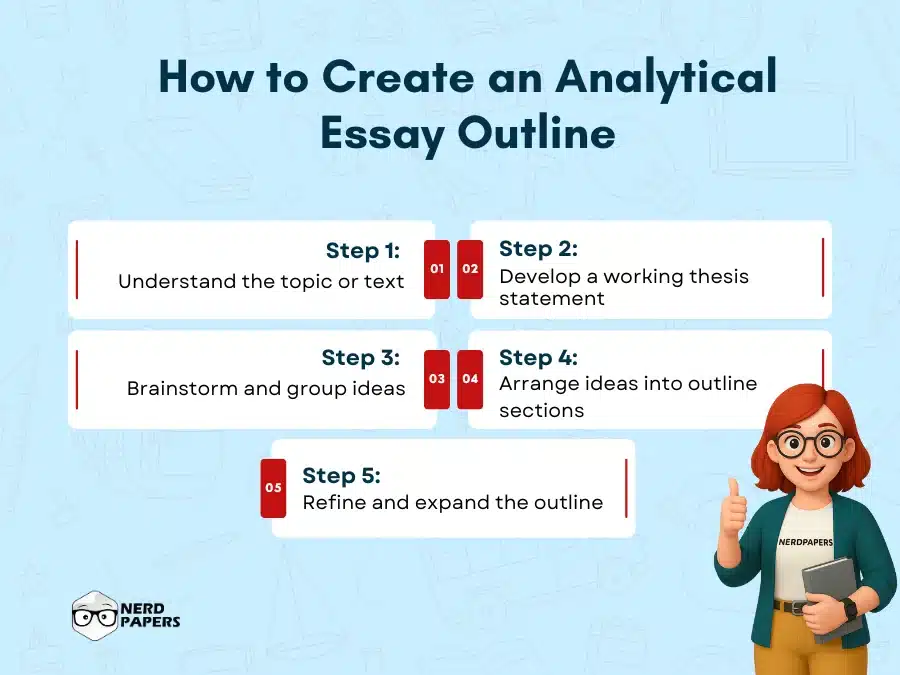
By following these steps, you’ll have a clear, well-organized outline for your analytical essay that will help you organize your thoughts and focus on the writing process. Its primary focus is on structure and clarity as a planning aid, not on beautiful writing.
Example of an Analytical Essay Outline
To make the process clearer, here’s a sample analytical essay outline for analyzing symbolism in a novel:
Topic: Analyzing symbolism in a novel
Introduction
- Hook idea: Start with a compelling question about the symbolism in the novel.
- Context: Brief background on the novel and its themes.
- Working Thesis: “In The Great Gatsby, the green light symbolizes the unattainable nature of the American Dream, reflecting both hope and disillusionment for the characters.”
Body Paragraph 1
- Topic: Gatsby’s pursuit of the green light represents his personal ambition.
- Evidence: Quote from Gatsby looking at the light across the bay.
- Analysis: Connect how this ambition drives his decisions and reflects broader societal ideals.
Body Paragraph 2
- Topic: The green light symbolizes the illusion of success.
- Evidence: Scenes showing the contrast between Gatsby’s dream and reality.
- Analysis: Show how the symbol highlights the gap between desire and attainment.
Body Paragraph 3
- Topic: The green light and disillusionment.
- Evidence: Characters’ reactions when Gatsby’s dream fails.
- Analysis: Explain how the symbol reinforces the theme of lost hope and societal critique.
Conclusion
- Restate Thesis: Summarize how the green light symbolizes ambition, illusion, and disillusionment.
- Key Insights: Highlight how symbolism deepens the novel’s message.
- Final Thought: Consider how the theme of unreachable dreams resonates beyond the story.
This example shows how an outline of an analytical essay organizes your thoughts, evidence, and analysis points before writing. It acts as a roadmap, making it easier to convert ideas into fully developed paragraphs while keeping the argument focused and coherent.
Common Mistakes To Avoid in Analytical Essay Outlines
Even strong ideas can get lost if your outline isn’t carefully crafted. Here are common pitfalls to watch out for when creating an analytical essay outline, along with tips to avoid them:
- Being too vague: Writing broad points like “analyze the character” or “discuss the theme” doesn’t give clear direction. Instead, specify exactly which character traits or themes you will analyze and which evidence supports them.
- Overloading with quotes or examples:Outlines serve to show ideas rather than keep full text. Long sections will make your outline complicated and useless. Note just major citations or quotations with brief annotations.
- No logical flow:Your argument may be messed up if you arrange points randomly. Gather connected concepts and see to it that body paragraphs follow sensibly from one to the other.
- Forgetting analysis notes: Just giving facts without noting how they support the argument sometimes causes writers to go overboard. Include brief reminders of the analysis you want to present.
- Ignoring paragraph balance: Sometimes outlines show unbalanced body parts, with one paragraph loaded with notes and another empty. Make sure every paragraph concentrates equally so the finished essay is balanced.
- Failing to refine the thesis alignment: Outlines sometimes diverge from the main idea. To maintain focus, make sure every argument in your essay is precisely tied to your thesis.
By avoiding these mistakes, your analytical essay outline becomes a powerful tool that saves time, keeps arguments organized, and ensures your final essay is cohesive and persuasive.
Tips to Make Your Analytical Essay Outline More Effective
Creating an outline is only the first step; making it strong ensures your essay will be coherent, focused, and persuasive. Here are practical strategies to enhance your analytical essay outline:
- Keep it flexible: Outlines do not have a fixed pattern. As your analysis progresses, be prepared to change arguments or shift evidence. Your essay can develop organically if you are flexible.
- Focus on analysis, not summary:The topic or idea you will be presenting should be reflected in each point of your outline, not merely the events of the text. This makes sure that the essay maintains its analytical approach rather than becoming descriptive.
- Align every point with the thesis:Check your outline to see that every argument, bit of data, and piece of analysis contributes squarely to your thesis. A strong argument may be undermined by points that don’t connect.
- Use concise keywords or phrases: Write down brief words or phrases rather than complete statements in the outline. With this approach, the outline is still readable and concentrates on structure rather than design.
- Balance paragraphs and sections: Ensure body paragraphs have roughly equal weight and all sections are proportionate. A balanced outline helps the essay maintain clarity and flow.
- Incorporate evidence cues: Note where you will include quotes, examples, or references, but keep them brief. Short cues help you remember your sources without cluttering the outline.
- Check for logical progression: Review the sequence of points to confirm that arguments build on each other. Smooth transitions in the outline make drafting the essay much easier.
By following these tips, your analytical essay outline becomes a practical roadmap that simplifies writing, strengthens arguments, and improves the overall quality of your essay.
Final Thoughts on Analytical Essay Outlines
An analytical essay outline does not simply carry a means for planning, but is reduced to a coherent, persuasive, and well-structured essay. Structuring the thought, fact, and reasoning first, then writing, allows one to concentrate on making useful arguments, rather than tying them together in the process.
It makes clear the logical flow, the balance of paragraphs, and the effectiveness of each piece of evidence in proving one’s thesis. Think of your outline as an elastic map to aid your writing but still gives the opportunity to improve it as you learn more about the subject.
Finally, taking time to prepare a thorough outline will simplify the task of writing your essay and improve the overall level of your analysis essay. Learning to write an outline of an analytical essay is one of the steps on the way to writing better and more confidently, with clearer arguments.
Frequently Asked Questions (FAQs)
What is an analytical essay outline?
An analytical essay outline is a structured plan that organizes your main ideas, evidence, and analysis points before writing. It helps clarify your thesis, maintain logical flow, and ensure each paragraph supports your argument.
Why do I need to write an analytical essay outline?
Writing an outline saves time during drafting, keeps your ideas organized, prevents off-topic tangents, and ensures each piece of evidence supports your thesis. Essentially, it acts as a roadmap for a clear and persuasive essay.
How detailed should my analytical essay outline be?
Your outline should include key points, supporting evidence, and brief notes on analysis. It doesn’t need full sentences or fully developed paragraphs, just enough guidance to make drafting the essay easier.
Should I use full sentences in my analytical essay outline?
Using full sentences is optional. Many writers prefer short phrases or keywords to keep the outline concise and flexible. Full sentences can help clarify complex points but may slow down the planning process.
Should I fully stick to my analytical outline when writing?
An outline is a guide, not a strict rule. It’s fine to adjust points, reorganize evidence, or add new insights while drafting. Flexibility ensures your essay develops naturally and accommodates stronger arguments that arise during writing.
Can I use first person in an analytical essay outline?
Yes, your outline can include first-person notes if it helps organize thoughts, but the final essay typically avoids first-person unless the assignment specifically allows a personal perspective.
Do teachers or professors require formal outlines for analytical essays?
Some instructors may request formal outlines, especially for longer essays, while others may encourage informal planning. It’s best to clarify expectations for each assignment.
Is there a universal template for analytical essay outlines?
While the basic structure of introduction, body paragraphs, and conclusion remains consistent, outlines can be adapted to fit different topics, subjects, and essay lengths. Flexibility is key.