

Ever stared at a blank page, knowing you’re supposed to analyze a book, film, or poem, but instead find yourself retelling the story? You’re not alone. Many students confuse analysis with summary, and that’s exactly where most analytical essays fall short.
An analytical essay isn’t about narrating what happened; it’s about breaking down a subject through close reading, interpreting its elements, and using textual evidence to show how those parts create meaning. Whether you’re examining a character in a novel, the symbolism in a movie, or the rhetoric in a speech, analytical writing pushes you to think deeper and argue smarter.
In this guide, we’ll cover everything from understanding what an analytical essay really is to structuring your ideas, avoiding common mistakes, and polishing your work so it leaves a lasting impact. And if you ever feel stuck or want professional guidance, you can always turn to an analytical essay writing service to get tailored support while you refine your own skills.
What Is an Analytical Essay?
An analytical essay is a type of academic writing that goes beyond summarizing a subject. Instead of retelling what happened in a text, event, or film, you examine its parts using critical thinking and literary analysis techniques, interpret their meaning, and explain how they work together to create a larger message.
It’s easy to confuse analytical essays with other types of writing, so here’s the distinction:
- A descriptive essay paints a picture of what something is, without asking why.
- An argumentative essay tries to convince the reader of one side using logic and evidence.
- An analytical essay, on the other hand, doesn’t aim to persuade or merely describe; it evaluates and interprets details to reveal underlying meaning.
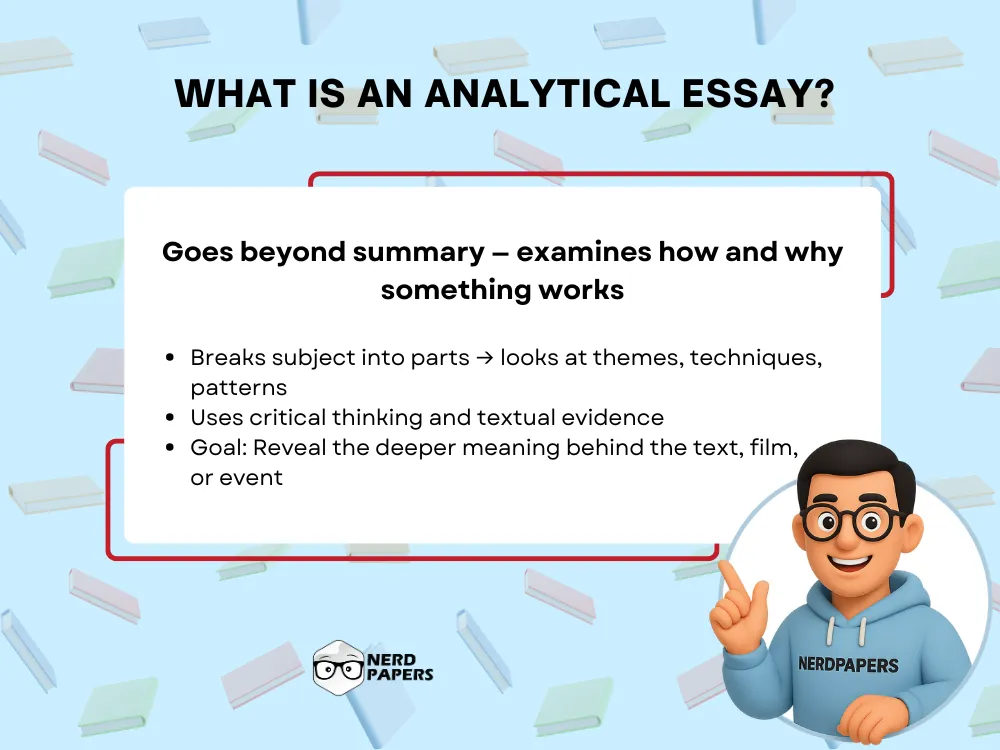
But what is the aim of an analytical essay? It is fundamentally about learning to think, argue and give evidence, and deliver a balanced explanation. You are not responding to what has happened, but why it happened and why it is important.
As an example, you would have the analysis of a novel in terms of the repetition of imagery to the main theme of the novel. In a speech you can examine how rhetorical techniques like repetition or pathos affect the response of the listeners/readers. The subject matter may change but the principle is the same, deconstruct, analyze it and present your findings in a manner that could be understood.
Why Are Analytical Essays Important?
Analytical essays are not like other academic assignments; rather, they are a way to learn stretch skills that you can use long after you have finished your studies. Fundamentally, they help you become more adept at thinking critically and to approach things with curiosity and openness rather than taking them at face value. By breaking down the complicated issue, you develop your ability to recognize relationships, evaluate the available data, and draw logical conclusions.
They also help in strengthening you as a communicator. Writing clearly is thinking clearly, and practicing writing an analytical essay will compel you to organize the points, describe them accurately and support them with evidence. The same skills are sought in work-related areas where clarity and rational thinking are important, e.g., law, business, journalism, etc.
Analytical essays are also found in the academic world: in literature, you may analyze themes and symbols; in history, you may examine causes and effects; in psychology, you may analyze studies and action; in film studies, you may analyze cinematography and storyline. The qualities do not change, no matter the topic, clarity, logical arguments, and evidence-based arguments are the same attributes.
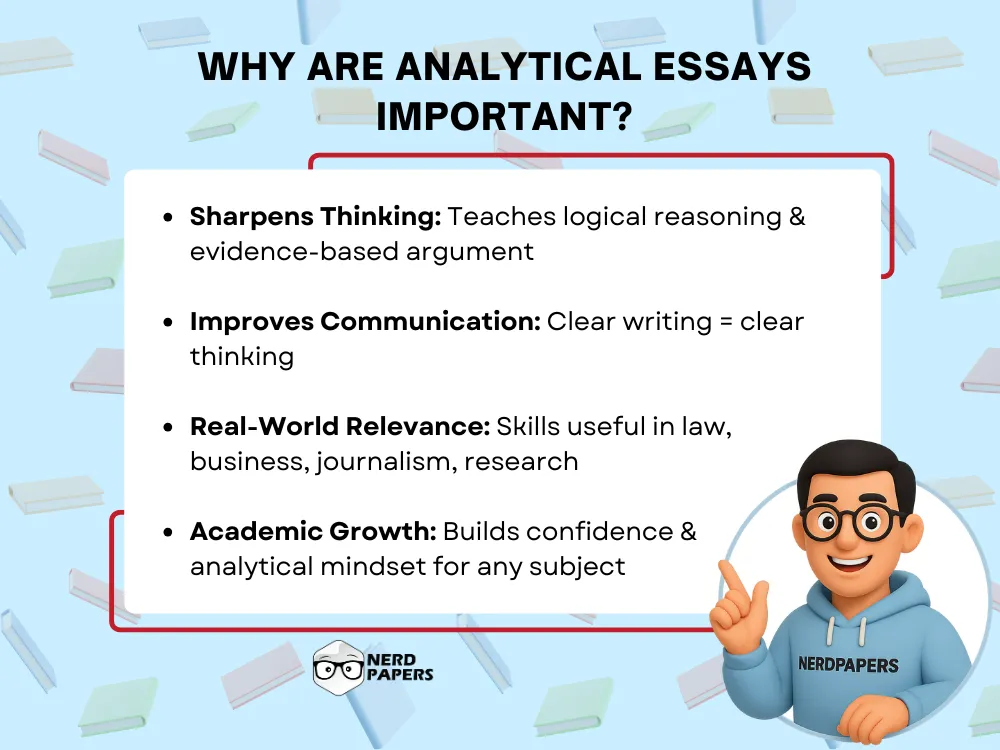
That’s why mastering analytical writing isn’t just about passing a class. It’s about learning how to process information critically, communicate persuasively, and make arguments that actually hold weight.
Analytical Essay Structure (The Framework You Need)
Every strong essay stands on a solid framework, and an analytical essay is no different. Knowing how to structure an analytical essay helps you stay organized, make your argument clear, and guide your reader from start to finish. The standard structure follows a simple but effective outline: Introduction → Body Paragraphs → Conclusion.
1. Introduction
The opening sets the tone. Start with a hook to grab attention, provide enough context to ground your reader, and end with a clear thesis statement that outlines the main point you’ll be analyzing.
2. Body Paragraphs
Each body paragraph should focus on a single idea. Begin with a topic sentence, then support it with textual evidence, quotes, examples, or data. Follow up with your analysis, showing how and why the evidence matters. Smooth transitions between paragraphs keep the flow logical and easy to follow.
3. Conclusion
The conclusion isn’t just a repeat of your thesis; it’s your chance to leave an impression. Restate your main argument in fresh words, summarize the key insights from your analysis, and close with a final thought that reinforces the significance of your essay.
This basic analytical essay structure works across subjects, whether you’re analyzing a novel, a historical event, or a piece of media. Stick to it, and you’ll have a clear, reader-friendly essay every time.
Steps to Write an Analytical Essay
Knowing the structure is one thing; actually writing an analytical essay is another. To make the process less overwhelming, break it down into clear, manageable steps:
1. Choose a strong topic
Pick a subject that’s specific enough to analyze but broad enough to discuss in detail. The best topics allow you to dig beneath the surface instead of just summarizing.
2. Read or observe your subject carefully
Whether it’s a novel, poem, film, or speech, spend time engaging with it. Take notes, mark key passages, and pay attention to recurring themes, techniques, or patterns.
3. Develop a thesis statement
Your thesis is the backbone of your essay. It should present a clear claim about your subject and hint at the evidence you’ll use to support it.
4. Create an outline
Before you start analytical essay writing, sketch a roadmap: introduction, body paragraphs, and conclusion. This prevents your essay from drifting and keeps your argument focused.
5. Write the introduction
Begin with a hook, provide context, and introduce your thesis. This tells your reader exactly what your essay will analyze and why it matters.
6. Build body paragraphs
Each paragraph should focus on one point. Start with a topic sentence, back it up with evidence, and then explain how that evidence supports your thesis. Smooth transitions keep your essay cohesive.
7. Conclude with insights
In your conclusion, restate your thesis in fresh words, tie together your main points, and leave the reader with a final insight or takeaway.
8. Edit and proofread
No matter how strong your ideas are, careless errors can weaken them. Revise for clarity, grammar, and logical flow before submitting.
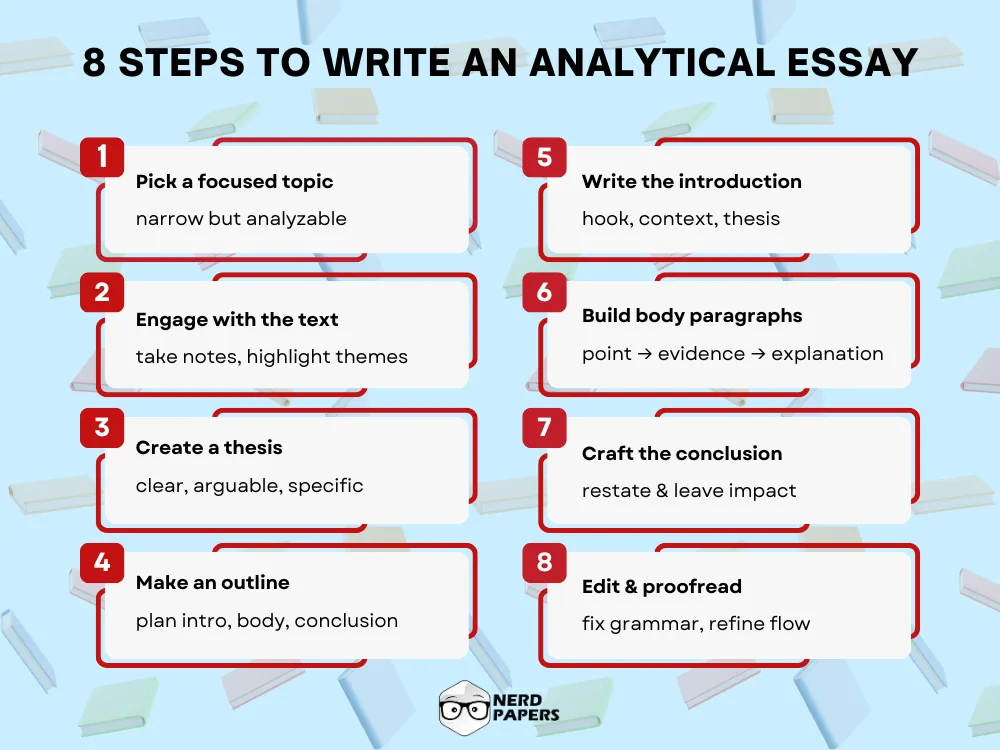
Following these steps makes analytical essay writing far more approachable. Instead of staring at a blank page, you’ll have a clear process for how to write analytical essay assignments with confidence and structure.
How to Start an Analytical Essay (Crafting the Introduction)
The first few lines of your analytical essay decide whether your reader leans in with interest or skims past without much thought. That’s why learning how to start an analytical essay is just as important as building the body or the conclusion. A strong analytical essay introduction usually follows three key moves:
1. Hook your reader
Begin your analytical essay with something that grabs attention, a striking quote from the text, a thought-provoking question, or a piece of context that immediately sets the stage. For example, if you’re analyzing a dystopian novel, you might open with a question about freedom and control.
2. Provide background
After the hook, give just enough context so the reader knows what work you’re analyzing. Mention the author, title, and relevant details, but keep it concise; you’re preparing for analysis, not writing a summary.
3. Present a clear thesis statement
Your thesis is the heart of a thesis-driven essay. It should be arguable, specific, and concise, laying out both your main claim and the direction of your analysis. For example:
“In George Orwell’s 1984, the concept of surveillance is portrayed not only as a political tool but also as a means of erasing individuality.”
Now, compare a weak thesis with a strong one:
Weak thesis: “George Orwell’s 1984 is about a government that controls people.”
This is too broad and simply restates the obvious.
Strong thesis: “In 1984, Orwell uses the motif of surveillance to show how authoritarian control erases both privacy and individuality.”
This makes a clear, arguable claim that sets up focused analysis.
That one sentence makes all the difference. It tells the reader what you’ll analyze, how you interpret it, and why it matters. Nail this, and your introduction sets the perfect foundation for the rest of your essay.
Writing the Body Paragraphs (The Heart of Analysis)
If the introduction sets the stage, the body paragraphs are where the real performance happens. This is the section where you build your argument piece by piece, using evidence and explanation to prove your thesis. In an analytical or interpretive essay, every body paragraph should feel like a mini-essay in itself: focused, structured, and connected to the bigger picture.
1. Start with a topic sentence
Each paragraph begins with a clear topic sentence that introduces the main idea. Think of it as a promise to the reader: “Here’s what this paragraph will prove.”
2. Provide textual evidence
Once the idea is set, back it up with evidence quotes, paraphrased passages, or references from the text, film, or speech you’re analyzing. Evidence is what makes your argument credible.
3. Explain how the evidence supports your thesis
Don’t just drop in a quote and move on. Break it down, interpret its meaning, and connect it directly to your thesis. This is where the analysis happens, where you show not just what the text says, but why it matters.
4. Use transitions to maintain flow
Good analytical essay writing flows logically. Transitions between sentences and paragraphs help your reader follow your line of reasoning without confusion or gaps.
Strong body paragraphs are built on relevance, clarity, and logical flow. If your evidence doesn’t serve your argument, cut it. If your explanation isn’t clear, refine it. The goal is not to stack quotes but to demonstrate how each piece of evidence deepens your interpretation and strengthens your thesis.
How to Write an Analytical Essay Conclusion
Your conclusion is the last thing your reader sees, which makes it your final chance to leave an impact. A good analytical essay conclusion doesn’t just repeat what you’ve already said; it pulls everything together and shows why your analysis matters.
1. Restate your thesis in fresh words
Don’t copy-paste your introduction. Instead, rephrase your thesis so it feels reinforced, not recycled.
2. Summarize key insights
Briefly remind the reader of the main points you proved in your body paragraphs. Keep it concise; this isn’t the place to dive back into details.
3. Leave a final thought
End with a broader takeaway: Why does your analysis matter? Does it reveal something universal about human nature, society, or the author’s intent? This closing reflection gives your essay weight beyond the page.
4. Avoid new evidence
The conclusion isn’t the spot to introduce a new quote or idea. Stick to wrapping up and reinforcing what’s already been discussed.
Common Mistakes to Avoid in Analytical Essay Writing
Even students who understand the basics of analytical writing often slip into avoidable errors. Knowing what not to do can be just as valuable as learning the right techniques. Here are the most common pitfalls that weaken analytical essays:
1. Summarizing instead of analyzing
Simply retelling the plot or event isn’t analysis. Analytical writing techniques require you to explain how and why details matter, not just what happened.
2. Weak or vague thesis statements
A thesis like “This book is interesting” doesn’t give you room to build an argument. In academic essay writing, your thesis must be arguable, specific, and tightly focused.
3. Lack of evidence
Claims without support don’t hold weight. Without textual evidence, quotes, examples, or references, your essay reads more like opinion than analysis.
4. Over-quoting
Dropping long quotes without breaking them down is another red flag. Quotes should serve as evidence, not replace your own explanation.
5. Poor structure and flow
Jumping from one idea to another without transitions leaves your essay scattered. Strong analysis relies on logical progression.
6. Informal or biased tone
An analytical essay isn’t the place for slang, sweeping generalizations, or personal rants. The tone should remain academic, balanced, and objective.
Avoiding these mistakes helps ensure your essay is clear, persuasive, and academically sound.
Tips to Make Your Analytical Essay Stronger
If you want your analytical essay to stand out, it’s not just about avoiding mistakes; it’s about going the extra mile to make your writing sharp, persuasive, and polished. Here are some proven strategies:
1. Develop a clear, arguable thesis
A strong essay starts with a strong claim. Make sure your thesis is specific and debatable, not just a statement of fact.
2. Balance evidence with your own analysis
Don’t let your essay become a string of quotes. Every piece of evidence should be followed by your interpretation, showing how it connects back to your thesis.
3. Use credible sources and proper citations
If your assignment allows secondary research, rely on scholarly or reputable sources. Proper referencing strengthens your credibility and avoids plagiarism.
4. Keep paragraphs focused
Stick to one main idea per paragraph. This makes your argument easier to follow and prevents your essay from feeling scattered.
5. Maintain an academic tone
Stay professional, objective, and precise. Avoid casual language, exaggerations, or personal bias.
6. Revise for clarity, flow, and grammar
Great writing comes from rewriting. Read your essay aloud, check transitions, and polish grammar to ensure your ideas flow smoothly.
By applying these strategies, you move from simply writing an analytical essay to crafting one that demonstrates depth, clarity, and critical thinking, exactly what professors and readers are looking for.
Final Thoughts on How to Write an Analytical Essay
The art of writing an analytical essay is all a matter of repetition, organization, and practice. The best essays do not regurgitate information, they dissect it, interpret it, and provide new knowledge with believable evidence. It is possible to improve the quality of writing by creating a clear thesis, backing it up with an even-handed analysis, and even keeping the academic tone, to get beyond the realm of superficial observations.
Frequently Asked Questions (FAQs):
What is an analytical essay?
An analytical essay is a type of academic writing where you break down a subject, such as a book, film, poem, or issue, into parts, examine how those parts work together, and explain their overall meaning or impact. Instead of just summarizing, you interpret and evaluate.
What is the main goal of an analytical essay?
The main goal of an analytical essay is to show critical thinking by analyzing how and why something works, not just what happens.
How is analytical essay writing different from descriptive or narrative writing?
Descriptive writing explains or paints a picture, and narrative writing tells a story. Analytical writing digs deeper by questioning meaning, significance, and technique.
Can I write an analytical essay in the first person?
Generally, no. Analytical essays should be written in the third person to maintain an academic, objective tone. First-person phrases like “I think” or “In my opinion” weaken the analysis by making it sound subjective.
What are the most common mistakes in analytical essay writing?
Some common pitfalls include summarizing instead of analyzing, writing vague thesis statements, not using enough evidence, over-quoting, weak structure, and slipping into an informal tone.
How can I make my analytical essay stronger?
Start with a clear, arguable thesis, balance evidence with analysis, use credible sources, keep each paragraph focused on one idea, and revise carefully for clarity, grammar, and logical flow.
Do I need to use formal language in an analytical essay?
Yes. Academic essays should avoid slang, bias, and casual phrasing. Your goal is to present clear, well-supported arguments in a professional tone.