

Coursework is the most significant part of academic writing and requires a lot of time and effort. You should consider the guidance of your teachers and your seniors who have similar experiences in writing coursework. This makes the process of working faster and more effective, which leads to the best outcomes. This guide will help you to understand what coursework is and how to write coursework effectively, based on expert tips from our coursework writing service team.
What is Coursework?
Coursework consists of all basic assignments given to students to evaluate their level of understanding. It includes many types of assignments, such as essay writing, research papers, discussion boards, and written reports. To get excellent grades and grade point averages (GPA), students must understand the basic concepts of their courses. Coursework is difficult to define, even though it is usually important to complete a specific program. This kind of assignment can be completed in a wide range of formats.
Importance of Coursework
Coursework is the most common type of assignment that teachers give students to understand their level of learning on a specific topic or subject. Moreover, it shows how well a student understands and uses the topic in various contexts.
Through coursework writing, students may improve their research abilities, increase their understanding of a subject, develop their analytical skills, and apply the knowledge they have discovered to use independently. Furthermore, students learn to summarize the topic with key arguments and then draw conclusions by learning how to write coursework.
Types of Coursework
Five different types of coursework are given to students:
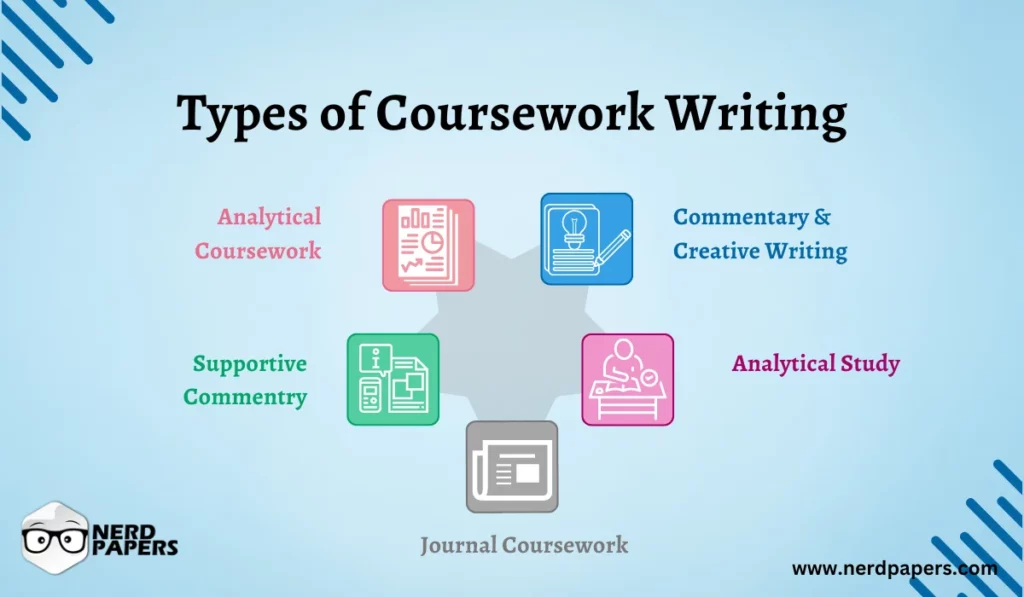
Analytical Coursework
Analytical Coursework presents a thesis statement or claim and demonstrates how to study different things. It usually focuses on the literary style of the text rather than the synopsis.
Supportive Commentary
Supportive Commentary helps students to create a single piece of media writing. Coursework should be written in an experimental mode, such as written, spoken, or multimodal. Students must also include a supporting statement that contains all the information and aspects.
Journal Coursework
Writing journals for coursework is regarded as an act that promotes casual writing as a regular activity. This can take many different forms and is useful for multiple purposes. It can be both creative and personal. In order to organize their thoughts, compose their ideas, and respond to them, students are always expected to keep journals as part of their coursework.
Analytical Study
Analytical study is the process of sharing an analysis of the chosen work and how it relates to the relevant material. It also shows how well the writer understands the entire process of writing. Students should use proper vocabulary and must maintain word consistency. Also, understand the structure and format of writing.
Commentary and Creative Writing
In commentary and creative writing coursework, students are asked to generate creative content that reflects the tone or style of the assessed text. It also helps to share comments to support the knowledge. Additionally, the major purpose of creative writing and commentary is to demonstrate knowledge, test skills, and engage the target audience through various languages.
Coursework Writing Tips
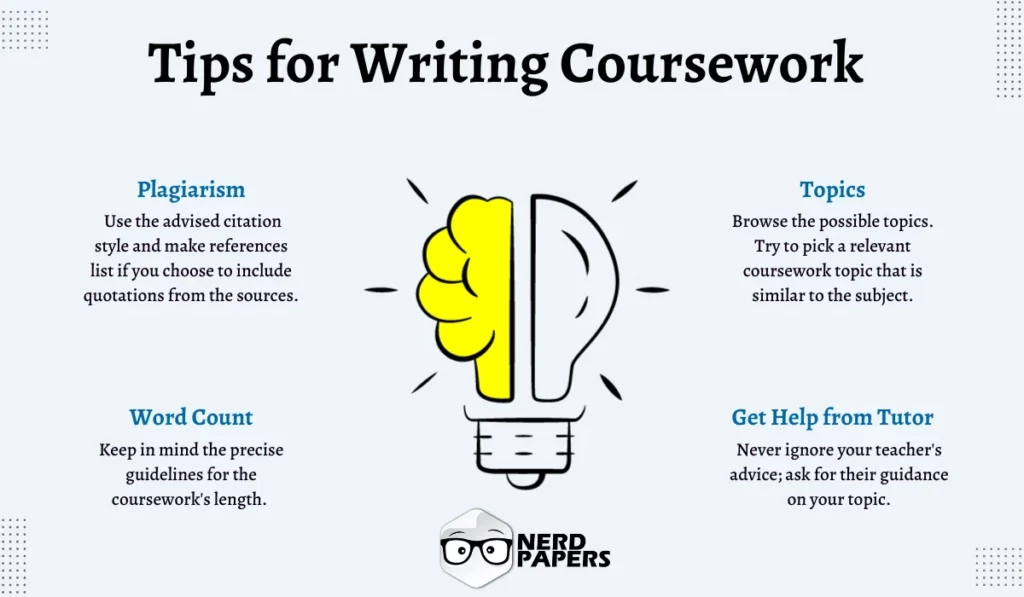
There are some key points that you should keep in mind while writing coursework.
Plagiarism
It is the worst possible scenario for any kind of academic writing assignment. Today, the internet has tons of relevant information, and professors become rigorous in the context of plagiarism. Your own words should be used in all writing! Use the advised citation style and make a references list if you choose to include quotations from the sources. Claim that it is your own project and sign the declaration.
Word Count
Keep in mind the precise guidelines for the coursework’s length. Specify whether the references, appendices, and footnotes are counted as part of the word count.
Topics
Browse the possible topics. Try to pick a relevant coursework topic that is similar to the subject of the upcoming exam if one will be held on it.
Get Help from Tutor
Never ignore your teacher’s advice; ask for their guidance on your topic. Also, to learn more, ask questions, but remember they may only read the first draft once and give general suggestions.
Perfect Coursework Writing Structure
The precision required for coursework writing depends not only on the writing process but also on the design. Even if you produce a stunning and thoroughly researched paper for the professor, poor design will still result in bad grades. We have chosen the most significant components to build a flawless coursework structure for you after reviewing many coursework standards. The structure consists of the following main components:
Introduction or Opening
The first step is to write the coursework introduction after choosing a topic. This introduction section needs to be extraordinary to catch the reader’s attention. Make sure to include all essential details, and keep it brief or precise.
Include any background data about the topic you have chosen. Write down your goals as well. This section should contain your thesis statement. Also, write the introduction in such a way that it serves as the reader’s guide.
Main Body
Your hard work and dedication will be reflected in this section. In the body section, you should add every minute detail you discovered on your research journey. Additionally, this section will be written in the past tense with an informative tone.
Readers may find research findings boring because they are just stats and figures. Therefore, this section should include appealing tables, graphs, infographics, and charts to make it interesting. Mention each statistic as it is; do not change any findings.
Conclusion
Summarize your whole coursework in this section. The conclusion needs to be short while covering all the details. You might mention the essential takeaways from the coursework.
How to Write a Coursework: Step-by-Step Guide
This step-by-step guide will walk you through how to write coursework effectively
Research: Gather information from primary and secondary sources, ensuring accuracy and reliability. Keep detailed notes and organize them in a table for easy reference.
Planning: Create a rough outline, deciding what to include in each section. Use a timeline to manage your tasks and meet deadlines.
Drafting: Start writing with the section you know best, using coursework examples to illustrate your points. Focus on gradually narrowing down your topic.
Editing: Proofread for consistency, style, grammar, and punctuation errors using tools like Grammarly. Ensure the document meets word count and formatting requirements, allowing time for thorough editing.
Formative vs Summative Coursework Assessments
Formative assessment assesses students’ understanding of a subject by offering them practice in essay creation and structure which can also be beneficial for tasks like term paper writing. It assists students in evaluating their strengths and weaknesses and focuses on areas that require improvement. Moreover, formative assessments help instructors identify students’ areas of difficulty and take action to resolve issues
Summative assessments, on the other hand, evaluate students’ knowledge at the end of the semester. Summative assessment includes mid-term exams and final-year projects. When completing courses, it is vital to understand the type of review you are submitting. If you understand the cocoursework’seaning and finish your assignments on time, you might obtain an A+.
Get Coursework Help from Experts
If you want to write your coursework successfully, follow all the steps mentioned above. If you still have difficulty writing coursework, you can get academic writing help at our essay writing service with one click. We have a group of experienced writers who can offer you timely, cost-effective coursework help online.