
An annotated bibliography might sound intimidating at first, but it’s simply a list of sources—like books, journal articles, or websites—followed by a brief explanation or evaluation of each one. Unlike a regular bibliography, which only includes citation details, an annotated bibliography adds context. It shows why each source is relevant to your research and how it contributes to your understanding of the topic.
Whether you’re writing a research paper, thesis, or class assignment, annotated bibliographies help you think critically about your sources. They demonstrate your ability to summarize, assess, and reflect on academic material—skills that professors and instructors value deeply.
Not sure where to begin or overwhelmed by citation rules and writing expectations? You’re not alone. If you’re looking for expert support, our annotated bibliography writing service is designed to make the process smoother, faster, and stress-free.
What Is an Annotated Bibliography?
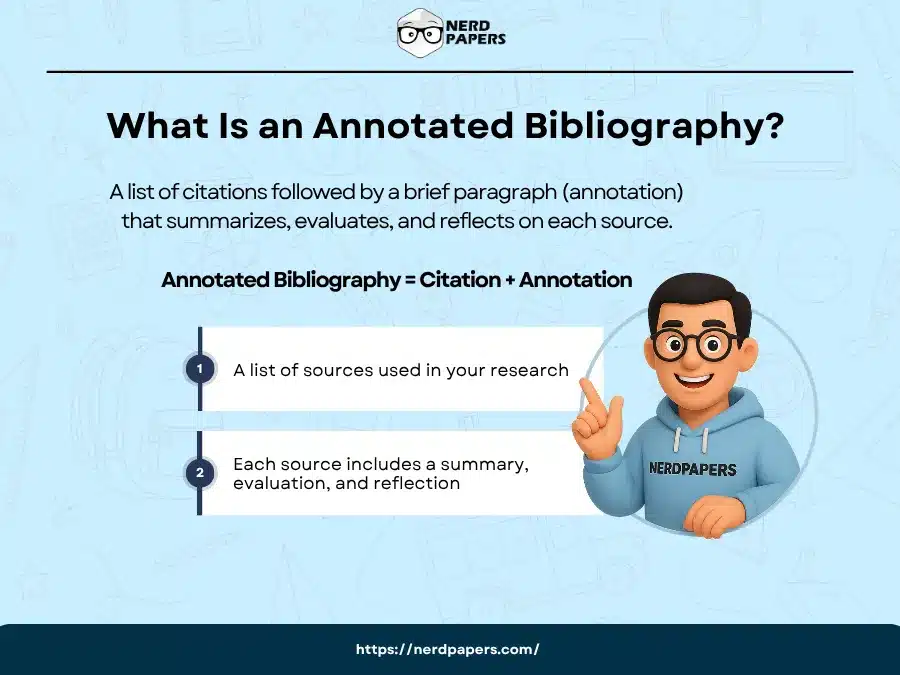
An annotated bibliography is a curated list of citations that includes not only the reference information—like the author’s name, publication date, and title—but also a short paragraph called an annotation. This annotation describes, analyzes, or evaluates the source. The goal is to help readers understand the value, relevance, and quality of each work in the context of a specific research topic.
Think of it as a bridge between simple citation and critical reflection. While a traditional bibliography just lists where your information came from, an annotated bibliography explains why each source matters. It shows your ability to assess sources and provides a snapshot of your research process.
For example, a basic entry in an annotated bibliography might look like this:
Smith, J. (2020). The Rise of Academic Writing Tools. Journal of Education, 34(2), 145–160.
This article explores the evolution of writing tools in academic settings. The author provides statistical evidence on how digital platforms like citation generators have improved citation accuracy among college students. This source will help support my argument about the benefits of reference management tools in modern research.
Each entry like this includes:
- A citation (APA, MLA, or Chicago style)
- A summary of the source
- An evaluation or reflection on how it contributes to your work
It’s a skill that combines research, writing, and critical thinking—all in one.
What Is the Purpose of an Annotated Bibliography?
At its core, the purpose of an annotated bibliography is to demonstrate your understanding of the sources you’re using in your research—and to prove that each one plays a meaningful role in your academic project.
Unlike a standard bibliography, which simply shows what you’ve read, an annotated bibliography shows how you’ve engaged with the material. It allows instructors to see:
- How carefully you’ve selected your sources
- Whether you can summarize and analyze key ideas
- How well you understand the credibility, relevance, and value of each source
For students and researchers alike, creating an annotated bibliography is more than a checklist task—it’s a way to:
- Organize your research early in the writing process
- Clarify your focus by filtering out weak or off-topic sources
- Develop your argument based on credible and useful materials
- Practice critical reading and evaluation skills
- Avoid unintentional bias by considering multiple perspectives
Professors often assign annotated bibliographies as standalone tasks to encourage deeper engagement with literature before you even begin writing a full paper. They’re commonly required in research essays, thesis work, literature reviews, or large writing projects that demand well-documented sources.
Key Components of an Annotated Bibliography
A strong annotated bibliography has two main parts: the citation and the annotation. Together, these parts provide both the technical reference and the analytical insight needed for academic writing.
Let’s break down the essential components:
1. Citation
This is the formal bibliographic entry for your source—book, journal article, website, or other academic material. It typically includes:
- Author’s name
- Publication year
- Title of the work
- Source (journal, publisher, URL, etc.)
2. Annotation
This is the paragraph that follows the citation. It summarizes and evaluates the source to explain its purpose, reliability, and relevance to your research.
Most annotations contain:
- A summary of the source’s main ideas
- An evaluation of the source’s credibility and usefulness
- A reflection on how the source fits into your topic or argument
3. Types of Annotations
Depending on your assignment, you may be asked to write one or more of the following annotation types:
| Type | Purpose |
| Descriptive | Summarizes the source without offering opinion or critique. |
| Evaluative | Assesses the quality, reliability, or biases of the source. |
| Analytical | Explores how the source contributes to your topic or compares to others. |
Understanding these components will help you create annotations that do more than just summarize. They’ll show your ability to engage with the material and position each source within your research.
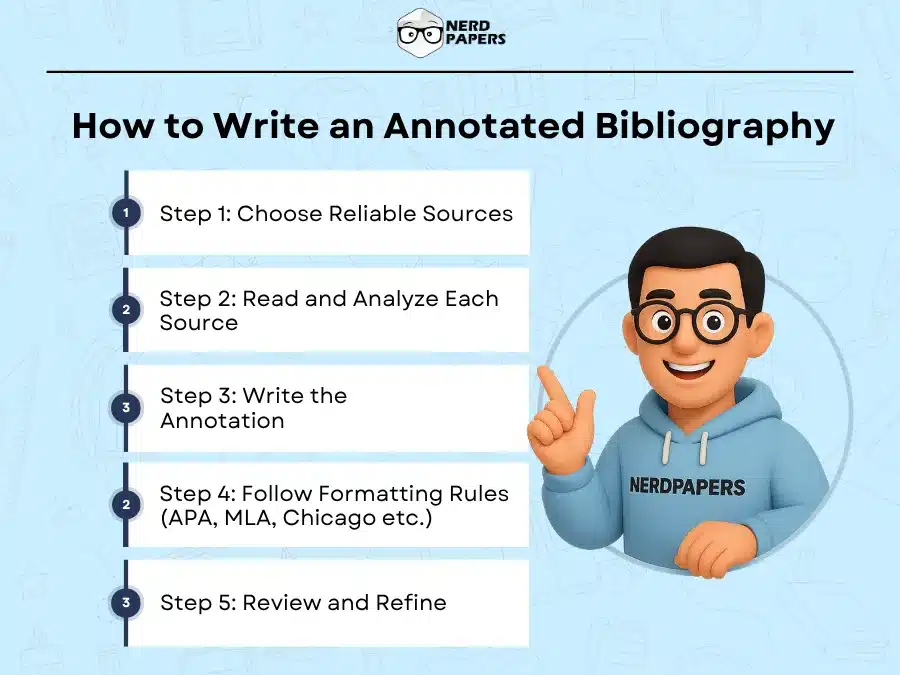
How to Write an Annotated Bibliography (Step-by-Step)
Creating an annotated bibliography might feel overwhelming at first, but breaking it down into clear steps can simplify the process. Here are the practical steps to help you write an effective annotated bibliography from start to finish.
Step 1: Choose Reliable Sources
Select academic sources that are:
- Credible (peer-reviewed journals, books, published research)
- Relevant to your topic or research question
- Recent, if your field requires up-to-date information
Step 2: Read and Analyze Each Source
Before writing your annotation, read the full source carefully. As you read:
- Highlight the main argument or thesis
- Note key supporting evidence or methodologies
- Identify the author’s qualifications and potential biases
Ask yourself:
👉 What is this source about?
👉 How is it useful to my topic?
👉 Is it credible and objective?
Step 3: Write the Annotation
Once you understand the source, write a short paragraph that includes:
- Summary: A brief restatement of the main points
- Evaluation: Comment on the source’s reliability, bias, or quality
- Reflection: How will you use this source in your paper?
- Length: Most annotations range from 100–200 words, but always check your assignment guidelines.
Step 4: Follow General Formatting Rules
While exact rules depend on your required citation style, here are some universal tips:
- Use double spacing
- Arrange entries in alphabetical order
- Maintain hanging indents for citations
- Indent the annotation paragraph under each citation
Step 5: Review and Refine
Proofread your annotations to check for:
- Clarity and conciseness
- Logical flow (summary → evaluation → reflection)
- Consistent tone and citation format
- Grammatical errors or vague statements
If needed, ask a peer, tutor, or writing service to review your annotated bibliography before submission.
Formatting Basics: What You Need to Know
Although formatting an annotated bibliography might seem straightforward, it’s one of the areas where students lose the most points—not because of poor content, but because of overlooked details.
Here are the universal formatting principles every annotated bibliography should follow, regardless of citation style:
General Formatting Rules
- Double-space all entries, including both the citation and annotation
- Use a hanging indent for the citation (first line aligned left, following lines indented)
- Place the annotation on a new line, indented underneath the citation
- Keep entries in alphabetical order by the author’s last name
- Maintain a consistent font (e.g., Times New Roman, size 12)
Citation Style Matters
Your professor may ask you to use:
- APA Style (often used in social sciences)
- MLA Style (common in humanities)
- Chicago Style (used in history and some humanities fields)
Each citation style has its own rules for punctuation, order of information, and spacing.
Helpful Tools to Stay Organized
Managing multiple sources and annotations? Use reference management tools to make the process easier:
| Tools | Key Feature |
| Zotero | Free and open-source; integrates with Word & Google Docs |
| Mendeley | Ideal for PDFs; syncs across devices |
| EndNote | Powerful for long-term research; university-supported |
These tools let you collect sources, auto-generate citations, and export formatted bibliographies that you can annotate.
Common Mistakes to Avoid in an Annotated Bibliography
Even well-researched annotations can fall short if a few key elements are missed. Here are the most common mistakes students make—and how to avoid them.
1. Mixing Up Summary and Evaluation
Many students stop at summarizing the source, forgetting to analyze or evaluate it. But the whole point of an annotation is to go beyond the “what” and include the “so what?”
2. Using Low-Quality or Irrelevant Sources
Using outdated, non-academic, or off-topic materials weakens your credibility. Wikipedia, blogs, or commercial websites are usually not accepted in academic research.
3. Ignoring the Scope or Word Count
Some annotations are too short to be useful; others ramble without focus. You may also include details not relevant to your research question or assignment.
4. Overwriting with Personal Opinions
Annotations should reflect critical thinking—not casual opinion. Avoid phrases like “I didn’t like this article” or “This was boring.”
5. Formatting Errors
Small details like missing indentation, incorrect spacing, or wrong citation order can lead to markdowns—even when your content is strong.
Annotated Bibliography Example (Short & Generic Format)
To bring everything together, here’s a sample annotated bibliography entry that uses a neutral format (not APA, MLA, or Chicago), so you can focus on the structure and tone of the annotation itself.
Smith, J., Doe, A., & Roe, B. (2020). Impact of Online Pedagogical Feedback on Academic Performance : A Comparative Study. Journal of Educational Psychology, 15, 123–136.
This study investigates the effect of online pedagogical feedback on student academic performance by comparing different feedback models in higher education settings. The authors collected data from several universities, using quantitative measures (grades, retention rates) and qualitative surveys to assess student perceptions of feedback effectiveness.
The results suggest that timely, structured online feedback significantly improves student outcomes, particularly in courses with high digital engagement. The methodology is rigorous and the sample size is adequate, though the study is limited to certain disciplines and doesn’t deeply analyze long-term retention beyond one semester.
This article is relevant to my research on effective strategies in online learning environments. I plan to use it to support the argument that instructor feedback tools are crucial in virtual education design.
Why This Example Works:
- Clear citation (in placeholder format — follow your assigned style)
- Balanced annotation covering:
- Summary of the article
- Evaluation of the credibility and relevance
- Reflection on how it will be used in the paper
Quick Tip: You can create a strong annotation by asking:
- What is the author’s main argument?
- Is the source trustworthy and relevant?
- How will I use it in my research or assignment?
Conclusion
An annotated bibliography isn’t just a list of sources—it’s a reflection of your research process, critical thinking, and ability to engage with academic material. Whether you’re preparing for a research paper, thesis, or class assignment, writing clear and insightful annotations helps you stay organized, focused, and academically credible.
By understanding the definition, purpose, and components of an annotated bibliography, and by following a step-by-step approach, you can build a bibliography that adds real value to your work—not just in terms of structure, but in terms of substance.
Frequently Asked Questions
What is the difference between a bibliography and an annotated bibliography?
A standard bibliography is a list of sources used in a research project, containing only citation information. An annotated bibliography includes that citation plus a brief paragraph (annotation) that summarizes and evaluates each source.
How long should an annotated bibliography be?
The length depends on your assignment, but most annotations are between 100–200 words. A full annotated bibliography may include 5 to 15 sources, unless your instructor specifies otherwise.
What should be included in an annotation?
A complete annotation typically includes a summary of the source, an evaluation of its credibility or usefulness, and a reflection on how it supports your research.
What is the purpose of an annotation in research?
Annotations help you reflect critically on each source, assess its relevance to your topic, and demonstrate to your instructor that you’ve engaged meaningfully with your research material.
How do I choose the right sources for an annotated bibliography?
Choose credible, academic sources such as peer-reviewed journal articles, books, and scholarly websites. Avoid sources that are outdated, overly biased, or lack author credentials.
What is the scope in an annotated bibliography?
Scope refers to the range and focus of sources you include. Some assignments require broad coverage across perspectives, while others want focused, highly relevant sources that align tightly with your topic.
Is an abstract the same as an annotation?
No. An abstract is a standalone summary of a source written by the original author. An annotation is written by you and includes both a summary and your evaluation of the source.
Are there tools to help organize or format annotated bibliographies?
Yes. Reference management tools like Zotero, Mendeley, and EndNote can help you collect, organize, and cite sources correctly. They also make it easier to export bibliographies in various citation styles.